Comparison · vs. cloud SaaS
Same job, different long-term economics
Cloud platforms for winter service handle the same surface-level problems Wintertrace handles. The differences sit underneath: who holds the data, what happens if the provider changes its terms, and what year five looks like compared with year one.
This page argues the category, so it names no product: the differences below hold whichever cloud platform you are looking at. If you already have a specific one in mind, the named comparisons work from that company's own published figures instead — they are listed at the bottom of this page.
Side by side
| Aspect | Typical cloud SaaS | Wintertrace |
|---|---|---|
| Data location | On the provider infrastructure | On your hosting |
| Cost model | Monthly per-seat subscription | Free; hosting only |
| Cost over five years | Compounds with team size and retained data | Roughly the same as year one |
| Vendor disappears | Software stops or freezes; data may be hostage | Application keeps running unchanged |
| Data format | Proprietary; export may be limited | Open MySQL / MariaDB schema |
| Migrate away | Migration plan needed; sometimes blocked | Database dump; standard formats |
| Telemetry | Often opaque | None |
| Source code audit | Vendor-controlled, usually closed | Open on GitHub |
| Onboarding speed | Often very fast — vendor handles setup | Roughly 10 minutes plus hosting setup |
| Specialised features | May include routing, dispatch, billing | Documentation focus only |
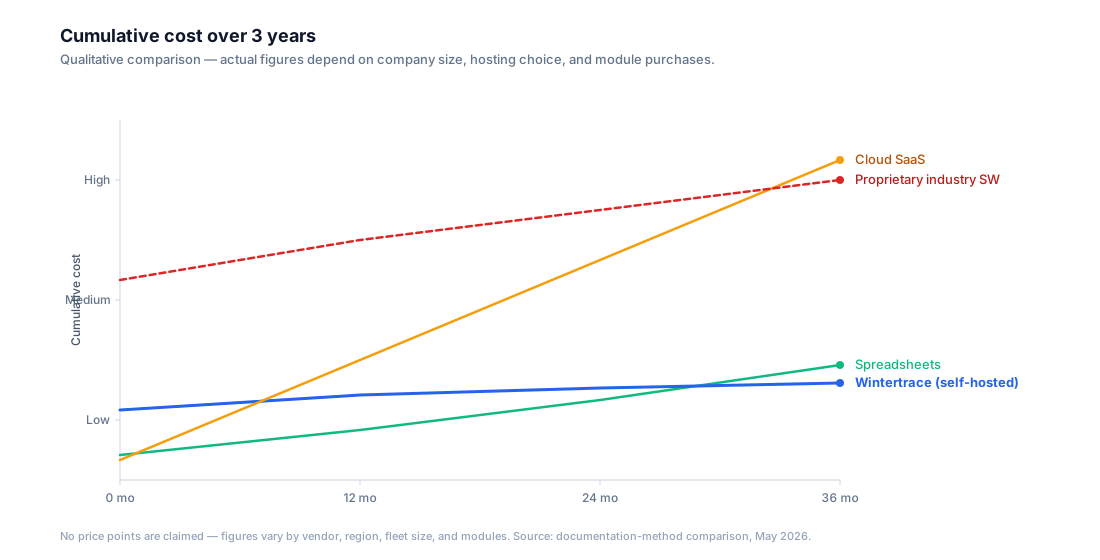
Over three years, a spreadsheet and a self-hosted Wintertrace install both stay near-flat: the cost is your own time plus ordinary hosting. A cloud subscription climbs steadily with every month and every seat, and proprietary industry software starts high and keeps climbing. No figures are claimed — the shape is the point, not the numbers.
Where cloud SaaS legitimately wins
A good cloud vendor handles onboarding, hosting, support, and an ecosystem of integrations. For an operator who values "I want someone else to keep this running" above all else, that is exactly the right trade.
Many cloud products also bundle features Wintertrace deliberately does not include — routing optimisation, dispatch, billing, CRM. These are real features. Wintertrace focuses on documentation only.
A reasonable Wintertrace setup may include a cloud product alongside it for billing or dispatch. The two are not mutually exclusive.
What Wintertrace optimises for
- Long-term cost stability. A subscription that compounds with team size is fine — until margins compress.
- Survival of the vendor. An open-source application on the operator's own hosting cannot be discontinued.
- Data ownership. Customer addresses, photographs of private property, driver movement profiles — these stay on the operator's server.
- No telemetry. Verifiable in code, not promised on a marketing page.
- Migration freedom. A MySQL dump is the export format; standard tools take it anywhere.
Where the decision usually lands
A small operator with no IT comfort and a strong support need generally lands on a cloud product. A small operator who already runs their own website on shared hosting, who reads the fine print, or who has a long memory of vendor lock-in tends toward self-hosting.
The "right" answer depends on which risk the operator weighs more heavily: the risk of running the application themselves, or the risk of being tied to a vendor's terms.
Note: The comparison describes operational and architectural differences. It is not legal advice and does not assess which approach better satisfies any specific regulatory framework. Wintertrace provides documentation support — it is not a substitute for legal advice.
Also compared
Named products in this category, and the other category comparisons.
Wintertrace is free and open source. You can install it on hosting you already pay for, or try a temporary instance first.