Comparison · vs. proprietary industry software
Built for the same job. Priced for a different buyer.
Established industry software for winter service has been on the market for years. It is feature-broad, well-supported, and built for operators who already budget for it. Wintertrace overlaps on the documentation side and diverges on almost everything else — pricing model, hardware, contract, ownership.
No specific product is named. The comparison is at the category level — operators who know the market can fill in the names.
Side by side
| Aspect | Proprietary industry software | Wintertrace |
|---|---|---|
| Pricing model | Per-vehicle or per-driver subscription, often plus setup fee | Free; hosting only |
| Hardware | Proprietary GPS dongle or in-vehicle unit, sometimes leased | Driver smartphone with OwnTracks |
| Contract length | Typically multi-year with cancellation windows | None — uninstall removes it |
| Onboarding | Vendor-led; days to weeks; often billable | Self-installed in roughly 10 minutes |
| Customisation | Gated by the vendor roadmap | Open source — fork, patch, deploy |
| Integrations | Closed APIs; case-by-case unlock | Open MySQL / MariaDB schema |
| Data location | Vendor infrastructure | Your hosting |
| Migrate away | Often blocked by data format and contract | Database dump; standard formats |
| Feature scope | Broad: routing, dispatch, billing, CRM | Focused on documentation only |
| Vendor lock-in | High — by contract, data format, and hardware | Effectively none |
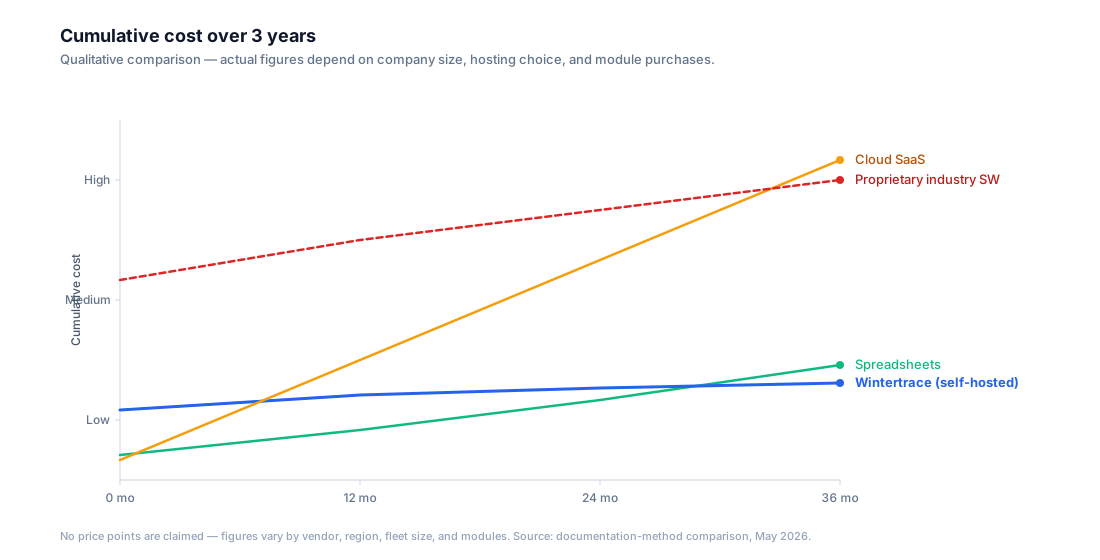
Over three years, a spreadsheet and a self-hosted Wintertrace install both stay near-flat: the cost is your own time plus ordinary hosting. A cloud subscription climbs steadily with every month and every seat, and proprietary industry software starts high and keeps climbing. No figures are claimed — the shape is the point, not the numbers.
Where proprietary industry software legitimately wins
Larger operators with full fleets, dispatch teams, and tight insurer relationships often need more than documentation. Mature industry software bundles route optimisation, real-time dispatch, billing, and CRM in one place. For a fleet of fifty trucks running multiple shifts, that bundle is hard to replicate with separate tools.
Vendor support is also real. A phone line that picks up on a winter weekend has measurable value. So does an account manager who understands the operator's contracts with municipalities.
Wintertrace does not try to replace any of that. It is a documentation tool. Operators who need dispatch, routing, or integrated billing should keep using the software that does those things.
What Wintertrace optimises for
- No per-vehicle pricing. Adding a fifth truck does not change the bill. Adding a fiftieth does not either.
- No proprietary hardware. The driver's existing smartphone with the free OwnTracks app is the GPS device.
- No contract. The software is on the operator's hosting. There is nothing to cancel.
- Data ownership. Customer addresses, GPS tracks, photographs — all on the operator's server.
- Open source. The full source code is on GitHub under AGPLv3. Anyone can audit, fork, or extend it.
- A clean focus. Documentation, evidence, audit trail. Not a platform — a tool that does one job well.
Where the decision usually lands
A larger operator with a dedicated office team, an existing contract with an industry vendor, and a need for dispatch and billing in the same place tends to stay with what they have. The switching cost is real and the bundle has value.
A smaller or mid-sized operator — three to twenty drivers, perhaps a property maintenance side business — often runs into a different calculation. The industry software is priced as if every truck generates dispatch volume, but the actual need is documentation that holds up when an incident arises. For that operator, the per-vehicle model can look heavy for what is delivered.
Some operators run both: Wintertrace for documentation, an industry product for routing or billing. The two are not mutually exclusive.
Note: The comparison describes operational and commercial differences between two software categories. It does not assess regulatory fit and is not legal advice. Wintertrace provides documentation support — it is not a substitute for legal advice.
Also compared
Named products in this category, and the other category comparisons.
Wintertrace is free and open source. You can install it on hosting you already pay for, or try a temporary instance first.