Winter service · Alberta
Winter service in Edmonton
What winter is really like in Edmonton: around 124 cm of snow, January near −10 °C and snow on the ground a third of the year, with no chinooks to thaw it. How the City deliberately keeps a 5 cm snowpack on residential streets, the sidewalk bylaw that sets no deadline, the seasonal parking ban, and who is responsible for what.
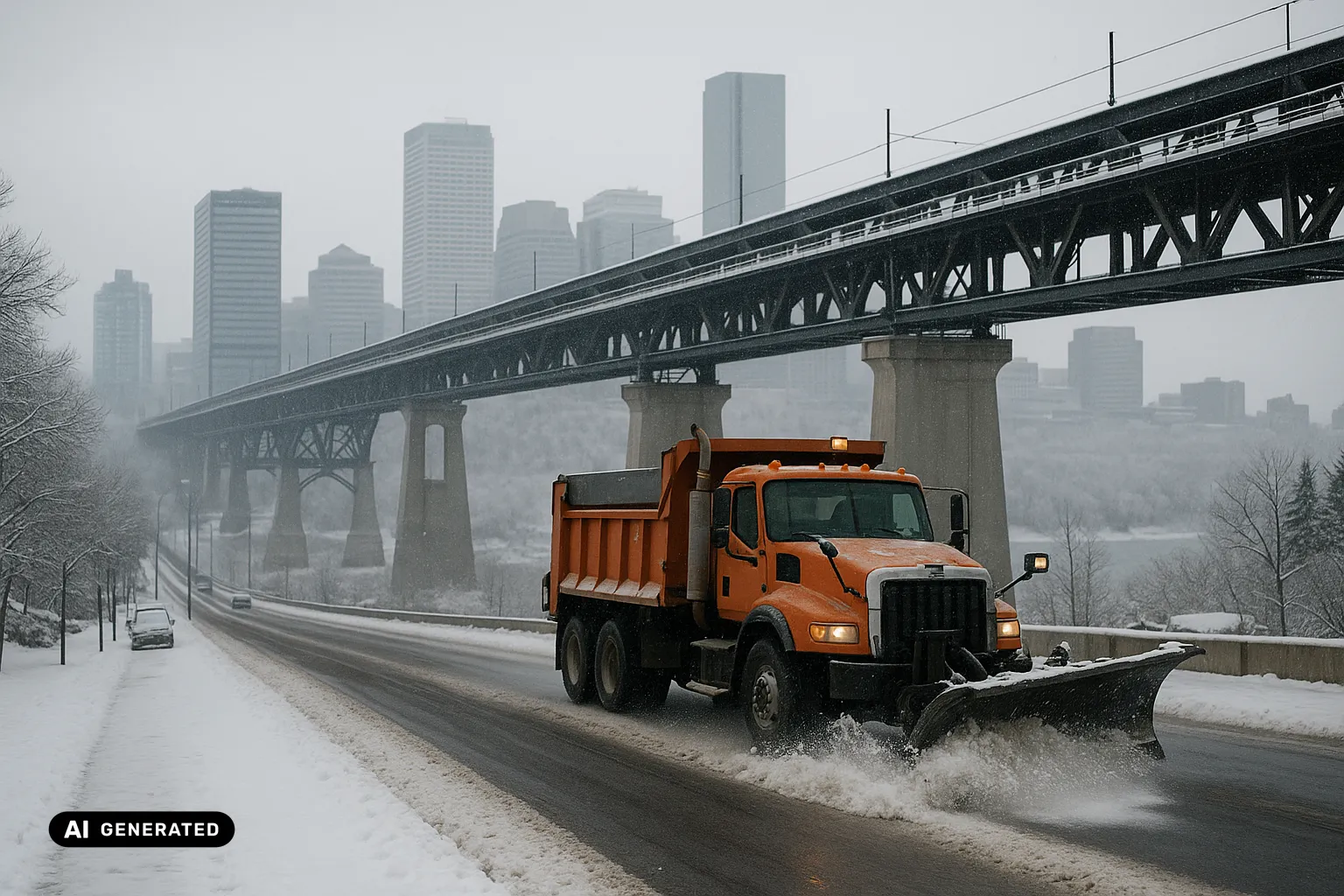
A winter city, not a thaw city
Edmonton sits on the North Saskatchewan River at about 671 metres, on the seam where prairie gives way to aspen parkland, with the river carving a deep valley through the middle of the city — the “Ribbon of Green,” over 7,300 hectares and more than 160 km of trails, the largest urban park system in Canada. But the thing that defines winter here is not the geography. It is the cold, and how long it stays. An average year brings around 124 cm of snow; January averages about −10.3 °C with a mean low near −14.7 °C; the temperature drops below −20 °C on roughly 25 days; and there is snow on the ground for about a third of the year. The record low is −49.4 °C.
The crucial difference from Calgary, a few hours south, is what is missing: chinooks. Edmonton sits too far north for the warm foothills winds that keep southern Alberta in a cycle of thaw and refreeze. So winter here is not a series of melts to chase — it is one long, frozen season, punctuated by polar-vortex cold snaps. That single fact shapes everything about how the city runs winter service. When the snow that falls in November is still on the ground in March, the job stops being “clear the last storm” and becomes manage the snowpack.
The snowpack philosophy
Here is the part that surprises people from cities that scrape to the asphalt: Edmonton deliberately keeps a 5 cm snowpack on residential streets rather than clearing them to bare pavement. A compacted, frozen pack keeps windrows smaller and reduces flooding when things finally melt — and in a climate that simply stays cold, a hard pack is stable footing rather than a problem to fight. Main roads and bus routes are treated and plowed first; residential streets are Priority 4, and residential blading is triggered only once the snowpack passes 5 cm and temperatures are below freezing, then completed within 14 days of a cycle starting.
What goes down is a sand-and-salt mix prewetted with calcium chloride for traction and melting, varied by temperature; calcium chloride with a corrosion inhibitor is also used on City-maintained sidewalks, protected bike lanes and active-mobility pathways. And the windrows the blade leaves are, on standard residential streets, left in place — the only exception being a windrow 30 cm or higher blocking a driveway, which is opened to about a car’s width within 4 hours of the street being bladed. When a heavier snowfall calls for it, the City declares a Seasonal Parking Ban so crews can reach the full width of the road: Phase 1 covers arterials, bus routes and marked snow routes, and Phase 2 extends to residential streets, cul-de-sacs and back lanes. A ban can be called with as little as 8 hours’ notice, with status posted on the City’s snow-clearing map.
What the local rules ask of you
On your own frontage, the Community Standards Bylaw 14600 sets the duty: keep the sidewalk next to land you own or occupy clear of all snow and ice, the full width and length, down to the surface. What it pointedly does not set is a deadline. The City states plainly that the bylaw “does not provide a timeframe for snow removal” and asks that sidewalks be cleared “as quickly as possible,” especially through a prolonged snowfall. That open standard is itself a contrast with cities that run a hard clock — it asks for steady attention rather than a countdown.
The consequences are concrete enough. An uncleared sidewalk can bring a $100 fine, plus the cost of the City arranging the clearing through a contractor; unpaid, that cost is added to the property tax roll. And the snow you clear has to go somewhere sensible: pushing snow out onto the road or lane is not allowed — a hazard, and one that has been reported to carry its own fine on top. Your driveway, steps and private walks are yours throughout.
Designing for winter, not waiting it out
The backdrop to all of this is that Edmonton has decided, officially, to be a winter city. Its WinterCity Strategy, adopted in 2012, set the goal of becoming a “world-leading winter city,” built on four pillars — Winter Life, Winter Design, Winter Economy and Our Winter Story — with 10 goals and 64 actions, later joined by Winter City Design Guidelines for streets and buildings. The practical translation for winter service is a mindset of living with a long winter and designing for it, rather than treating snow as an emergency to be erased. The 5 cm snowpack, the season-long blading cycles, the calcium-chloride pathways: they are all of a piece with a city that has stopped pretending winter is short.
Around Edmonton
Edmonton anchors a metropolitan region of separate municipalities, and each runs its own winter rules — often diverging on exactly the points that catch people out. Spruce Grove, to the west, does set a hard deadline where Edmonton does not: its bylaw requires public sidewalks cleared within 48 hours of a snowfall. In Strathcona County (Sherwood Park), to the east, residential clearing can take up to 10 days once a cycle starts, and a vehicle left against a planned clearing can be towed and ticketed. St. Albert, Stony Plain, Leduc, Fort Saskatchewan and Beaumont each have their own rules as well. There is no single regional standard — so for routes or properties that cross a municipal line, the rule that governs you changes with the boundary.
Keeping the record straight
None of this is about winning an argument in court — it is about being able to show, plainly, what was done. In a winter this long, where the same surface is treated, holds a frozen pack for weeks, and is worked again and again across a season rather than a single storm, operational records that can support liability cases are worth keeping well. A simple, time-stamped log of where a crew went, when, and in what conditions is the kind of record of each treatment — set against what the weather was doing — that turns a season’s worth of work into something you can actually point to. That is the documentation support Wintertrace is built to make easy, whether you run a municipal-style program of routes or a single site. It does not change the rules; it just means that when someone asks what happened during a given storm, the answer is on file. Not a substitute for legal advice.
Local facts
- Around 124 cm of snow falls in an average year, and there is at least a centimetre on the ground on roughly 133 days — about a third of the year.Source
- January averages about −10.3 °C, with a mean low near −14.7 °C, and the temperature falls below −20 °C on roughly 25 days a year.Source
- Unlike Calgary and southern Alberta, Edmonton sits too far north for regular chinook thaws — so the winter is one of sustained deep cold and long-lasting snow cover rather than repeated melt-and-refreeze.Source
- The City keeps a 5 cm snowpack on residential streets rather than clearing to bare pavement; residential blading is a Priority 4 service, triggered only once snowpack passes 5 cm and temperatures are below freezing, and completed within 14 days of a cycle starting.Source
- Crews treat with a sand-and-salt mix prewetted with calcium chloride; calcium chloride with a corrosion inhibitor is also used on City-maintained sidewalks, protected bike lanes and active-mobility pathways.Source
- Plow windrows are not removed on standard residential streets; the exception is a windrow 30 cm or higher across a driveway, which is opened to about a car's width within 4 hours of the street being bladed.Source
- Under the Community Standards Bylaw 14600, a person must keep the sidewalk next to land they own or occupy clear of all snow and ice, the full width and length, down to the surface.Source (PDF)
- The bylaw sets no fixed deadline: the City states it 'does not provide a timeframe for snow removal' and asks that sidewalks be cleared 'as quickly as possible'.Source
- An uncleared sidewalk can bring a $100 fine plus the cost of the City arranging the clearing; unpaid costs are added to the property tax roll.Source
- A Seasonal Parking Ban runs in two phases — first arterials, bus routes and marked snow routes, then residential streets, cul-de-sacs and back lanes if needed — and can be called with 8 hours' notice.Source
- Edmonton adopted a WinterCity Strategy in 2012 to become a 'world-leading winter city' — built on four pillars (Winter Life, Winter Design, Winter Economy and Our Winter Story) with 10 goals and 64 actions.Source
- The North Saskatchewan River valley parks — the 'Ribbon of Green' — span over 7,300 hectares with more than 160 km of trails, the largest urban park system in Canada.Source
- Edmonton sits on the North Saskatchewan River at about 671 m, on the transition from prairie to aspen parkland; its record low is −49.4 °C.
Official contacts
City of Edmonton — Snow and ice (winter travel)
How the City responds to a snowfall, the Seasonal Parking Ban phases, the snow-clearing map, and how to reach 311.
City of Edmonton — Residential sidewalk snow and ice
What owners and occupants must do under Bylaw 14600, the 'as quickly as possible' standard, the $100 fine and cost recovery.
City of Edmonton — Neighbourhood roads in winter (service levels)
The 5 cm snowpack approach, residential blading priorities and timelines, windrows, and the materials used.
City of Edmonton — WinterCity Strategy
The city's plan to design and program for winter rather than wait it out — the backdrop to how it runs winter service.
Common questions about winter service in Edmonton
- How quickly do I have to clear the sidewalk in front of my property in Edmonton?
- There is no fixed number of hours — and that surprises people who know other cities' rules. Edmonton's Community Standards Bylaw 14600 asks you to keep the sidewalk next to your property clear of all snow and ice, the full width and length, down to the surface; the City explicitly says the bylaw 'does not provide a timeframe' and asks that you clear it 'as quickly as possible.' In practice that means staying on top of it through a storm rather than waiting out a deadline. Leaving it can bring a $100 fine plus the cost of the City sending someone to clear it, added to your property taxes if unpaid.
- Why doesn't the City clear residential streets down to the pavement?
- By design. Edmonton keeps a 5 cm snowpack on residential streets rather than scraping them bare, which keeps windrows smaller and reduces flooding when things eventually melt — an approach that fits a climate where it simply stays cold for long stretches. Residential blading is a Priority 4 service: it is triggered only once the snowpack passes 5 cm and temperatures are below freezing so the pack is frozen, and a blading cycle is completed within 14 days of starting. Main roads and bus routes are treated and plowed first; residential streets come later in the order.
- If Edmonton doesn't get chinooks, what is the main winter hazard?
- The cold itself, and how long it lasts. Edmonton sits too far north for the regular chinook thaws that define Calgary's winter, so instead of constant melt-and-refreeze it gets sustained deep cold — January around −10 °C, below −20 °C on roughly 25 days a year — and snow on the ground for about a third of the year. The job here is less about reacting to single storms and more about managing a snowpack and keeping traction over a very long season, with periodic polar-vortex cold snaps on top.
- The blade left a ridge across my driveway — will the City clear it?
- Usually not. Windrows are left in place on standard residential streets. The one exception is a windrow that is 30 cm or higher and blocks a driveway: that is opened up to about a car's width within 4 hours of the street being bladed. Anything smaller than that, or the rest of your driveway, is yours to clear — and the snow cannot be pushed back out onto the road or lane.
- What is the Seasonal Parking Ban, and how much warning do I get?
- When a significant snowfall calls for it, the City declares a Seasonal Parking Ban so crews can clear the full width of the road. It runs in two phases: Phase 1 covers arterials, bus routes and marked snow routes; Phase 2 extends to residential streets, cul-de-sacs and back lanes if needed. A ban can be called with as little as 8 hours' notice, and you can check current status on the City's snow-clearing map. A vehicle left on a route during a ban can be ticketed and towed.
- Are the rules the same in Sherwood Park, St. Albert or Spruce Grove?
- No — each municipality around Edmonton runs its own winter rules, and they differ in exactly the ways that catch people out. Spruce Grove, for instance, does set a hard deadline where Edmonton does not: its bylaw requires public sidewalks cleared within 48 hours of a snowfall. In Strathcona County (Sherwood Park) residential clearing can take up to 10 days once it starts, and a vehicle parked against a planned clearing can be towed and ticketed. St. Albert, Stony Plain, Leduc, Fort Saskatchewan and Beaumont each have their own rules too. If your routes cross municipal lines, read the local one rather than assuming Edmonton's applies.
- What does it mean that Edmonton calls itself a 'winter city'?
- In 2012 the City adopted a WinterCity Strategy with the goal of becoming a 'world-leading winter city' — built on four pillars (Winter Life, Winter Design, Winter Economy and Our Winter Story) with 10 goals and 64 actions, later followed by Winter City Design Guidelines for streets and buildings. The practical upshot for winter service is a mindset of designing for and living with a long winter rather than treating it as something to simply survive — which is part of why the road approach is about managing snow over a season, not erasing every storm.
Documenting winter service in Edmonton
Anyone clearing snow and ice in Edmonton may later need to show when and where a route was treated. Wintertrace is open-source software that records exactly that — time, location and weather for each run — as a calm basis for your own operational records and service proof. It is not a substitute for legal advice.
This overview is for general information and is not legal advice. Local rules on snow and ice clearing vary — the wording of the local rule and the responsible authority always govern.