Winter service · Alberta
Winter service in Calgary
What winter is really like in Calgary: chinook melt-and-refreeze, the Street Bylaw's 24-hour sidewalk rule, fines, snow route parking bans, and who is responsible.
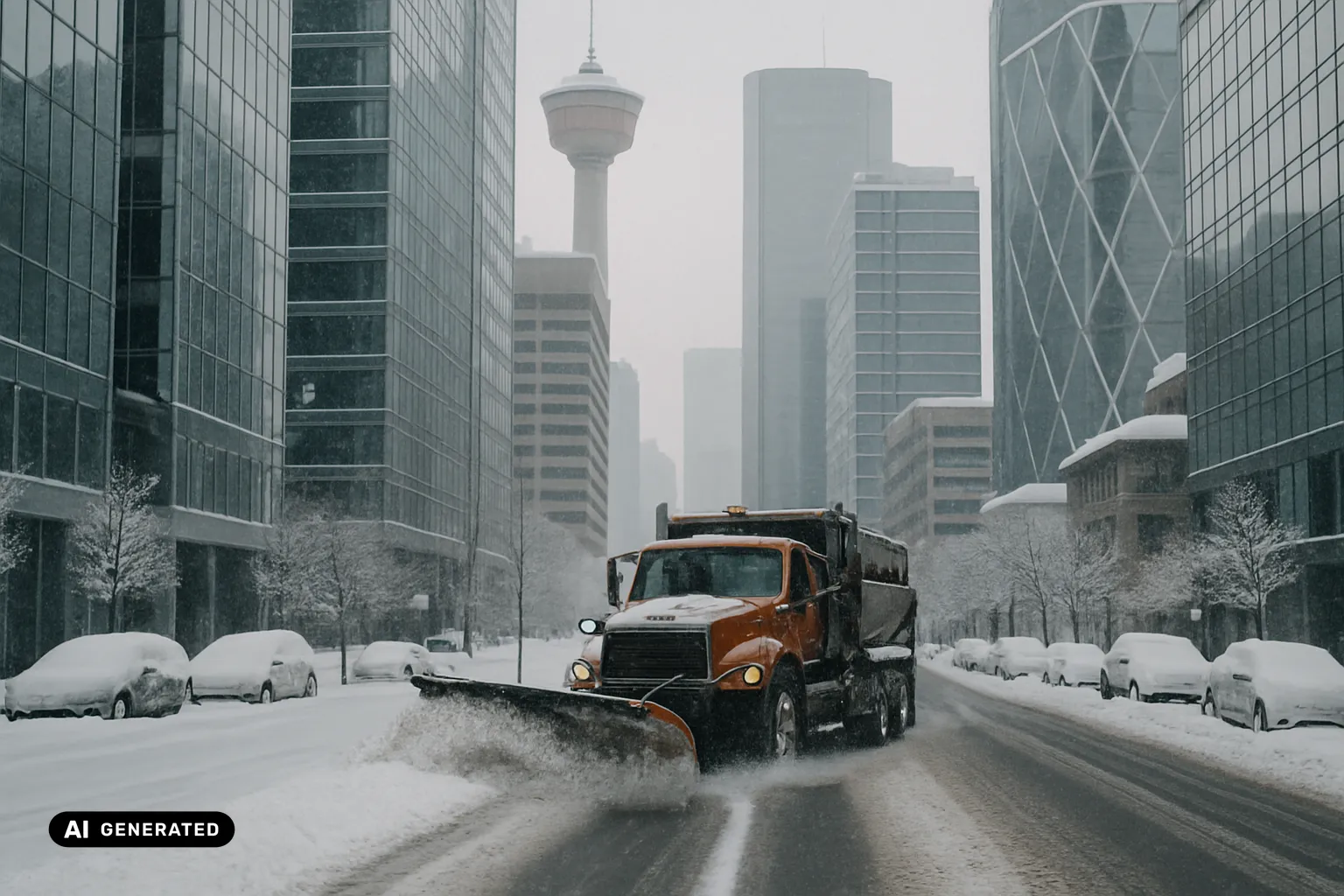
How Calgary sits, and what winter does here
Calgary sits where the Bow and Elbow rivers meet, on the high western edge of the Canadian prairies just before the land lifts into the foothills of the Rocky Mountains. At roughly 1,045 metres above sea level it is one of the highest major cities in the country, and that altitude — together with the open prairie around it — shapes a long, cold winter. Measurable snow can fall from late September well into May, with the heaviest month usually March; an average year brings around 129 cm of snow, there is at least a centimetre on the ground on about 88 days, and the temperature drops to −20 °C or below on roughly 22 days.
What makes Calgary’s winter distinctive, though, is not the snow total — it is the chinook. Several times each winter, warm, dry winds spill down the eastern slopes of the Rockies and can lift the temperature by 20 °C or more in a few hours. Snow that was frozen solid in the morning turns to meltwater by afternoon and refreezes after dark. The result is one of the iciest patterns a city can have: repeated melt-and-refreeze that glazes sidewalks, shaded streets and north-facing slopes with black ice, often when it has not snowed at all. For winter service in Calgary, the job is rarely just clearing depth — it is staying ahead of ice that comes and goes with the wind. It is almost the opposite of the winter a few hours north in Edmonton, where there are no chinooks to speak of and the cold simply settles in for the season.
What the local rules say
Snow and ice clearing on Calgary sidewalks is governed by Section 67 of the City’s Street Bylaw. The core rule is a 24-hour one: once a snowfall ends, the owner or occupant of a property has 24 hours to clear the public sidewalk bordering it, down to the bare surface. The City looks after sidewalks on its own land, and there is no obligation to clear the walkways that run between homes.
There are rules about where the snow goes, too. You may move snow from a public sidewalk onto the road, but you may not push snow from a private driveway out onto public space, into crosswalks, over storm drains, into a neighbour’s yard, or into the Bow or Elbow rivers.
If a sidewalk is left uncleared, enforcement runs through 311. A complaint cannot be filed until 24 hours have passed since the last snowfall, and the City does not accept anonymous complaints. Fines escalate with repetition — $250 for a first offence, $500 for a second and $750 for a third within twelve months — and if the City ends up clearing the walk itself, it charges at least $150 plus GST and an administration fee, added to the property’s tax bill if it goes unpaid.
On the ground: where it gets tricky
A few things catch people out. Bridges and overpasses — and Calgary has many, crossing the Bow and Elbow — freeze before the streets around them, because cold air reaches them from above and below. The chinook black ice tends to linger longest on shaded, north-facing stretches and on the city’s escarpment hills, where a surface can stay glazed long after the open roads have dried.
On the roads, the City runs a priority system: Priority 1 and 2 snow routes (major and transit roads) are cleared first under a published seven-day snow plan, and the program also covers many sidewalks, bikeways and pathways. The part most likely to affect anyone parking on the street is the snow route parking ban. When the City calls one, it typically starts about 18 hours after the snow stops and can last up to 72 hours; a vehicle left on a snow route during the ban can be ticketed $120 and towed. Bans are usually announced a day or two ahead, and you can check your address or sign up for alerts.
Keeping a clear record of when and where a route was treated — and under what weather — is worth more in a chinook climate than in most, precisely because conditions can change between one pass and the next.
Around Calgary
Calgary’s winter is not quite the region’s winter. To the northwest, Cochrane sits closer to the foothills and tends to see more snow; Airdrie to the north, Chestermere to the east and Okotoks to the south sit out on the prairie, with the surrounding Rocky View County in between. Each of these is its own municipality with its own clearing rules and timelines, so a property just outside the city limits will not necessarily follow Calgary’s 24-hour standard. If you work across the region, it is worth checking each one rather than assuming the rule travels.
Local facts
- Sidewalk clearing deadline: within 24 hours of a snowfall ending, cleared to the bare surface (Street Bylaw, Section 67).Source
- Responsibility: the owner or occupant clears the public sidewalk bordering the property; the City clears sidewalks on City land.Source
- Fines for an uncleared sidewalk: $250, then $500, then $750 for a first, second and third offence within 12 months.Source
- If the City clears it for you: a minimum $150 plus GST and an administration fee, added to property taxes if unpaid.Source
- Snow route parking ban: starts about 18 hours after snowfall ends and can last up to 72 hours; $120 ticket and a tow for vehicles left on a route.Source
- Average annual snowfall about 128.8 cm; snow can fall from late September to mid-May, heaviest in March.Source
- At least 1 cm of snow on the ground on roughly 88 days a year; the temperature reaches −20 °C or below on about 22 days.Source
- Chinook winds can raise the temperature 20 °C or more in hours, driving repeated melt-and-refreeze and black ice.Source
- Set where the Bow and Elbow rivers meet, at about 1,045 m — among the highest major cities in Canada.
Official contacts
City of Calgary — Snow and ice control
The City's winter program: priority snow routes, the seven-day snow plan, and live road-condition updates.
City of Calgary — Snow route parking bans
Whether a ban is currently in effect, how to find alternate parking, and how to sign up for alerts.
City of Calgary — Snow clearing bylaw and 311
The Street Bylaw rules, the fines that can follow, and how to report an uncleared sidewalk through 311.
Common questions about winter service in Calgary
- How soon do I have to clear my sidewalk in Calgary?
- Within 24 hours of the snowfall ending. Calgary's Street Bylaw (Section 67) asks property owners and occupants to clear the public sidewalk bordering their property down to the bare surface within that window.
- Is it my job or the City's?
- Yours, for the public sidewalk that borders your property. The City clears sidewalks on its own land, and no one is required to clear the walkways that run between homes.
- What happens if I don't clear it?
- Once 24 hours have passed since the last snowfall, someone can report it through 311 (complaints are not anonymous). Fines run $250, then $500, then $750 for repeat offences within a year, and if the City clears the walk itself it charges at least $150 plus GST and a fee — added to your property taxes if unpaid.
- Where am I allowed to put the snow?
- You can move snow from a public sidewalk onto the road. You cannot push snow from a private driveway onto public space, into crosswalks, over storm drains, into a neighbour's yard, or into the Bow or Elbow rivers.
- What is a snow route parking ban, and when does it apply?
- When the City declares one, parking is banned on designated snow routes so crews can clear them. It usually begins about 18 hours after the snow stops and can last up to 72 hours; a vehicle left on a route can be ticketed $120 and towed. Bans are normally announced a day or two ahead — you can check your address or sign up for alerts.
- Why is ice such a problem here even when it barely snows?
- Chinooks. Several times a winter, warm winds off the Rockies can lift the temperature 20 °C or more in hours; snow melts by day and refreezes at night, leaving black ice on sidewalks and shaded streets even when no new snow has fallen.
- Does the City clear pathways and bikeways too?
- Yes. The snow and ice control program covers many sidewalks, bikeways and pathways alongside the road network, with major Priority 1 and 2 routes cleared first under a seven-day snow plan.
- Are the rules the same in the towns around Calgary?
- Not necessarily. Cochrane, Airdrie, Chestermere, Okotoks and the surrounding Rocky View County are separate municipalities, each with its own clearing rules and timelines. A property outside the city limits won't automatically follow Calgary's 24-hour standard.
Documenting winter service in Calgary
Anyone clearing snow and ice in Calgary may later need to show when and where a route was treated. Wintertrace is open-source software that records exactly that — time, location and weather for each run — as a calm basis for your own operational records and service proof. It is not a substitute for legal advice.
This overview is for general information and is not legal advice. Local rules on snow and ice clearing vary — the wording of the local rule and the responsible authority always govern.