Winter service · Nova Scotia
Winter service in Halifax
What winter is really like in Halifax: 154 cm of snow on a harbour peninsula, why the municipality clears most public sidewalks itself, the service standards by priority, the overnight parking ban during declared storms, the S-300 snow rule, and what White Juan taught Nova Scotia.
How Halifax sits, and what winter does here
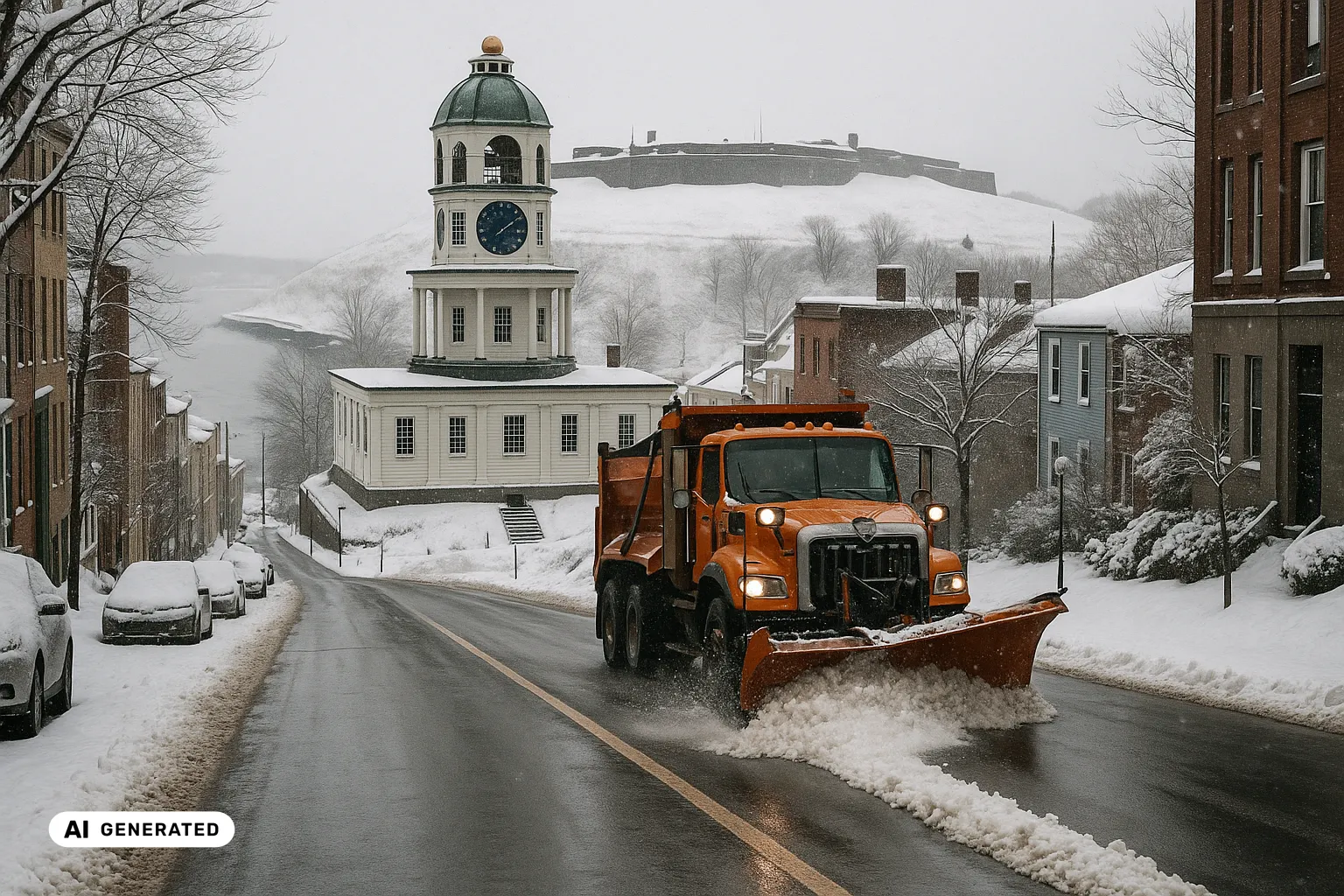
Halifax is built around one of the world’s largest natural deep-water harbours. The old city sits on the Halifax Peninsula, with Dartmouth facing it across the water and Citadel Hill — the star-shaped fort with its Town Clock — standing over downtown. The ground is anything but flat: it climbs from the waterline to about 241.9 metres at the municipality’s highest point, so a single storm can play out very differently between the harbour’s edge, the peninsula’s streets and the higher, more exposed ground inland.
The numbers are real but not the whole story. Halifax averages about 154 cm of snow a year, sitting underneath roughly 1,468 mm of total precipitation — and that ratio is the tell. A great deal of Halifax winter arrives as rain and mixed wet weather, not tidy snow. With around 131 air frosts but only 49 full days below freezing, the Atlantic keeps the city from settling into a deep, dry cold; instead it hovers near the freezing line and swings across it. A nor’easter can throw down snow, turn to freezing rain, wash it to plain rain, and then hand the city a hard overnight freeze. For anyone running winter service here, the job is less about one decisive clearing pass and more about staying ahead of a surface that keeps changing.
What the local rules say
Here is the thing that surprises people who have plowed elsewhere: in Halifax, the municipality clears the sidewalks. Halifax Regional Municipality looks after about 1,000 km of public sidewalks and walkways and roughly 2,300 bus stops, with a mix of its own and contracted crews. In many North American cities the adjacent homeowner is responsible for the public sidewalk; in HRM that is the city’s job. What stays with the resident is their own property — chiefly the driveway and private paths.
Clearing runs to published service standards, measured from the end of a declared event. Streets are graded Priority 1 — arterials, emergency and transit routes and roads with steep grades — cleared to bare pavement within 12 hours, and Priority 2 — residential and gravel roads — within 24 hours, to a standard the municipality frankly calls “snow covered but passable” rather than bare. Sidewalks and bike lanes carry their own priorities: downtown Halifax and Dartmouth, the main arterials and school drop-off zones within 12 hours, Halifax Transit routes within 18, and residential sidewalks within 36. A snowfall over 30 cm, or a blizzard, buys more time; crews work the high-priority routes first and keep going until everything is clear. If clearing runs past those windows, residents report it to 311 — though some roads are the province’s responsibility (Nova Scotia Public Works, on 511) rather than the municipality’s, and HRM’s online map shows which is which.
The hard rule cuts the other way. Under By-law S-300, it is an offence to throw or pile snow onto the street or the sidewalk — cleared snow has to stay on your own property. HRM uses graduated enforcement: where an owner piles snow into the right-of-way, the municipality can post a 24-hour Order to Remove Snow and Ice, and if it goes unheeded HRM clears it and adds the cost as a lien against the property, collected like property taxes; a violation may also draw a summary offence ticket of no less than $100. During a plowing run, crews may push snow across the end of a driveway to keep the road open; that is expected, and the windrow left behind is the resident’s to clear. There is also a quieter piece of the system worth knowing: HRM funds a YMCA-run snow-removal program for seniors (65+) and people with disabilities, which clears steps, walkways and ramps — though not driveways — for income-eligible residents who cannot manage it themselves. It is means-tested and first-come, first-served, and helps around 450 households a winter.
On the ground: where it gets tricky
The terrain does most of the catching-out. The peninsula’s hills and the climb toward Citadel Hill hold ice long after the flatter, sunnier roads have dried, and because the city so often sits near freezing, the real enemy is the rain-on-snow then hard-freeze cycle — a street can go from wet to glazed in an evening with no new snowfall at all.
Then there are the crossings. The Macdonald and MacKay bridges over the harbour are among the most weather-exposed assets in the region, and Halifax Harbour Bridges manages them by wind speed: at 75–85 km/h the Macdonald’s sidewalk and bike lane close, at 85 km/h high-sided vehicles are restricted on the MacKay, and at 120 km/h both bridges shut to all traffic. Winter storms here routinely reach those thresholds, so a crossing can close while crews are still working the approaches on either side.
And then there is the worst case. “White Juan” — the nor’easter of 17–20 February 2004 — buried Nova Scotia at hurricane strength. Halifax logged its snowiest day on 19 February, with regional totals around 60–90 cm, snowfall near 5 cm an hour for half a day, and gusts to about 124 km/h; both Nova Scotia and Prince Edward Island declared states of emergency. It is the local benchmark for how bad an Atlantic storm can get — and exactly why a contractor or a municipal crew here keeps a clear record of where and when each route was treated, alongside what the weather was doing, when conditions can turn between one pass and the next.
The overnight winter parking ban
The part most likely to cost a resident money is parking. HRM’s overnight winter parking ban is in place annually from 15 December to 31 March, but — and this is the part people miss — it is only enforced when a weather event is declared and snow-removal operations are running, between 1 and 6 a.m. It is not a blanket every-night ban. The municipality divides the area into Zone 1 (Central) — the Halifax peninsula and downtown Dartmouth inside the Highway 111 circumferential — and Zone 2 (Non-Central) for the rest. When the ban is declared, a vehicle left on the street — or left hanging out of a driveway across the sidewalk — can be ticketed and/or towed at the owner’s expense. The scale is real: across the 2025/26 season the ban produced 8,702 tickets and 468 tows, with single nights topping a thousand tickets. And the tow power is not limited to the ban — under Section 139 of the Nova Scotia Motor Vehicle Act, a vehicle interfering with snow clearing can be towed any day of the year. HRM announces the ban through its alerts and Service Updates page, so the habit worth forming is to check before going to bed on a stormy night rather than assume.
One municipality, many communities
This is where Halifax differs sharply from most cities its size. On 1 April 1996, the former City of Halifax, City of Dartmouth, Town of Bedford and the surrounding county were amalgamated into a single Halifax Regional Municipality. So Dartmouth, Bedford and Sackville are not separate towns with their own rules — they are communities inside one municipality, covered by one set of service standards and by-laws that reaches from the dense peninsula out to suburban and rural roads. For someone working across the metro area, that is a real simplification: the rule does travel here, unlike in regions stitched together from many small municipalities.
The genuinely separate neighbours sit at the edges. The rural Municipality of East Hants borders HRM to the north, and West Hants Regional Municipality lies to the west, each running its own winter operations on its own roads. A property just over those municipal lines will not automatically follow HRM’s standards, so anyone working near the boundary is wise to confirm whose system applies rather than assume HRM’s reaches that far.
Keeping the record straight
None of this is about proving a point in court — it is about being able to show, plainly, what was done. In a place where a route can be treated, thaw and ice over again before morning, and where a single storm shifts from snow to rain to glaze, operational records that can support service proof are worth more than most. A simple, time-stamped log of where a crew went, when, and in what conditions is exactly the kind of documentation support Wintertrace is built to make easy — whether you run a single truck or a municipal operation. It does not change the rules or anyone’s obligations; it just means that when someone asks what happened during the last storm, the answer is on file. Not a substitute for legal advice.
Local facts
- Halifax averages 154.2 cm of snow a year, on top of around 1,468 mm of total precipitation — much of it rain and mixed wet weather rather than dry snow, because the Atlantic moderates the winter.Source
- The city sees roughly 131 air frosts and about 49 full days below freezing a year — enough cold to ice surfaces, rarely enough to lock them in for long.Source
- Halifax Regional Municipality (HRM) clears public sidewalks itself — about 1,000 km of sidewalks and walkways and roughly 2,300 bus stops — using its own and contracted crews.Source
- Streets are cleared by priority from the end of a declared event: Priority 1 (arterials, emergency and transit routes, steep grades) within 12 hours to bare pavement; Priority 2 (residential and gravel roads) within 24 hours, to a 'snow covered but passable' standard rather than bare.Source
- Sidewalks and bike lanes run on their own priorities: downtown Halifax and Dartmouth, main arterials and school drop-off zones within 12 hours; Halifax Transit routes within 18; residential sidewalks within 36. Snowfalls over 30 cm or blizzards buy more time.Source
- Not every road is the municipality's: some streets are maintained by the province (Nova Scotia Public Works, reached on 511) rather than by HRM (311), and an interactive map shows which is which.Source
- Under By-law S-300 it is an offence to throw or pile snow onto the street or sidewalk; cleared snow has to stay on your own property. HRM can post a 24-hour Order to Remove Snow and Ice — if it is ignored, the municipality clears it and adds the cost as a lien against the property, collected like property taxes — and a violation may also draw a summary offence ticket of no less than $100.Source
- An overnight winter parking ban runs annually 15 December to 31 March, enforced 1–6 a.m. only during declared weather events and snow-removal operations, split into Zone 1 (Central) and Zone 2 (Non-Central).Source
- The scale is real: across the 2025/26 winter the ban produced 8,702 parking tickets and 468 tows, with single nights topping a thousand tickets. Regardless of the ban, a vehicle interfering with snow clearing can be towed any day under Section 139 of the Nova Scotia Motor Vehicle Act.Source
- On the harbour bridges, Halifax Harbour Bridges closes the Macdonald Bridge sidewalk and bike lane at winds of 75–85 km/h, restricts high-sided vehicles on the MacKay Bridge at 85 km/h, and closes both bridges to all traffic at 120 km/h.Source
- Since amalgamation on 1 April 1996, Halifax, Dartmouth, Bedford and Sackville are not separate towns but communities inside one municipality — so a single set of service standards covers urban core, suburbs and rural roads alike.Source
- HRM funds a YMCA-run snow-removal program for income-eligible seniors (65+) and people with disabilities, clearing steps, walkways and ramps — but not driveways — for around 450 households a winter.Source
- Halifax sits on a peninsula above one of the world's largest natural deep-water harbours, with Dartmouth across the water and Citadel Hill over downtown; ground rises from sea level to about 241.9 metres at the highest point in the municipality.
Official contacts
The municipality's hub for how Halifax salts, plows and clears streets, sidewalks and bus stops through the winter.
HRM — Snow Clearing Service Standards
The priority order for streets and sidewalks and the response-time targets measured from the end of snowfall.
HRM — Overnight Winter Parking Ban
When the ban is in force, the 1–6 a.m. enforcement during declared events, and the Central / Non-Central zones.
HRM — Do Your Part (By-law S-300)
What residents are asked to do, and the snow-piling rule under By-law S-300 with its summary-offence penalty.
Common questions about winter service in Halifax
- Do I have to clear the public sidewalk in front of my house in Halifax?
- Generally no. Halifax Regional Municipality clears public sidewalks itself — around 1,000 km of them, plus about 2,300 bus stops — using its own and contracted crews. That is unusual among North American cities, where the adjacent homeowner is often responsible. What stays with you is your own property: your driveway and private paths.
- How quickly is everything cleared after a storm?
- HRM works to published service standards, measured from the end of a declared event. Streets come first: Priority 1 — arterials, emergency and transit routes and steep grades — within 12 hours to bare pavement, and Priority 2 — residential and gravel roads — within 24, to a 'snow covered but passable' standard rather than bare. Sidewalks carry their own priorities: downtown Halifax and Dartmouth, main arterials and school drop-off zones within 12 hours, Halifax Transit routes within 18, and residential sidewalks within 36. A snowfall over 30 cm or a blizzard buys more time.
- Who do I contact about an uncleared street or sidewalk?
- Call 311, or email ContactUs@311.halifax.ca, to report clearing concerns on municipal streets, sidewalks and bike lanes — but only once the service timeline for that priority has expired, because crews are still working within it before then. Not every road is the municipality's, though: some are maintained by the province, and those go to Nova Scotia Public Works on 511. HRM's interactive map shows whether a given street is municipal or provincial.
- Can I shovel my driveway snow onto the road?
- No. Under By-law S-300 it is an offence to throw or pile snow onto the street or the sidewalk — cleared snow has to stay on your own property. A breach can draw a summary offence ticket of no less than $100. During a plowing run, crews may also push snow across the end of your driveway to keep the road clear, which is part of how the system works.
- When does the overnight parking ban apply?
- The ban is in place annually from 15 December to 31 March, but it is only enforced 1 to 6 a.m. during declared weather events and snow-removal operations — not every night. The municipality splits the area into Zone 1 (Central — the Halifax peninsula and downtown Dartmouth) and Zone 2 (Non-Central). Park on the street when the ban is declared and your vehicle could be ticketed and/or towed at your expense.
- Why is Halifax weather so hard on winter operations?
- The Atlantic is the reason. Maritime air keeps Halifax milder than inland Canada — about 49 full freezing days a year against 154 cm of snow — but it also means storms swing between snow, freezing rain and plain rain, sometimes within one system. The harbour peninsula's hills hold ice, and a thaw followed by a hard freeze can glaze a street with no new snow at all. The work is less one big clearing pass than staying ahead of a surface that keeps changing.
- What happens on the harbour bridges in a winter storm?
- The Macdonald and MacKay bridges are wind- and weather-exposed, and Halifax Harbour Bridges manages them by wind speed. At 75–85 km/h the Macdonald Bridge sidewalk and bike lane close; at 85 km/h high-sided vehicles are restricted on the MacKay; at 120 km/h both bridges close to all traffic. Winter storms here regularly push winds into those ranges, so crossings can shut while crews are still working the roads on either side.
- What was White Juan?
- The blizzard of 17–20 February 2004 — a hurricane-strength nor'easter that buried Nova Scotia. Halifax recorded its snowiest day on 19 February, with regional totals of roughly 60–90 cm, snowfall around 5 cm an hour for half a day, and gusts to about 124 km/h. Nova Scotia and Prince Edward Island declared states of emergency. It is the standing reminder of what the worst Atlantic storms can do to a harbour city.
- Are the rules different in Dartmouth, Bedford or Sackville?
- No — and that is the point of amalgamation. Since 1996, Halifax, Dartmouth, Bedford and Sackville are communities inside a single municipality, so one set of service standards and by-laws covers the urban core, the suburbs and the rural roads alike. The genuinely separate neighbours are the rural municipalities that border HRM, such as East Hants to the north and West Hants to the west, which run their own winter operations.
Documenting winter service in Halifax
Anyone clearing snow and ice in Halifax may later need to show when and where a route was treated. Wintertrace is open-source software that records exactly that — time, location and weather for each run — as a calm basis for your own operational records and service proof. It is not a substitute for legal advice.
This overview is for general information and is not legal advice. Local rules on snow and ice clearing vary — the wording of the local rule and the responsible authority always govern.