Winter service · Ontario
Winter service in Ottawa
What winter is really like in Ottawa: around 232 cm of snow, nights below −20 °C, the City's own sidewalk clearing with published target times, the Winter Weather Parking Ban, and who is responsible for what.
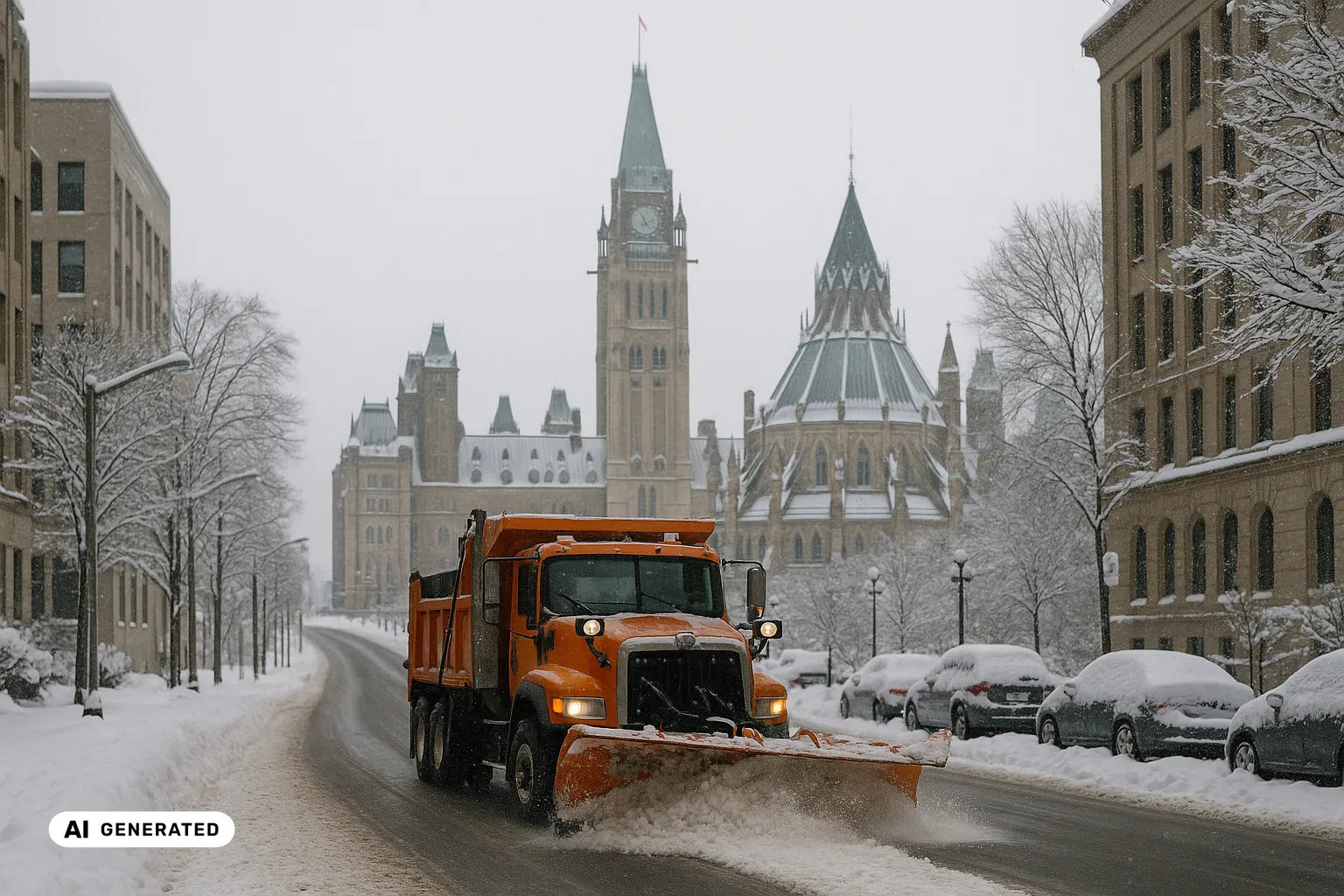
How Ottawa sits, and what winter does here
Ottawa stands at the confluence of the Ottawa and Rideau rivers, with the Rideau Canal threading through the centre of the city, at only about 70 metres above sea level. It is Canada’s capital, and it sits right on the Ontario side of the Ontario–Québec border — the city of Gatineau is directly across the river. None of that hints at the thing that defines winter here: the cold. Ottawa is commonly cited as one of the coldest capital cities in the world by average temperature, and the numbers bear out why. An average year brings about 232 cm of snow, mainly from November through April; there is at least a centimetre on the ground on roughly 115 days; and January sits at an average minimum near −14.3 °C, with the temperature dropping below −20 °C on about 16 nights.
So the winter-service job in Ottawa is shaped less by a single dramatic storm and more by sustained, deep cold over a long season, punctuated by the freezing rain that Eastern Ontario is prone to. Salt loses its bite in the hardest cold, packed snow turns to a stubborn base, and the bridges over the two rivers and the canal freeze before the streets around them. It is the kind of winter where the work is steady, repetitive and unforgiving of a missed pass.
What the local rules say
Here is what surprises people who have cleared snow in other Canadian cities: in Ottawa, the City clears the sidewalks — residential ones included. In Toronto, for instance, owners still carry a nominal 12-hour sidewalk duty that a City exception mostly absorbs; Ottawa drops that obligation altogether. It plows roads and sidewalks on a council-set priority system, with high-use, emergency and transit routes cleared first, and it publishes target clearing times that depend on the street class and how much has fallen:
- Arterials and the Transitway: 2 to 4 hours.
- Downtown sidewalks and the winter cycling network (from 2.5 cm): up to 4 hours.
- Minor collector streets (from 5 cm): up to 6 hours.
- Residential sidewalks (from 5 cm): 12 to 16 hours.
- Residential streets and lanes (from 7 cm and up): 10 to 16 hours.
When the City declares a Significant Weather Event, those timelines can be paused, and crews keep working as conditions allow rather than against the clock.
Because the City does the sidewalks, the property owner’s duties run the other way: you may not push or blow snow and ice onto the street, sidewalk, path, park or right of way, and you must keep fire hydrants clear. The rule against putting snow on the road sits in the Use and Care of Roads By-law (No. 2003-498). Your own driveway and private paths are yours to clear — and if you hire help, note that anyone running a snow-clearing business needs a snow plow contractor licence and may only place snow on the client’s property or at an authorised snow-disposal facility, never on City land, accessible parking spaces or a neighbour’s lot.
The Winter Weather Parking Ban
The part most likely to cost a resident money is parking. Between 15 November and 1 April, the City can call a Winter Weather Parking Ban when freezing rain occurs or Environment Canada forecasts 7 cm or more of snow, so plows can reach the full width of the road. The window depends on the call: overnight bans run 7 p.m. to 7 a.m. and are announced by 9 a.m.; daytime bans run 10 a.m. to 7 p.m. and are announced by 3:30 p.m. The City issues a Special Advisory to local media and posts the ban on ottawa.ca. A vehicle left on the street without a residential parking permit during a ban can be ticketed and towed; permit holders are exempt. Knowing whether your street is covered — and whether you hold the permit that exempts you — before the first big system is worth doing once, in November.
On the ground: where it gets tricky
A few things catch people out. The bridges over the Ottawa and Rideau rivers and across the canal freeze ahead of the roads around them, as cold air reaches them from above and below. And while Ottawa’s signature is cold rather than thaw, it is squarely in freezing-rain country: the January 1998 ice storm dropped more than 80 hours of freezing rain across Eastern Ontario and southern Québec, cut power to hundreds of thousands of customers, and triggered the largest peacetime military deployment in Canada to that point. A glaze event of that kind turns every untreated surface to a hazard at once, which is exactly when a clear record of when and where each route was treated — and under what the weather was doing — earns its keep.
There is a lighter side to all that cold, too. When the canal freezes deep enough, the Rideau Canal Skateway opens — at 7.8 km, the world’s largest naturally frozen skating rink, running right through downtown and maintained by the National Capital Commission. It is the clearest sign that in Ottawa, a hard, sustained freeze is simply part of how the city works.
Around Ottawa, and across the river
One quirk of Ottawa is that its 2001 amalgamation folded former cities and townships — Kanata, Nepean, Gloucester, Cumberland, Vanier and the rural townships, with Orléans as an eastern district — into a single City of Ottawa. Within those boundaries, Ottawa’s rules apply throughout; they are not separate municipalities with their own snow bylaws.
The real line is the river. Gatineau sits directly across the Ottawa River in Québec — a different province, with its own municipal winter rules and its own legal framework. For anyone commuting or working across the interprovincial bridges, that means the responsibilities change with the shoreline. The rule that governed you on the Ontario side does not cross the bridge with you, so it is worth checking Gatineau’s rules on their own terms.
Keeping the record straight
None of this is about winning an argument in court — it is about being able to show, plainly, what was done. In a winter this long and this cold, where a route can be treated, freeze hard, and need attention again before morning, operational records that can support service proof are worth keeping well. A simple, time-stamped log of where a crew went, when, and in what conditions is the kind of documentation support Wintertrace is built to make easy — whether you look after a single property or a fleet of routes. It does not change the rules; it just means that when someone asks what happened during the last storm, the answer is on file. Not a substitute for legal advice.
Local facts
- On average about 232 cm of snow falls a year, mainly from November through April.Source
- There is at least a centimetre of snow on the ground on roughly 115 days a year.Source
- January is the coldest month, with an average minimum near −14.3 °C; the temperature drops below −20 °C on about 16 nights a year.Source
- Ottawa is commonly cited as one of the coldest capital cities in the world by average temperature.Source
- Unlike many Canadian cities, the City of Ottawa plows roads and sidewalks itself — including residential sidewalks — on a council-set priority system.Source
- Target clearing times after snow stops: arterials and the Transitway in 2–4 hours; downtown sidewalks and the winter cycling network (from 2.5 cm) up to 4 hours; residential sidewalks (from 5 cm) 12–16 hours; residential streets (from 7 cm+) 10–16 hours.Source
- Property owners must not push snow or ice onto the street, sidewalk, path, park or right of way, and must keep fire hydrants clear; the legal basis is the Use and Care of Roads By-law (No. 2003-498).Source
- Anyone running a snow-clearing business needs a snow plow contractor licence, and may not dump snow on City property, accessible parking spaces or someone else's land.Source
- A Winter Weather Parking Ban can be called between 15 November and 1 April when freezing rain occurs or Environment Canada forecasts 7 cm or more of snow; overnight bans run 7 p.m.–7 a.m. and daytime bans 10 a.m.–7 p.m. Vehicles without a residential parking permit can be ticketed and towed.Source
- The Rideau Canal Skateway is the world's largest naturally frozen skating rink — 7.8 km through the city centre, maintained by the National Capital Commission.Source
- Ottawa sits at the confluence of the Ottawa and Rideau rivers, with the Rideau Canal running through the centre, at about 70 m elevation — Canada's capital, on the Ontario side of the Ontario–Québec border.
Official contacts
City of Ottawa — Snow plowing and clearing
The priority system, the target clearing times by street class, and what a declared Significant Weather Event changes.
City of Ottawa — Clearing snow from your property
What property owners must and must not do with their snow, the contractor licence, and driveway markers.
City of Ottawa — Winter Weather Parking Bans
When a ban can be called, the overnight and daytime windows, how it is announced, and the permit exemption.
City of Ottawa — Report a problem (winter) / 311
How to report an uncleared road, sidewalk or pathway through the City's winter service request.
Common questions about winter service in Ottawa
- Do I have to clear the sidewalk in front of my house in Ottawa?
- Generally not. Ottawa is one of the cities that clears its sidewalks itself — including residential ones — on a priority system, working to a target of 12 to 16 hours after 5 cm or more has fallen. What the City asks of property owners is mainly the other side of the job: do not push or blow snow and ice onto the street, sidewalk, path or right of way, and keep fire hydrants clear. Your own driveway and private paths are yours to clear.
- How quickly is everything cleared after a storm?
- The City works to published targets that depend on the street class and how much has fallen. Arterials and the Transitway are aimed at 2 to 4 hours; downtown sidewalks and the winter cycling network at up to 4 hours once 2.5 cm has accumulated; minor collector streets at up to 6 hours from 5 cm; residential sidewalks at 12 to 16 hours from 5 cm; and residential streets and lanes at 10 to 16 hours once 7 cm or more has fallen. When a Significant Weather Event is declared, those timelines can be paused and crews keep working as conditions allow.
- What is a Winter Weather Parking Ban, and when does it apply?
- Between 15 November and 1 April, the City can call a ban when freezing rain occurs or Environment Canada forecasts 7 cm or more of snow, so plows can reach the full width of the road. Overnight bans run 7 p.m. to 7 a.m. and are announced by 9 a.m.; daytime bans run 10 a.m. to 7 p.m. and are announced by 3:30 p.m. A vehicle parked on the street without a residential parking permit during a ban can be ticketed and towed; permit holders are exempt.
- How do I find out whether a ban is in effect, and how do I report an uncleared street?
- The City issues a Special Advisory to local media and posts bans on ottawa.ca, with overnight bans announced by 9 a.m. and daytime bans by 3:30 p.m. To flag a road, sidewalk or pathway that has been missed, use the City's winter 'Report a problem' service or call 311.
- The plow left a ridge of snow across the end of my driveway — whose job is that?
- That ridge — a windrow — is a normal part of plowing the street, and clearing it falls to the property owner along with the rest of the driveway. To help crews see the edge of your property in deep snow, the City allows driveway markers within set limits. Pushing that snow back onto the road is not allowed.
- Can a contractor I hire dump the snow on the road or next door?
- No. Anyone running a snow-clearing business in Ottawa needs a snow plow contractor licence, and may only place snow on the client's own property or at an authorised snow-disposal facility — never on City property, accessible parking spaces or someone else's land. Private operators cannot use the City's snow-disposal facilities. The underlying rule against putting snow on the carriageway is the Use and Care of Roads By-law (No. 2003-498).
- Are the rules the same across the river in Gatineau?
- No. Gatineau sits directly across the Ottawa River in Québec — a different province with its own municipal winter rules and its own law. Anyone who commutes or works across one of the interprovincial bridges crosses into a separate set of responsibilities, so it is worth checking Gatineau's rules rather than assuming Ottawa's travel with you.
- Why is ice such a recurring problem here?
- Two reasons. Ottawa sits through long stretches of deep cold — below −20 °C on around 16 nights a year — but it also gets freezing-rain systems off the same Eastern Ontario setup that produced the 1998 ice storm. Add the bridges over the Ottawa and Rideau rivers and the canal, which freeze before the roads around them, and a surface can glaze over without any fresh snow at all.
Documenting winter service in Ottawa
Anyone clearing snow and ice in Ottawa may later need to show when and where a route was treated. Wintertrace is open-source software that records exactly that — time, location and weather for each run — as a calm basis for your own operational records and service proof. It is not a substitute for legal advice.
This overview is for general information and is not legal advice. Local rules on snow and ice clearing vary — the wording of the local rule and the responsible authority always govern.