Winter service · Ontario
Winter service in Toronto
What winter is really like in Toronto: around 100–122 cm of snow but a season ruled by melt-and-refreeze and freezing rain, the City's 12-hour sidewalk rule and the exception that quietly hands most of it to the City, the windrow lottery across the GTA, and who is responsible for what.
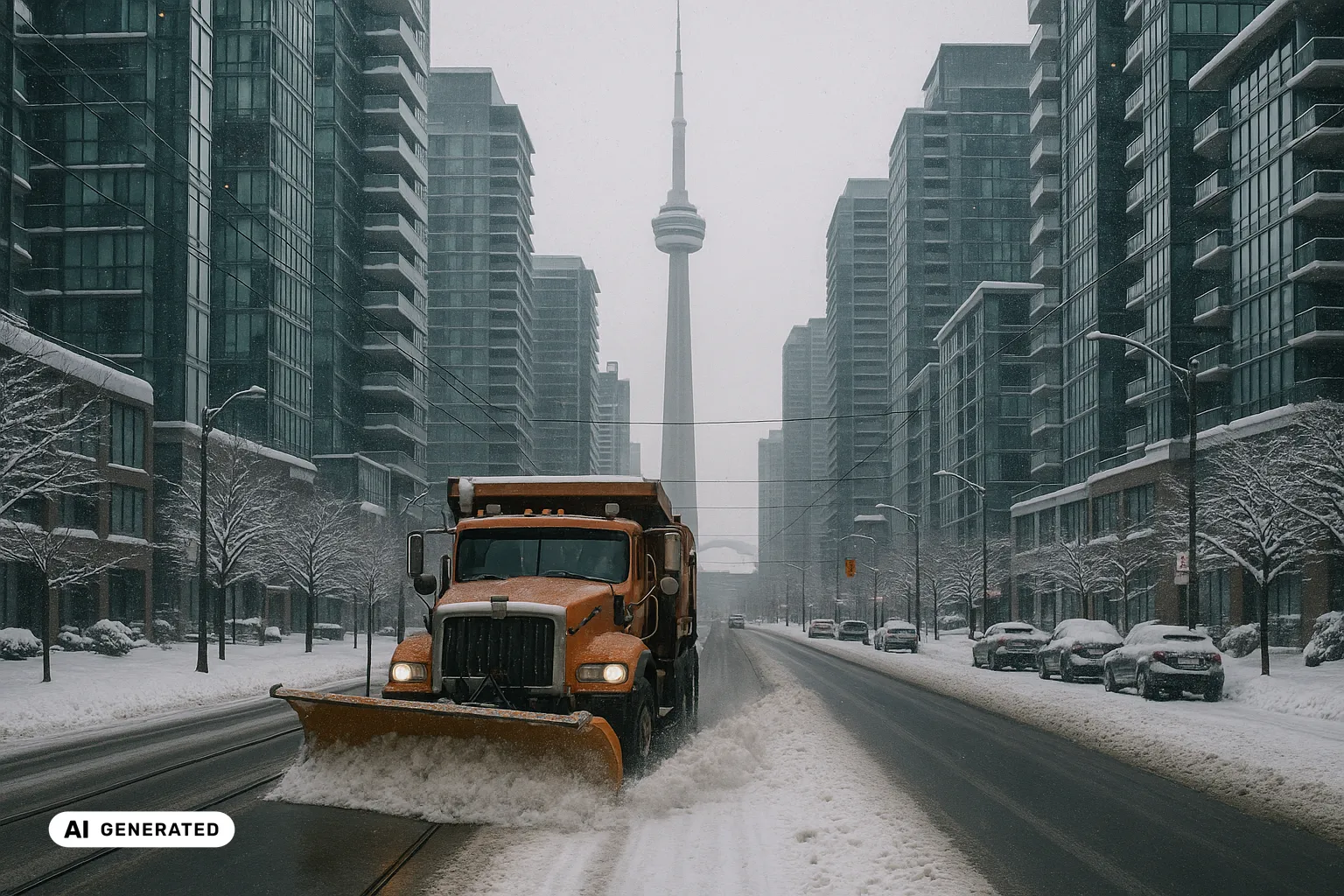
What winter actually does in Toronto
Toronto sits on the northwest shore of Lake Ontario, spread over about 630 km² of former-glacial hills and ravines, with the Don, Humber and Rouge rivers running south to the lake. The headline snow numbers are middling for Canada — around 100 cm a year at Pearson Airport, nearer 122 cm downtown, depending on which station you read — and that is exactly why they mislead. Winter here is not decided by depth. It is decided by temperature sitting close to 0 °C for long stretches, and by the freezing rain that comes with it.
The lake is part of the reason. Lake Ontario moderates the cold and gives Toronto milder nights than its latitude would suggest, so the city is not a heavy lake-effect snow city the way Buffalo or the eastern Great Lakes towns are — its bigger events usually arrive on “Colorado Lows” tracking in from the southwest, picking up extra moisture off the lake on the way. What that leaves, operationally, is the hardest kind of winter to keep ahead of: snow, ice pellets, freezing rain and plain rain mixed in a single system, then a thaw, then a hard overnight freeze. A surface that was bare in the afternoon can be sheet ice by morning with no new snow at all.
So the work in Toronto is anti-icing more than snow-pushing. Salt goes down the moment snow starts to stick; a route gets treated, melts, refreezes, and needs treating again. The February-heavy snow (about 34 cm, the snowiest month) matters, but the thing that fills the season is the freeze-thaw cycle — and that is where keeping a clear record of when each surface was treated, and in what conditions, stops being paperwork and starts being the whole story.
What the local rules say
The City of Toronto’s rules live in Toronto Municipal Code, Chapter 719 — Snow and Ice Removal, and the sidewalk rule reads more strictly than most people experience it. Under §719-2 A, an owner or occupant must clear snow and ice from the sidewalk along the building within 12 hours of a snow, rain or hail ending, and §719-2 B adds that a slippery sidewalk must be treated with sand, salt or ash as often as needed.
The reason most residents never feel that duty is the exception right beneath it. §719-2 C removes it wherever the City clears the sidewalk under its own policy — and in practice the City mechanically clears public sidewalks once 2 cm has fallen, covering roughly 98% of them. So the 12-hour obligation is real but narrow: it bites mainly on the small events, under 2 cm, that the City’s machines don’t roll out for. (In Ottawa, a few hundred kilometres east, there is no such nominal duty at all — the City there clears residential sidewalks outright.) Your private steps, walks, driveways and ramps are a separate matter — those are yours to clear within 24 hours of a snowfall, and to salt or sand if slippery (§719-4.1, added in 2022 by By-law 594-2022).
Two prohibitions are worth knowing plainly. You may not push or move snow and ice from private property onto a highway, sidewalk or laneway (§719-5) — a common, and ticketable, shortcut. And an offence under the chapter is liable, on conviction, to a fine of up to $5,000 through the Provincial Offences Act (§719-6); the City can also clear an uncleared sidewalk itself and recover the cost from the owner. The exact ticket amounts for individual offences are set by the City elsewhere rather than written into the chapter, so the figure that lives in the bylaw is that ceiling.
How the city clears — and the windrow lottery
On the road side, Transportation Services runs a large, round-the-clock program, and it works to thresholds by road class: salting as soon as snow sticks, then plowing at about 2.5 cm on expressways (target ~2 hours), 5 cm on arterials and main roads (~6 hours), and 8 cm on local and residential streets (~14 hours). Residents can track clearing by address through PlowTO and report a missed road, sidewalk or windrow through 311. A Salt Management Plan balances road safety against the environmental load of all that salt — which is its own quiet pressure in a freeze-thaw climate that asks for a lot of it.
The part that surprises people is the windrow — the ridge a plow leaves across the end of a driveway. The City clears a 3 m opening in it after the street is plowed, but not everywhere: the service reaches about 262,000 households, concentrated in North York, Scarborough and Etobicoke. Across much of the older, denser core, the windrow is the property owner’s to clear. Whether that ridge is the City’s job or yours genuinely depends on where you live — one of the clearest examples of how uneven a single city’s winter rules can be from district to district.
Districts, not neighbours — and the GTA around you
It is easy to mistake Etobicoke, Scarborough, North York, East York and the former City of York for separate towns. They are not, any more — they are the six municipalities that amalgamated into the single City of Toronto in 1998, and they appear in Chapter 719 only as the former bylaws the current code replaced. Across all of them, Toronto’s rules apply uniformly; there is no patchwork of district snow bylaws inside the city.
The patchwork is outside it. The Greater Toronto Area is Toronto plus four regional municipalities — Durham, Halton, Peel and York — and about 25 municipalities in total, each running its own roads and its own winter rules. The genuinely separate places next door are Mississauga and Brampton in Peel; Markham, Vaughan and Richmond Hill in York Region; Pickering and its neighbours in Durham; Oakville, Burlington and Milton in Halton. Anyone whose routes or properties cross those boundaries is crossing into a different rulebook each time, so it pays to read the local one rather than assume Toronto’s travels with you.
Keeping the record straight
None of this is about winning an argument in court — it is about being able to show, plainly, what was done. In a winter run by freeze-thaw, where a single route can be salted, melt, glaze over on a freezing-rain night and need treating again before morning, operational records that can support liability cases are worth keeping well. A simple, time-stamped log of where a crew went, when, and in what conditions is the kind of record of each treatment — set against what the weather was doing — that turns a vague “we were out all night” into something specific. That is the documentation support Wintertrace is built to make easy, whether you look after a single property or a fleet of routes. It does not change the rules; it just means that when someone asks what happened during the last storm, the answer is on file. Not a substitute for legal advice.
Local facts
- Around 100 cm of snow falls in an average year at Pearson Airport; downtown totals run nearer 122 cm — so figures depend on which station you read.Source
- The snowiest months are February (about 34 cm), January (about 24 cm) and December (about 20 cm), with measurable snow on roughly 41 days a year.Source
- January is the coldest month, averaging about −5.4 °C; there is at least a centimetre of snow on the ground on roughly 65 days, typically December into late March.Source
- Winter systems regularly mix snow, ice pellets, freezing rain and rain, and mid-winter thaws above 0 °C are common — so melt-and-refreeze and glaze ice, not snow depth, define the work.Source
- Lake Ontario moderates the cold and gives milder nights; Toronto is not a heavy lake-effect snow city — its bigger events tend to arrive on 'Colorado Lows' that pick up extra moisture off the lake.Source
- Under the City of Toronto's bylaw, an owner or occupant must clear snow and ice from the sidewalk along their building within 12 hours of a snow, rain or hail ending (Toronto Municipal Code, Chapter 719, §719-2 A).Source (PDF)
- That duty does not apply where the City clears the sidewalk under its own policy (§719-2 C): in practice the City mechanically clears public sidewalks once 2 cm has fallen, covering about 98% of them — under 2 cm, the owner's 12-hour duty stands.Source
- Private steps, walks, driveways and ramps must be cleared within 24 hours of a snowfall, and slippery surfaces salted or sanded (§719-4.1, added 2022 by By-law 594-2022).Source (PDF)
- Pushing or moving snow or ice from private property onto a highway, sidewalk or laneway is prohibited (§719-5); on conviction, an offence under the chapter carries a fine of up to $5,000 via the Provincial Offences Act (§719-6).Source (PDF)
- City salting starts as soon as snow sticks; plowing thresholds are about 2.5 cm on expressways (target ~2 h), 5 cm on arterials and main roads (~6 h) and 8 cm on local and residential streets (~14 h).Source
- The plow windrow service — clearing a 3 m opening across a driveway after the street is plowed — is not city-wide: it reaches about 262,000 households, mainly in North York, Scarborough and Etobicoke.Source
- Transportation Services runs the program; residents track clearing by address through PlowTO and report missed routes through 311.Source
- Toronto sits on the northwest shore of Lake Ontario over about 630 km², on a base of ravines and former-glacial hills, with the Don, Humber and Rouge rivers running south to the lake.
Official contacts
City of Toronto — Winter maintenance
The program hub: how the City salts and plows, what each snowfall triggers, and the current state of operations.
City of Toronto — Clearing snow and ice from your property
What owners and occupants must do, the sidewalk exception where the City clears, and what counts as private property.
City of Toronto — Levels of snow clearing service
The salting and plowing thresholds by road class, target times, the windrow service, and the Salt Management Plan.
City of Toronto — PlowTO and 311
Track clearing status by address through PlowTO, and report an uncleared road, sidewalk or windrow through 311.
Common questions about winter service in Toronto
- Do I have to shovel the sidewalk in front of my property in Toronto?
- On paper, yes — the City's bylaw asks an owner or occupant to clear the sidewalk along the building within 12 hours of snow, rain or hail ending, and to salt or sand it if it turns slippery. But there is a large exception: where the City clears the sidewalk under its own policy, that duty does not apply, and in practice the City mechanically clears public sidewalks once 2 cm has fallen — about 98% of them. So for most snowfalls the City does the sidewalk; it is the smaller events, under 2 cm, where your own 12-hour duty quietly comes back. Your private steps, walks and driveway are always yours, within 24 hours.
- If Toronto doesn't get that much snow, why is ice such a constant problem?
- Because the season is ruled by temperature, not depth. Toronto sits close enough to 0 °C through much of winter that surfaces melt by day and refreeze overnight, again and again, and its storms regularly mix snow with ice pellets, freezing rain and rain rather than dropping a clean blanket of snow. A freezing-rain event glazes every untreated surface at once, and a thaw followed by a hard night can turn a clear sidewalk into sheet ice with no fresh snow at all. It is anti-icing, not snow-pushing, that never really stops here.
- Is Toronto a lake-effect snow city like Buffalo?
- Not really. Lake Ontario mostly moderates Toronto's cold and gives it milder nights, rather than burying it in lake-effect squalls the way the eastern Great Lakes cities get hit. The bigger events here tend to come from 'Colorado Lows' tracking in from the southwest, which can pick up extra moisture off the lake on the way. The defining winter hazard is the freeze-thaw cycle and freezing rain, not lake-effect accumulation.
- How quickly is everything cleared after a storm?
- The City salts as soon as snow starts to stick, then plows by road class once thresholds are reached: about 2.5 cm on expressways, aiming for roughly two hours; 5 cm on arterials and main roads, around six hours; and 8 cm on local and residential streets, around fourteen hours. Sidewalks are cleared mechanically from 2 cm. Those are targets, and a long freezing-rain or freeze-thaw event stretches them, because crews end up treating the same surfaces more than once.
- The plow left a ridge of snow across the end of my driveway — whose job is that?
- It depends where you live. That ridge — a windrow — is left behind when the street is plowed, and the City clears a 3 m opening across it only on eligible streets, reaching about 262,000 households mainly in North York, Scarborough and Etobicoke. In much of the older, denser core the windrow is the property owner's to clear. You can check your address and request status through PlowTO or 311. Either way, the snow cannot be pushed back onto the road.
- Are Etobicoke, Scarborough and North York separate cities with their own rules?
- No — and this trips people up. Those names, along with East York and the former City of York, are the six municipalities that amalgamated into the single City of Toronto in 1998. They are districts within the city now, and Toronto's bylaw applies right across them. The genuinely separate municipalities are the surrounding ones — Mississauga and Brampton in Peel, Markham, Vaughan and Richmond Hill in York Region, Pickering and the others in Durham — each of which runs its own roads and its own winter rules.
- What can happen if a sidewalk isn't cleared, or snow ends up on the road?
- The bylaw lets the City clear an uncleared sidewalk itself and recover the cost from the owner, and an offence under the chapter is liable on conviction to a fine of up to $5,000 under the Provincial Offences Act. Moving snow or ice from private property onto a highway, sidewalk or laneway is separately prohibited. The exact set-fine amounts for individual tickets are set elsewhere by the City rather than written into the chapter, so the figure that matters in the bylaw itself is that ceiling. This is general information, not a substitute for legal advice.
Documenting winter service in Toronto
Anyone clearing snow and ice in Toronto may later need to show when and where a route was treated. Wintertrace is open-source software that records exactly that — time, location and weather for each run — as a calm basis for your own operational records and service proof. It is not a substitute for legal advice.
This overview is for general information and is not legal advice. Local rules on snow and ice clearing vary — the wording of the local rule and the responsible authority always govern.