Winter service · British Columbia
Winter service in Prince George
What winter is really like in Prince George, BC: about 204 cm of snow a year, January lows near −12 °C, the owner's four-day duty to clear footpaths under Bylaw No. 8425, the 15 Oct–15 Apr parking restrictions and how the City plows.
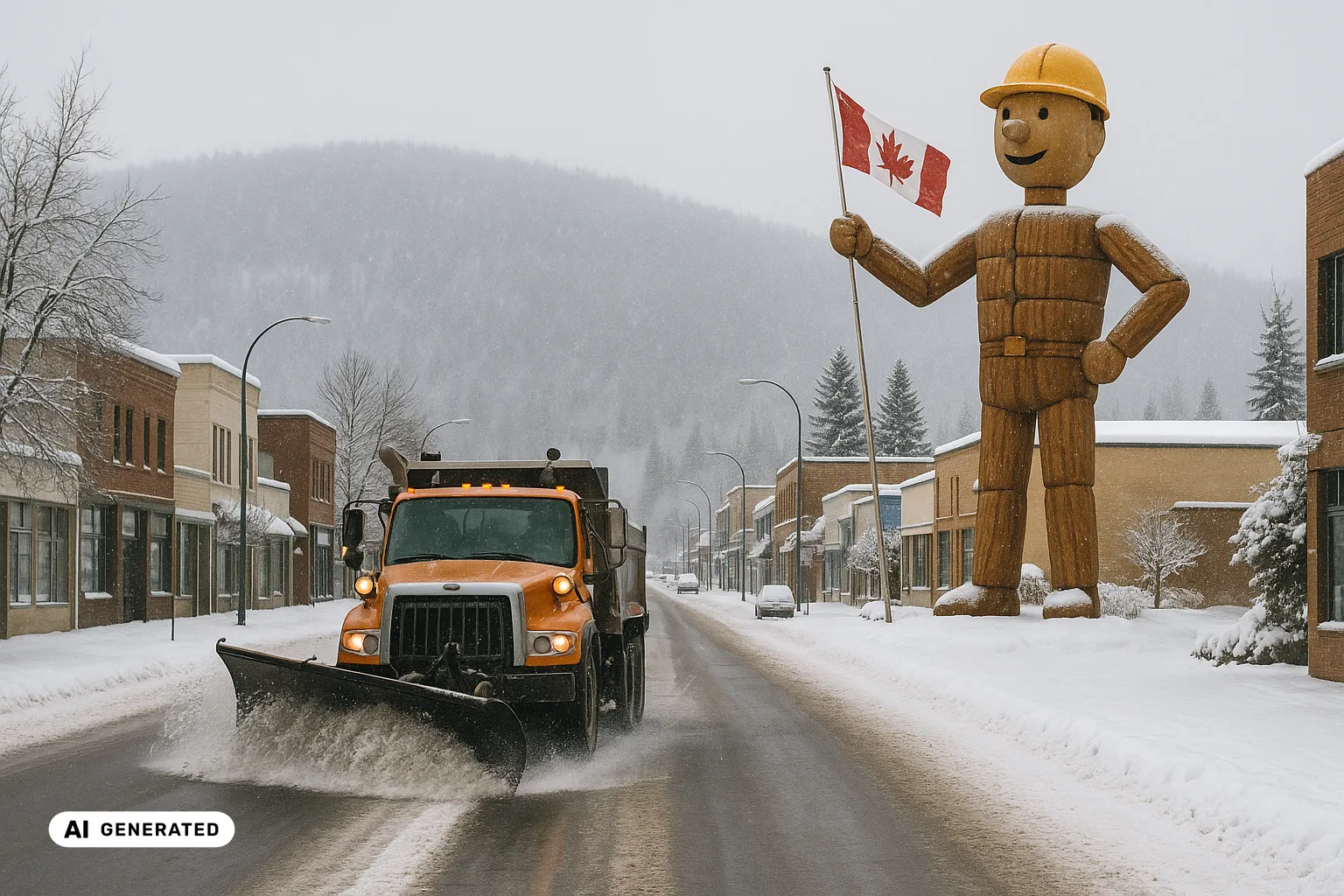
How Prince George sits, and what winter does here
Prince George stands where the Fraser and Nechako rivers meet, in the Central Interior of British Columbia, at about 575 m above sea level and roughly 784 km north of Vancouver by road. That inland, upland position is the single most important fact about its winter. This is not the mild, oceanic coast: it is a humid-continental climate (Köppen Dfb) with long, cold winters and a snowpack that settles in and stays.
An average year brings about 204 cm of snow, measured against Environment and Climate Change Canada’s 1991–2020 normals rather than the lower figures some weather portals quote. More telling than the total is the cold and its length: in January the average daytime high is around −3.9 °C and the overnight low about −11.7 °C, so the heart of winter stays below freezing day and night. Measurable snow falls on roughly 61 days a year, and the record low is a remarkable −50.0 °C, set in 1950. Where coastal BC — Vancouver, Victoria — sees a handful of snow days that melt within a day, Prince George collects over two metres of snow and holds a continuous cover for months. It is a real, plannable winter-service location, and that is what sets it apart from the rest of the province.
What gives the winter its local shape is the two river valleys. The Fraser and Nechako flats collect cold air, and the bridges and riverside streets cool from above and below, so they frost and ice earlier than the ground around them. Higher neighbourhoods such as Hart Highlands in the north and College Heights in the south sit above the river sole, picking up their own snow and their own place in the clearing order — the City even names “priority hills” as a category of their own.
What the local rules say
The first thing to know is that clearing the sidewalk is the property owner’s responsibility — and it goes a little further than people expect. According to the City of Prince George’s Property Maintenance Bylaw No. 8425, 2012, every owner or occupier must remove snow and ice from the footpaths and sidewalks on and adjoining their land within four days of it accumulating (Section 8(2)). That includes the public sidewalk alongside the property, not just the private walk to the door. The same bylaw asks that driveways, paths, steps and parking spaces be kept safe for normal use. An offence under the bylaw is liable, on summary conviction, to a fine of up to $10,000, with each day a separate offence (Section 22) — though in practice the day-to-day route is a ticket or bylaw notice rather than a maximum fine, and there is no separate, lower figure set just for the sidewalk duty.
The City clears about 735 km of roads and 200 km of sidewalks, but it is explicit that it does not clear sidewalks that are not part of a major pedestrian area — so on a residential street the sidewalk duty sits with the owner. Roads are cleared on a colour-coded priority system: Priority 1 for arterials, downtown and the hospital district; Priority 2 for collectors, priority hills, transit routes and commercial or industrial areas; and Priority 3 for residential streets and parks. Clearing kicks in once a snow event — 7.5 cm or more in 24 hours — has occurred. The City then aims to clear Priority 1 and 2 within 48 hours, and Priority 3 within 72 hours of finishing the higher priorities. In a heavy storm those targets stretch, so residential streets, and the sidewalks beside them, are routinely last.
The rule most likely to catch a driver out is the winter parking restriction, in force each year from 15 October to 15 April. The hours depend on where you are: Priority 1 streets and the hospital district are no-parking 10 p.m. to 7 a.m., downtown is midnight to 7 a.m., and residential areas are 8 a.m. to 6 p.m., with parking allowed overnight on the odd-numbered side. A vehicle left in the plough’s way is a $50 ticket per offence and may be towed.
On the ground: where it gets tricky
A few things shape winter service in Prince George specifically. The long season is the big one: with snow on roughly 61 days and a cover that lasts months, this is winter measured in months of settled cold, not in single storms. Because residential streets are Priority 3 and the City clears no residential sidewalks at all, owners and businesses carry their own frontage — sidewalk, driveway and steps — for the whole of it. The two river valleys and their bridges ice up before the surrounding streets, making them predictable early hazards worth treating first. And the higher neighbourhoods can be holding more snow than the river flats on the same day, so timing varies across the city.
Over a season this long, the passes add up, and a dated record of when and where each surface was cleared — and under what weather — is far easier to stand behind later than memory. Where an owner’s frontage runs along a public sidewalk under the four-day rule, keeping that record is especially worth the habit.
Around Prince George
Prince George’s rules stop at the city limits. It is the seat of the Regional District of Fraser–Fort George, but the towns of the wider Central Interior — Mackenzie to the north, Vanderhoof to the west, Quesnel to the south, and McBride and Valemount in the Robson Valley — each run their own clearing and set their own timelines. Bylaw No. 8425, the four-day sidewalk duty and the winter parking restrictions are Prince George’s own and do not travel with you across that boundary, so anyone clearing snow across the region is better off checking each community’s rules than assuming Prince George’s apply.
Local facts
- Prince George sits at the confluence of the Fraser and Nechako rivers in the Central Interior of British Columbia, at about 575 m (1,886 ft) elevation — well inland and well above the mild coast, roughly 784 km north of Vancouver by road.Source
- Average annual snowfall is about 204 cm (80 in), per Environment and Climate Change Canada Climate Normals 1991–2020 (station Prince George A). Use the official normals rather than weather portals, which can understate Canadian snowfall.Source
- In January the average daytime high is about −3.9 °C and the average overnight low about −11.7 °C, so the core of winter stays below freezing around the clock. Measurable snow falls on roughly 61 days a year, and the record low is −50.0 °C, set on 2 January 1950.Source
- The climate is humid continental (Köppen Dfb) — long, cold winters with a reliable, lasting snowpack — unlike the oceanic, mostly snow-free winters of coastal BC such as Vancouver and Victoria.Source
- According to the City of Prince George's Property Maintenance Bylaw No. 8425, 2012, every owner or occupier must remove snow and ice from all footpaths and sidewalks on and adjoining their land within four days of the snow or ice accumulating (Section 8(2)).Source (PDF)
- Under Bylaw No. 8425, an offence is liable on summary conviction to a fine of up to $10,000, and each day an offence continues counts as a separate offence (Section 22); day-to-day enforcement is also available by ticket or bylaw notice. The bylaw does not set a separate, lower figure specific to the sidewalk duty.Source (PDF)
- The City clears about 735 km of roads and 200 km of sidewalks, but it states it does not clear sidewalks that are not part of a major pedestrian area — so residential-street sidewalks fall to the owner under Bylaw No. 8425.Source
- Roads are cleared on a colour-coded priority system: Priority 1 (arterials, downtown, hospital district), Priority 2 (collectors, priority hills, transit routes, commercial/industrial), and Priority 3 (residential streets, parks). A snow event is defined as 7.5 cm or more in 24 hours.Source
- After a snow event the City aims to clear Priority 1 and 2 within 48 hours, and Priority 3 within 72 hours of finishing Priority 1 and 2 — so residential streets come last in the order of work.Source
- Winter parking restrictions run each year from 15 October to 15 April, by zone: Priority 1 and the hospital district 10 p.m.–7 a.m., downtown midnight–7 a.m., and residential areas 8 a.m.–6 p.m. with an odd-side overnight allowance. A vehicle in breach is a $50 ticket per offence and/or may be towed.Source
Official contacts
City of Prince George — Snow Clearing
The City's winter programme: the colour-coded road priorities, what the City clears and what it does not, the snow-event definition and the winter parking restrictions.
City of Prince George — Property Maintenance Bylaw No. 8425 (PDF)
The consolidated bylaw. Section 8(2) sets the four-day duty for owners and occupiers to clear footpaths and sidewalks on and adjoining their land.
City of Prince George — Good Neighbour Guide
A plain-language summary of the property duties, including 'remove snow and ice from your driveway and footpaths within four days' under Bylaw No. 8425.
Common questions about winter service in Prince George
- Who has to clear the sidewalk in Prince George?
- The property owner or occupier. Under the City of Prince George's Property Maintenance Bylaw No. 8425, you must clear snow and ice from the footpaths and sidewalks on and adjoining your land — and that includes the public sidewalk running alongside your property, not just your own walk. The City clears about 200 km of sidewalks in major pedestrian areas, but it says plainly that it does not clear sidewalks outside those areas, so on a residential street the stretch in front of your property is yours.
- How long do I have to clear it?
- Four days. Section 8(2) of Bylaw No. 8425 sets the duty as removing the accumulation within four days of the snow or ice forming. That is a longer window than the overnight or next-morning deadlines some cities use, but in a Prince George winter the snow tends to keep coming, so clearing promptly — before it packs to ice — is the practical reading of the rule.
- When does the City plough the streets after a storm?
- By priority, and only once enough has fallen to count as a snow event — 7.5 cm or more in 24 hours. The City then aims to clear Priority 1 and 2 routes (arterials, downtown, the hospital district, collectors, priority hills and transit routes) within 48 hours, and Priority 3 residential streets within 72 hours of finishing the higher priorities. In a heavy storm those targets stretch out, so residential streets and their sidewalks are routinely the last to be reached.
- What are the winter parking rules?
- Winter parking restrictions run from 15 October to 15 April. The hours depend on the zone: Priority 1 streets and the hospital district are no-parking 10 p.m. to 7 a.m., downtown is midnight to 7 a.m., and residential areas are 8 a.m. to 6 p.m. with parking allowed overnight on the odd-numbered side. The point is to keep the plough's path clear; a vehicle left in the way is a $50 ticket and may be towed.
- Is Prince George really a snowy place, or is it mild like the BC coast?
- It is a genuine Interior winter, not a coastal one. Prince George sits about 575 m up and more than 780 km inland, with a humid-continental climate: roughly 204 cm of snow a year by the official 1991–2020 normals, January days that stay below freezing, and a snowpack that lasts for months. Coastal BC — Vancouver, Victoria — sees only a handful of snow days that usually melt within a day. The two are not comparable, which is exactly why a winter-service operation here plans for a long, reliable season.
- Why do the bridges and riverside streets ice up first?
- Prince George sits where the Fraser and Nechako rivers meet, and the two valleys cut through the city. Low river flats collect cold air, and the bridges over both rivers lose heat from above and below, so they tend to frost and ice earlier than the streets around them and hold it longer. They are predictable early trouble spots worth treating first when a cold snap or freezing damp moves in.
- Does the City clear the snow the plough leaves across my driveway?
- No. Like most cities, Prince George does not clear the windrow — the ridge of snow a passing plough leaves across the end of a private driveway. Clearing the driveway, the walk and the steps is the owner's job under Bylaw No. 8425, which also asks that driveways, paths and steps be kept safe for normal use.
- Are the rules the same in the communities around Prince George?
- Not necessarily. Prince George is the seat of the Regional District of Fraser–Fort George, but towns in the wider Central Interior — Mackenzie, Vanderhoof, Quesnel, and McBride and Valemount in the Robson Valley — each run their own clearing programmes and timelines. Bylaw No. 8425, the four-day duty and the winter parking restrictions are Prince George's own, so anyone working across the region should check each community's rules rather than assume they match.
Documenting winter service in Prince George
Anyone clearing snow and ice in Prince George may later need to show when and where a route was treated. Wintertrace is open-source software that records exactly that — time, location and weather for each run — as a calm basis for your own operational records and service proof. It is not a substitute for legal advice.
This overview is for general information and is not legal advice. Local rules on snow and ice clearing vary — the wording of the local rule and the responsible authority always govern.