Winter service · Newfoundland and Labrador
Winter service in St. John's
What winter is really like in St. John's: the foggiest, windiest major city in Canada, who clears the 193 km of city sidewalks, the overnight parking ban, fines, and what Snowmageddon taught the place.
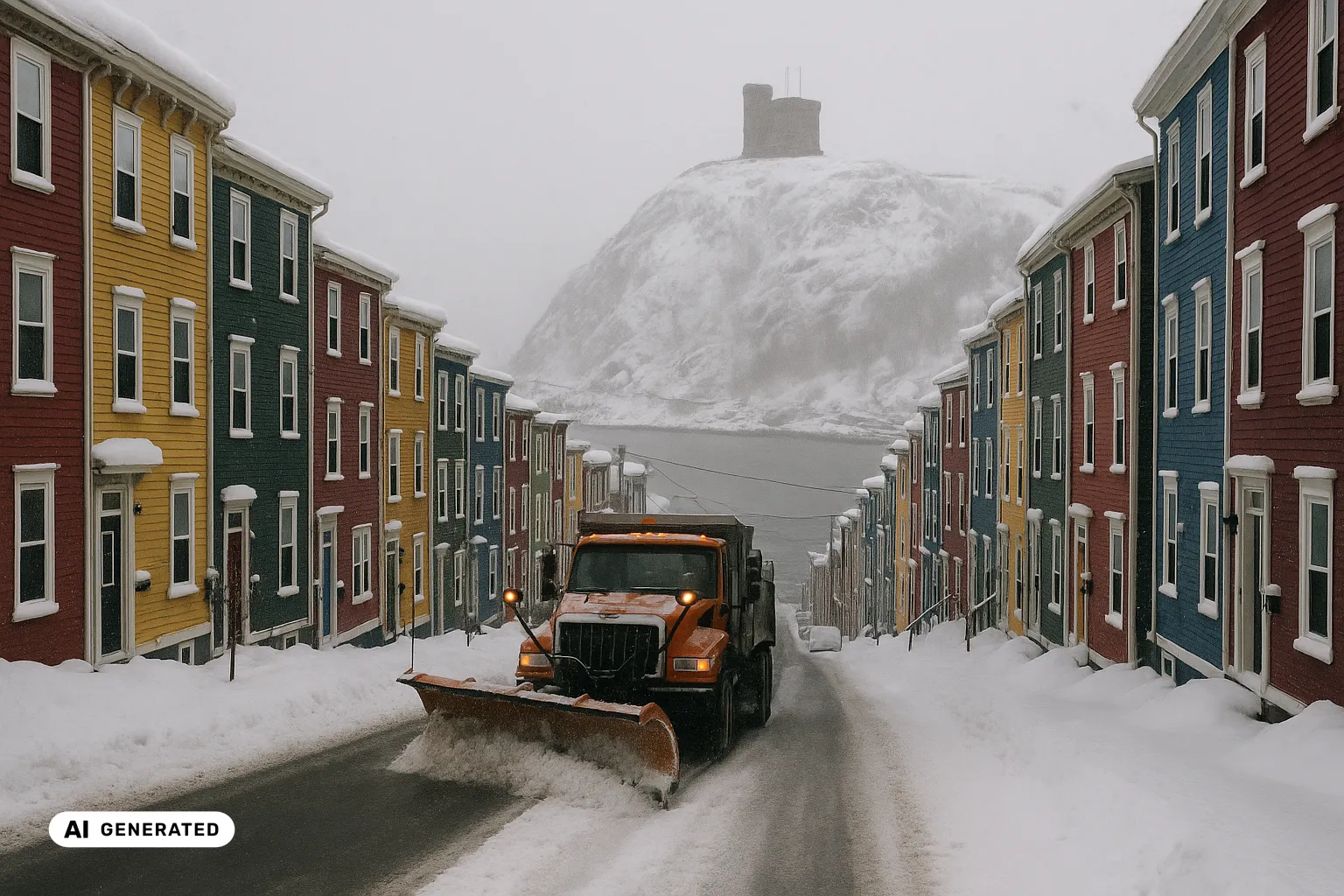
How St. John’s sits, and what winter does here
St. John’s sits on the eastern tip of the Avalon Peninsula, at the edge of the North Atlantic — the most easterly city in North America, leaving Greenland aside. The old town climbs a wall of steep hills around a deep natural harbour, whose narrow mouth, The Narrows, is guarded by Signal Hill. Ground rises from sea level to nearly 192 metres, so a single storm can play out very differently between the waterfront, the downtown gut and the higher, more exposed neighbourhoods.
The numbers are big, but they are not the whole story. The City puts the annual snowfall at around 322 cm, on top of roughly 1,191 mm of rain, with a winter that hovers near 0 °C rather than sitting deep in the cold. What truly sets St. John’s apart is the Atlantic weather: it is the foggiest major city in Canada — about 124 days of fog a year — and the windiest, with an average wind speed near 24.3 km/h. Storms here rarely arrive as tidy snow. A single system can swing from heavy snow to freezing rain to plain rain and back, the wind re-drifts whatever has fallen, and a thaw followed by a hard freeze glazes those hills with ice. For winter service, the work is less about one big clearing pass and more about staying ahead of a surface that keeps changing.
What the local rules say
Here is the thing visitors from other Canadian cities get wrong: in St. John’s, the City clears the sidewalks. It salts and plows the streets and looks after 193 km of designated sidewalks, prioritised along the arterial and collector streets where people actually walk. On an ordinary residential street, the public sidewalk is the City’s responsibility — not the homeowner’s. The clear exception is downtown, where property owners on designated streets are asked to keep the adjacent sidewalk free of snow and ice.
What is yours is your own property. Driveways are the resident’s job, and during a plowing run crews may push snow across the end of a driveway to keep the road clear — that is allowed and expected. The hard rule cuts the other way: you may not push or throw snow into the street. Doing so breaches Section 163.3 of the Highway Traffic Act, and snow has to be piled on your own property. (You can generally put snow on a sidewalk that isn’t part of the City’s clearing programme — just not onto the carriageway.)
Clearing runs on a published priority order. Streets are graded Priority 1 (arterials) down through collectors, local streets and city-maintained private lanes; sidewalks put school zones first. The City works to targets: ice control within about three hours, plowing of up to 25 cm within 24 hours of a storm ending, and most cleared sidewalks within five days of the end of a winter event. Bigger storms stretch all of that.
On the ground: where it gets tricky
The terrain does most of the catching-out. The steep downtown streets between the harbour and Signal Hill hold ice long after the flatter, sunnier roads have dried, and the higher, wind-exposed neighbourhoods see snow packed and re-drifted by gales that the sheltered gut never feels. Because the city so often hovers around freezing, the real enemy is the rain-on-snow then hard-freeze cycle — a surface can go from wet to glazed in an evening, with no new snowfall at all.
And then there is the worst case. On 17 January 2020 — “Snowmageddon” — a one-day record 76 cm of snow fell on the city behind winds up to 130 km/h. The City declared a state of emergency that lasted eight days, and the Canadian Army was called in to help dig St. John’s out. It is the standing reminder of what an Atlantic storm can do to a hilly city, and why a contractor or a municipal crew here keeps a clear record of when and where each route was treated — and under what the weather was doing — when conditions can turn between one pass and the next.
The winter parking ban
The part most likely to cost a resident money is parking. Through the winter season — roughly January to mid-April — an overnight parking ban keeps streets clear for the plows, and the hours depend on where you are. Downtown, on Water Street and Duckworth Street, parking is banned 4 to 6 a.m. daily. Outside downtown, the ban runs 12:30 to 7:30 a.m. daily. On any street scheduled for snow removal, parking is banned 11 p.m. to 6 a.m., with the affected streets announced by mid-afternoon that day. A vehicle left in breach can draw a $75 fine and be towed. The City posts the current bans and lets you check by address, so it is worth knowing which rule covers your street before the first storm.
Around St. John’s
St. John’s winter is not quite the region’s winter. Mount Pearl and Paradise sit just inland to the west, Conception Bay South (CBS) stretches along the bay, and Torbay and Portugal Cove–St. Philip’s lie to the north — all separate municipalities on the northeast Avalon, each with its own clearing approach, sidewalk rules and parking restrictions. A property just over the city line will not automatically follow St. John’s standards, so anyone working across the metro area is wise to check each one rather than assume the rule travels.
Keeping the record straight
None of this is about proving a point in court — it is about being able to show, plainly, what was done. In a place where a route can be treated, thaw, and ice over again before morning, operational records that can support service proof are worth more than most. A simple, time-stamped log of where a crew went, when, and in what conditions is exactly the kind of documentation support Wintertrace is built to make easy — whether you run a single truck or a municipal operation. It does not change the rules; it just means that when someone asks what happened during the last storm, the answer is on file. Not a substitute for legal advice.
Local facts
- The City puts annual snowfall at 322 cm, with about 1,191 mm of rain and a winter average around 0 °C.Source
- St. John's is the foggiest major city in Canada — roughly 124 days of fog a year — and the windiest, with an average wind speed of about 24.3 km/h.Source
- On 17 January 2020 — 'Snowmageddon' — a one-day record of 76 cm of snow fell with winds to 130 km/h; a state of emergency was declared and the Canadian Army was called in.Source
- Unlike many Canadian cities, St. John's clears 193 km of designated sidewalks itself; residents are not generally responsible for the public sidewalk along residential streets.Source
- Service targets: ice control within 3 hours, plowing of up to 25 cm within 24 hours of a storm ending, and most cleared sidewalks within 5 days of the end of a winter event.Source
- Driveways are the resident's job, and pushing or throwing snow into the street breaches Section 163.3 of the Highway Traffic Act — snow has to be kept on your own property.Source
- Overnight winter parking ban: 4–6 a.m. downtown (Water and Duckworth streets), 12:30–7:30 a.m. elsewhere, and 11 p.m.–6 a.m. on streets scheduled for snow removal; a $75 fine and a possible tow.Source
- Set on the eastern tip of the Avalon Peninsula, St. John's is the most easterly city in North America (excluding Greenland), built on steep hills around a natural harbour whose entrance is The Narrows, below Signal Hill.
Official contacts
City of St. John's — Snow Clearing
How the City salts, plows and clears streets and designated sidewalks, and what is left to residents.
City of St. John's — Service Priority
The priority order for streets and sidewalks, the 193 km of cleared sidewalks, and the response-time targets.
City of St. John's — Winter Parking
Overnight parking bans, scheduled snow-removal bans, the times that apply by area, and the fines.
Common questions about winter service in St. John's
- Do I have to clear the sidewalk in front of my house in St. John's?
- Usually not. St. John's is unusual among Canadian cities in clearing sidewalks itself — about 193 km of them, prioritised along arterial and collector streets where foot traffic is heaviest. The public sidewalk along an ordinary residential street is the City's responsibility, not yours. Downtown is the exception, where property owners on designated streets are asked to keep the adjacent sidewalk clear.
- Then what am I responsible for?
- Your own property — chiefly your driveway and any private paths. The City clears the road and designated sidewalks; your driveway is your job, and crews may push snow across the end of it while plowing the street, which is allowed.
- Can I shovel my driveway snow onto the road?
- No. Throwing or pushing snow onto the street breaches Section 163.3 of the Highway Traffic Act. Snow has to be piled on your own property. You can generally put it on a sidewalk that isn't part of the City's clearing programme, but not onto the carriageway.
- How quickly does the City clear everything after a storm?
- The City works to targets: ice control within about three hours of icy conditions, plowing of up to 25 cm within 24 hours of a storm ending, and most cleared sidewalks within five days of the end of a winter event. Bigger storms stretch those timelines, and crews work major arterials and school-zone sidewalks first.
- When does the overnight parking ban apply?
- Through the winter season, roughly January to mid-April. Downtown — on Water Street and Duckworth Street — parking is banned 4 to 6 a.m. daily; outside downtown the ban runs 12:30 to 7:30 a.m. daily. On any street scheduled for snow removal, parking is banned 11 p.m. to 6 a.m., announced by mid-afternoon that day. A breach is a $75 fine and your vehicle may be towed.
- Why is the weather here so hard on winter operations?
- St. John's is the foggiest and windiest major city in Canada — around 124 days of fog a year and an average wind near 24.3 km/h. Sitting on the open Atlantic, it gets storms that swing between heavy snow, freezing rain and plain rain within a single system. Wind packs and re-drifts snow, and rain-on-snow followed by a hard freeze glazes the hills with ice.
- What was 'Snowmageddon'?
- The blizzard of 17 January 2020. A one-day record of 76 cm of snow fell with hurricane-force winds up to 130 km/h. The City declared a state of emergency that lasted eight days, and the Canadian Army was brought in to help dig the city out — a useful reminder of what the worst Atlantic storms can do here.
- Are the rules the same in Mount Pearl, Paradise or CBS?
- Not necessarily. Mount Pearl, Paradise, Conception Bay South, Torbay and Portugal Cove–St. Philip's are separate municipalities on the northeast Avalon, each with its own snow-clearing approach, sidewalk rules and parking restrictions. A property just over the city line won't automatically follow St. John's rules.
Documenting winter service in St. John's
Anyone clearing snow and ice in St. John's may later need to show when and where a route was treated. Wintertrace is open-source software that records exactly that — time, location and weather for each run — as a calm basis for your own operational records and service proof. It is not a substitute for legal advice.
This overview is for general information and is not legal advice. Local rules on snow and ice clearing vary — the wording of the local rule and the responsible authority always govern.