Winter service · Manitoba
Winter service in Brandon
What winter is really like in Brandon, Manitoba: about 128 cm of snow, January lows near −22 °C, the owner's duty to clear sidewalks, the 15 Nov–31 Mar snow-route parking ban, fines and how the City plows.
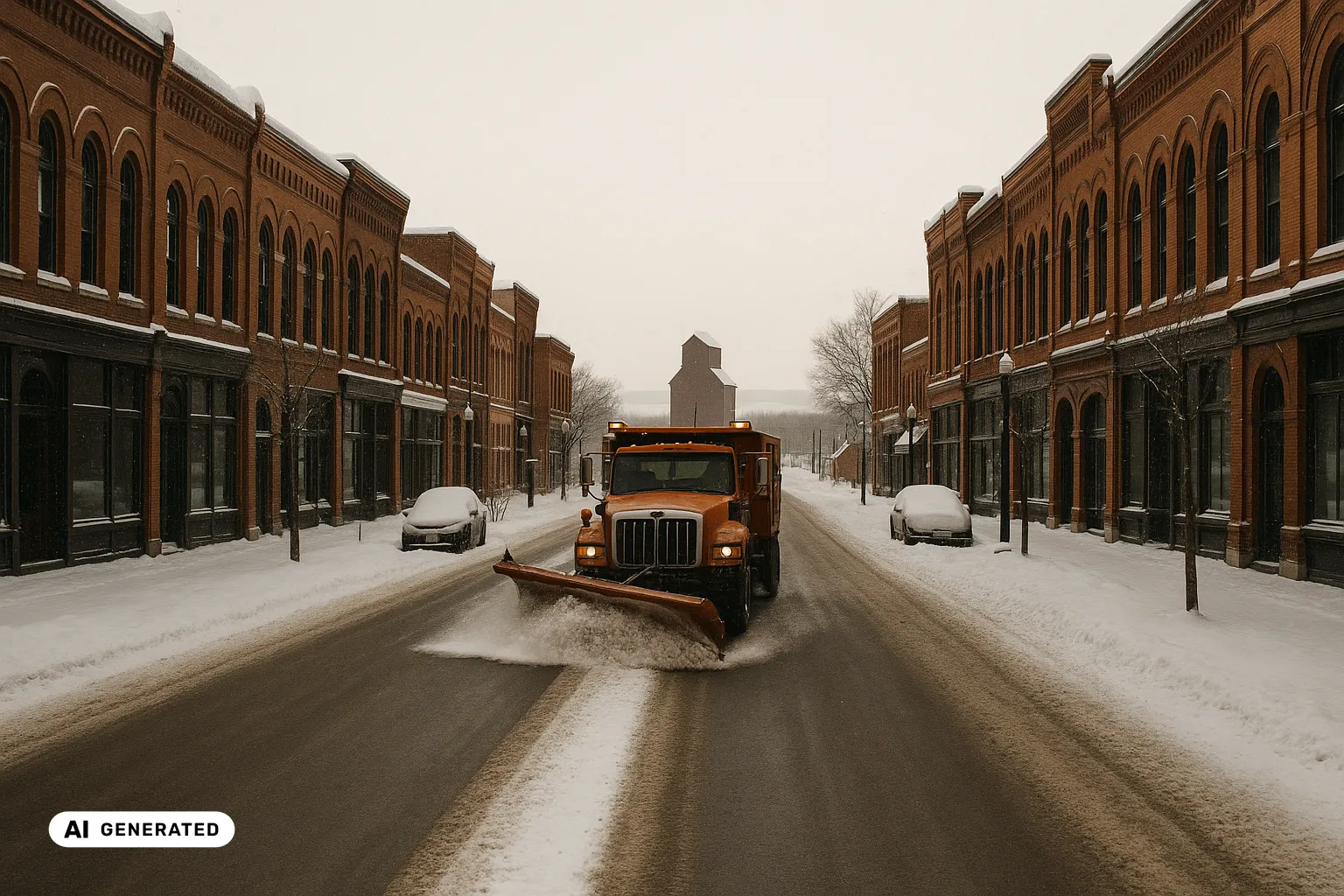
How Brandon sits, and what winter does here
Brandon stands on the banks of the Assiniboine River in south-western Manitoba, roughly 214 km west of Winnipeg and only about 120 km east of the Saskatchewan border — Manitoba’s second-largest city and the commercial anchor of the surrounding Westman region. The land here is flat to gently rolling prairie at around 400 m elevation, with few hills, trees or lakes to break the weather, and that openness is the single biggest fact about its winter.
An average year brings about 128 cm of snow, measured against Environment and Climate Change Canada’s 1991–2020 normals rather than the lower figures some weather portals quote. More telling than the total is the cold and its length: average daily lows sit near −18.5 °C in December, −21.9 °C in January and −19.7 °C in February, and even the average daytime high stays below freezing right through the core of winter. The record low is −46.7 °C, set back in 1893. Snow falls on roughly 54 days a year, and once it is down it stays — the season runs from November into March or April, so this is a winter measured in months of settled cold rather than in single storms. It is a long, continental prairie winter, closer in character to the persistent cold a couple of hours east in Winnipeg than to anything coastal.
What gives Brandon its own signature is the wind. On open prairie with no real windbreaks, an arctic wind doesn’t just drop the wind chill — it lifts snow that has already fallen and drifts it back across roads and driveways hours after the sky clears. Here, blowing and drifting snow is its own job, not a footnote to how much falls.
What the local rules say
The first thing to know about Brandon is that clearing the sidewalk is the property owner’s responsibility — and that goes further than many people expect. Under the City of Brandon’s Community Standards Bylaw, owners and occupants are responsible for the sidewalks abutting their property, including the public sidewalk that runs alongside it. So the stretch of public walk in front of a property is the owner’s to clear, not the City’s.
For businesses there is a clock on it: the sidewalk in front of the premises must be cleared before 10:00 a.m. on each day following a snowfall, under Traffic By-law No. 5463, clause 10.7. The penalty for leaving a walk uncleared is a $100 fine — reduced to $50 if paid within 15 days — and the City can additionally bill an owner for the cost of clearing it on their behalf. The approach has been described as education-first: the focus is on repeat offenders rather than residents who genuinely cannot shovel, and a Snow Angels program connects volunteers with people who have mobility limits.
The City clears the streets on a priority system. Priority 1A main routes are cleared within 24 hours of a snow event beginning; the numbered P1 routes (1–6), covering arterial and collector roads, normally within 24 to 72 hours; and residential zones A–G after the priority routes are done. The City’s own designated sidewalks and walking paths are cleared last — only once the P1 and P2 street routes are nearly complete — which is part of why the residential sidewalk duty sits with owners through the long season.
The rule most likely to catch a driver out is the Snow Route Parking Ban. From 15 November to 31 March, parking is banned on signed snow routes daily between 11:00 p.m. and 8:00 a.m. — but not automatically every night. The City calls the ban when more than 5 cm of snow falls or wind causes significant drifting, gives notice by 4:00 p.m., and the ban then takes effect at 11:00 p.m. that night (Traffic By-law No. 5463/16/87). The signed routes are Rosser Avenue, Princess Avenue, Ninth Street, Tenth Street and Louise Avenue, and a vehicle left on one during a ban can be ticketed and towed at the owner’s expense.
On the ground: where it gets tricky
A few things shape winter service in Brandon specifically. The flat, open prairie means drifting snow can undo a cleared surface long after the plow has passed — the same wind that bites the wind chill keeps moving snow around, so timing and repeat passes matter more than a single clearance. The Assiniboine River valley and its bridges cool from above and below and tend to ice up before the surrounding streets, making them predictable early hazards worth treating first. And because residential zones and sidewalks come last in the City’s order of work, owners and businesses carry the day-to-day burden of keeping their own frontage clear for months at a stretch.
Over a winter that long, the passes add up, and a dated record of when and where each surface was cleared — and under what weather — is far easier to stand behind later than memory. Where a property owner’s frontage runs along a public sidewalk, having that record is especially worth the habit.
Around Brandon
Brandon’s rules stop at the city limits. The rural municipalities that ring it — Cornwallis, Elton, Riverdale and Whitehead — each run their own clearing and have their own timelines, as do the Westman towns a little further out: Carberry, Virden, Minnedosa, Neepawa and Melita. The city’s snow-route ban, its sidewalk-clearing duty and its fine schedule do not travel with you across that boundary, so anyone clearing snow across the wider region is better off checking each municipality’s rules than assuming Brandon’s apply.
Local facts
- Average annual snowfall about 128 cm, per Environment and Climate Change Canada Climate Normals 1991–2020 (station Brandon CDA); use the official normals rather than weather portals, which can understate prairie snowfall.Source
- Average daily lows of about −18.5 °C in December, −21.9 °C in January and −19.7 °C in February; even average daytime highs stay below freezing through the core winter. The record low is −46.7 °C, set on 1 February 1893.Source
- Measurable snow falls on roughly 54 days in an average year, and the snow season runs broadly from November into March or April.Source
- According to the City of Brandon's Community Standards Bylaw, property owners and occupants are responsible for clearing the sidewalks abutting their property — including the public sidewalk alongside it. Sidewalk clearing in Brandon rests with the owner, not the City.Source
- Businesses must clear the sidewalk in front of their premises before 10:00 a.m. on each day following every snowfall, under Traffic By-law No. 5463, clause 10.7.Source
- The sidewalk-clearing penalty is a $100 fine, reduced to $50 if paid within 15 days; owners who do not clear can also be billed for the City's cost of doing it for them.Source
- Streets are cleared by priority: Priority 1A main routes within 24 hours of a snow event starting; P1 routes 1–6 (arterial and collector roads) normally within 24–72 hours; residential zones A–G after that. City-designated sidewalks and paths are cleared only once the P1 and P2 street routes are nearly complete.Source
- Annual Snow Route Parking Ban: from 15 November to 31 March, parking is banned on signed snow routes daily between 11:00 p.m. and 8:00 a.m. It is triggered by more than 5 cm of snow and/or drifting, with notice given by 4:00 p.m. and the ban taking effect at 11:00 p.m. (Traffic By-law No. 5463/16/87).Source
- The signed snow routes are Rosser Avenue, Princess Avenue, Ninth Street, Tenth Street and Louise Avenue; vehicles left on them during a ban can be ticketed and/or towed at the owner's expense.Source
- Brandon sits on the Assiniboine River in south-western Manitoba, about 214 km west of Winnipeg and 120 km east of the Saskatchewan border. It is Manitoba's second-largest city (population 51,313 in 2021) and the commercial hub of the Westman region, serving a catchment of more than 190,000 people.Source
Official contacts
City of Brandon — Snow Clearing
The City's winter program: street priorities (P1A, P1, residential zones), the sidewalk-clearing duty, deadlines and fines.
City of Brandon — Winter Parking and Snow Routes
How the Snow Route Parking Ban works, when it is in effect, which streets are snow routes, and Traffic By-law No. 5463/16/87.
City of Brandon — Public Works Department
Responsible for snow clearing (900 Richmond Avenue East). A recorded snow-route line at 204-729-2500 carries ban updates.
Common questions about winter service in Brandon
- Who has to clear the sidewalk in Brandon?
- The property owner or occupant. Under the City of Brandon's Community Standards Bylaw, you are responsible for the sidewalks abutting your property — and that includes the public sidewalk running alongside it, not just the private walk up to your door. So unlike places where the municipality clears public sidewalks, in Brandon the stretch in front of your property is yours to keep clear.
- Is there a deadline to clear it?
- For businesses, yes: the sidewalk in front of the premises must be cleared before 10:00 a.m. on each day following a snowfall, under Traffic By-law No. 5463, clause 10.7. For homeowners the by-law sets the duty rather than a fixed clock time, but the practical expectation is the same — clear it promptly after the snow stops, before it packs down to ice.
- What happens if I don't shovel?
- The penalty is a $100 fine, reduced to $50 if paid within 15 days, and the City can also bill you for clearing the walk itself. In practice the City has said its focus is education first and repeat offenders rather than people who genuinely cannot shovel, and a Snow Angels program pairs volunteers with residents who have mobility limits.
- What is the Snow Route Parking Ban and when is it in effect?
- It is a seasonal overnight ban that lets crews clear key streets. From 15 November to 31 March, parking is not allowed on signed snow routes between 11:00 p.m. and 8:00 a.m. It is not automatic every night — the City calls it when more than 5 cm of snow falls or wind drives drifting, gives notice by 4:00 p.m., and the ban takes effect at 11:00 p.m. that night.
- Which streets are snow routes?
- The signed routes are Rosser Avenue, Princess Avenue, Ninth Street, Tenth Street and Louise Avenue. When a ban is on, a vehicle left on one of these can be ticketed and towed at the owner's expense, so it is worth knowing whether you park on or near one. The recorded snow-route line (204-729-2500) carries the current status.
- How soon are the streets plowed after a storm?
- By priority. Priority 1A main routes are cleared within 24 hours of a snow event starting; the numbered P1 routes (arterial and collector roads) usually within 24 to 72 hours; and residential zones A through G after the priority routes are done. City-cleared sidewalks and paths come last, only once the main street routes are nearly finished — another reason the residential sidewalk duty sits with owners.
- Why is blowing snow such a problem in Brandon?
- Brandon sits on flat, largely open prairie with few natural windbreaks, so an arctic wind can pick up fallen snow and redeposit it across roads and driveways hours after the last flake. The City's own snow-route ban is triggered by drifting as well as fresh snowfall — a sign that here, managing wind-blown snow matters as much as clearing what falls.
- Does the river make a difference for winter service?
- Yes, locally. The Assiniboine River valley and the bridges that cross it cool from above and below, so they tend to form ice earlier and hold it longer than the streets around them — predictable trouble spots worth treating first when a cold snap or freezing drizzle moves in.
- Are the rules the same in the towns around Brandon?
- Not necessarily. The rural municipalities ringing the city — Cornwallis, Elton, Riverdale and Whitehead — and Westman towns such as Carberry, Virden, Minnedosa, Neepawa and Melita each run their own clearing programs and timelines. Brandon's snow-route ban, sidewalk duty and fines do not automatically apply outside the city limits, so anyone working across the region should check each one.
Documenting winter service in Brandon
Anyone clearing snow and ice in Brandon may later need to show when and where a route was treated. Wintertrace is open-source software that records exactly that — time, location and weather for each run — as a calm basis for your own operational records and service proof. It is not a substitute for legal advice.
This overview is for general information and is not legal advice. Local rules on snow and ice clearing vary — the wording of the local rule and the responsible authority always govern.