Winter service · Prince Edward Island
Winter service in Charlottetown
What winter is really like in Charlottetown, PEI: about 285 cm of snow a year, the commercial-only sidewalk duty under the Snow Removal Bylaw, residential streets the City clears, the 15 Nov–15 Apr overnight parking ban, ice storms and Nor'easters.
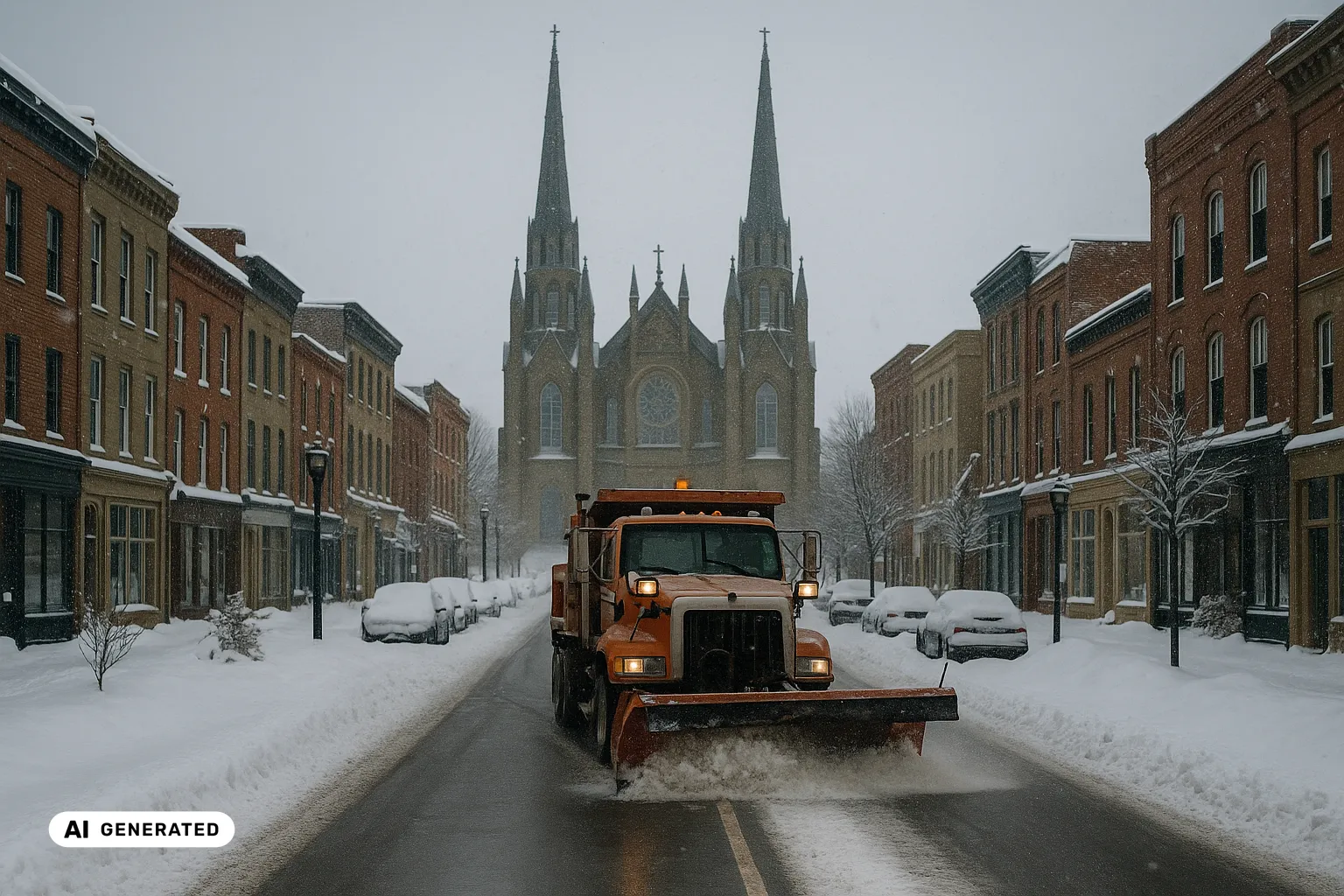
How Charlottetown sits, and what winter does here
Charlottetown is the capital of Prince Edward Island, set on its namesake harbour where three rivers meet on the island’s south shore. The city is roughly V-shaped, hemmed between the North (Yorke) and Hillsborough (East) rivers, with land from sea level up to about 49 m. That maritime, between-two-tidal-rivers position is the key to its winter: damp sea air and constant swings between thaw, rain and frost.
An average year brings about 285 cm of snow, measured against Environment and Climate Change Canada’s 1991–2020 normals (station Charlottetown A) rather than the lower figures some weather portals quote, with roughly 73 days of measurable snow. The cold is steady rather than extreme: January and February average highs near −3 °C and lows near −11.5 °C, so the core months stay below freezing day and night, and the record low is −32.8 °C from 1877. But on PEI the snow total is only half the story. The sea adds a hard ice and mixed-precipitation theme: warm maritime air can flip snow to rain or freezing rain, and Nor’easters bring heavy snow, strong winds and ice build-up. During “White Juan” in February 2004, the city broke its all-time daily record with 74.4 cm in a single day.
What the local rules say
The first thing to know is that who clears the sidewalk depends on whether the property is commercial. According to the City of Charlottetown’s Snow Removal Bylaw, the duty to clear an abutting sidewalk falls on commercial abutters only — the bylaw defines an “abutter” as the owner, lessee or occupier of commercial premises or a lot that abuts a street. A 1995 amendment limited enforcement to commercial properties precisely because the City now supplies removal and ploughing in residential areas. So in the downtown commercial core the sidewalk is the business’s to keep clear, while residential streets are cleared by the City.
Where the duty does apply, the deadline runs from when the storm ends: snow and ice must be cleared within four hours of a storm ceasing if it ends in the daytime, or before 10:00 a.m. the following day if it ends at night (Section 2.2). For ice, it is enough to remove it or cover it with sand, ashes or other material that gives pedestrians safe footing (Section 2.3). Snow and ice may not be dumped on any street, sidewalk, lot, yard, playground or other City property (Section 3.2). Enforcement escalates: an officer can order clearing within 24 hours (4.1); the City can then clear it and recover the cost (4.2); and on conviction an offence carries a fine up to $500, up to 90 days’ imprisonment, or both (4.3), with each day a continuing breach counting separately (4.4).
For the streets, the City ploughs across 20 designated sections over more than 250 lane-km, generally starting once 2.5 cm accumulates on priority routes and 4 cm on other streets. The rule most likely to catch a driver out is the overnight winter parking ban: on-street parking is banned citywide between 11 p.m. and 6 a.m. from 15 November to 15 April, and it applies to all vehicles, including those with residential permits, so crews can pull snow out of the parking lanes overnight.
On the ground: where it gets tricky
A few things shape winter service in Charlottetown specifically. The commercial sidewalk duty means downtown businesses carry their own frontage to a tight deadline through the season, while the City handles residential walks — a split worth knowing whichever side of it you are on. The ice and freezing-rain cycle is its own job: the bylaw’s allowance for sanding to safe footing reflects a winter where traction, not just clearing, is the daily task. And the water crossings — the Hillsborough Bridge above all — frost and ice before the streets around them.
Across a winter this changeable, a dated record of when and where each surface was cleared or treated — and under what weather — is far easier to stand behind later than memory, especially for a commercial property carrying its own sidewalk duty through repeated thaw-and-freeze.
Around Charlottetown
Charlottetown’s rules stop at the city limits. Stratford, across the Hillsborough Bridge to the south, and Cornwall, immediately to the west, are separate towns with their own councils and their own clearing — even though all three sit within the Charlottetown census agglomeration. The Snow Removal Bylaw, the commercial-only sidewalk duty and the overnight parking ban are Charlottetown’s own, so anyone clearing snow across the area is better off checking each municipality’s rules than assuming the capital’s apply.
Local facts
- Charlottetown is the capital of Prince Edward Island, set on its namesake harbour where three rivers meet on the island's south shore. The city is roughly V-shaped, hemmed by the North (Yorke) and Hillsborough (East) rivers, between sea level and about 49 m elevation.Source
- Average annual snowfall is about 285 cm (112 in), per Environment and Climate Change Canada Climate Normals 1991–2020 (station Charlottetown A), with roughly 73 days of measurable snow a year. Use the official normals rather than weather portals, which can understate snowfall.Source
- January and February average highs sit near −3 °C and lows near −11.5 °C, so the core winter months stay below freezing day and night. The record low is −32.8 °C, set on 29 January 1877.Source
- The maritime setting adds an ice and mixed-precipitation theme on top of the snow. During the Nor'easter 'White Juan' in February 2004, Charlottetown broke its all-time daily snowfall record with 74.4 cm in a single day.Source
- Under the City of Charlottetown's Snow Removal Bylaw, the duty to clear an abutting sidewalk falls on commercial abutters only: 'abutter' is defined in the bylaw as the owner, lessee or occupier of commercial premises or a lot that abuts a street. A 1995 amendment limited enforcement to commercial properties because the City now supplies removal and ploughing in residential areas.Source
- Where the duty applies, snow and ice must be cleared within four hours of a snow storm ceasing if it ends in the daytime, or before 10:00 a.m. the following day if it ends at night (Section 2.2). For ice, covering with sand, ashes or other material that gives pedestrians safe footing is sufficient (Section 2.3).Source
- The City ploughs streets across 20 designated sections over a network of more than 250 lane-km, generally starting once 2.5 cm of snow accumulates on priority routes and 4 cm on other streets, and it provides mechanical equipment to remove most snow from sidewalks after a weather event.Source
- An overnight winter parking ban prohibits on-street parking citywide between 11 p.m. and 6 a.m. from 15 November to 15 April each year. It applies to all vehicles, including those with residential parking permits, and vehicles impeding clearing can be removed under the Highway Traffic Act and the City Traffic Bylaw.Source
Official contacts
City of Charlottetown — Winter Operations
The City's winter programme: plough thresholds, the 20 clearing sections, the overnight parking ban and how sidewalks are handled.
City of Charlottetown — Snow Removal Bylaw (PDF)
The bylaw text. Defines the commercial-only sidewalk duty, the clearing deadlines (Section 2.2), the ice/footing rule (Section 2.3) and the penalties (Section 4).
City of Charlottetown — Snow Removal Bylaw (overview)
A plain-language explainer of the snow-removal duties and how the bylaw is enforced.
Common questions about winter service in Charlottetown
- Who has to clear the sidewalk in Charlottetown?
- It depends on whether the property is commercial. Under the City of Charlottetown's Snow Removal Bylaw, the duty to clear an abutting sidewalk falls on commercial abutters only — the bylaw defines an 'abutter' as the owner, lessee or occupier of commercial premises or a lot that abuts a street. Residential areas are different: a 1995 amendment limited enforcement to commercial properties precisely because the City now supplies removal and ploughing in residential areas. So in the downtown commercial core the sidewalk is the business's to keep clear, while on residential streets the City does the work mechanically.
- If I run a business downtown, how long do I have to clear the walk?
- Section 2.2 of the bylaw sets it by when the storm ends: within four hours of the snow ceasing if it stops during the daytime, or before 10:00 a.m. the following day if it stops at night. For ice, Section 2.3 says it is enough to remove it or cover it with sand, ashes or other material that gives pedestrians safe footing — so treating for traction counts, you do not have to get down to bare pavement.
- What happens if a commercial property doesn't clear its sidewalk?
- An enforcement officer can order the snow or ice removed within 24 hours (Section 4.1). If it is still not done after that, the City can clear it and recover the cost from the abutter or owner (Section 4.2). On summary conviction, an offence carries a fine of up to $500, up to 90 days' imprisonment, or both (Section 4.3) — and if the breach lasts more than a day, each day counts as a separate offence (Section 4.4).
- When does the City plough the streets?
- The City ploughs across 20 designated sections covering more than 250 lane-km, generally starting once 2.5 cm of snow has built up on priority routes and 4 cm on other streets. Priority within a section can sit with school zones, or shift to commercial, seniors' or church areas when schools are closed. The City also provides mechanical equipment to clear most snow from sidewalks after a weather event.
- What are the overnight winter parking rules?
- On-street parking is banned citywide between 11 p.m. and 6 a.m. from 15 November to 15 April each year. It applies to all vehicles, including those with residential parking permits, so a permit does not exempt you overnight. The point is to let crews pull snow out of the parking lanes — they start after 10 p.m. and push snow from both sides toward the centre. Vehicles that get in the way can be removed under the Highway Traffic Act and the City Traffic Bylaw.
- Why is ice as much of a problem here as snow?
- Because Charlottetown is a maritime capital. It sits on a harbour where three rivers meet, between the Gulf of St. Lawrence and the Northumberland Strait, so relatively warm sea air can turn snow to rain or freezing rain and back again. Nor'easters bring heavy snow, strong winds and ice build-up — White Juan dropped a record 74.4 cm in a single day in 2004. So alongside very high snow totals, freezing rain and a thaw-rain-freeze cycle are a constant part of winter service here, which is why the bylaw treats sanding for safe footing as a valid response to ice.
- Which spots ice up first?
- The water crossings. The Hillsborough Bridge, carrying traffic over the Hillsborough River to neighbouring Stratford, is a classic bridge-over-water location that frosts and ices early and holds it, with heavy commuter traffic over it. More generally, the V-shaped peninsula between the North (Yorke) and Hillsborough rivers gives a damp maritime micro-climate with frequent thaw-rain-freeze swings, so riverside and low-lying stretches are worth watching closely.
- Are the rules the same in Stratford and Cornwall?
- No. Stratford, across the Hillsborough Bridge to the south, and Cornwall, immediately to the west, are separate towns with their own councils and their own clearing — even though all three sit within the Charlottetown census agglomeration. Charlottetown's Snow Removal Bylaw, its commercial-only sidewalk duty and its overnight parking ban apply within the city, so anyone working across the area should check each municipality's own rules.
Documenting winter service in Charlottetown
Anyone clearing snow and ice in Charlottetown may later need to show when and where a route was treated. Wintertrace is open-source software that records exactly that — time, location and weather for each run — as a calm basis for your own operational records and service proof. It is not a substitute for legal advice.
This overview is for general information and is not legal advice. Local rules on snow and ice clearing vary — the wording of the local rule and the responsible authority always govern.