Winter service · Newfoundland and Labrador
Winter service in Corner Brook
What winter is really like in Corner Brook, NL: about 408 cm of sea-effect snow a year on a steep hillside above the Bay of Islands, the City ploughing seven routes and clearing sidewalks itself, and a midnight-to-8 a.m. parking ban from 1 December to 1 May — a different winter from St. John's.
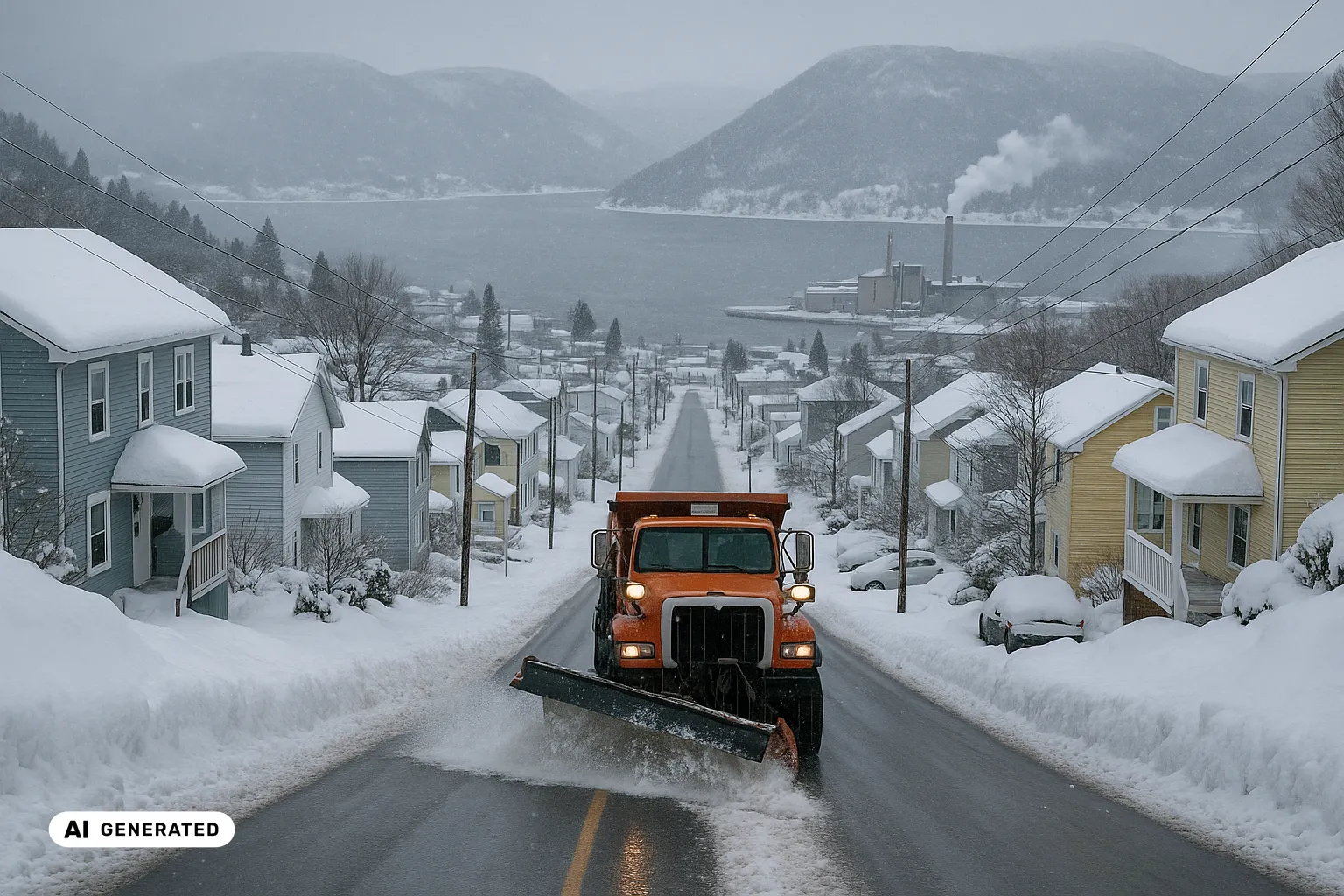
How Corner Brook sits, and what winter does here
Corner Brook is the second-largest city in Newfoundland and Labrador, on the island’s west coast, where the Humber River meets the Humber Arm of the Bay of Islands. It is a steep city — climbing from sea level to about 304 m in an amphitheatre of hills around the bay — and that combination of deep snow and steep ground is the whole character of its winter.
The snow totals are near the top of the national scale. An average year brings about 408 cm of snow on roughly 92 days of snowfall, with December and January alone delivering nearly 200 cm, while January averages −6.2 °C and February −6.6 °C (Environment and Climate Change Canada 1991–2020 normals). The cause is sea-effect snow: cold air crossing the open Gulf of St. Lawrence picks up moisture and unloads it over the west coast. It makes Corner Brook markedly snowier than St. John’s, and the surrounding hills get more still — Marble Mountain, 7 km east, averages 5 m a year. This is a city that sits inside a snow belt.
What the local rules say
In Corner Brook the City clears both the streets and the sidewalks. According to its snow-clearing information, crews plough primary streets first, secondary next and side streets last, working seven routes — Townsite, O’Connell Drive, the Country Road area, Humbermouth, the Sunnyslope area, the Elizabeth Street area and Curling — at roughly 12 hours per route in normal conditions. A sidewalk blower clears around schools first, then the business districts. No by-law could be found that requires residents to clear the public sidewalk, so what falls to an owner is mainly the driveway.
Two rules shape what you do with snow. The City reminds residents that pushing snow into a street or roadway, and piling it around fire hydrants, breaks city by-laws and regulations, and it asks people not to park on city streets during daytime clearing, since a parked car leaves a strip of snow in the right-of-way. On top of that sits the overnight parking ban: from 1 December to 1 May, no parking on the street between midnight and 8 a.m. so crews can clear and de-ice, with vehicles left out — including ones sticking out of a driveway — liable to be ticketed and towed. The ban rests on the City’s Traffic Regulations, where an offence is referred to section 438 of the City of Corner Brook Act; the regulations set no fixed fine, so in practice the rule is simply to keep cars off the street overnight through the winter.
On the ground: where it gets tricky
Two things define winter service in Corner Brook specifically. The first is volume — over four metres of snow in a long season that runs with the December-to-May parking ban, enough that the work is constant rather than occasional. The second is the terrain: because the residential streets climb steeply from the Humber Arm, the snow cannot simply be pushed to the verge — much of it has to be hauled away downhill, slower and heavier work that is the real reason the priority-order, seven-route system matters here. Together they make this a city where clearing is less about reacting to the odd storm than about moving an enormous amount of snow off a hillside, week after week.
For anyone clearing through a season this heavy, a dated record of when and where each surface was cleared or treated — and under what weather — is far easier to stand behind later than memory, especially across months of repeated, large-volume snow.
Around Corner Brook
The City’s routes, sidewalk clearing and parking ban apply within Corner Brook — the surrounding communities of the Bay of Islands and Humber valley run their own. Steady Brook, at the foot of Marble Mountain to the east, Massey Drive in the hills above the city, and Mount Moriah to the west are separate municipalities with their own councils and rules; Steady Brook, in fact, announces its own overnight parking ban alongside Corner Brook’s, a reminder that neighbouring towns run similar but separate regimes. Across the province, the contrast is the sharpest in Newfoundland: on the far Avalon coast, St. John’s faces the wind, fog and storms of the open North Atlantic, while Corner Brook, sheltered in its valley, simply faces snow — a great deal of it, uphill.
Local facts
- Corner Brook is the second-largest city in Newfoundland and Labrador, on the island's west coast where the Humber River meets the Humber Arm of the Bay of Islands. It climbs steeply from sea level to about 304 m in an amphitheatre of hills around the bay, over a land area of 147.88 km², with a population of 19,316 (about 29,762 in the wider area).Source
- Average annual snowfall is about 408 cm on roughly 92 days of snow — December and January alone bring nearly 200 cm — with January averaging −6.2 °C and February −6.6 °C and annual precipitation about 1,293 mm (Environment and Climate Change Canada Climate Normals 1991–2020). That is far snowier than St. John's, the product of 'sea-effect' snow as cold air crosses the open Gulf of St. Lawrence. Use the official normals rather than weather portals, which can understate snowfall.Source
- The scale of the snow belt shows next door: Marble Mountain, about 7 km east at Steady Brook, averages 5 m (16 ft) of snow a year — more than Mont Tremblant's 3.65 m.Source
- According to the City's snow-clearing information, crews plough primary streets first, secondary streets next and side streets last, working seven clearing routes (Townsite, O'Connell Drive, the Country Road area, Humbermouth, the Sunnyslope area, the Elizabeth Street area and Curling) at roughly 12 hours per route in normal conditions, while a sidewalk blower clears around schools first, then business districts.Source
- The City reminds residents that pushing snow into any street or roadway, and piling it around fire hydrants, is in violation of City by-laws and regulations, and asks people not to park on city streets during daytime clearing, which leaves snow in the right-of-way. Private driveways are the owner's responsibility; no by-law requiring residents to clear the public sidewalk could be found.Source
- An overnight on-street parking ban runs from 1 December to 1 May, with no parking between midnight and 8 a.m. so crews can clear and de-ice; vehicles left out can be ticketed and towed. The ban rests on the City of Corner Brook's Traffic Regulations, where an offence is referred to section 438 of the City of Corner Brook Act — the regulations set no fixed fine amount.Source
- The terrain is the second half of the job: residential streets climb steeply from the Humber Arm, so over four metres of snow a year has to be hauled away downhill rather than simply pushed to the side — a different problem from clearing a flat city.Source
Official contacts
City of Corner Brook — Snow Clearing
The City's snow-clearing FAQ: the primary–secondary–side street order and seven routes, the sidewalk blower, the rules on snow in the right-of-way and around hydrants, and daytime parking.
City of Corner Brook — Traffic Regulations (PDF)
Section 9 (overnight parking) and section 13 (offence and penalty, referring to section 438 of the City of Corner Brook Act).
City of Corner Brook — Winter Parking Ban
The City's notice of the 1 December–1 May overnight ban, the midnight–8 a.m. window, and ticketing and towing.
Common questions about winter service in Corner Brook
- Who clears the streets and sidewalks in Corner Brook?
- The City does both. According to its snow-clearing information, crews plough primary streets first, secondary streets next and side streets last, working seven routes across the city at roughly 12 hours per route in normal conditions, while a sidewalk blower clears around schools first and then the business districts. No by-law could be found requiring residents to clear the public sidewalk in front of their property, so the public network is the City's job — what falls to a property owner here is mainly the driveway.
- So what am I responsible for, and where can I put the snow?
- Your own driveway, and not creating a hazard with the snow you move. The City reminds residents that pushing snow into a street or roadway, and piling it around fire hydrants, breaks city by-laws and regulations — both put drivers and residents at risk. It also asks people not to park on city streets during daytime clearing, because a parked car leaves a strip of snow in the right-of-way. The City clears its own hydrants, but if one is near your house you are encouraged to keep it clear.
- What are the overnight parking rules?
- An on-street parking ban runs from 1 December to 1 May, with no parking between midnight and 8 a.m. so crews can clear and de-ice, on downtown and residential streets alike. A vehicle left out — including one sticking out of a driveway or parked on a sidewalk — can be ticketed and towed. The ban sits under the City's Traffic Regulations; an offence is referred to section 438 of the City of Corner Brook Act, and the regulations themselves do not set a fixed fine, so the practical message is simply to keep cars off the street overnight through the winter.
- Why does Corner Brook get so much snow?
- Sea-effect snow. Cold arctic air sweeps from the west and north-west across the open water of the Gulf of St. Lawrence, picks up moisture, and dumps it as snow over the west coast. The result is about 408 cm a year on some 92 days of snow — with December and January alone bringing nearly two metres — well above St. John's. The nearby hills get even more: Marble Mountain, 7 km east, averages 5 m a year. This is a city built inside a snow belt.
- What makes clearing hard here beyond the sheer amount?
- The hills. Corner Brook rises steeply from the Humber Arm to about 304 m, an amphitheatre of residential streets climbing away from the bay. With more than four metres of snow in a season, the snow on those streets has to be hauled away downhill rather than just pushed to the verge, which is slower and heavier work than clearing a flat town — and it is why the seven-route, priority-order system matters so much here.
- How is Corner Brook different from St. John's?
- Same province, opposite winter. Corner Brook is the smaller west-coast city, tucked into the sheltered Bay of Islands and Humber valley with mountains around it, where the story is the sheer volume of sea-effect snow on steep ground. St. John's is the larger Avalon capital, open to the North Atlantic, where the defining feature is wind, fog and dramatic storms — the 2020 'Snowmageddon' dropped about 76 cm in a single day. One city shovels metres of snow uphill all winter; the other manages storms and glaze on the coast.
Documenting winter service in Corner Brook
Anyone clearing snow and ice in Corner Brook may later need to show when and where a route was treated. Wintertrace is open-source software that records exactly that — time, location and weather for each run — as a calm basis for your own operational records and service proof. It is not a substitute for legal advice.
This overview is for general information and is not legal advice. Local rules on snow and ice clearing vary — the wording of the local rule and the responsible authority always govern.