Winter service · New Brunswick
Winter service in Fredericton
What winter is really like in Fredericton, NB: a colder, inland river-valley capital with about 241 cm of snow, the City clearing streets within 24 hours and sidewalks within 48, an overnight parking ban that runs 1 Oct–31 May whether it snows or not, and the snowpack that feeds the spring freshet.
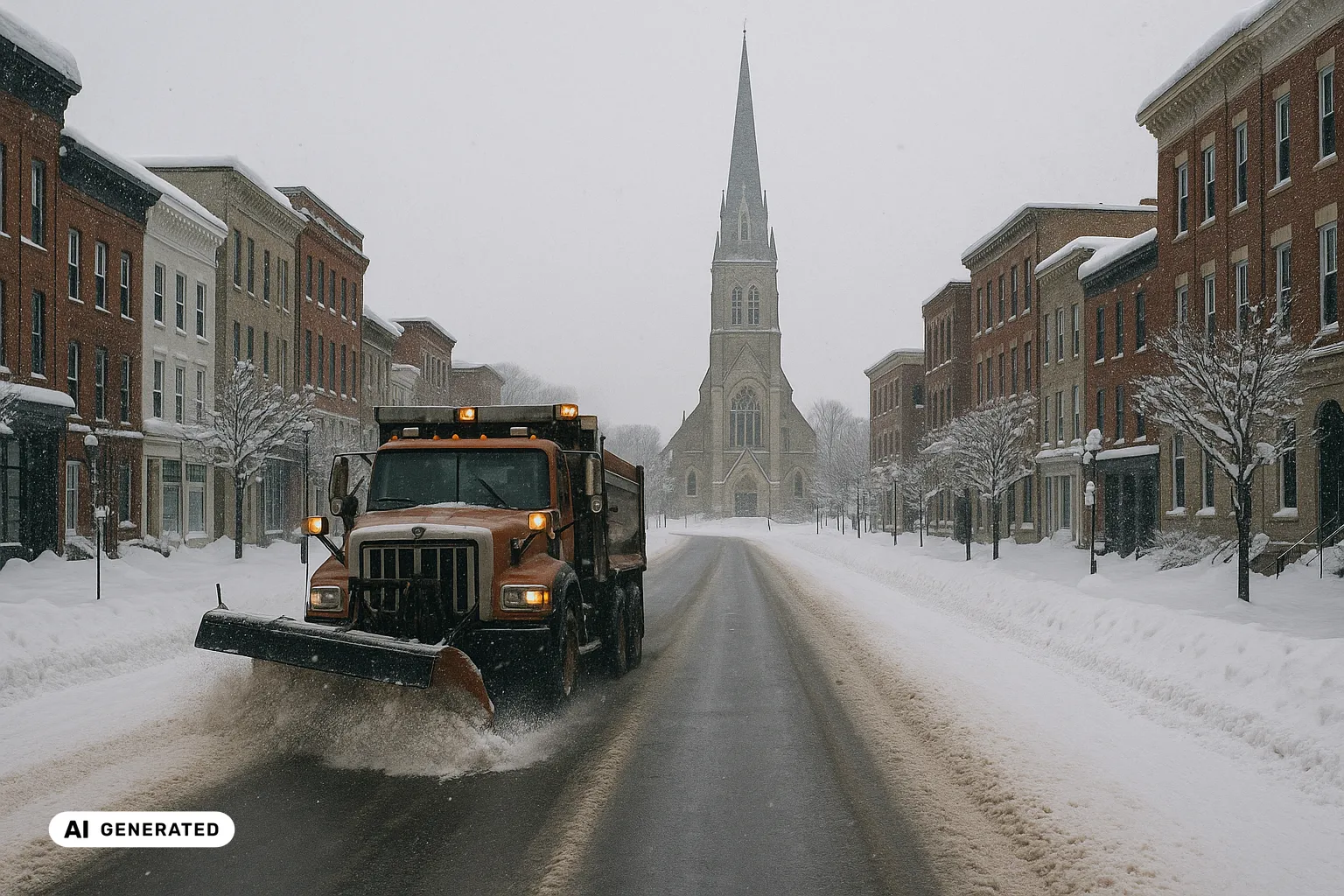
How Fredericton sits, and what winter does here
Fredericton is the capital of New Brunswick, set on the Saint John River — known by its Indigenous name Wolastoq — about 100 km inland from the Bay of Fundy. It is a river-valley city, rising from about 20 m at the water to 100 m on the banks, and a government and university town: the provincial Legislature and two universities (UNB and St. Thomas) fill the downtown and campuses with traffic that has to stay clear through a long winter. Being inland is the whole story of that winter — Fredericton is colder and more continental than the New Brunswick coast.
An average year brings about 241 cm of snow on roughly 46 snowfall days, with about 1,022 mm of precipitation (Environment and Climate Change Canada 1991–2020 normals, Fredericton Airport). That is less than Moncton’s 310 cm — Fredericton is not the province’s snowiest city — but it is colder: January averages about −9.2 °C (high −3.8 °C, low −14.6 °C) and February about −8.1 °C, both below freezing day and night, and colder than Moncton or the milder, foggier Fundy coast. The defining trait here is a long, frost-stable season: the cold holds the snowpack in place, with far less of the coast’s freezing rain and fog. That same deep snowpack also ties winter to spring — in the record 2018 freshet the river at Fredericton reached 8.12 m, well above the 6.5 m flood stage, as a heavy late-season snowpack melted fast.
What the local rules say
Fredericton is one of the Canadian cities that clears both the streets and the public sidewalks itself. According to the City, crews plough all streets within 24 hours of a storm ending, on three priority levels — Priority 1 arterials and major collectors (named routes include Regent Street, the Westmorland Street Bridge and Union Street), Priority 2 minor collectors and local bus, school and hospital zones, and Priority 3 everything else. The sidewalks are the City’s job too: all ploughed within 48 hours, on four priority levels, with downtown, main routes and school zones first. So what falls to a property owner is mainly the driveway.
Two things still sit with owners. Snow from a driveway or lot must not be pushed onto the street or sidewalk — the City calls that a hazard for drivers and pedestrians — and once banks build up the City runs an overnight snow haul, trucking snow off to its storage facility off Wallace Avenue, so there is no windrow to fight back into the road.
The rule most likely to catch a driver out is the overnight parking ban. Under the City’s By-Law No. T-1, it runs from 1 October to 31 May, prohibiting on-street parking between midnight and 7 a.m. — and, unusually, it is in effect whether there is snow or not, so there is no same-day notice to watch for; the rule simply runs all winter. A breach carries a $50 fine, and a vehicle can be towed at the owner’s expense.
On the ground: where it gets tricky
A few things shape winter service in Fredericton specifically. The cold is the first — a continental valley where the core months stay well below freezing keeps a stable, long-lived snowpack, so the season is less about thaw-freeze glaze than about steady clearing over months. The river crossings and valley grades are the early ice points: named Priority 1 corridors like the Westmorland Street Bridge and Regent Street span the water or climb from the valley floor, and bridges frost before the streets around them. And the snowpack-to-freshet link gives the season a tail the coast does not have — how much snow lies in the basin, and how fast it melts, shapes the spring flood.
Across a long inland season like this, a dated record of when and where each surface was cleared or treated — and under what weather — is far easier to stand behind later than memory, whether you manage a campus lot or clear for others from October right through to the May thaw.
Around Fredericton
The City’s 24-hour, 48-hour and overnight-ban rules apply within Fredericton — the surrounding communities run their own. Oromocto, a town about 20 km south-east at the mouth of the Oromocto River and home to CFB Gagetown, has its own winter parking and snow-deposit rules; New Maryland, a village of about 4,153 just south, and Hanwell to the west are separate local governments again. So anyone clearing across the wider Fredericton area is better off checking each community than assuming the capital’s rules carry over. Across the province, the contrast is sharp: coastal Saint John is milder, foggier and hillier on the Bay of Fundy, and Moncton sits under far heavier snow — three New Brunswick cities, three distinct winters.
Local facts
- Fredericton is the capital of New Brunswick, set on the Saint John River — known by its Indigenous name Wolastoq — about 100 km inland from the Bay of Fundy coast. The city covers 133.93 km² in a river valley that rises from about 20 m at the water to 100 m on the banks.Source
- The city's population was 63,116 at the 2021 census (Fredericton CMA 108,610). It is a government and university town — home to the provincial Legislature and to two universities, the University of New Brunswick and St. Thomas University — which fills the downtown and campuses with traffic that has to be kept clear in winter.Source
- Average annual snowfall is about 241 cm (95 in) on roughly 46 days of snowfall, with annual precipitation about 1,022 mm (Environment and Climate Change Canada Climate Normals 1991–2020, station Fredericton Airport). That is less snow than coastal-continental Moncton's 310 cm, but Fredericton is colder — its defining trait is a long, frost-stable season, not the biggest totals. Use the official normals rather than weather portals, which can understate snowfall.Source
- January averages about −9.2 °C (high −3.8 °C, low −14.6 °C) and February about −8.1 °C, both well below the freezing point day and night and colder than Moncton (January about −8.4 °C) or the milder, foggier Fundy coast — the mark of an inland, continental valley location.Source
- According to the City of Fredericton, City crews plough all streets within 24 hours of the end of a storm, on three priority levels: Priority 1 arterials and major collectors (such as Regent Street, the Westmorland Street Bridge and Union Street), Priority 2 minor collectors and local bus, school and hospital zones, and Priority 3 all remaining streets.Source
- The City also clears the public sidewalks itself — all sidewalks ploughed within 48 hours of a storm, on four priority levels (downtown, main routes and school zones first). It asks residents not to push snow from a driveway or lot onto the street or sidewalk, which it calls a hazard for drivers and pedestrians, and runs an overnight snow haul to its snow storage facility off Wallace Avenue once banks build up.Source
- Under the City's By-Law No. T-1, an overnight parking ban runs from 1 October to 31 May, prohibiting parking on streets between 12:00 a.m. and 7:00 a.m. — and it is in effect whether there is snow or not. A breach carries a $50 fine, and vehicles can be towed at the owner's expense.Source
- The valley's winter snowpack is tied to its spring flood risk: in the record 2018 freshet the Saint John River at Fredericton reached 8.12 m, well above the 6.5 m flood stage, driven by the rapid melt of a heavy late-season snowpack — a winter-into-spring concern the coastal cities do not share.Source
Official contacts
City of Fredericton — Snow Removal
The City's winter programme: streets within 24 hours and sidewalks within 48, the road and sidewalk priority levels, the overnight snow haul, and the rule against pushing snow onto streets or sidewalks.
City of Fredericton — Overnight Parking
The 1 October–31 May overnight ban: the midnight–7 a.m. window that applies whether it snows or not, By-Law No. T-1, the $50 fine and towing at the owner's expense.
City of Fredericton — By-Laws / Law Index
The City's by-laws, including By-Law No. T-1 (the traffic by-law behind the overnight parking ban).
Common questions about winter service in Fredericton
- Who clears the streets and sidewalks in Fredericton?
- The City does both. According to the City of Fredericton, crews plough all streets within 24 hours of a storm ending — Priority 1 arterials and major collectors first, then minor collectors and bus, school and hospital zones, then everything else — and clear all public sidewalks within 48 hours on four priority levels, with downtown, main routes and school zones taken first. So unlike many places where the owner must clear the public walk in front of their property, in Fredericton the sidewalk network is the City's job, and what falls to you is mainly the driveway.
- So what am I responsible for as a property owner?
- Your driveway and private walkways, and where you put the snow. The City asks residents not to push snow from a driveway or parking lot onto the street or sidewalk — it calls that a hazard for drivers and pedestrians, and it also undoes the plough's work. Once snow banks build up the City runs an overnight haul, trucking snow off to its storage facility off Wallace Avenue, so there is no need to fight a windrow back into the road.
- What are the overnight parking rules?
- Strict and calendar-based. Under By-Law No. T-1 an overnight parking ban runs from 1 October to 31 May, and on-street parking is not allowed between midnight and 7 a.m. — and, importantly, it applies whether there is snow or not, so you cannot wait to see a storm. A breach carries a $50 fine and the vehicle can be towed at the owner's expense. This is a different model from event-based bans elsewhere, where you have to watch for a same-day notice; in Fredericton the overnight rule simply runs all winter.
- How is Fredericton's winter different from the New Brunswick coast?
- It is colder and more continental. Fredericton sits about 100 km inland in the Saint John River valley, so January averages about −9.2 °C — colder than Moncton and well below the milder, foggier Fundy coast at Saint John. It gets about 241 cm of snow, less than Moncton's 310 cm, but the cold holds the snowpack longer and there is less of the coast's freezing-rain and fog. The theme here is a long, frost-stable season rather than the heaviest totals or constant thaw-freeze glaze.
- Why does winter snow matter for spring flooding here?
- Because of the valley. The Saint John River basin is a known flood area, and a heavy, late-melting winter snowpack is what drives the spring freshet. In the record 2018 event the river at Fredericton reached 8.12 m, well over the 6.5 m flood stage, as a deep snowpack melted fast. It is a winter-into-spring link that the tidal and coastal New Brunswick cities do not have, and it is why the season's snow total is watched beyond just the clearing season.
- Which spots tend to ice up first?
- The bridge and the valley grades. Named Priority 1 corridors like the Westmorland Street Bridge and Regent Street either span the river or climb from the valley floor, and bridges lose heat from above and below, so they frost and glaze before the streets around them. In a cold inland valley, the river crossings and the rising bank streets are the ones to watch.
Documenting winter service in Fredericton
Anyone clearing snow and ice in Fredericton may later need to show when and where a route was treated. Wintertrace is open-source software that records exactly that — time, location and weather for each run — as a calm basis for your own operational records and service proof. It is not a substitute for legal advice.
This overview is for general information and is not legal advice. Local rules on snow and ice clearing vary — the wording of the local rule and the responsible authority always govern.