Winter service · New Brunswick
Winter service in Moncton
What winter is really like in Moncton, NB: about 310 cm of snow a year, January lows near −13 °C, the City's own sidewalk clearing in three priority zones, the 1 Dec–15 Apr parking restrictions, and a thaw-freeze tidal valley.
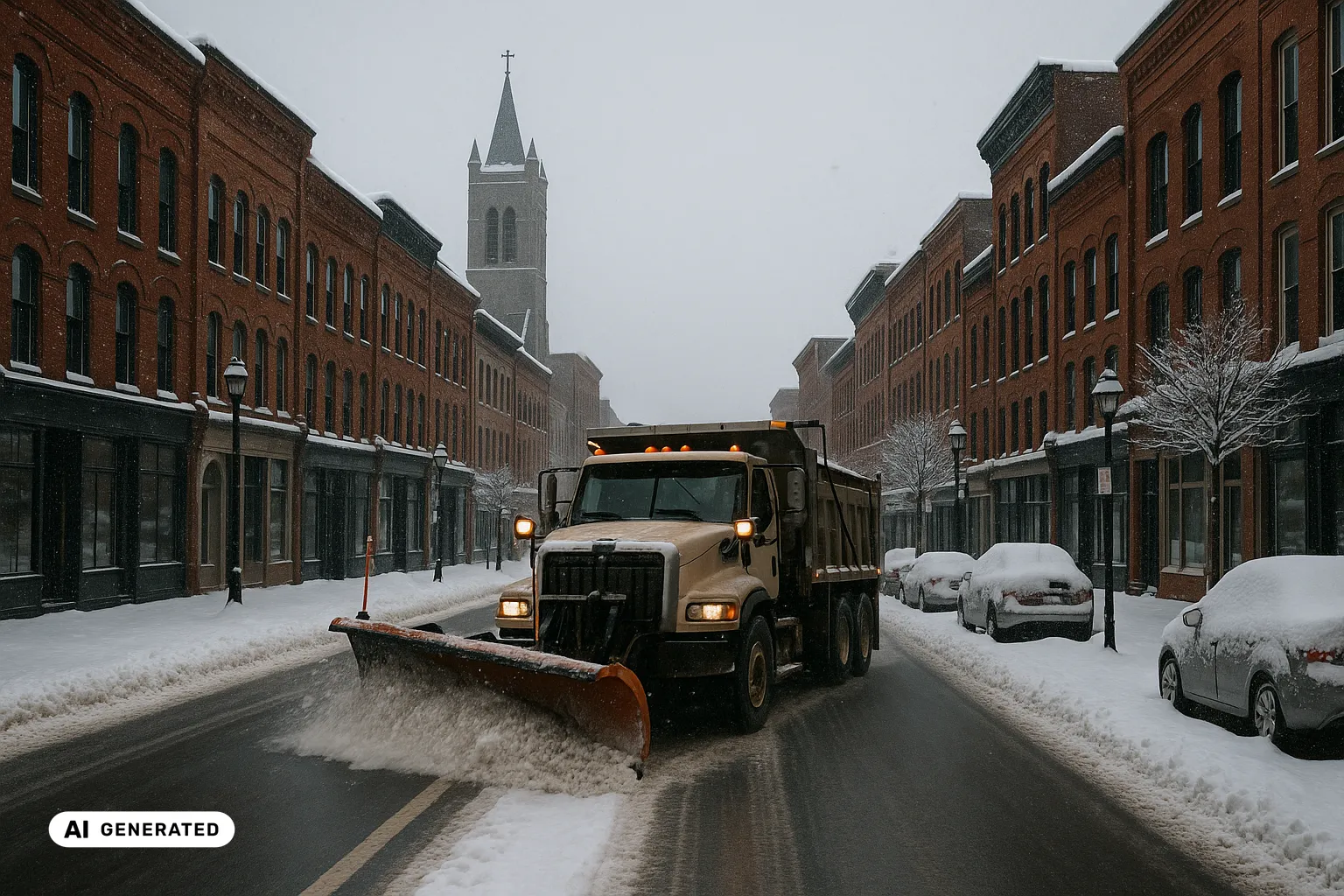
How Moncton sits, and what winter does here
Moncton stands in southeastern New Brunswick, at the geographic centre of the Maritime Provinces, on the Petitcodiac River where it bends sharply from a west–east to a north–south course. The land is low — from sea level at the river up to about 70 m — a gently rolling valley. And that valley is the key to its winter, because the Petitcodiac drains into Shepody Bay at the northern end of the Bay of Fundy, home to the highest tides in the world. A tidal bore runs upriver twice a day, and the water can rise about 7.5 m within an hour. It is a damp, saline, low-lying setting that swings between thaw and frost.
An average year brings about 310 cm of snow, measured against Environment and Climate Change Canada’s 1991–2020 normals (Greater Moncton Roméo LeBlanc International Airport) rather than the lower figures some weather portals quote — exceptionally high for a mid-size city, around three metres. The cold matches it: January averages a high of −3.5 °C and a low of −13.3 °C, February a high of −2.5 °C and a low of −12.7 °C, so the core months stay below freezing day and night. But the snow total is only half the story. Annual precipitation runs to about 1,203 mm, much of it rain or wet snow, so on top of the volume there is a hard thaw-and-freeze ice theme — continental frost meeting Atlantic damp.
What the local rules say
The thing that sets Moncton apart from much of Canada is that the City clears the sidewalks. According to the City of Moncton, it runs a Sidewalk Snow Clearing Plan — adopted each year by City Council — working three priority zones, with school and hospital zones first. Some routes are cleared on both sides, others on one side only. So unlike places where the owner must clear the public walk in front of their property, here the sidewalk network is the City’s job, and what falls to a property owner is mainly the driveway.
That still leaves two things to owners. When the plough passes it leaves a windrow across a driveway end, and clearing that is the owner’s — the City suggests waiting until the crew has finished so you only do it once. And snow must not be deposited onto the sidewalk or street: the City says that endangers the public and its operators and is contrary to its Use of Streets By-Law (By-Law T-410). Roads themselves are cleared by priority — Priority 1 covers 526 lane-km of main and secondary routes, cleared after 5 cm has fallen, and Priority 2 covers 586 lane-km of quieter streets, where contract crews start after 5–8 cm.
The rule most likely to catch a driver out is the winter parking restriction, in place from 1 December to 15 April. Overnight parking is generally fine — except when clearing or de-icing is expected or under way, and then on-street parking is not permitted from midnight to 7 a.m. It is not every night: the City issues notice by 4 p.m., and it is on residents to check. A vehicle left on the street during a restriction risks being ticketed and towed.
On the ground: where it gets tricky
A few things shape winter service in Moncton specifically. The sheer volume — about three metres of snow over a long season — drives a two-priority road programme and a three-zone sidewalk plan, with school and hospital zones taken first. The thaw-and-freeze cycle is its own job: in a tidal valley that swings across freezing, staying ahead of freezing wet surfaces matters as much as moving the snow. And the riverfront and bridges — the Gunningsville crossing to Riverview among them — frost and ice before the streets around them.
Across a winter this heavy and this changeable, a dated record of when and where each surface was cleared or treated — and under what weather — is far easier to stand behind later than memory, whether you manage a commercial lot or clear for others through repeated thaw and freeze.
Around Moncton
Moncton forms a “tri-community” with Dieppe to the east and Riverview across the Petitcodiac to the south, all three linked by bridges. But each runs its own clearing and its own rules. Moncton’s Sidewalk Snow Clearing Plan, its road priorities and its winter parking restrictions apply within the city, so anyone clearing snow across Greater Moncton is better off checking each municipality’s rules than assuming the Hub City’s carry across the river. Further afield, the same Fundy-shaped, thaw-and-freeze winter is felt in places like Truro over in Nova Scotia, though each town handles its sidewalks differently.
Local facts
- Moncton sits in southeastern New Brunswick, at the geographic centre of the Maritime Provinces, on the Petitcodiac River where it bends sharply from west–east to north–south. The land is low, from sea level at the river to about 70 m, in a gently rolling valley.Source
- Average annual snowfall is about 310 cm (122 in), per Environment and Climate Change Canada Climate Normals 1991–2020 (station Greater Moncton Roméo LeBlanc International Airport) — exceptionally high for a mid-size city. Use the official normals rather than weather portals, which can understate snowfall.Source
- January averages a high of about −3.5 °C and a low of −13.3 °C, February a high of −2.5 °C and a low of −12.7 °C, so the core months stay below freezing day and night. Annual precipitation is about 1,203 mm — much of it rain or wet snow, which feeds a thaw-and-freeze ice theme on top of the snow.Source
- The Petitcodiac drains into Shepody Bay at the northern end of the Bay of Fundy, home to the world's highest tides. A tidal bore runs upriver twice a day and the water level can rise about 7.5 m within an hour — a low, damp, saline valley that swings between thaw and frost.Source
- According to the City of Moncton, the City clears the public sidewalks itself, under a Sidewalk Snow Clearing Plan adopted annually by City Council, with three priority zones; school and hospital zones get first priority, and some routes are cleared on both sides while others on one side only.Source
- Roads are cleared by priority: Priority 1 streets cover 526 lane-km of main and secondary routes and are cleared after 5 cm of snow has fallen; Priority 2 streets cover 586 lane-km (under 5,000 vehicles a day) and contract crews start after 5–8 cm has fallen.Source
- Snow must not be deposited onto a sidewalk or street; the City states this poses risks to the public and to its operators and is contrary to its Use of Streets By-Law (By-Law T-410). Clearing the windrow the plough leaves at a private driveway is the owner's job — the City suggests waiting until the crew has passed.Source
- Winter parking restrictions run from 1 December to 15 April. On-street parking is not permitted from midnight to 7 a.m. when clearing is expected or under way; notice is issued by 4 p.m. and residents must check for it. Vehicles left on the street during a restriction risk being ticketed and towed.Source
Official contacts
City of Moncton — Snow Clearing Operations
The City's winter programme: the Sidewalk Snow Clearing Plan and its three priority zones, the road priorities and 5 cm trigger, and the rule against depositing snow on streets.
City of Moncton — Winter Parking Restrictions
How the 1 December–15 April restrictions work, the midnight–7 a.m. window, the 4 p.m. notice and the risk of ticketing and towing.
The City's by-laws, including the Use of Streets By-Law (T-410) referenced in the snow-clearing rules.
Common questions about winter service in Moncton
- Who clears the sidewalk in Moncton?
- The City does. According to the City of Moncton, it clears the public sidewalks itself under a Sidewalk Snow Clearing Plan that City Council adopts each year, working three priority zones with school and hospital zones first. Some routes are cleared on both sides, others on one side only. So unlike many Canadian cities, where the owner must clear the public walk in front of their property, in Moncton the sidewalk network is the City's responsibility — what is left to you is mainly your own driveway.
- So what am I responsible for as a property owner?
- Your driveway and private walkways, and where you put the snow. When the plough passes it leaves a windrow across the end of a driveway, and clearing that is the owner's job — the City suggests waiting until the crew has finished before you clear the end, so you only do it once. And snow must not be pushed back onto the sidewalk or street: the City says that endangers the public and its operators and is contrary to its Use of Streets By-Law (T-410).
- When does the City plough the streets?
- By priority, once enough has fallen. Priority 1 streets — 526 lane-km of main and secondary routes — are cleared after 5 cm of snow has fallen. Priority 2 streets — 586 lane-km carrying under 5,000 vehicles a day — see contract crews start after 5 to 8 cm. With about 310 cm of snow a year, that is a programme that runs hard through a long season, so quieter residential streets follow the busy routes.
- What are the winter parking rules?
- Winter parking restrictions are in place from 1 December to 15 April. On most city streets overnight parking is fine — except when clearing or de-icing is expected or under way, and then on-street parking is not permitted from midnight to 7 a.m. The City issues notice by 4 p.m., and it is on residents to check, because it is not every night. A vehicle left on the street during a restriction risks being ticketed and towed.
- If Moncton gets so much snow, why is ice still a problem?
- Because of where it sits. Moncton is in a low river valley at the head of the Bay of Fundy tides, so the air is maritime, damp and salty, and the temperature swings across freezing often. Much of the 1,200 mm of annual precipitation falls as rain or wet snow, so on top of the very high snow totals you get freezing wet surfaces and a thaw-and-freeze cycle. Clearing the volume is one job; staying ahead of the ice is another.
- Which spots tend to ice up first?
- The riverfront and the bridges. The Petitcodiac valley is low and damp, and crossings like the Gunningsville Bridge over to Riverview lose heat from above and below, so they frost and ice before the streets around them. In a valley that swings between thaw and frost twice a day with the tide, riverside and low-lying stretches are the ones to watch.
- Are the rules the same in Dieppe and Riverview?
- No. Moncton forms a 'tri-community' with Dieppe to the east and Riverview across the river to the south, and the three are connected by bridges, but each runs its own clearing and its own rules. Moncton's Sidewalk Snow Clearing Plan, its road priorities and its winter parking restrictions apply within the city, so anyone working across Greater Moncton should check each municipality rather than assume Moncton's apply.
Documenting winter service in Moncton
Anyone clearing snow and ice in Moncton may later need to show when and where a route was treated. Wintertrace is open-source software that records exactly that — time, location and weather for each run — as a calm basis for your own operational records and service proof. It is not a substitute for legal advice.
This overview is for general information and is not legal advice. Local rules on snow and ice clearing vary — the wording of the local rule and the responsible authority always govern.