Winter service · Nova Scotia
Winter service in Truro
What winter is really like in Truro, Nova Scotia: a snowy season that runs from early November to the end of April, a town built on the Salmon River floodplain where the Bay of Fundy tide turns, and a sidewalk by-law whose clearing duty falls only on non-residential properties in the Urban Regional Core — plus the overnight winter parking ban and what happens if a property goes uncleared.
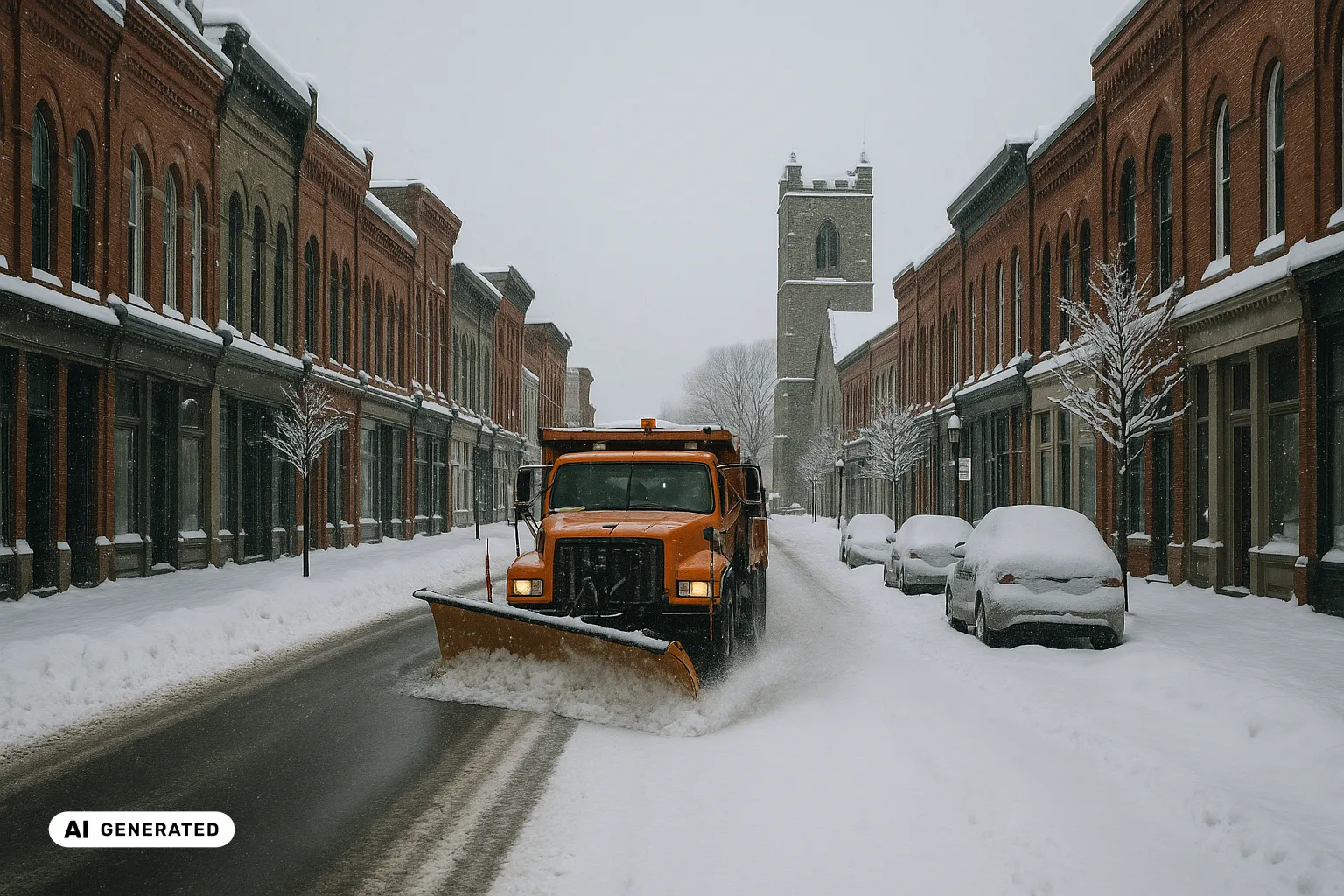
How Truro sits, and what winter does here
Truro is the shire town of Colchester County — its administrative seat — set in central Nova Scotia on the south side of the Salmon River floodplain, near where the river reaches the eastern end of Cobequid Bay. The ground is low, only about 19 metres above sea level, and that low, valley-bottom setting matters more than its modest elevation suggests. Cobequid Bay is the eastern end of the Bay of Fundy, home to the highest tides in the world, and a tidal bore runs twice a day up the lower Salmon River to the head of the tide right at Truro. This is a town built where fresh water, salt water and frost all meet.
The town’s nickname tells the rest: the “Hub of Nova Scotia.” Highway 102 and Highway 104 — the Trans-Canada, both four-lane expressways — cross at Onslow just to the north, so a great deal of the province’s winter traffic passes within sight of Truro. A storm here is not only a local clearing job; it lands on a regional crossroads.
The climate reads accordingly. By Environment and Climate Change Canada’s 1981–2010 normals, Truro averages about 215 cm of snow a year — more, in fact, than coastal Halifax — falling mainly from December through March, with January the snowiest month at roughly 55 cm and meaningful snow running from November into April. January itself sits near −1 °C by day and −12 °C at night. The more telling part is the setting: damp, maritime air over a tidal floodplain means Truro spends a lot of the winter hovering around the freezing line rather than locked into a deep, dry cold — and that is exactly the condition that turns wet pavement into glaze.
What the local rules say
Truro’s sidewalk rule has a twist worth understanding before anything else. Under the Town of Truro’s Sidewalk Bylaw (B180-006, approved 3 December 2007), the snow- and ice-clearing duties do not fall on every property owner. They apply only to abutters of non-residential properties within the “Urban Regional Core” — broadly, the commercial frontages of the town centre. If you have plowed sidewalks in a city where every adjacent homeowner is on the hook, Truro works differently: the by-law’s clearing obligation is aimed at the commercial core, and the Town itself states it is responsible for street and sidewalk maintenance and snow clearing more broadly, maintaining over 93 km of streets and 73 km of sidewalks through the winter.
Where the by-law does apply, it is specific. The sidewalk has to be cleared within 4 hours after snow stops falling if it ends during daylight and at least four hours before sunset; if the snow ends at another time, the clock becomes within 4 hours after sunrise the next day. The cleared path must run the full length of the property to a width of the lesser of 1 metre or the full sidewalk, and it must be sanded or salted for traction. One detail catches people out: that traction duty applies whether or not the Town has already plowed, sanded or salted the sidewalk — the abutter’s obligation is independent of the municipal pass.
The enforcement side is built on cost recovery rather than a fixed fine. If a covered abutter does not clear, the Engineer can order it done within 24 hours or sooner. If it still is not done, the Town can clear it itself, recover the cost with interest, and register that cost as a first lien against the property — a charge that rides with the land. The by-law names no set dollar penalty; the consequence is the recovered cost and the lien. And the Town inspects only on complaint about a specific location, not by patrol. For residents outside the Core, the standing ask is simpler: clear your own driveway and paths, and do not deposit that snow or ice back onto the street or sidewalk.
On the ground: where it gets tricky
The setting does most of the catching-out. Sitting low on a tidal floodplain at the head of the Cobequid Bay tide, Truro gets damp, maritime air and a winter that swings repeatedly across freezing. The recurring problem is less one big snowfall than the thaw-then-freeze glaze: a surface that was merely wet in the afternoon can be iced over by morning with no new snow at all. Sand and salt, and the timing of when to apply them, matter as much here as the plow.
Then there is the traffic. With Highway 102 and 104 meeting at Onslow just north, Truro carries a lot of through-traffic in winter — provincial routes and town streets feeding the same crossroads. The boundary between what the province maintains on the highways and what the Town maintains on its streets and sidewalks is the kind of line worth knowing before a storm rather than during one.
When conditions can turn between one pass and the next — wet to glazed, plowed to re-iced — a clear, time-stamped record of where and when each route was treated, alongside what the weather was doing, is worth more than memory. That is true for the contractor clearing a Core frontage on the 4-hour clock and for anyone tracking a glaze that came back overnight.
The overnight winter parking ban
The part most likely to put a resident in the way of the crews is parking. Truro’s overnight winter parking ban runs annually from 15 December to 1 April, and during that window parking on Town streets is prohibited between 1 a.m. and 7 a.m. so vehicles do not obstruct snow and ice clearing. The exceptions are deliberately narrow — physicians and surgeons, police and peace officers, and commercial vehicles actively loading or unloading. Unlike some cities’ bans, this one is written as a flat overnight prohibition across the season rather than something declared storm-by-storm, so the safe habit through the winter months is simply to keep Town streets clear in those early-morning hours.
One town among county neighbours
Truro is a town in its own right, not part of a larger amalgamated municipality, and its immediate neighbours sit within Colchester County: the village of Bible Hill just northeast across the Salmon River, Onslow by the Highway 102/104 interchange to the north, and the communities of Valley, Salmon River and Lower Truro nearby. That matters for anyone working across the area, because the Town of Truro’s by-laws and the Town’s clearing responsibility apply within Truro’s own boundaries. A property just over the municipal line follows whoever maintains the roads there — not Truro’s Sidewalk Bylaw — so confirming whose system applies near a boundary is wiser than assuming Truro’s standards travel.
Keeping the record straight
None of this is about proving a point in court — it is about being able to show, plainly, what was done. In a place that spends much of the winter near freezing, where a treated surface can glaze again overnight and a sidewalk in the Core runs on a 4-hour clock, operational records that can support service proof are worth keeping. A simple, time-stamped log of where a crew went, when, and in what conditions is exactly the kind of documentation support Wintertrace is built to make easy — whether you clear one commercial frontage or a route across the hub of Nova Scotia. It does not change the by-law or anyone’s obligations; it just means that when someone asks what happened during the last storm, the answer is on file. Not a substitute for legal advice.
Local facts
- Truro is the shire town — the seat — of Colchester County in central Nova Scotia, built on the south side of the Salmon River floodplain near the river's mouth, at the eastern end of Cobequid Bay, on low ground only about 19 metres above sea level.Source
- It is known as the 'Hub of Nova Scotia': Highway 102 and Highway 104 (the Trans-Canada) — both four-lane expressways — meet at Onslow just north of town, making Truro a regional crossroads with heavy through-traffic in winter.Source
- Cobequid Bay is the eastern end of the Bay of Fundy, home to the world's highest tides, and a tidal bore runs twice daily up the lower Salmon River to the head of the tide at Truro — a town shaped by the meeting of fresh water, salt water and frost.Source
- Truro averages about 215 cm of snow a year — more, in fact, than coastal Halifax — according to Environment and Climate Change Canada's 1981–2010 normals. It falls mainly from December through March, with January the snowiest month at roughly 55 cm.Source
- Winters are cold but maritime: by the 1981–2010 normals January averages about −1 °C by day and −12 °C at night, and meaningful snow runs from November into April rather than settling into a single deep-freeze.Source
- Under the Town of Truro's Sidewalk Bylaw (B180-006, approved 3 December 2007), the snow- and ice-clearing duties in Sections 4 to 8 apply only to abutters of non-residential properties within the 'Urban Regional Core' — not to every homeowner across town.Source
- Where the by-law applies, the sidewalk must be cleared within 4 hours after snow stops falling (or, if the snow ends overnight, within 4 hours after sunrise the next day), to a width of the lesser of 1 metre or the full sidewalk — and sanded or salted for traction regardless of whether the Town has already plowed or treated it.Source
- If an abutter in the Core does not clear, the Engineer can order it done within 24 hours or sooner; if it still is not done, the Town can clear it, recover the cost with interest, and register that cost as a first lien against the property. The by-law sets no fixed fine — the consequence is the cost recovery and lien.Source
- The Town of Truro states it is responsible for street and sidewalk maintenance and snow clearing, and maintains over 93 km of streets and 73 km of sidewalks; residents are asked to clear their own driveways and paths without depositing the snow or ice onto the street or sidewalk.Source
- An overnight winter parking ban runs annually from 15 December to 1 April, prohibiting parking on Town streets between 1 a.m. and 7 a.m. so vehicles do not obstruct snow and ice clearing, with narrow exceptions for physicians and surgeons, police and peace officers, and commercial vehicles actively loading or unloading.Source
- Truro's immediate neighbours sit within Colchester County: the village of Bible Hill just northeast across the Salmon River, Onslow by the Highway 102/104 interchange to the north, and the communities of Valley, Salmon River and Lower Truro nearby.Source
Official contacts
Town of Truro — Snow Clearing & Winter Parking Ban
The Town's own page on how it clears streets and sidewalks, what residents are asked to do, and the overnight winter parking ban.
Town of Truro — Sidewalk Bylaw B180-006 (PDF)
The full text of the sidewalk by-law: who must clear, the 4-hour deadline, the cleared width, traction, and what follows non-compliance.
The Town's index of by-laws, including the Sidewalk Bylaw and related Engineering & Public Works rules.
Common questions about winter service in Truro
- Do I have to clear the public sidewalk in front of my property in Truro?
- It depends on the property. Under the Town of Truro's Sidewalk Bylaw (B180-006), the sidewalk snow- and ice-clearing duties apply only to abutters of non-residential properties within the 'Urban Regional Core' — broadly, commercial frontages in the town centre. They do not fall on every homeowner across town. The Town itself states it is responsible for street and sidewalk maintenance and snow clearing more generally. What stays with every resident is their own property: the driveway and private paths. This describes the by-law as written; it is not legal advice, and the definitive wording is in the by-law itself.
- Where the by-law applies, how quickly must a sidewalk be cleared?
- Within 4 hours after the snow stops falling, if it ends during daylight and at least 4 hours before sunset. If the snow ends at another time — overnight, for instance — the clock is within 4 hours after sunrise the following day. The cleared path has to run the full length of the property to a width of the lesser of 1 metre or the full sidewalk, and be sanded or salted for traction. Notably, that traction duty applies whether or not the Town has already plowed, sanded or salted.
- Who clears the streets and sidewalks in Truro?
- The Town of Truro. It states that it is responsible for street and sidewalk maintenance and snow clearing, and that it maintains over 93 km of streets and 73 km of sidewalks through the winter. The Sidewalk Bylaw's clearing duty for non-residential abutters in the Urban Regional Core sits on top of that municipal work, not instead of it — the by-law expressly says an abutter's duty to sand or salt applies even where the Town has already treated the sidewalk.
- Can I push my driveway snow onto the street or sidewalk?
- No. The Town asks residents to clear their own driveways and walkways without depositing the snow or ice onto the street or the sidewalk. Beyond the obvious — it undoes the clearing the Town has just done — piling snow back into the right-of-way works against the whole system during an active storm.
- When does the winter parking ban apply in Truro?
- The overnight winter parking ban runs annually from 15 December to 1 April. During that window, parking on Town streets is prohibited between 1 a.m. and 7 a.m. so that vehicles do not obstruct snow and ice clearing. The exceptions are narrow — physicians and surgeons on call, police and peace officers, and commercial vehicles actively loading or unloading. Leave a vehicle on the street overnight in that period and it can be in the way of the crews who need the road clear.
- What happens if a property in the Core is not cleared?
- The by-law uses cost recovery rather than a set fine. If an abutter who is covered does not clear, the Engineer can order it done within 24 hours or sooner. If it still is not done, the Town can clear it, recover the cost with interest, and register that cost as a first lien against the property. The by-law does not name a fixed dollar penalty — the consequence is the recovered cost and the lien. The Town also inspects only on complaint about a specific location, not on patrol.
- Why is Truro's winter weather hard on clearing?
- Truro sits low — about 19 metres above sea level — on the Salmon River floodplain at the head of the Cobequid Bay tide, where the Bay of Fundy turns. That maritime, valley-bottom setting brings damp air and frequent swings across the freezing line, so the recurring problem is as much ice and the thaw-then-freeze glaze as it is fresh snowfall. A surface can be wet in the afternoon and glazed by morning with no new snow at all.
- Does the Bay of Fundy tide actually affect the town in winter?
- Indirectly, but it is part of what makes the setting distinctive. A tidal bore runs twice daily up the lower Salmon River to the head of the tide at Truro — a visible sign of the extreme Fundy tides at the town's doorstep. The practical takeaway for winter is the microclimate that comes with sitting on a tidal floodplain: moist air and a town that hovers around freezing rather than locking into a deep, dry cold.
- Are Bible Hill and the nearby communities under the same rules?
- Not necessarily. Bible Hill, Onslow, Valley, Salmon River and Lower Truro are neighbouring communities in Colchester County, but the Town of Truro's by-laws and the Town's clearing responsibility apply within the Town of Truro's own boundaries. A property just over the municipal line follows whoever maintains the roads there, not Truro's Sidewalk Bylaw. Anyone working across the boundary is wise to confirm whose system applies rather than assume Truro's reaches that far.
Documenting winter service in Truro
Anyone clearing snow and ice in Truro may later need to show when and where a route was treated. Wintertrace is open-source software that records exactly that — time, location and weather for each run — as a calm basis for your own operational records and service proof. It is not a substitute for legal advice.
This overview is for general information and is not legal advice. Local rules on snow and ice clearing vary — the wording of the local rule and the responsible authority always govern.