Winter service · New Brunswick
Winter service in Saint John
What winter is really like in Saint John, NB: about 215 cm of snow but a season ruled by Bay of Fundy fog and freezing rain on a hilly city, the City's Winter Management Plan that maintains about 55% of sidewalks, and overnight parking bans that change by zone.
How Saint John sits, and what winter does here
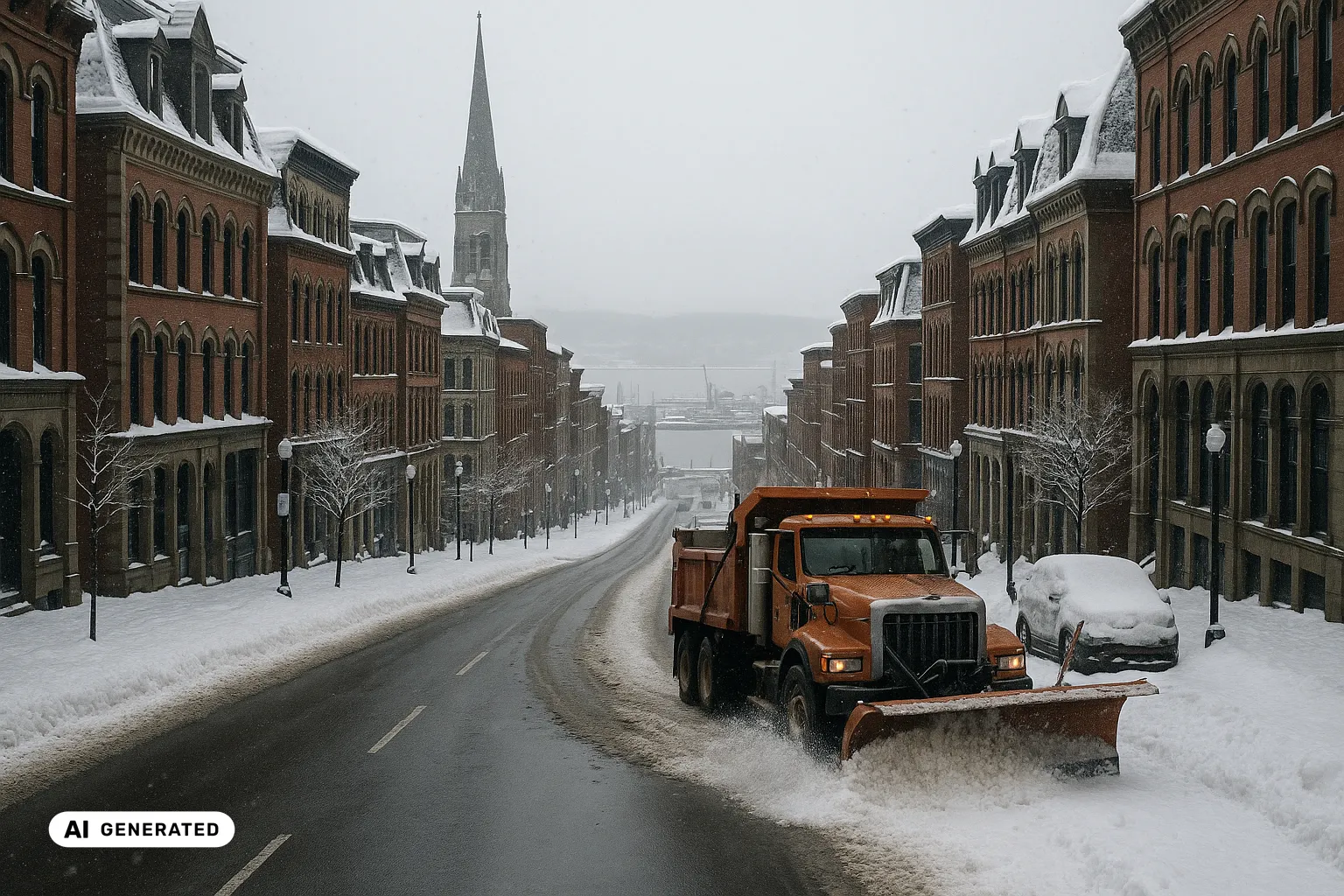
Saint John is a port city on the Bay of Fundy, set where the Saint John River meets the sea at the Reversing Falls — the spot where the bay’s enormous tides actually reverse the river’s flow for several kilometres. It is, unusually for the region, a hilly city: the land is shaped by two coastal mountain ranges running along the Fundy shore, so slopes, crests and waterfront flats sit close together. That topography, more than sheer snow depth, is what shapes winter here.
An average year brings about 215 cm of snow — measured against Environment and Climate Change Canada’s 1991–2020 normals (Saint John Airport), and noticeably less than continental Moncton’s 310 cm. The reason is the bay: the Bay of Fundy never fully freezes, so it moderates the cold, and snow generally grows heavier the further north you travel away from the water. But the season is very wet — about 1,271 mm of precipitation a year — and much of it arrives as rain, wet snow or freezing rain, with fog a frequent visitor. January averages about −7.9 °C (high −2.5 °C, low −13.2 °C) and February about −7.1 °C, on roughly 50 days of snowfall, so the core months stay below freezing while the Fundy air keeps temperatures pivoting around the freezing point. The upshot is a glaze-and-thaw winter: less about moving big volumes, more about staying ahead of ice.
What the local rules say
Saint John runs a Winter Management Plan for streets and sidewalks, and the way it splits the work is its own. According to the City, streets are cleared on a priority system and treated with salt or sand: Priority 1 takes arterials, highway connections and emergency routes; Priority 2 the major bus routes, schools, community centres and business districts; Priority 3 the collectors and industrial parks. For Priority 1 and 2 the City’s targets are passable lanes within 8 hours of a storm and pushed-back lanes plus anti-icing within 48 hours, so the busy network is stabilised before quieter streets are fully widened.
On sidewalks, the City says it maintains about 55% of the city’s sidewalks — some 225 km — on four priority levels: Priority 1 and 2 aimed at basic passability within 12 hours of a storm ending, Priority 3 within a day and Priority 4 within three days. That share is the City’s; the remaining stretches, and every private walk and driveway, fall to owners. The City also asks residents to keep cleared snow off streets and sidewalks and, where they can, to keep nearby catch basins and hydrants clear so meltwater drains in a thaw.
The rule most likely to catch a driver out is the overnight parking ban, declared under sections 5(6) and 5(7) of the City’s Traffic By-law (By-Law MV-10.1) when snow removal is needed. Crucially, the times change by zone: vehicles must be off the street between midnight and 7 a.m. in the North, East and West, but between 11 p.m. and 7 a.m. in the South / Central Peninsula — the dense downtown peninsula clears earlier. Vehicles in the way are ticketed and/or towed at the owner’s expense, and when a ban is on, off-street municipal lots open from 6 p.m. for affected on-street residents. It is not declared every night, so the real task is knowing when a ban is on for your zone.
On the ground: where it gets tricky
A few things define winter service in Saint John specifically. The terrain does most of it: on a hilly city built where two ranges meet the bay, slopes, crests and bridges lose grip first, so salt and sand on grades matter as much as the plough. The Fundy fog and freezing rain are the second theme — damp, near-freezing air turning wet surfaces to glaze, especially on the low, exposed waterfront near the harbour and the Reversing Falls. And the zoned logistics — a street priority system layered over zone-by-zone overnight bans with different clock times — make timing, not just volume, the daily problem.
Across a season that swings between thaw and freeze this often, a dated record of when and where each surface was cleared or treated — and under what weather — is far easier to stand behind later than memory, whether you manage a commercial lot on a Saint John hill or clear for others through repeated glaze events.
Around Saint John
Saint John anchors a wider area, but the rules stop at the city line. The Kennebecasis Valley towns of Quispamsis and Rothesay, north-east of the city, run their own clearing and their own parking rules — Quispamsis, for example, bans on-street parking from midnight to 7 a.m. for snow removal and tows at the owner’s expense — while Grand Bay-Westfield to the west is different again. Saint John’s Winter Management Plan and its zoned bans apply within the city, so anyone clearing across the region is better off checking each municipality than assuming the city’s carry across the line. Further afield, the same province feels winter very differently: inland Fredericton is colder and more continental, and Moncton sits under far heavier snow — three New Brunswick cities, three distinct winters.
Local facts
- Saint John is a port city on the Bay of Fundy at the mouth of the Saint John River — site of the Reversing Falls, where the bay's tides reverse the river's flow for several kilometres. The land is hilly, shaped by two coastal mountain ranges along the Fundy shore.Source
- The Bay of Fundy never fully freezes, so it moderates Saint John's winter temperatures compared with inland places; snow is generally more abundant the further north you go, away from the bay.Source
- Average annual snowfall is about 215 cm (84.6 in) and annual precipitation about 1,271 mm — markedly less snow than continental Moncton's 310 cm, but very wet, so a large share falls as rain, wet snow or freezing rain (Environment and Climate Change Canada Climate Normals 1991–2020, station Saint John Airport). Use the official normals rather than weather portals, which can understate snowfall.Source
- January averages about −7.9 °C (high −2.5 °C, low −13.2 °C) and February about −7.1 °C, with roughly 50.7 days of snowfall a year; the core months stay below freezing, but Fundy air keeps temperatures swinging around the freezing point.Source
- Under the City of Saint John's Winter Management Plan, streets are cleared on a priority system and treated with salt or sand: Priority 1 covers arterials, highway connections and emergency routes; Priority 2 major bus routes, schools, community centres and business districts; Priority 3 collector streets and industrial parks. The targets for Priority 1 and 2 are passable lanes within 8 hours of a storm and pushed-back lanes plus anti-icing within 48 hours.Source
- Under its Winter Management Plan 2025–2026, the City says it maintains about 55% of the city's sidewalks — some 225 km — on four priority levels: Priority 1 and 2 targeted for basic passability within 12 hours of a storm ending, Priority 3 within a day and Priority 4 within three days. It asks residents to keep cleared snow off streets and sidewalks and, where possible, to keep nearby catch basins and hydrants clear to help meltwater drain.Source
- Overnight parking bans are declared under sections 5(6) and 5(7) of the City's Traffic By-law (By-Law MV-10.1) to allow snow removal. When a ban is on, vehicles must be off the street between midnight and 7 a.m. in the North, East and West, and between 11 p.m. and 7 a.m. in the South / Central Peninsula; vehicles obstructing clearing are ticketed and/or towed at the owner's expense.Source
- When a ban is declared, off-street municipal parking lots open from 6 p.m. for affected on-street residents — a detail particular to Saint John's zoned approach, which differs from a single city-wide window.Source
Official contacts
City of Saint John — Snow Removal
The Winter Management Plan: the road priority system and salt/sand treatment, the 8-hour and 48-hour targets, and the City's maintenance of about 55% of sidewalks.
City of Saint John — Parking Bans
How the zoned overnight bans work — the midnight–7 a.m. and 11 p.m.–7 a.m. windows under the Traffic By-law (MV-10.1) sections 5(6) and 5(7), ticketing and towing, and the relief lots.
The City's by-laws, including the Traffic By-law (MV-10.1) whose sections 5(6) and 5(7) authorise the overnight parking bans.
Common questions about winter service in Saint John
- Who clears the sidewalks in Saint John?
- The City clears most of them. Under its Winter Management Plan the City says it maintains about 55% of the city's sidewalks — some 225 km — on four priority levels: Priority 1 and 2 aimed at basic passability within 12 hours of a storm, Priority 3 within a day and Priority 4 within three days. That leaves the rest of the network, plus every private walk and driveway, to property owners. So the honest answer is split: the City carries a little over half of the public sidewalks, but not all of them, and the exact stretch in front of a given property is worth checking rather than assuming.
- So what am I responsible for as a property owner?
- Your driveway and private walkways, the sidewalk stretches the City does not maintain, and where you put the snow. The City asks residents to keep cleared snow off the streets and sidewalks — pushing it back out is a hazard and undoes the plough's work — and, where you can, to keep nearby catch basins and fire hydrants clear so meltwater can drain in a thaw.
- When does the City plough the streets?
- On a priority system, treated with salt or sand. Priority 1 — arterials, highway connections and emergency routes — comes first, then Priority 2 (major bus routes, schools, community centres, business districts), then Priority 3 collectors and industrial parks. For Priority 1 and 2 the City's targets are passable lanes within 8 hours of a storm and pushed-back lanes plus anti-icing within 48 hours, so the busy routes are stabilised before quieter streets are fully widened.
- What are the winter parking rules, and why do the times differ?
- Because Saint John runs its bans by zone, not city-wide. When an overnight ban is declared under sections 5(6) and 5(7) of the Traffic By-law (MV-10.1), vehicles must be off the street between midnight and 7 a.m. in the North, East and West, but between 11 p.m. and 7 a.m. in the South / Central Peninsula — the denser downtown peninsula clears earlier. Vehicles in the way are ticketed and/or towed at the owner's expense, and off-street municipal lots open from 6 p.m. for affected residents. It is not every night, so the catch is knowing when a ban is on for your zone.
- If Saint John gets less snow than Moncton, why is ice such a theme?
- Because of the Bay of Fundy. Saint John gets about 215 cm of snow a year — well under Moncton's 310 cm — but it sits on a bay that never fully freezes, so the air is damp, salty and often near the freezing point. Much of the heavy annual precipitation arrives as rain, wet snow or freezing rain, and fog is common. The result is a glaze-and-thaw season: less about moving big volumes of snow and more about staying ahead of freezing wet surfaces.
- Which spots tend to ice up first?
- The hills, the crests and the waterfront. Saint John's terrain is genuinely hilly — the city sits where two coastal ranges meet the bay — so slopes and high points lose grip first, and low, damp stretches near the harbour and the Reversing Falls swing across freezing as the fog and tide move through. That is why salt and sand on grades, not just ploughing, carries the season here.
- Are the rules the same in Quispamsis and Rothesay?
- No. The Kennebecasis Valley towns of Quispamsis and Rothesay, north-east of the city, run their own clearing and their own rules — Quispamsis, for instance, bans on-street parking from midnight to 7 a.m. for snow removal and tows offenders at the owner's expense. Grand Bay-Westfield to the west is different again. Saint John's Winter Management Plan and its zoned bans apply within the city, so anyone working across the wider area should check each municipality rather than assume the city's apply.
Documenting winter service in Saint John
Anyone clearing snow and ice in Saint John may later need to show when and where a route was treated. Wintertrace is open-source software that records exactly that — time, location and weather for each run — as a calm basis for your own operational records and service proof. It is not a substitute for legal advice.
This overview is for general information and is not legal advice. Local rules on snow and ice clearing vary — the wording of the local rule and the responsible authority always govern.