Winter service · Ontario
Winter service in Niagara Falls
What winter is really like in Niagara Falls, Ontario: about 154 cm of snow a year, lake-moderated and milder than the Buffalo snow belt just across the river, the spray-ice the falls throw off, the City's 8 cm plough threshold and the three tiers that clear the roads, and the new sidewalk by-law coming into effect on 1 October 2026.
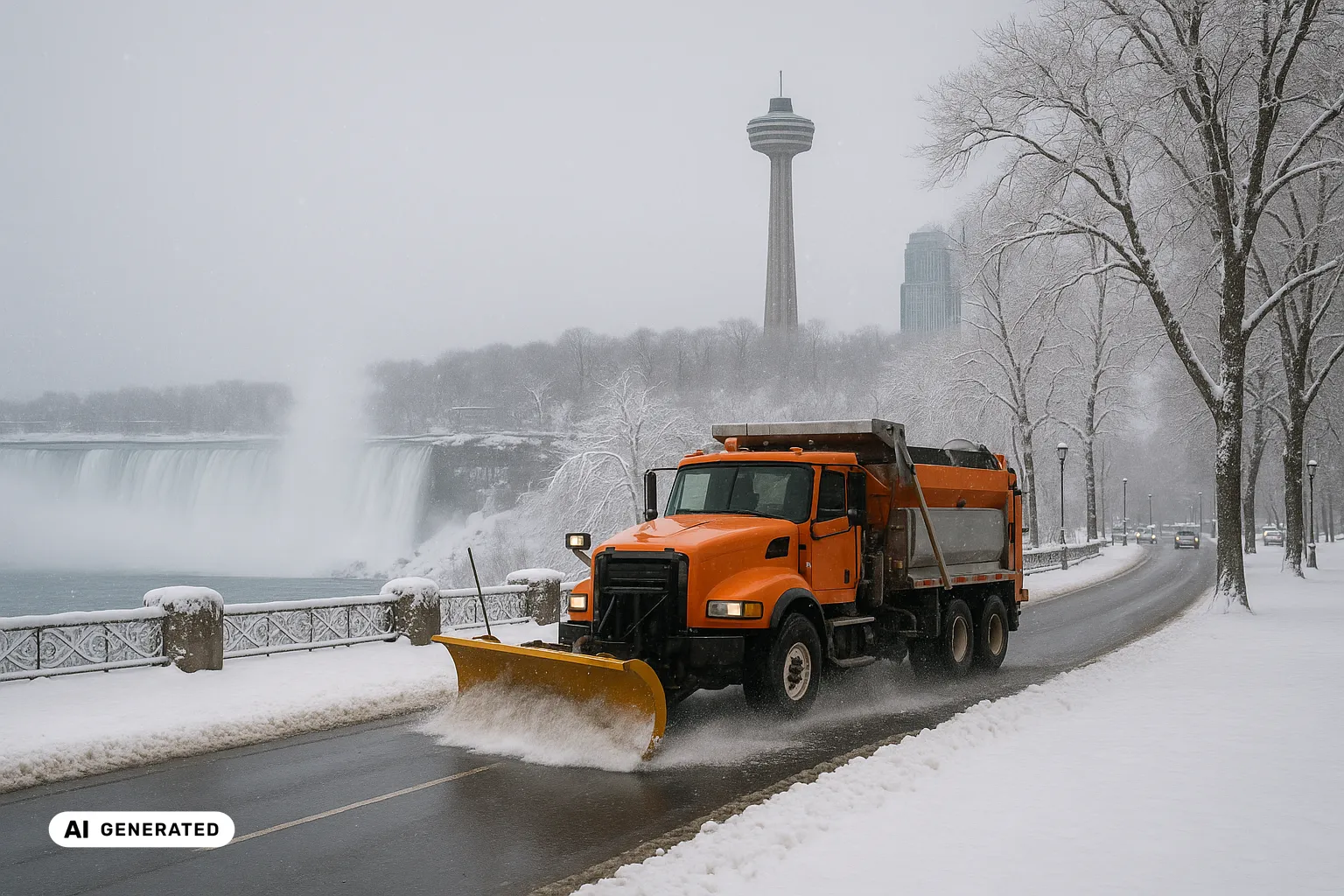
What winter actually does in Niagara Falls
Niagara Falls sits on the west bank of the Niagara River, on the Canadian side of a border the river itself draws, built along the falls and the Niagara Gorge where the water runs from Lake Erie down to Lake Ontario. The land here rises to the Niagara Escarpment — the very cliff the river plunges over, which gives the falls their drop and then runs on through the region as a wooded ridge. Two big lakes close by, a river between them, and a cliff: that is the frame the winter works in.
The snow numbers are moderate for Canada — about 154 cm a year — and the climate is lake-moderated in every season. That single fact separates Niagara Falls from its famous neighbour. Just across the river, Buffalo is a heavy lake-effect city that measures its snow in the hundreds of centimetres; here, the same lake sits mostly to the south-west, and the heavy lake-effect bands set up over Buffalo and southward, leaving the northern side of the peninsula lighter, sometimes missed altogether. So winter in Niagara Falls is ruled less by snow depth than by frost, freeze-thaw and ice — January hovers around −0.4 °C by day and −7.8 °C at night, close enough to zero that surfaces melt and refreeze, and mild spells break the cold rather than deep snow burying it.
There is one hazard, though, that no other city has, and it comes straight off the falls.
The falls make their own ice
The falls throw up a permanent cloud of mist and spray, and in a hard cold snap that mist freezes onto everything downwind. Railings, footpaths, bare trees and the roads along the rim ice over; over the water itself, the spray builds a crust of ice, and below the falls the drifting ice piles into an “ice bridge” that can reach the height of about ten storeys. The falls never actually freeze — the volume and current keep the water moving underneath — but the look of a frozen Niagara is a real winter feature, and so is the ice it leaves on the ground.
For winter service that is not scenery, it is a glaze hotspot. The City names the “misty areas near the falls” as a clearing priority in their own right, alongside the main roads and the hills — because a stretch of the rim can turn to sheet ice from spray alone, with little or no snow falling. It is the local version of the rule that a bridge freezes before the road around it: here, the thing that freezes first is whatever the falls are breathing on.
Across the river: how Niagara Falls and Buffalo differ
It is tempting to assume that two cities this close — facing each other across the Niagara River, sharing the same storms — must have the same winter. They do not, and the differences are exactly what make the pairing worth understanding.
Climate. Buffalo sits in the Lake Erie snow belt and averages well over 240 cm a year, with its Southtowns buried under multiples of that in a big lake-effect event. Niagara Falls, a few kilometres north across the river, averages about 154 cm and is moderated by the water around it. The same south-westerly winds that aim the heaviest bands at Buffalo carry them away from the Canadian side. Same weather map, two different snow climates.
The rulebook. This is where the border really shows. In Buffalo, road clearing is one City operation, and property owners are already responsible for their own sidewalks — within 24 hours, and overnight snow before 9 a.m. On the Canadian side, clearing the roads is split across three levels of government — the City, Niagara Region and the Province (plus the Niagara Parks Commission on the parkway at the falls) — and the duty on owners to clear sidewalks is brand new, only taking effect on 1 October 2026. So a contractor or property manager working both sides of the river is dealing with two snow climates and two entirely different systems of who is responsible for what. Neighbours on the map; different countries in practice.
What the local rules say
On the City’s own roads, the operation is straightforward to follow. Clearing runs in priority order — main roads, hills, and the misty areas near the falls first — and once snow reaches 8 cm, the City ploughs every city road, residential streets and cul-de-sacs included. The network runs to about 592 km of roads and 218 km of sidewalks and trails, and residents can look up the service level of their own street through the City’s Winter Roadway Service Tool.
The sidewalk side is changing. Under a new by-law (By-law No. 2025-016), passed on 4 February 2025 and taking effect on 1 October 2026, owners and occupants will have to clear the sidewalk next to their property within 24 hours of the substantial end of a snowfall; an uncleared walk runs through a notice and, if still not done, City clearing at the owner’s cost. Recognising that this asks more of some residents than others, the City is also starting a Sidewalk and Windrow Assistance pilot for the 2026–2027 season, for older residents, people with disabilities and those in financial hardship. Until the by-law takes effect the duty is not yet in force — the point here is simply what is coming, and none of it is a substitute for legal advice.
Three levels of responsibility
The thing that most distinguishes Niagara Falls from a US city is that no single authority clears all the roads. Ontario runs a three-tier system, and the falls add a fourth body on top:
- The City of Niagara Falls clears local city streets and, from 2026, enforces the sidewalk duty.
- Niagara Region maintains about 1,739 lane-kilometres of regional roads — the busier through-routes, several of them running through the city — around the clock, aiming to clear within six to eight hours of a storm ending.
- The Ontario Ministry of Transportation runs the QEW and the 400-series highways.
- And the Niagara Parks Commission, a provincial body, owns and clears the Niagara Parkway and Queen Victoria Park right along the gorge — so the road at the very edge of the falls answers to yet another authority.
Around the city are its neighbours in Niagara Region — Fort Erie to the south on Lake Erie, Niagara-on-the-Lake to the north on Lake Ontario, and St. Catharines, Thorold and Welland to the west — each one a separate municipality running its own local roads and rules. Cross a boundary, and the level of service, and the phone number you call, changes with it.
Keeping the record straight
In a winter defined less by snowfall totals than by ice — freeze-thaw on the hills, spray-ice off the falls, a mild spell that glazes everything by morning — the useful thing is being able to show, plainly, what was treated and when. Not to win an argument, but because conditions this variable, split across this many authorities, generate exactly the questions a vague answer cannot settle. A simple, time-stamped record of each treatment, set against what the weather was actually doing, turns “we were out all night” into something specific. That is the documentation support Wintertrace is built to make easy — a clear log of where a crew went and when — whether you look after a single property on the parkway or a run of routes up onto the escarpment. It does not change whose road is whose, or what any by-law requires; it just means that when someone asks what happened during the last freeze, the answer is on file. Not a substitute for legal advice.
Local facts
- Niagara Falls sits on the Niagara Peninsula on the west bank of the Niagara River — which here forms the international border with New York — built along the falls and the Niagara Gorge where the river runs from Lake Erie down to Lake Ontario.Source
- The falls drop over the Niagara Escarpment, the cliff for which the escarpment is named; its forested crest stands roughly 75 to 300 metres above the surrounding lowland, and the ridge runs on through the region.Source
- The average annual snowfall is about 154 cm (61 in), and the climate is moderated in all seasons by the surrounding bodies of water.Source
- January is the coldest month, averaging a high of about −0.4 °C and a low of about −7.8 °C, with frequent spells above freezing that drive melt-and-refreeze.Source
- Lake-effect snow is mainly localised to areas near Buffalo and southward, so the north side of the peninsula — including Niagara Falls — is often lighter or missed entirely; the city can, though, catch lake-effect off both Lake Erie and Lake Ontario.Source
- In hard cold the rising mist and spray form a crust of ice over the rushing water and coat the surrounding railings, trees and ground in ice; the falls themselves never fully freeze, because the volume and current keep the water moving under the ice.Source
- Often in January a mild spell followed by a strong south-west wind breaks ice loose to travel down the river and over the falls, where it piles below into an 'ice bridge' that can build to the height of about ten storeys.Source
- The City clears in priority order — main roads, hills, and the misty areas near the falls first — and once snow reaches 8 cm it ploughs all city roads, including residential streets and cul-de-sacs; the network runs to about 592 km of roads and 218 km of sidewalks and trails.Source
- Residents can look up the winter service level and plough priority of their own street through the City's Winter Roadway Service Tool.Source
- Under a new sidewalk snow-clearing by-law (By-law No. 2025-016), passed by City Council on 4 February 2025 and taking effect on 1 October 2026, owners and occupants will have to clear the sidewalk adjacent to their property within 24 hours of the substantial end of a snowfall.Source
- For the 2026–2027 season the City is launching a Sidewalk and Windrow Snow Clearing Assistance pilot for older residents, people with disabilities and those in financial hardship.Source
- Niagara Region maintains about 1,739 lane-kilometres of regional roads around the clock, aiming to clear snow within six to eight hours of a winter event ending; several regional roads run through Niagara Falls itself.Source
- The Queen Elizabeth Way and the 400-series highways through the region are the responsibility of the Ontario Ministry of Transportation, not the City.Source
- The scenic Niagara Parkway and Queen Victoria Park along the gorge are owned and maintained by the Niagara Parks Commission, a provincial body — not the City — so the road right at the falls is cleared by a different authority again.Source
- Niagara Falls is one of twelve local municipalities in Niagara Region; its neighbours include Fort Erie, Niagara-on-the-Lake, St. Catharines, Thorold and Welland, each running its own local roads and rules.Source
Official contacts
City of Niagara Falls — Snow Clearing
How the City ploughs: the priority order, the 8 cm threshold for all roads, and the size of the road and sidewalk network.
City of Niagara Falls — Sidewalk Snow Clearing (by-law)
The new sidewalk-clearing by-law taking effect on 1 October 2026: the owner duty, timing and enforcement.
Niagara Region — Seasonal Road Operations
How the Region clears the regional roads that run through the city, its network size and its response targets.
Ontario (MTO) — How we clear the highways in winter
The Province's operation on the QEW and 400-series highways — the top tier of the three that clear roads here.
Common questions about winter service in Niagara Falls
- Does Niagara Falls get as much snow as Buffalo, right across the river?
- No — and that surprises people, because the two cities face each other across the Niagara River. Buffalo sits in the Lake Erie snow belt and averages well over 240 cm a year, with its southern suburbs getting far more; Niagara Falls, Ontario averages about 154 cm and is moderated by the surrounding water. The reason is geography: lake-effect snow bands off Lake Erie mainly set up over Buffalo and to its south, so the Canadian side to the north is often lighter or missed entirely. Same weather systems, genuinely different winters — Niagara's is real but moderate, ruled more by frost, freeze-thaw and spray-ice than by deep snow.
- Do the falls actually freeze in winter?
- Technically, no. The volume of water and the constant current keep it moving, so the falls never fully freeze. What you see in a hard cold snap is ice forming around and over the rushing water — the rising mist and spray freeze and coat the railings, trees and ground nearby, and below the falls the drifting ice can pile into an 'ice bridge' up to about ten storeys high. It looks frozen; the water is still flowing underneath.
- Is the spray from the falls a real problem for winter service?
- Yes, and the City treats it as one. The mist thrown up by the falls freezes onto everything downwind — railings, paths and the roads along the rim — so the 'misty areas near the falls' are named as a clearing priority alongside the main roads and the hills. It is a genuine glaze hotspot that has no equivalent in an ordinary city: a stretch of road can ice over from spray even when little or no snow is falling.
- Do I have to clear the sidewalk in front of my property?
- Soon, yes. Under a new by-law (By-law No. 2025-016) passed by City Council on 4 February 2025 and taking effect on 1 October 2026, owners and occupants will be responsible for clearing the sidewalk next to their property within 24 hours of the substantial end of a snowfall. If a walk is left uncleared the process runs through a notice and, after a further period, City clearing at the owner's cost. For older residents, people with disabilities and those in financial hardship, the City is starting an assistance pilot for the 2026–2027 season. This is general information, not a substitute for legal advice.
- Who ploughs my street, and when?
- The City clears its own roads in priority order — main roads, hills and the misty areas near the falls first — and once 8 cm has fallen it ploughs every city road, including residential streets and cul-de-sacs. You can check your own street's service level through the City's Winter Roadway Service Tool. But not every road you drive is the City's: the regional roads are Niagara Region's, the QEW and 400-series highways are the Province's, and the Niagara Parkway at the falls belongs to the Niagara Parks Commission — so which crew clears a given road depends on whose road it is.
- Why are the roads on the hills and by the gorge cleared first?
- Because they are where ice bites hardest. The land rises to the Niagara Escarpment, and hills lose traction first in freeze-thaw; the roads along the gorge and rim catch the frozen spray off the falls. Both are named ahead of residential streets in the City's priority order, for the same reason a bridge is salted before the road around it — they turn dangerous before flat, sheltered streets do.
- How is winter service here different from Buffalo, just across the border?
- In two ways. First, climate: Buffalo is a heavy lake-effect snow-belt city, Niagara Falls is lake-moderated and markedly less snowy, even though they share the same river and the same passing storms. Second, the rulebook: Buffalo runs on a single City ordinance and one public-works operation, with property owners already responsible for their sidewalks within 24 hours. On the Canadian side, road clearing is split across three levels — City, Region and Province, plus the Parks Commission at the falls — and the sidewalk duty on owners is brand new, only taking effect in 2026. Neighbours on a map, different countries in practice: the border means the rules do not carry across it.
- Which roads belong to the City, and which to the Region or the Province?
- It is a three-tier system, which is normal in Ontario. The City of Niagara Falls clears local city streets and, from 2026, enforces the sidewalk duty. Niagara Region maintains the regional roads — the busier through-routes — around the clock, targeting six to eight hours after a storm ends. The Ontario Ministry of Transportation runs the QEW and the 400-series highways. And the Niagara Parkway right along the falls is the Niagara Parks Commission's. For anyone whose routes cross those boundaries, the practical point is that responsibility — and the level of service — changes with the road, not with the neighbourhood.
Documenting winter service in Niagara Falls
Anyone clearing snow and ice in Niagara Falls may later need to show when and where a route was treated. Wintertrace is open-source software that records exactly that — time, location and weather for each run — as a calm basis for your own operational records and service proof. It is not a substitute for legal advice.
This overview is for general information and is not legal advice. Local rules on snow and ice clearing vary — the wording of the local rule and the responsible authority always govern.