Winter service · New York
Winter service in Buffalo
What winter is really like in Buffalo: about 95 inches of snow a year, but a city defined by lake-effect variance — feet of snow in the Southtowns while downtown stays bare. The four storms that shaped it, the City of Buffalo's 24-hour sidewalk rule and 9 a.m. deadline, how the DPW plows, and who clears what.
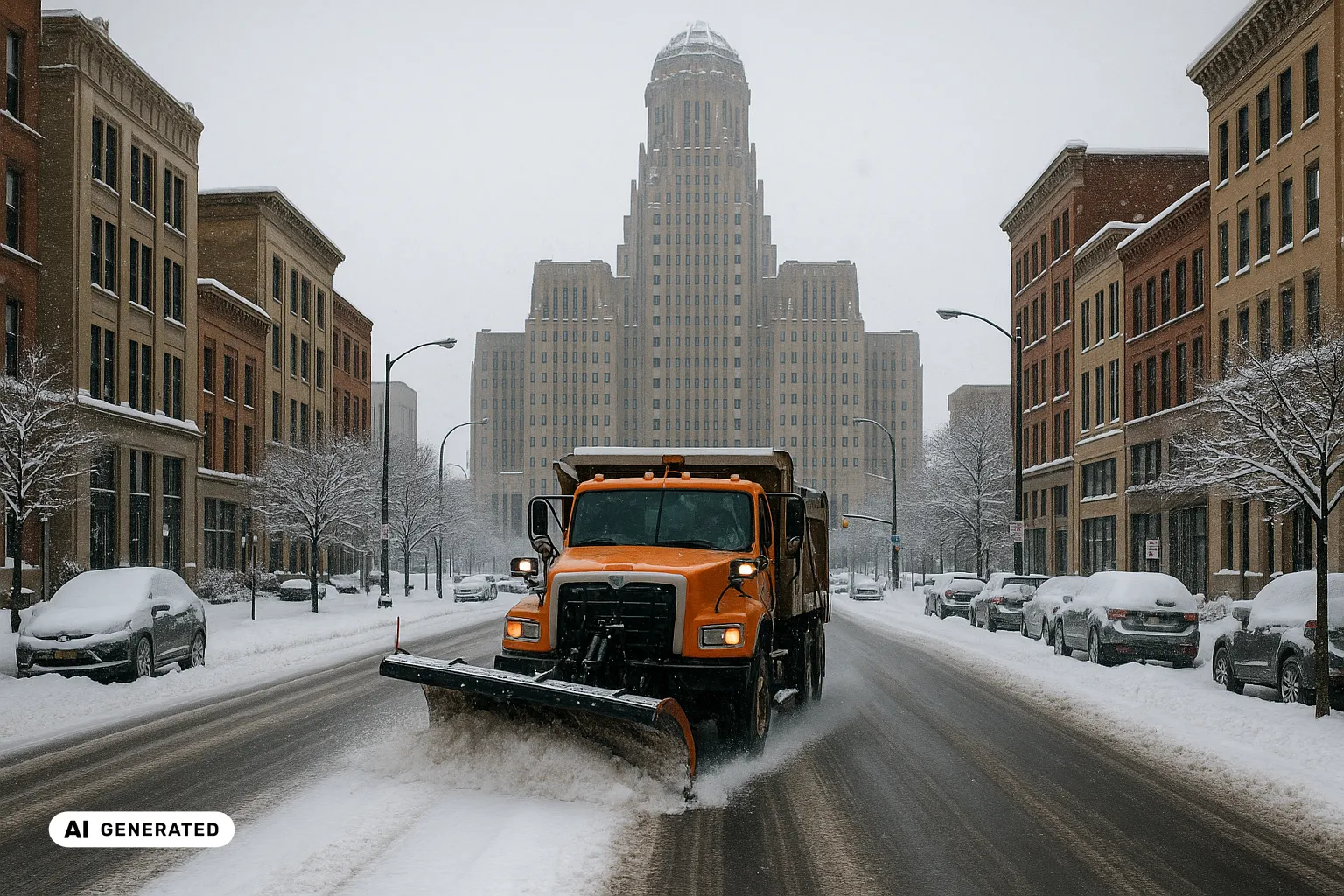
What winter actually does in Buffalo
Buffalo sits at the eastern end of Lake Erie, at the head of the Niagara River where it begins its run north toward the falls, at about 600 feet of elevation. The city itself is mostly flat; the land only starts to climb once you head south, into the hilly Southtowns and the Cattaraugus Hills beyond. That geography — a big, shallow lake to the west and rising ground to the south — is the whole explanation for Buffalo’s winter.
The headline number, about 95 inches of snow a year at the airport, puts Buffalo among the top five snowiest large cities in the United States. But the average is almost the least useful thing you can know about snow here, because Buffalo’s snow is lake-effect, and lake-effect snow does not fall evenly. Cold air crossing the long, open, relatively warm water of Lake Erie picks up heat and moisture, turns unstable, and organises into narrow, intense bands. A band can park over one neighbourhood for hours, dropping snow by the foot, while a few miles away the sun is out. Wind direction decides everything: a west or south-westerly flow runs the entire length of the lake and aims the heaviest bands straight at the city and, above all, at the hills south of it.
So the defining fact of winter service in Buffalo is not depth — it is variance. On the same afternoon, downtown can stay nearly bare while the Southtowns measure in feet. This is the mirror image of a city like Toronto, across the lake, where the snow is moderate but the season is ruled by freeze-thaw and freezing rain. In Buffalo the freeze-thaw is a footnote; the story is how much fell, and exactly where.
A lake on the doorstep does not automatically mean lake-effect, either. Burlington sits on the eastern shore of Lake Champlain and gets none of it: the valley lies in the lee of the Adirondacks, and the University of Vermont calls it the state’s “banana belt”. The water there is too small, and lies in the wrong axis, to build bands.
The four storms that explain Buffalo
Buffalo’s reputation rests on a handful of events, and they are worth separating, because they are not the same kind of storm — and the difference is itself the local lesson.
The Blizzard of 1977 is the famous one, and it is routinely misunderstood. Only about 12 inches of new snow actually fell in the city. The catastrophe was a ground blizzard: Lake Erie had frozen over in a record mid-December, and sustained winds gusting to 69 mph stripped the loose snow off the ice and the fields and piled it into drifts of 30 to 40 feet. Twenty- three people died in Western New York. The takeaway that still shapes operations here is that in Buffalo, wind can matter more than snowfall.
The lake-effect events are a different animal. In November 2014, “Snowvember” dropped 5 to 7 feet on the Southtowns in back-to-back bands, peaking near 88 inches at Cowlesville, collapsing roofs and stranding thousands of cars. In November 2022, a band buried Orchard Park under about 77 inches and forced a Bills home game to be moved to Detroit. Both hit the southern hills hardest and left much of the city comparatively light — classic lake-effect geography.
And then there is the December 2022 blizzard, which was neither of the above: a broad, synoptic storm that hit the city itself hardest — about 51.5 inches at the airport, blizzard winds, days-long power outages, and roughly 46 deaths in Erie County, more than 1977. A travel ban ran for days. Reading these four events together tells you what a Buffalo winter plan has to survive: a wind-driven ground blizzard, two southern-hills lake-effect burials, and a city-wide blizzard — each demanding something different.
That reliance on the big event is also what distinguishes Buffalo from its upstate rival Syracuse, which is snowier on average but gathers its total from many smaller falls off Lake Ontario and the Tug Hill rather than a few big ones off Lake Erie. The two trade the annual Golden Snowball for most snow — and the contrast is real for anyone running crews: Buffalo braces for the storm, Syracuse manages the grind. At the far end of that same five-city contest sits Albany, the state capital in the Hudson Valley and the least snowy of the five — a city with no lake-effect at all, where cold and ice matter more than depth.
What the local rules say
The City of Buffalo’s sidewalk rule lives in the City of Buffalo Code, Chapter 413, Article VIII — Snow and Ice Removal, and its core is §413-50. The standing duty is a morning one: the owner or occupant of property abutting a public sidewalk has to clear the overnight snow and ice before 9 a.m., over a strip at least three feet wide, and keep the gutter clear too. A further provision puts the same responsibility on a 24-hour footing after a snowfall, and where ice has frozen too hard to lift, it has to be treated with sand, ashes or salt until it can be removed.
If a walk is left uncleared, the Commissioner of Street Sanitation can have it cleared and charge the cost back to the owner, assessed against the property (§413-51). In practice, though, this is a rule observed unevenly: Buffalo has an openly acknowledged sidewalk-clearing problem, and a 2025 proposal to reform the system — shifting more of the burden to the City — was rejected. So the duty is real and on the books, but a resident’s lived experience is of patchy compliance rather than tight enforcement. None of this is legal advice; the point here is simply what the code says and how it plays out. Across the border in Niagara Falls, Ontario, a short drive down the river, the arrangement is different again — a reminder that these rules are strictly local.
How the city clears — and the driving-ban reality
On the road side, the Department of Public Works (Parks & Streets) runs the plowing, and it works to a priority order: primary and emergency routes first — the streets carrying buses, hospitals, fire and police — then secondary streets, then residential ones. The stated aim is at least one plow pass on every residential street within 24 hours of a snowfall ending, and residents can follow the operation through the City’s online plow tracker. Those are targets, and a persistent lake-effect band that keeps refilling the same streets stretches them; in the worst storms the tracker itself has gone dark while crews focus on digging out.
The instrument that sets Buffalo apart from milder cities is the driving ban. When a storm is severe enough, the City or Erie County can make it unlawful to be on the roads except for emergencies — clearing the way for plows and responders. This is not theatre: in December 2022 a ban held for several days and, from 27 December, was enforced by state and military police. For anyone operating here, a travel ban is part of the plan, not an interruption to it — work stops, and the record of what was done up to that point is what remains.
Downtown, the Southtowns, and the border
It helps to picture Buffalo winter service as several climates on one map. Downtown is flat, dense, and often on the lighter edge of a given band — steady plowing, salting, and keeping crossings and sidewalks passable. The Southtowns — Orchard Park, Hamburg, West Seneca, Eden, Elma, East Aurora — take the raw volume, the multi-foot events and the roof loads. The Northtowns, Amherst and Tonawanda, usually sit lighter still. The immediate neighbours — Cheektowaga, Lackawanna and the rest — each run their own roads and rules, all inside Erie County.
North along the river is the border. Buffalo sits opposite Fort Erie, Ontario, with the Peace Bridge between them and the exposed, wind-open Niagara River frontage in between; a little further down the river is Niagara Falls, Ontario on the Canadian side.
That neighbour is worth looking at closely, because it defeats an easy assumption. You would expect a city a few kilometres away, across a river, under the same passing storms, to share Buffalo’s winter — and it does not. Niagara Falls, Ontario averages about 154 cm of snow a year; Buffalo averages well over 240 cm, and the Southtowns far more again. The cause is the very lake-effect geography that defines Buffalo: the bands organise over the city and to its south, so the Canadian side to the north is routinely lighter, or missed entirely. And because it is a different country, the rulebook changes completely at the water’s edge. Buffalo runs on a single City ordinance, with owners already clearing their own sidewalks within 24 hours; across the river, road clearing is split across City, Region and Province (with the Niagara Parks Commission on the parkway at the falls), and an owner sidewalk duty only arrives in 2026. A route or a portfolio that crosses the Niagara corner is working two snow climates and two systems at once — which is exactly why you read the local rule rather than assume Buffalo’s travels with it.
And when Highmark Stadium in Orchard Park disappears under a lake-effect band, the city’s answer is characteristically practical: the Bills pay fans to shovel it out — $20 an hour, food and hot drinks included — before kickoff.
Keeping the record straight
In a place where one storm is a 12-inch ground blizzard and the next drops seven feet on the hills, the useful thing is being able to show, plainly, what was done and when. Not to win an argument, but because a winter this variable generates exactly the questions — was the route cleared, when, in what conditions — that a vague answer can’t settle. A simple, time-stamped record of each treatment, set against what the weather was actually doing, turns “we were out all night” into something specific. That is the documentation support Wintertrace is built to make easy — a clear log of where a crew went and when — whether you look after a single property or a fleet of routes across the Southtowns. It does not change any local rule; it just means that when someone asks what happened during the last band, the answer is on file. Not a substitute for legal advice.
Local facts
- Around 95 inches (about 242 cm) of snow falls in an average year at Buffalo Niagara International Airport — enough to place Buffalo among the top five snowiest large cities in the United States (NCEI 1991–2020 normals).Source
- The snowiest months are January (about 26.7 inches), December (about 25.3 inches) and February (about 18.1 inches), with measurable snow on roughly 59 days a year.Source
- The airport's snowiest season on record was 1976–77 with 199.4 inches, according to the National Weather Service in Buffalo.Source
- Buffalo sits at the eastern end of Lake Erie, at the head of the Niagara River, at about 600 feet of elevation; the city itself is mostly flat, but the land rises south into the hilly Southtowns and the Cattaraugus Hills of the Appalachian Upland.Source
- Its snow is lake-effect: cold wind crossing the long, open, relatively warm water of Lake Erie forms narrow, intense snow bands whose position depends entirely on wind direction — and once the lake freezes over, that classic lake-effect supply shuts off.Source
- Because the hills south of the city stall those bands, the Southtowns routinely receive several times the downtown total; the defining local reality is extreme variance over a few miles, not one citywide snow depth.Source
- In the Blizzard of 1977, only about 12 inches of new snow fell in Buffalo — the catastrophe came from sustained winds gusting to 69 mph that lifted snow already lying on the frozen surface of Lake Erie into drifts of 30 to 40 feet; 23 people died in Western New York.Source
- In November 2014's 'Snowvember', back-to-back lake-effect bands dropped 5 to 7 feet on the Southtowns, peaking near 88 inches at Cowlesville, collapsing hundreds of roofs and stranding thousands of vehicles.Source
- A November 2022 lake-effect storm buried Orchard Park under about 77 inches and forced a Buffalo Bills home game to be relocated to Detroit.Source
- The December 2022 blizzard hit the city itself hardest — about 51.5 inches at the airport, with blizzard winds and days-long power outages; roughly 46 people died in Erie County, and a travel ban ran for days, enforced from 27 December by state and military police.Source
- Under the City of Buffalo Code (Chapter 413, Article VIII — Snow and Ice Removal, §413-50), the standing duty on the owner or occupant of property abutting a public sidewalk is to clear the overnight snow and ice before 9 a.m., over a strip at least three feet wide, and to keep the gutter clear.Source
- A further provision of the same section also puts that responsibility on a 24-hour footing after snowfall, and where ice has frozen too hard to remove it must be treated with sand, ashes or salt until it can be cleared.Source
- If a sidewalk is left uncleared, the Commissioner of Street Sanitation can have it cleared and charge the cost back to the owner, assessed against the property (§413-51); enforcement in practice is limited, and a 2025 reform proposal was rejected.Source
- On the road side, the City's Department of Public Works (Parks & Streets) plows in priority order — primary and emergency routes first, then secondary streets, then residential — aiming for at least one plow pass on every residential street within 24 hours of a snowfall ending, and it runs an online plow tracker.Source
- When lake-effect snow buries Highmark Stadium in Orchard Park, the Buffalo Bills routinely pay fans — $20 an hour, plus food and hot drinks — to shovel it clear before kickoff.Source
Official contacts
City of Buffalo Code — Chapter 413, Article VIII (Snow and Ice Removal)
The sidewalk snow-and-ice ordinance: the owner and occupant duty, the timing, and the City's power to clear an uncleared walk at the owner's cost.
City of Buffalo — Snow Plan (Department of Public Works, Parks & Streets)
How the City plows: route priorities, the residential-street target and the winter operation, as a PDF.
National Weather Service, Buffalo — snowfall records
Monthly and seasonal snowfall history for Buffalo, including the record seasons.
National Weather Service, Buffalo — Lake Effect Snow archive
The forecast office's event-by-event archive of lake-effect snow across Western New York.
Common questions about winter service in Buffalo
- Do I have to shovel the sidewalk in front of my property in Buffalo?
- Under the City of Buffalo Code (Chapter 413, Article VIII), the owner or occupant of property abutting a public sidewalk has to keep it clear. The standing rule is a morning one — remove the overnight snow and ice before 9 a.m., over a strip at least three feet wide, and keep the gutter clear — and a further provision puts it on a 24-hour footing after a snowfall. If the ice has frozen too hard to lift, it has to be treated with sand, ashes or salt until it can be removed. If a walk is left uncleared, the Commissioner of Street Sanitation can have it done and bill the cost back to the owner. In practice enforcement is limited — Buffalo has an openly acknowledged sidewalk problem, and a 2025 attempt to reform the system was rejected — but the duty is on the books. This is general information, not a substitute for legal advice.
- Why does Buffalo get so much more snow than most cities its size?
- Because of the lake. Cold air crossing the long, open, relatively warm water of Lake Erie picks up moisture and heat, becomes unstable, and organises into narrow, intense snow bands — lake-effect snow. A single band can sit over one area for hours and drop feet of snow while a few miles away it stays dry. Wind direction decides everything: a westerly or south-westerly flow runs the length of the lake and aims the heaviest bands at Buffalo and, especially, the hills to its south.
- Why do the Southtowns get buried when downtown stays clear?
- It is the same lake-effect mechanism plus terrain. The Southtowns — Orchard Park, Hamburg, West Seneca, Eden and their neighbours — rise into the Cattaraugus Hills, and that higher ground stalls the snow bands and wrings them out in place. With a typical south-westerly wind the ranking runs Southtowns, then metro Buffalo, then the flatter Northtowns like Amherst and Tonawanda. It is entirely normal for Orchard Park to measure in feet while downtown, fifteen kilometres north, measures in inches. For anyone running winter service, that variance over a short distance is the whole challenge.
- How was the Blizzard of 1977 so deadly with only 12 inches of snow?
- Because it was a ground blizzard, not a snowstorm. Only about 12 inches of new snow fell in Buffalo during the event. The danger came from wind — sustained gales gusting to 69 mph over a Lake Erie that had frozen over in mid-December, a record early freeze. The wind stripped the loose snow off the ice and off the fields and piled it into drifts of 30 to 40 feet, burying cars and streets and cutting the city off. Twenty-three people died in Western New York, and nine counties were declared a disaster area. It is the clearest illustration that in Buffalo the wind can matter more than the snowfall total.
- What is a 'driving ban', and does it really get enforced?
- A driving or travel ban makes it unlawful to be on the roads except for emergencies, so crews can plow and first responders can move. In Buffalo and Erie County they are a real instrument, not a formality: during the December 2022 blizzard a ban ran for several days, and from 27 December it was backed by state and military police. When one is in force, the safest and expected thing is to stay off the road until it lifts.
- How quickly does the City plow my street after a storm?
- The Department of Public Works works in priority order: primary and emergency routes first — the roads carrying buses, hospitals, fire and police — then secondary streets, then residential ones. The stated aim is at least one plow pass on every residential street within 24 hours of a snowfall ending, and residents can follow progress on the City's online plow tracker. Those are targets: a prolonged lake-effect band that keeps refilling the same streets stretches them, and in an extreme storm the tracker itself can go dark while crews concentrate on digging out.
- Does the snow ever stop once the lake freezes?
- Largely, yes — for the classic lake-effect kind. Lake-effect snow needs open water for the cold air to draw heat and moisture from; once Lake Erie ices over, that engine shuts down and the relentless bands ease. Erie is shallow and freezes earlier than the other Great Lakes, so Buffalo's fiercest lake-effect stretch tends to be early and mid-winter, before the lake locks up. Synoptic storms — the broad systems that snow anywhere — can still arrive after that, as December 2022 showed.
- Is winter service harder downtown or out in the suburbs?
- They are different problems. Downtown Buffalo is flat, dense and often on the lighter side of a given band, so the work is steady plowing, salting and keeping sidewalks and crossings passable. The Southtowns face the raw volume — the multi-foot events, the roof loads, the roads that need clearing several times in a day. A contractor whose routes cross from the city into the hills is really working two climates at once, and a storm total for 'Buffalo' can badly understate what fell on the southern end of the route.
- Are the Southtowns and Erie County part of the City of Buffalo?
- No. The City of Buffalo is one municipality; the Southtowns — Orchard Park, Hamburg, West Seneca and the rest — and the Northtowns like Amherst and Tonawanda are separate towns, all within Erie County, each running its own roads and its own winter rules. Erie County handles county responsibilities and can impose the county-wide travel bans. So the City's sidewalk ordinance and plow plan describe Buffalo proper; cross a town line and you are into a different local rulebook.
Documenting winter service in Buffalo
Anyone clearing snow and ice in Buffalo may later need to show when and where a route was treated. Wintertrace is open-source software that records exactly that — time, location and weather for each run — as a calm basis for your own operational records and service proof. It is not a substitute for legal advice.
This overview is for general information and is not legal advice. Local rules on snow and ice clearing vary — the wording of the local rule and the responsible authority always govern.