Winter service · New York
Winter service in Binghamton
What winter is really like in Binghamton: about 86 inches of snow a year — less than its lake-effect neighbours — but one of the cloudiest cities in America, set in a bowl-shaped valley where the Susquehanna and Chenango meet. Grey, damp winters, an alternate-side parking rule from December, and a City Code that leaves the sidewalk to the property owner.
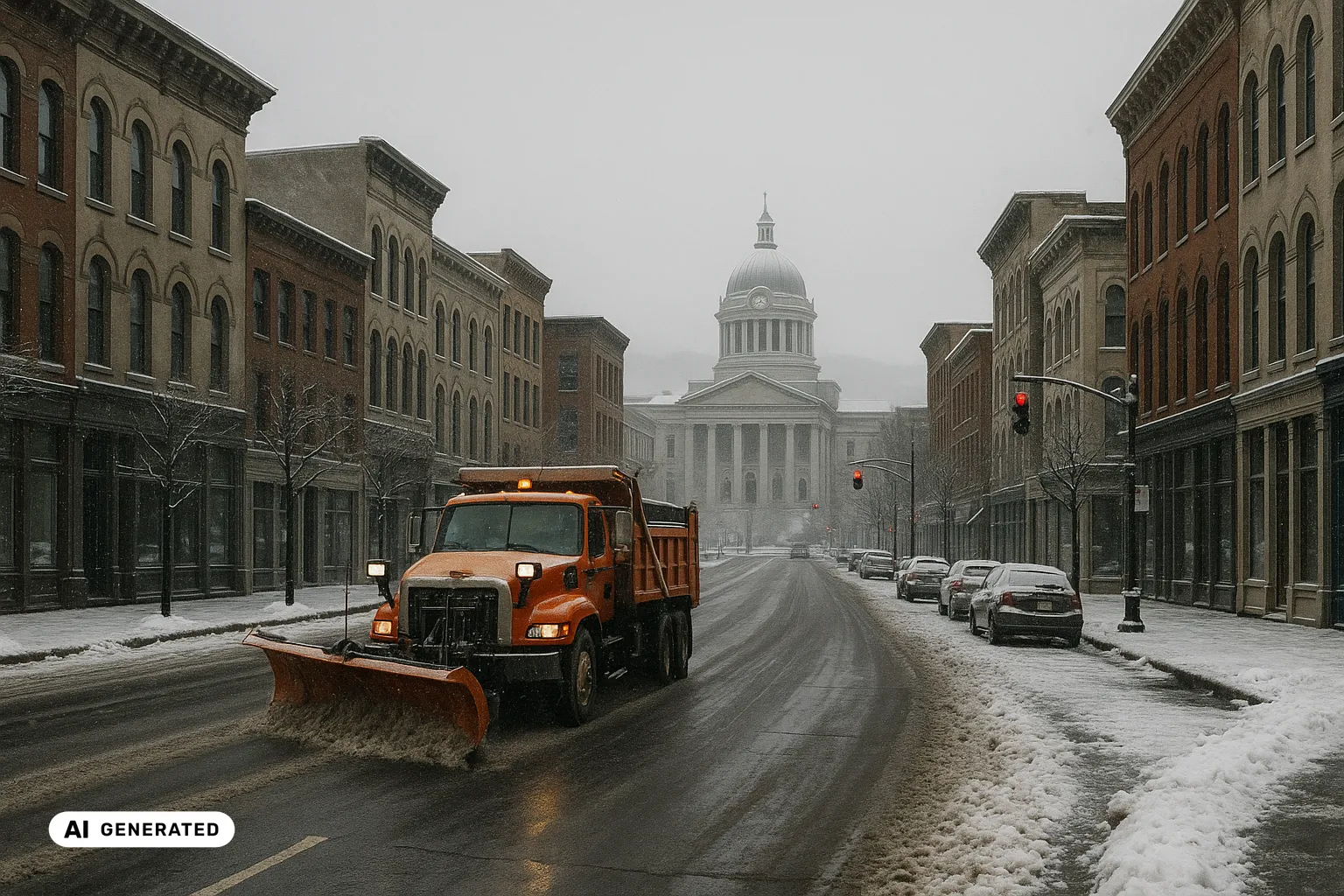
What winter actually does in Binghamton
Binghamton is the quiet one among New York’s snow cities. Its neighbours up the Thruway trade record snowfalls; Binghamton, down in the Southern Tier near the Pennsylvania border, averages a more modest 86 inches a year — a lot by most standards, but well short of the lake-effect giants. What actually defines the winter here is not the depth of the snow. It is the grey. Binghamton is one of the cloudiest cities in the United States — about 190 cloudy or mostly-cloudy days a year, among the most of any American city — and the gloom is thickest in winter.
The setting is a big part of it. The city sits in a bowl-shaped valley at the confluence of the Susquehanna and Chenango rivers, ringed by rolling hills. The relief is steep: downtown is at about 860 feet, while the residential hillsides climb over 1,800 feet, up to Table Rock Ridge at 1,854 feet. That shape gives the city its two winters at once — a damp, low, river-bottom downtown and colder, snowier ground just up the slopes — and the low valley floor, with its rivers and bridges, is exactly the kind of place that frosts and refreezes on a grey, wet day near freezing.
The cloudiest corner of New York — valley, rivers, and grey
It is worth being honest about what makes a Binghamton winter hard work, because it is not the same thing that makes Buffalo’s hard. Cold air passing over the Great Lakes to the west picks up moisture and keeps the sky overcast for days at a time, and Binghamton catches the tail of that — one count puts it at the 11th cloudiest city in the country, and some rankings place it higher still. The result is a winter that spends a great deal of its time hovering around freezing under a flat grey sky: long spells of damp, thaw-and-refreeze weather rather than the occasional clean, big snowfall.
For anyone keeping surfaces safe, that steady freeze-thaw is its own kind of demand — less about clearing a foot of snow overnight than about staying ahead of ice that forms, melts a little, and forms again, over and over, on the bridges and river-bottom streets and the shaded hillside grades. The 86-inch average undersells the season: it is not the number that wears you down here, it is the length and the greyness of it.
What the local rules say — the owner clears the sidewalk
On the sidewalks, Binghamton takes the opposite approach to Rochester and Syracuse across the state, where the city itself ploughs residential walks. Here it follows the common American model: under the City of Binghamton Code, snow and ice must be cleared from a sidewalk within 24 hours of the snow stopping, and the duty falls on the owner of the adjoining property. If a walk is left uncleared, the City’s Code Enforcement Director can have the Department of Public Works clear it and bill the cost back to the owner.
So the practical picture is the straightforward one most of the US shares: the frontage in front of your building is yours to keep clear, on the City’s 24-hour clock. The provisions sit in the City Code’s property-maintenance chapter, and the point here is simply how the city approaches it — not a substitute for legal advice, and worth checking against the current Code text for the exact wording and any deadlines that apply to a specific property.
How the city ploughs — alternate-side parking and the two-inch rule
The most visible winter rule for anyone living or working in Binghamton is parking. From 1 December to 15 March the city runs daily alternate-side parking: on even calendar dates you park on the even-numbered side of the street until 5:00 p.m., on odd dates the odd side — a simple rule with one purpose, to let the plows reach the whole roadway. On top of that, any snowfall of two inches is treated as a snow emergency, and vehicles that block the plough are towed. That two-inch threshold is low, and in a Binghamton winter it comes up often, so the safe habit is to get off the wrong side of the street early.
The ploughing and salting of the city streets is the Department of Public Works’ job. As with any city, though, not every road through town is the City’s: the county and the state run their own, which is the next distinction to keep straight.
Broome County and the Triple Cities
Binghamton is the seat of Broome County, and it does not stand alone — with the villages of Johnson City and Endicott it forms the historic “Triple Cities,” and the wider metro area, out to Tioga County, counts about 247,000 people. On the roads, responsibility splits three ways: the City DPW on the city streets, Broome County’s Highway Division on 343 centerline miles of county road with an explicit emphasis on snow and ice control, and NYSDOT Region 9 — headquartered right here in Binghamton — on the interstates and state highways, I-81, I-86/NY-17 and I-88. The county’s other towns and villages — Vestal, Endwell, Chenango, Conklin, Kirkwood, Port Dickinson and the rest — each run their own local streets and rules, so the answer to “who clears this, and what are the sidewalk rules” can change the moment you cross a municipal line.
And across Upstate, Binghamton shares the season — from a friendly distance — with the other Golden Snowball cities: Buffalo, Syracuse, Rochester and Albany. Binghamton is usually the underdog of the five, with the lowest average — but it does win, taking the 2020–21 title with 103.2 inches, a single strong season well above its long-run norm.
Keeping the record straight
In a winter defined by grey, freeze-thaw days rather than headline snowfalls — sidewalks on the owner’s 24-hour clock, an alternate-side rule that turns on a two-inch storm — the useful thing is being able to show, plainly, what was done and when. Not to win an argument, but because a long, damp, refreezing winter generates exactly the questions a vague answer cannot settle: was the walk cleared, when, in what conditions, how often the ice was treated as it kept coming back. A simple, time-stamped record of each treatment, set against what the weather was actually doing, turns “we were out all week” into something specific. That is the documentation support Wintertrace is built to make easy — a clear log of where a crew went and when — whether you look after a single frontage on a downtown block or a run of routes across Broome County. It does not change whose sidewalk is whose; it just means that when someone asks what happened during the last stretch of winter, the answer is on file. Not a substitute for legal advice.
Local facts
- Binghamton averages about 86.5 inches (roughly 220 cm) of snow a year on the 1991–2020 normals — a figure the climate record and the airport data agree on — falling across roughly 64 to 65 days a year.Source
- It is one of the cloudiest cities in the United States: about 190 cloudy or mostly-cloudy days a year — the 11th most among US cities by one count, and higher still on some rankings — with the gloom heaviest in winter.Source
- Binghamton sits in New York's Southern Tier near the Pennsylvania border, in a bowl-shaped valley at the confluence of the Susquehanna and Chenango rivers, surrounded by rolling hills; it is the seat of Broome County.Source
- The relief is steep: downtown sits at about 860 feet while residential areas in the hills climb over 1,800 feet, up to Table Rock Ridge at 1,854 feet — so the hillside neighbourhoods hold more snow, and hold it longer, than the low valley floor.Source
- The city had 47,969 residents in the 2020 census and forms, with the villages of Johnson City and Endicott, the historic 'Triple Cities'; the wider metropolitan area counted 247,138.Source
- The record low is −20 °F (−29 °C), set on 15 January 1957 — January being the core of the cold season.Source
- Binghamton is one of the five Golden Snowball cities — Albany, Binghamton, Buffalo, Rochester and Syracuse — that compete each year for the most seasonal snow, and it won the 2020–21 season with 103.2 inches (a single strong season, well above its ~86-inch average).Source
- On the sidewalks the City follows the common US model: under the City of Binghamton Code, snow and ice must be removed from a sidewalk within 24 hours of the snow stopping, and the responsibility falls on the owner of the adjoining property.Source
- If a walk is not cleared, the City's Code Enforcement Director can have the Department of Public Works clear it and bill the cost back to the property owner.Source
- From 1 December to 15 March the city runs daily alternate-side parking: on even calendar dates park on the even-numbered side until 5:00 p.m., on odd dates the odd side — so the plows can reach every street.Source
- Any snowfall of two inches counts as a snow emergency, and vehicles that block ploughing are towed.Source
- The City of Binghamton Department of Public Works ploughs and salts the city streets; Broome County's Highway Division keeps 343.24 centerline miles of county road under a programme that puts explicit emphasis on snow and ice control.Source
- NYSDOT Region 9 is headquartered in Binghamton and looks after the state highways and interstates — I-81, I-86/NY-17 and I-88 — through the area; local reporting puts its winter effort at around 400 staff and some 51,000 tons of road salt.Source
Official contacts
City of Binghamton — Department of Public Works
The department responsible for ploughing and salting the city streets.
City of Binghamton — Alternate Side / Winter Parking
The winter alternate-side parking rule (1 December–15 March) and the two-inch snow-emergency and towing rules.
City of Binghamton — Code, Chapter 265 (Housing and Property Maintenance)
Where the sidewalk snow-and-ice provisions sit — the 24-hour clearing duty on the property owner, and the City's ability to clear and bill.
Broome County — Highway Division
The county's snow-and-ice control on 343.24 centerline miles of county road outside the city network.
The State's regional office, based in Binghamton, responsible for the interstates and state highways through the area.
Common questions about winter service in Binghamton
- How much snow does Binghamton get?
- About 86.5 inches a year on the 1991–2020 normals, across roughly 64 to 65 snow days. That is a lot of snow by most standards, but noticeably less than its lake-effect neighbours Buffalo and Syracuse — Binghamton is not in the direct lake-effect firing line. What defines the winter here is less the depth of snow than the persistence of the grey: this is one of the cloudiest cities in the country, and the season is long, damp and overcast.
- Why is Binghamton so cloudy?
- It has a genuine reputation for it — about 190 cloudy or mostly-cloudy days a year, among the most of any US city, and higher still on some rankings. The gloom is heaviest in winter, when cold air passing over the Great Lakes to the west loads up with moisture and keeps the sky overcast for days at a time. For anyone maintaining surfaces, the practical effect of all that cloud is a winter that spends a great deal of time hovering around freezing — long spells of damp, grey, thaw-and-refreeze weather rather than the occasional clean big snowfall. That steady freeze-thaw is its own kind of work.
- Do I have to shovel my own sidewalk in Binghamton?
- Yes. Unlike Rochester or Syracuse across the state — where the city itself ploughs residential sidewalks — Binghamton follows the common American model: under the City of Binghamton Code, snow and ice must be cleared from the sidewalk within 24 hours of the snow stopping, and the duty falls on the owner of the adjoining property. If a walk is left uncleared, the City's Code Enforcement Director can have the Department of Public Works clear it and bill the cost back to the owner. So the frontage in front of your building is yours to keep clear. This is general information, not a substitute for legal advice.
- Where can I park during winter in Binghamton?
- From 1 December to 15 March the city runs daily alternate-side parking: on even calendar dates you park on the even-numbered side of the street until 5:00 p.m., and on odd dates the odd side, so the plows can reach the whole roadway. On top of that, any snowfall of two inches is treated as a snow emergency, and vehicles that block the plough are towed. In practice that means the safe move in a storm is to get off the wrong side of the street early — the two-inch threshold is low, and it comes up often in a Binghamton winter.
- How is Binghamton's snow different from Buffalo's or Syracuse's?
- Binghamton is the odd one out among the Golden Snowball cities. Buffalo (off Lake Erie) and Syracuse (off Lake Ontario and the Tug Hill) are true lake-effect snow machines, piling up well over a hundred inches most winters. Binghamton, down in the Southern Tier near the Pennsylvania border, is not in that direct lake-effect corridor — it averages closer to 86 inches, and its winter is defined more by the valley and the clouds than by record snowfalls. It sits in a bowl-shaped valley where the Susquehanna and Chenango meet, ringed by hills that climb over 1,800 feet, so snow and ice vary sharply between the low downtown and the higher neighbourhoods.
- What is the Golden Snowball, and has Binghamton ever won it?
- It is a friendly annual contest between the five biggest Upstate New York cities — Albany, Binghamton, Buffalo, Rochester and Syracuse — for the most snow in a season. Binghamton is usually the underdog, with the lowest average of the five, but it does win: it took the 2020–21 title with 103.2 inches. That figure is a single strong season, though, not the yearly norm — the long-run average is closer to 86 inches, and the two are worth keeping apart.
- Who clears the roads and highways in and around Binghamton?
- It splits by whose road it is. The City of Binghamton Department of Public Works ploughs and salts the city streets. Broome County's Highway Division handles 343.24 centerline miles of county road, with explicit emphasis on snow and ice control. And NYSDOT Region 9 — which is headquartered in Binghamton — looks after the interstates and state highways, I-81, I-86/NY-17 and I-88, through the region. So on a route that crosses city, county and state roads, the crew clearing each stretch depends on which authority owns it.
Documenting winter service in Binghamton
Anyone clearing snow and ice in Binghamton may later need to show when and where a route was treated. Wintertrace is open-source software that records exactly that — time, location and weather for each run — as a calm basis for your own operational records and service proof. It is not a substitute for legal advice.
This overview is for general information and is not legal advice. Local rules on snow and ice clearing vary — the wording of the local rule and the responsible authority always govern.