Winter service · New York
Winter service in Rochester
What winter is really like in Rochester: about 102 inches of snow a year off the south shore of Lake Ontario, a Genesee River that bisects the city, and the unusual arrangement under which the City itself ploughs residential sidewalks once four inches fall — while the property owner still owes the rest under the City Code.
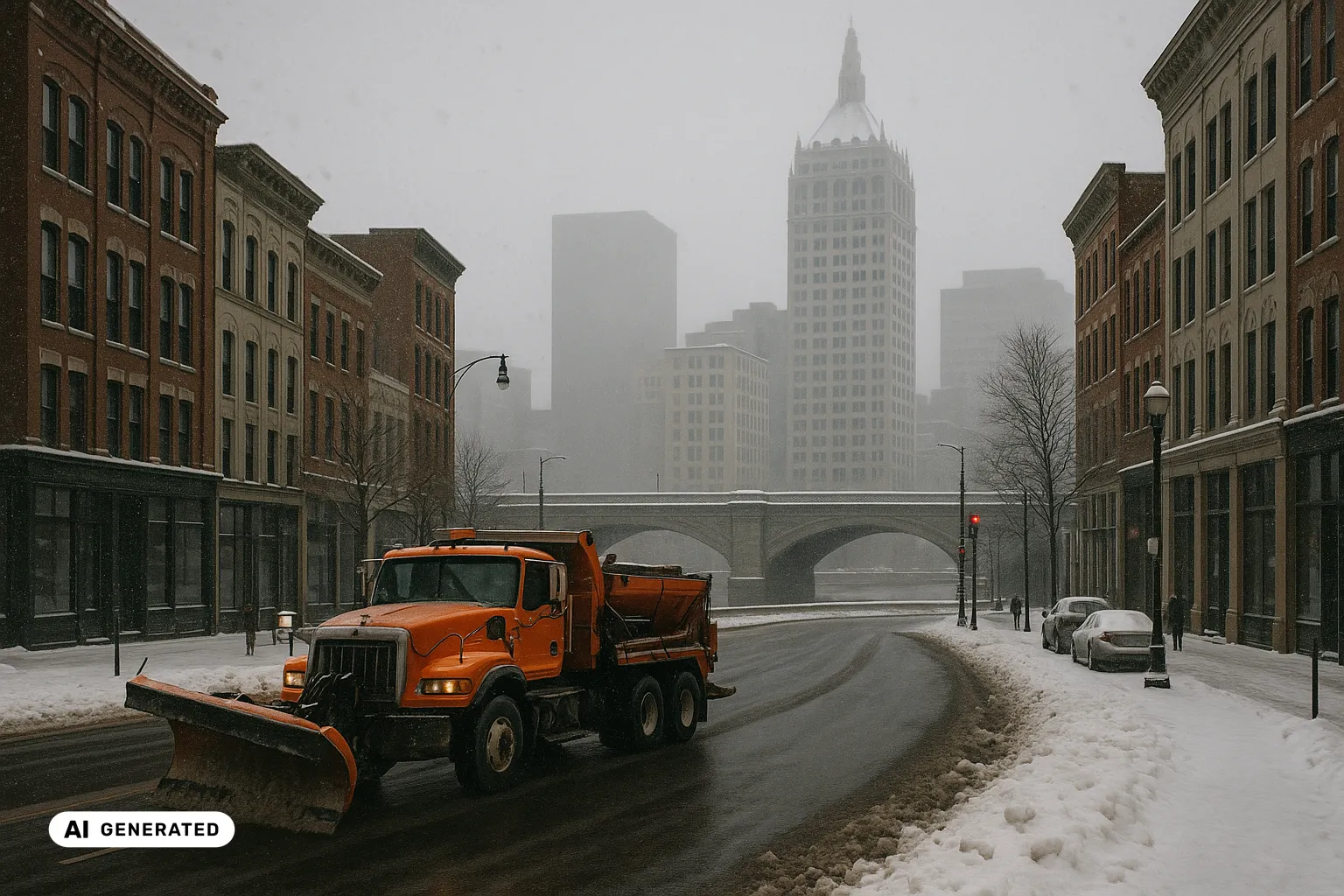
What winter actually does in Rochester
Rochester is a lake city, and that one fact shapes its whole winter. It sits on the southern shore of Lake Ontario, the fourth-largest city in New York State, with the Genesee River cutting straight through it on its way north into the lake. The 1991–2020 normals put it at about 102 inches of snow a year at the airport — a little above the round “hundred-plus” the city is usually credited with — falling across roughly 65 days, heaviest from December through February. There is a small local quirk worth knowing: February here edges out December for snow, which is not the pattern up the lake at Buffalo.
The snow is lake-effect off Lake Ontario, and it is the everyday kind rather than the record-book kind. The city has no single extreme snow-belt zone like the hills south of Buffalo; instead it gets a heavy, steady share of Ontario’s output, winter after winter. What makes Rochester genuinely unusual is not the amount of snow but what the city does about the sidewalks — and that is where this page really differs from its neighbours.
Lake Ontario, and how Rochester’s snow differs from Buffalo’s
The mechanics are worth being precise about, because the two great New York snow cities get their snow in opposite ways. Cold air crossing the relatively warm, open water of a Great Lake picks up moisture and heat, turns unstable, and organises into narrow, intense snow bands. Wind direction decides who gets hit. Buffalo sits at the western end of the shallower Lake Erie and takes its biggest bands on a west or south-west wind, piled onto the hilly Southtowns. Rochester sits on the southern shore of the deeper Lake Ontario, and its heaviest snow comes when a north or north-west wind runs the cold air down the long axis of the lake and wrings it out over the south shore — with Rochester and the lakeshore towns in the target corridor.
There is a second difference that matters for the length of the season. Lake Ontario freezes over far less completely than Lake Erie, so the lake-effect supply off Ontario can keep feeding snow later into the winter. The practical upshot: Rochester’s snow is steady and reliable rather than the single-storm spectacle Buffalo is famous for, and there is no one hotspot neighbourhood that takes wildly more than the rest of the city. It is a hundred-inch city that behaves like one all winter.
Who clears the sidewalk here — the City ploughs, and you still shovel
This is the part that sets Rochester apart. It is one of the very few US cities that plough residential sidewalks — but the arrangement has two layers that have to be kept apart, because both apply at once.
First, the municipal programme. Once four inches of new snow have fallen, the City sends contractors to plough the sidewalks — about 878 miles of them, every walk at least five feet wide, in roughly 15-mile routes that each take about five hours. It is paid for by an “embellishment fee” on the property-tax bill, scaled to the property’s front footage. Below four inches, the City does not come, and the walk is yours.
Second, the owner’s own duty, which the City plough does not cancel. Under the City of Rochester Code, Chapter 104 (Right-of-Way Code), §104-11, the owner of a building or lot must keep the adjoining sidewalk clear of snow and ice — not letting overnight snow remain past 9:00 a.m. — and must clear whatever the plough leaves behind, including the windrow thrown across an entrance and anything under the four-inch trigger. If snow or ice sits for 12 hours, the Commissioner of Environmental Services can have it removed and bill the owner, with 10% added if it goes unpaid and is placed against the property taxes. So the real picture is a partnership: the City does the bulk sidewalk ploughing that most American cities leave entirely to owners, and the owner keeps their own frontage genuinely clear on top of it. None of this is a substitute for legal advice — the exact wording of §104-11 sits in the City Code, and the point here is simply how the city approaches it.
How the City ploughs the streets — priorities, salt, and PlowTrax
On the roads, the Department of Environmental Services maintains 1,146 lane-miles of city street and spreads more than 20,000 tons of salt in a typical winter. Ploughing goes by three priority tiers: arterials and collectors first — the routes emergency services depend on — then local roads, bus routes and school areas, and finally the cul-de-sacs. A residential plough run is about eight miles and takes roughly five hours in routine snow, longer when it is heavy.
The salt strategy is more selective than a newcomer might expect: salt goes mainly on the main arterials and on secondary streets with special features — schools, bus routes, bridges and hills — while, as a rule, residential streets are not salted. The Genesee bridges and the city’s grades are exactly the kind of surfaces that ice first and get salt priority. During a snow event the City runs PlowTrax, a live GPS map showing where its roughly 150 plows are in real time. On parking, two rules keep the lanes open: no vehicle on a city street for more than 12 hours, and 65 designated “parking emergency streets” where on-street parking is banned once a winter parking emergency is declared. Rochester itself runs no citywide odd-even overnight ban — though, as ever, the suburbs differ.
Monroe County and the towns around it
Rochester is the seat of Monroe County, and the moment you cross the city line the rules can change. The county’s own snow-and-ice programme covers about 1,480 lane-miles of county highway through Monroe County DOT, and NYSDOT Region 4, headquartered in Rochester, handles the state highways through the city — so on a route that crosses city, county and state roads, the crew clearing each stretch depends on whose road it is. The suburbs — Irondequoit, Greece, Brighton, Gates, Henrietta, Pittsford, Penfield, Webster and the village of East Rochester among them — handle sidewalks unevenly: some, like Greece and Irondequoit, clear residential walks the way the city does; others plough only their main roads. Overnight winter parking bans vary too, town by town. Across Upstate, the other Golden Snowball cities — Buffalo, Syracuse, Binghamton and Albany — share the season’s weather from a friendly distance, but each answers the sidewalk question its own way, so a contractor who knows one city cannot assume the next.
Keeping the record straight
In a city where the sidewalk is a shared responsibility — the City ploughing the bulk of it, the owner clearing the rest under the Code — the useful thing is being able to show, plainly, what was done and when. Not to win an argument, but because a winter of steady lake-effect snow generates exactly the questions a vague answer cannot settle: was the frontage cleared, when, in what conditions, and what was left after the City plough went through. A simple, time-stamped record of each treatment, set against what the weather was actually doing, turns “we were out all morning” into something specific. That is the documentation support Wintertrace is built to make easy — a clear log of where a crew went and when — whether you look after a single frontage on a Genesee-side street or a run of routes across Monroe County. It does not change whose sidewalk is whose; it just means that when someone asks what happened during the last stretch of snow, the answer is on file. Not a substitute for legal advice.
Local facts
- Rochester averages about 102 inches (roughly 259 cm) of snow a year at the Greater Rochester International Airport, on the 1991–2020 climate normals — a little above the round '100-plus inches' the city is usually credited with.Source
- The snowiest months are January (about 27 inches), February (about 23 inches) and December (about 22 inches), with measurable snow on roughly 65 days a year — and, unusually, February edges out December here, unlike Buffalo up the lake.Source
- The snowiest season the National Weather Service has on record for Rochester was 1959–60 with 161.7 inches, just ahead of 1977–78's 160.9 inches (the NWS marks this table as unofficial; NCEI holds the official record).Source
- Rochester is the seat of Monroe County and the fourth-largest city in New York State (211,328 people in the 2020 census), sitting on Lake Ontario's southern shore with the Genesee River bisecting it on its way north into the lake; its metro area is about 1.05 million.Source
- It sits on the I-90 Thruway corridor about 74 miles from Buffalo and about 69 miles from Syracuse, linked to the interstate by I-490 and I-390.Source
- Rochester is one of the very few US cities that plough residential sidewalks: once four inches of new snow have fallen, the City sends contractors to plough the sidewalks; below four inches, residents clear their own.Source
- The programme covers about 878 miles of sidewalk — every walk at least five feet wide — run by private contractors in roughly 15-mile routes that each take about five hours, and it is paid for by an 'embellishment fee' on the property-tax bill, scaled to the property's front footage.Source
- The City plough does not end the owner's duty: under the City of Rochester Code, Chapter 104 (Right-of-Way Code), §104-11, the owner of a building or lot must keep the adjoining sidewalk clear of snow and ice — not letting it remain past 9:00 a.m. when it fell overnight — and must remove whatever the City plough leaves behind.Source
- Under the same chapter, the Commissioner of Environmental Services may remove snow or ice that has sat on a sidewalk for 12 hours and bill the owner for the work, adding 10% if it goes unpaid and is placed against the property taxes.Source
- On the roads, the City's Department of Environmental Services maintains 1,146 lane-miles of street and spreads more than 20,000 tons of salt in a typical winter, ploughing in three priority tiers — arterials and collectors first, then local roads, bus routes and school areas, then cul-de-sacs.Source
- Salt goes mainly on the main arterials and on secondary streets with special features — schools, bus routes, bridges and hills — and, as a rule, residential streets are not salted.Source
- During a snow event the City runs PlowTrax, a live GPS map that shows the current location of about 150 plows.Source
- Winter parking is governed by a 12-hour on-street limit and a list of 65 'parking emergency streets' where on-street parking is banned during a declared winter parking emergency; the City itself does not run a citywide odd-even overnight ban.Source
- Beyond the city streets, Monroe County DOT keeps about 1,480 lane-miles of county highway under its own snow-and-ice programme, and NYSDOT Region 4 — headquartered in Rochester — handles the state highways through the city.Source
Official contacts
City of Rochester — Sidewalk Snow Removal
The municipal programme under which the City ploughs residential sidewalks once four inches fall — how it works, the five-foot rule, and how the embellishment fee funds it.
City of Rochester — Street Snow Plowing and Salting
How the Department of Environmental Services ploughs and salts the roads: the three priority tiers, the salt strategy, and the residential plough runs.
The live GPS map that shows where the City's roughly 150 plows are during a snow event.
City of Rochester — Winter & snow parking rules
The 12-hour on-street limit and the 65 parking emergency streets where parking is banned during a declared emergency.
The county's snow-and-ice control programme for the county highways outside the city's own network.
The State's regional office, based in Rochester, responsible for the state highways that run through the city.
Common questions about winter service in Rochester
- How much snow does Rochester get?
- About 102 inches a year at the airport on the 1991–2020 normals — a little above the round 'hundred-plus inches' the city is usually credited with. It arrives across roughly 65 snow days, heaviest from December through February, and it is overwhelmingly lake-effect snow off Lake Ontario. So this is a real, sustained snow city: not the record-holder of the region, but reliably over a hundred inches winter after winter.
- Do I have to shovel my own sidewalk in Rochester?
- The honest answer here has two halves. Rochester is one of the very few US cities that plough residential sidewalks — once four inches of new snow fall, City contractors plough the walks. But that does not end your own duty: under the City of Rochester Code, Chapter 104, §104-11, the property owner must keep the adjoining sidewalk clear of snow and ice (not letting overnight snow remain past 9:00 a.m.), and must remove whatever the plough leaves behind — the windrow across your entrance, and anything under the four-inch trigger. If snow or ice sits for 12 hours, the City can clear it and bill the owner. So the picture is a partnership, not a hand-off: the City does the bulk sidewalk ploughing, you keep your own frontage genuinely clear. This is general information, not a substitute for legal advice.
- When does the City actually plough the sidewalks?
- Once four inches of new snow have accumulated. Below that threshold, residents are expected to clear their own walks; at four inches and above, the City's private contractors plough about 878 miles of sidewalk — every walk at least five feet wide — in roughly 15-mile routes that each take about five hours. The whole programme is paid for by an 'embellishment fee' on the property-tax bill, scaled to how much frontage a property has. It is an unusual arrangement for an American city, and it is why the sidewalk question in Rochester has a different answer than in most places.
- How is Rochester's snow different from Buffalo's?
- Different lake, different geometry. Buffalo sits at the western end of the shallower Lake Erie and takes its heaviest bands on a west or south-west wind, dumped onto the hilly Southtowns. Rochester sits on the southern shore of the deeper Lake Ontario and gets its heaviest snow when a north or north-west wind runs the cold air down the long axis of the lake and unloads it on the south shore. Lake Ontario also freezes over far less completely than Erie, so lake-effect snow off it can keep coming later into the season. Rochester has no single extreme snow-belt zone the way Buffalo's Southtowns do — its snow is heavy and steady rather than record-breaking.
- Where can I park during a snowstorm in Rochester?
- Two rules matter. First, a vehicle cannot be left on a city street for more than 12 hours (except where other signs say otherwise), which keeps the plough lanes clear. Second, the City designates 65 'parking emergency streets' where on-street parking is banned once a winter parking emergency is declared — so those are the streets to move off first. Note that the city itself does not run a citywide odd-even overnight parking ban, though some Monroe County suburbs around it do have their own overnight winter parking rules, so check the local one where you actually park.
- Can I see where the plows are?
- Yes. During a snow event the City runs PlowTrax, a live GPS map showing the current location of about 150 plows. It is the quickest way to see whether your street has been reached yet, and it takes a lot of the guesswork — and the phone calls — out of a long night of ploughing.
- Who clears the highways and state roads through Rochester?
- It depends whose road it is. The City's Department of Environmental Services handles the 1,146 lane-miles of city street. Monroe County DOT runs its own snow-and-ice programme on about 1,480 lane-miles of county highway. And NYSDOT Region 4, based in Rochester, looks after the state highways through the city. So on any given route, which crew is clearing it comes down to the road's ownership — worth knowing if your work crosses several of them in a shift.
- What about the suburbs — do the towns around Rochester plough sidewalks too?
- Not uniformly, which is exactly why the city's arrangement stands out. Within Monroe County the practice varies town by town: some, like Greece and Irondequoit, offer municipal sidewalk clearing, while others plough only their main roads and leave residential walks to owners. Overnight winter parking bans differ too — East Rochester, for instance, bans overnight on-street parking through the winter months. So the moment you cross from the City of Rochester into a neighbouring town, the sidewalk and parking rules can change under you. Check the specific municipality's rules; this is general information, not legal advice.
Documenting winter service in Rochester
Anyone clearing snow and ice in Rochester may later need to show when and where a route was treated. Wintertrace is open-source software that records exactly that — time, location and weather for each run — as a calm basis for your own operational records and service proof. It is not a substitute for legal advice.
This overview is for general information and is not legal advice. Local rules on snow and ice clearing vary — the wording of the local rule and the responsible authority always govern.