Winter service · New York
Winter service in Albany
What winter is really like in Albany: about 59 inches of snow a year — the least of the five Golden Snowball cities — from nor'easters and Alberta clippers, not lake-effect. The steep State Street climb to the Empire State Plaza, the City's owner-clears-the-sidewalk rule under §323-21, the even/odd Snow Emergency parking rhythm, and where the city ends and the state begins.
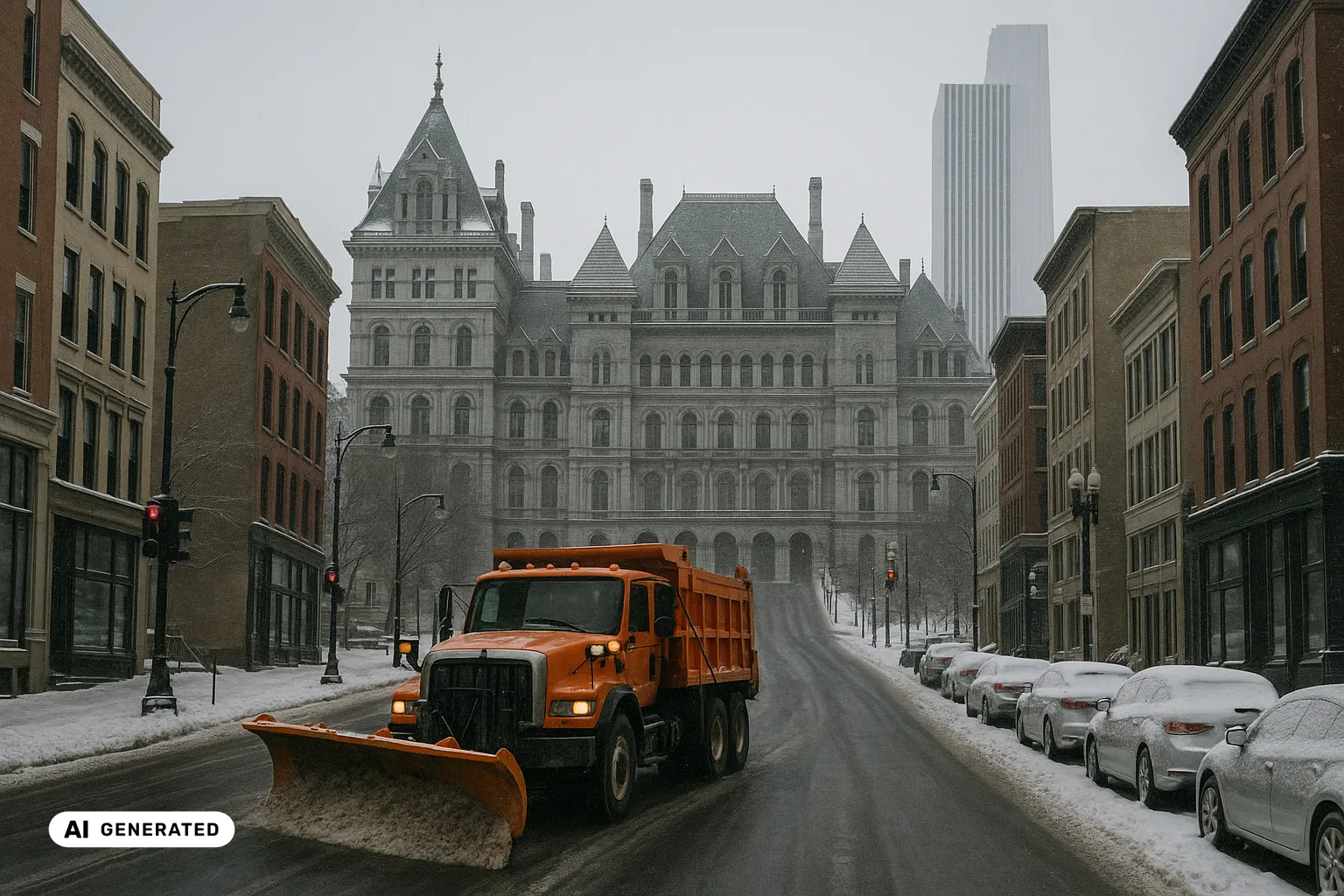
What winter actually does in Albany
Albany is the capital of New York State, and its winter is the quiet counterpoint to the lake-effect cities that dominate the state’s snow reputation. It sits on the west bank of the Hudson River, about 10 miles south of where the Hudson meets the Mohawk and roughly 135 miles north of New York City, at the core of the Capital District — a metro area of about 1.3 million people. The airport records around 59 inches of snow in an average year: a real winter, but the least of the five Golden Snowball cities, and less than half what falls on Syracuse. Here the defining hazard is not depth. It is cold and ice, arriving in many moderate falls across the season rather than in a handful of monster storms.
That difference is worth stating plainly, because it shapes everything about the work. Albany’s snow is spread evenly through the core winter — January averages about 15.6 inches, February 13.7, December 13.3 and March 12.0, with measurable snow on roughly 34 days a year. There is no single extreme month to brace for; instead there is a long, steady season of freeze-and-thaw, of grades that ice overnight, and of the occasional heavy nor’easter. The record cold here is −28 °F, set in January 1971. For anyone keeping ground clear, the job is less about digging out from a wall of snow and more about staying ahead of ice on a hilly, busy capital, week after week.
No lake, a different kind of snow
What makes Albany unlike Buffalo and Syracuse is simple: there is no lake. Lake-effect snow needs cold air to cross a long fetch of open, relatively warm water, which is exactly what happens off Lake Erie at Buffalo and Lake Ontario at Syracuse. Albany sits in the upper Hudson Valley, well to the east of the Great Lakes and ringed instead by the Adirondacks to the north, the Catskills to the south-west, the Berkshires and Taconics to the east and the Mohawk Valley to the north-west. Its snow comes from two synoptic sources: nor’easters, the coastal storms that track up the Atlantic seaboard and can drop a heavy, wet fall in a day, and Alberta clippers, the fast, dry low-pressure systems that sweep down out of Canada with lighter, powdery snow and a shot of cold behind them.
That mechanism is why the monthly totals are so level — no lake to fire off a week of relentless bands, just a succession of passing systems through the winter. It also caps the extremes. Albany’s snowiest season on record, 1970–71, brought 112.5 inches; the least snowy, 1912–13, only 13.8. Both figures come from the National Weather Service’s Albany record, which runs back to 1884. Put those next to the lake cities and the contrast is stark: Buffalo and Syracuse have each had seasons near 200 inches, roughly double Albany’s all-time high. Albany’s winter is not milder in temperature — the cold is genuine — but it is shallower in snow, and that shapes how a season is planned here.
The Golden Snowball — the modest member
Upstate New York turns its snow into a contest, and Albany is in it. The Golden Snowball Award tracks the season’s snowfall across the five biggest cities — Buffalo, Rochester, Syracuse, Binghamton and Albany — and hands the title to the snowiest each spring. Albany is the one that almost never wins: it is reliably the least snowy of the five. The record books tell the same story, with Buffalo’s 199.4 inches (1976–77) and Syracuse’s 192.1 inches (1992–93) towering over Albany’s 112.5-inch best.
There is no shame in it — being the modest member of a snow rivalry is a fair portrait of Albany’s winter. The city shares the season and the cold with its Upstate neighbours but carries a different signature: where Syracuse manages a relentless lake-effect grind and Buffalo braces for the single burying storm, Albany deals with cold, ice and the occasional sharp nor’easter on ground that complicates all three. That ground is the next part of the story.
Climbing from the river — State Street and the Capitol
Albany’s terrain does more to shape its winter work than its snowfall total does. The city climbs steeply from the Hudson: the low ground at the river sits only about 2 to 4 feet above sea level, while the natural high point near the Loudonville Reservoir reaches 378 feet, and the downtown plateau that carries the State Capitol and the Empire State Plaza rises to roughly 200–500 feet. The spine of that climb is State Street, a genuine grade running up from the water — and a grade is exactly what loses grip first in a freeze. Layer on the dense pedestrian and commuter traffic of a state-government district on that same rise, and the most demanding ground to keep safe is the busy, sloping core, not the flatter neighbourhoods.
The government district also introduces a split in responsibility that most cities never have to think about. The Empire State Plaza and the State Capitol are a state-owned complex, maintained by the New York State Office of General Services (OGS) — not the city. The City of Albany’s Department of General Services handles the city streets and the sidewalk rule. Because state-owned ground abuts city sidewalks right through the Capitol area, the line between who clears what runs through the daily walking route. Down at the bottom of the hill, the Hudson riverfront and the I-787 corridor are a different problem again: flat, but low, cold and wind-exposed along the water.
What the local rules say — the owner clears the sidewalk
On the sidewalks, Albany keeps the traditional arrangement: the property owner clears them. Under the City of Albany Code (Chapter 323, §323-21), the owner or occupant of a property must clear the sidewalk in front of it within 24 hours of a snowfall ending, and where the ice has frozen too hard to remove, it must be treated with ashes, sand or the like until it can be cleared. The City states the same in plain terms on its winter page: the ordinance “puts the responsibility of clearing sidewalks on property owners,” to be done within 24 hours of the storm’s end.
This is precisely the opposite of Syracuse across the state, which in 2021 took the job off owners and had the City clear the sidewalks itself. In Albany the duty stays with the owner, and it has teeth: if a walk is left uncleared, the Department of General Services can clear it and issue the owner a bill for the cost plus a fine. It is also against the rules to push snow from a sidewalk, lot or driveway into a city street — a common temptation that simply moves the hazard onto the road. The City’s page does not publish a set fine figure, so none is quoted here; the point is that the responsibility, and the cost of ignoring it, sit with the owner. This is general information, not a substitute for legal advice.
How the city plows — and the Snow Emergency parking rhythm
On the roads, the City of Albany Department of General Services plows the city streets in priority order — emergency routes and main roads first, then the remaining streets. The mechanism most residents actually feel, though, is the Snow Emergency. When the City declares one, the normal parking rules give way to an even/odd rhythm so the plows can clear each street kerb to kerb: for the first 24 hours you park on the even-numbered side of the street, then move to the odd-numbered side for the next 24, with hydrants, crosswalks and accessible spaces kept clear throughout. Declared emergencies and the switch-over are communicated through the Albany Parking Authority, so for a resident the drill is straightforward: watch for the declaration and move the car in time.
Beyond the city’s own streets, the usual patchwork of authorities applies. The state highways and the Thruway through the region — the Northway (I-87), the I-90 Thruway and I-787 along the river — are state responsibilities, run by NYSDOT and the Thruway Authority rather than the City, and the surrounding towns each plow their own roads. As ever, which crew is clearing a given road depends on whose road it is — and in a capital that mix includes the state itself.
The Capital District around it
Albany is the seat of Albany County and the anchor of the wider Capital District, and its neighbours each run their own roads and winter rules. Closest in are the towns and small cities of Albany County: Colonie — which contains Albany International Airport, where the climate station sits, along with the Wolf Road commercial strip — plus Cohoes and Watervliet at the rivers’ edge, Guilderland, Bethlehem and New Scotland. Across and up the water lie Rensselaer directly opposite, Troy the “Collar City,” and, further out, Schenectady and Saratoga Springs.
The sharpest local gradient runs west. As the land rises toward the Helderberg Escarpment and the rural Hilltowns — Berne, Knox, Westerlo, Rensselaerville — the snow totals climb above what falls in the lower downtown, the same terrain-and-elevation effect that gives every hill town more winter than the valley below it. And across Upstate, the Golden Snowball neighbours — Syracuse, Buffalo, Rochester and Binghamton — share the season from a friendly distance, on a completely different snow supply. Cross any of those lines and the totals, the crews and the rules change with them.
Keeping the record straight
In a city where the winter is defined less by a single storm than by a long season of cold, ice and steady moderate snow — thirty-odd days of it, on grades that ice overnight, with the city clearing the streets and owners clearing the walks — the useful thing is being able to show, plainly, what was done and when. Not to win an argument, but because a season this drawn-out generates exactly the questions a vague answer cannot settle: was the route treated, when, and in what conditions. A simple, time-stamped record of each treatment, set against what the weather was actually doing, turns “we were out all week” into something specific. That is the documentation support Wintertrace is built to make easy — a clear log of where a crew went and when — whether you look after a single property on the State Street hill or a run of routes across the Capital District. It does not change whose sidewalk is whose; it just means that when someone asks what happened during the last stretch of winter, the answer is on file. Not a substitute for legal advice.
Local facts
- Albany averages about 59 inches (roughly 150 cm) of snow a year at Albany International Airport on the NCEI 1991–2020 normals — a figure the National Weather Service in Albany gives identically as a 59.2-inch normal.Source
- The snow is spread evenly across the core season rather than concentrated in a few big events: January averages about 15.6 inches, February 13.7, December 13.3 and March 12.0, with measurable snow on roughly 34 days a year.Source
- Albany's snow comes from nor'easters — coastal lows tracking up the Atlantic seaboard — and fast, dry Alberta clippers out of Canada, not from lake-effect off the Great Lakes.Source
- The snowiest season on record was 1970–71 with 112.5 inches, the highest in the NWS Albany series that runs back to 1884; the least snowy was 1912–13 with just 13.8 inches.Source (PDF)
- The record low temperature is −28 °F (−33 °C), set on 19 January 1971 — cold, not snow depth, is the defining winter hazard here.Source
- Albany sits on the west bank of the Hudson River, about 10 miles south of where the Hudson meets the Mohawk and roughly 135 miles north of New York City; it is the capital of New York State and the core of the Capital District, a metro area of about 1.3 million.Source
- The city climbs sharply from the river: the low ground at the Hudson sits only about 2 to 4 feet above sea level, while the natural high point near the Loudonville Reservoir reaches 378 feet, and the downtown plateau carrying the Capitol and Empire State Plaza rises to roughly 200–500 feet — which is why State Street is a steep grade up from the water.Source
- The Golden Snowball Award is the annual contest for the most seasonal snow among the five biggest Upstate New York cities — Buffalo, Rochester, Syracuse, Binghamton and Albany — and Albany is reliably the least snowy of the five.Source
- The gap in record seasons shows the same order: Buffalo's 199.4 inches (1976–77) and Syracuse's 192.1 inches (1992–93) sit far above Albany's 112.5-inch record — the lowest of the group's peaks.Source
- Under the City of Albany Code (Chapter 323, §323-21), the owner or occupant of a property must clear the sidewalk in front of it within 24 hours of a snowfall ending, and where the ice has frozen too hard to remove it must be treated with ashes, sand or the like until it can be cleared.Source
- If a sidewalk is left uncleared, the City's Department of General Services can clear it and issue the owner a bill for the cost plus a fine; it is also against the rules to push snow from a sidewalk, lot or driveway into a city street.Source
- On the roads, the City of Albany Department of General Services plows the city streets in priority order — emergency routes and main roads first, then the remaining streets.Source
- When the City declares a Snow Emergency, an even/odd parking rhythm takes over so streets can be cleared kerb to kerb: park on the even-numbered side for the first 24 hours, then move to the odd-numbered side for the next 24, keeping hydrants, crossings and accessible spaces clear throughout.Source
- The Empire State Plaza and the State Capitol are a state-owned complex maintained by the New York State Office of General Services, not the city — so the line between who clears what runs right through the government district.Source
Official contacts
City of Albany — Snow Removal (Department of General Services)
The City's official winter page: the sidewalk rule, how the DGS plows the streets, and the Snow Emergency even/odd parking rhythm.
City of Albany Code — Chapter 323, §323-21 (snow and ice removal)
The ordinance placing sidewalk clearing on the property owner within 24 hours of a snowfall ending.
Where declared Snow Emergencies and the alternate-side parking rules are communicated to residents.
National Weather Service, Albany — Seasonal Snowfall Totals (1884–present)
The full seasonal snowfall record for Albany, including the 1970–71 record, as a PDF.
Common questions about winter service in Albany
- How much snow does Albany actually get?
- About 59 inches (150 cm) a year at Albany International Airport on the 1991–2020 normals — a figure the National Weather Service in Albany gives identically. That is a real winter, but it is far less than the lake-effect cities to the west: it makes Albany the least snowy of the five Golden Snowball cities. What sets the season apart is not the total but the spread and the cold — the snow arrives in many moderate falls from December through March rather than in a few huge storms, and the record low here is −28 °F.
- Why doesn't Albany get lake-effect snow like Buffalo and Syracuse?
- Because it is nowhere near a Great Lake. Lake-effect snow needs cold air to cross a long stretch of open, relatively warm water — which is what happens off Lake Erie at Buffalo and Lake Ontario at Syracuse. Albany sits in the upper Hudson Valley, well east of the lakes, ringed instead by the Adirondacks, Catskills, Berkshires and the Mohawk Valley. Its snow comes from nor'easters — coastal storms tracking up the Atlantic seaboard — and from fast Alberta clippers dropping down out of Canada. That is why its snow is spread evenly across the winter instead of dumped in a few enormous bands.
- Do I have to shovel my own sidewalk in Albany?
- Yes. Under the City of Albany Code (§323-21), the owner or occupant of a property has to clear the sidewalk in front of it within 24 hours of a snowfall ending, and if the ice has frozen too hard to lift it must be treated with ashes, sand or the like until it can be removed. If a walk is left uncleared, the Department of General Services can clear it and bill the owner for the cost plus a fine. This is the classic owner-responsibility model — and it is the opposite of Syracuse across the state, where the City itself now clears the sidewalks. This is general information, not a substitute for legal advice.
- What is a Snow Emergency in Albany, and where can I park?
- When the City declares a Snow Emergency, the normal parking rules give way to an even/odd rhythm so the plows can clear each street from kerb to kerb. For the first 24 hours you park on the even-numbered side of the street; after that you move to the odd-numbered side for the next 24. Hydrants, crosswalks and accessible spaces stay clear throughout. Declared emergencies and the switch-over are communicated through the Albany Parking Authority, so the practical drill for a resident is to watch for the declaration and move the car in time to avoid a ticket or a tow.
- Who clears the Empire State Plaza and the Capitol — the city?
- No — that is the state's job, not the city's. The Empire State Plaza and the State Capitol are a state-owned complex maintained by the New York State Office of General Services, while the City of Albany's Department of General Services handles the city streets and enforces the sidewalk rule. Because the government district sits on the downtown high ground with state-owned ground abutting city sidewalks, the line between who clears what runs right through the daily walking route around the Capitol. It is a wrinkle unique to a capital city.
- Why is downtown Albany tricky to keep clear in winter?
- The terrain. Albany climbs from the Hudson — only a couple of feet above sea level at the water — up onto a plateau at roughly 200 to 500 feet that carries the Capitol and the Empire State Plaza. State Street is the steep spine of that climb, and grades lose grip first in a freeze. Add the dense pedestrian and commuter traffic of a state-government district on that same rise, and the hardest ground to keep safe is the busy, sloping core rather than the flatter neighbourhoods. The low, wind-exposed strip along the river and I-787 is a different problem again — flat, but cold and open.
- What is the Golden Snowball, and where does Albany come in it?
- It is a friendly annual contest for the most seasonal snow among the five biggest Upstate New York cities — Buffalo, Rochester, Syracuse, Binghamton and Albany — tracked through the winter and settled in spring. Albany is the one that almost never wins: it is reliably the least snowy of the five. The order shows in the record books too, where Buffalo's and Syracuse's best seasons sit near 200 inches while Albany's record is 112.5. Being the modest member of a snow contest is itself a fair description of Albany's winter — genuine, but defined more by cold and ice than by depth.
- Does the rest of the Capital District get the same amount of snow?
- Roughly, but with real variation and separate local rules. Albany's immediate neighbours — Colonie, which contains the airport where the climate station sits, plus Cohoes, Watervliet, Guilderland and Bethlehem, and Troy, Rensselaer and Schenectady across and up the rivers — each run their own roads and their own winter rules. The clearest gradient is to the west: as the land rises to the Helderberg Escarpment and the rural Hilltowns like Berne and Knox, the snow totals climb above what falls in the lower downtown. Cross a town line or head uphill and both the numbers and the rulebook change.
Documenting winter service in Albany
Anyone clearing snow and ice in Albany may later need to show when and where a route was treated. Wintertrace is open-source software that records exactly that — time, location and weather for each run — as a calm basis for your own operational records and service proof. It is not a substitute for legal advice.
This overview is for general information and is not legal advice. Local rules on snow and ice clearing vary — the wording of the local rule and the responsible authority always govern.