Winter service · Quebec
Winter service in Quebec City
What winter is really like in Quebec City: roughly 300 cm of snow a year, the City clearing streets, sidewalks and stairs itself, the two-phase déneigement, the 1 Nov–15 Apr parking ban and the permit you need to push snow onto the street.
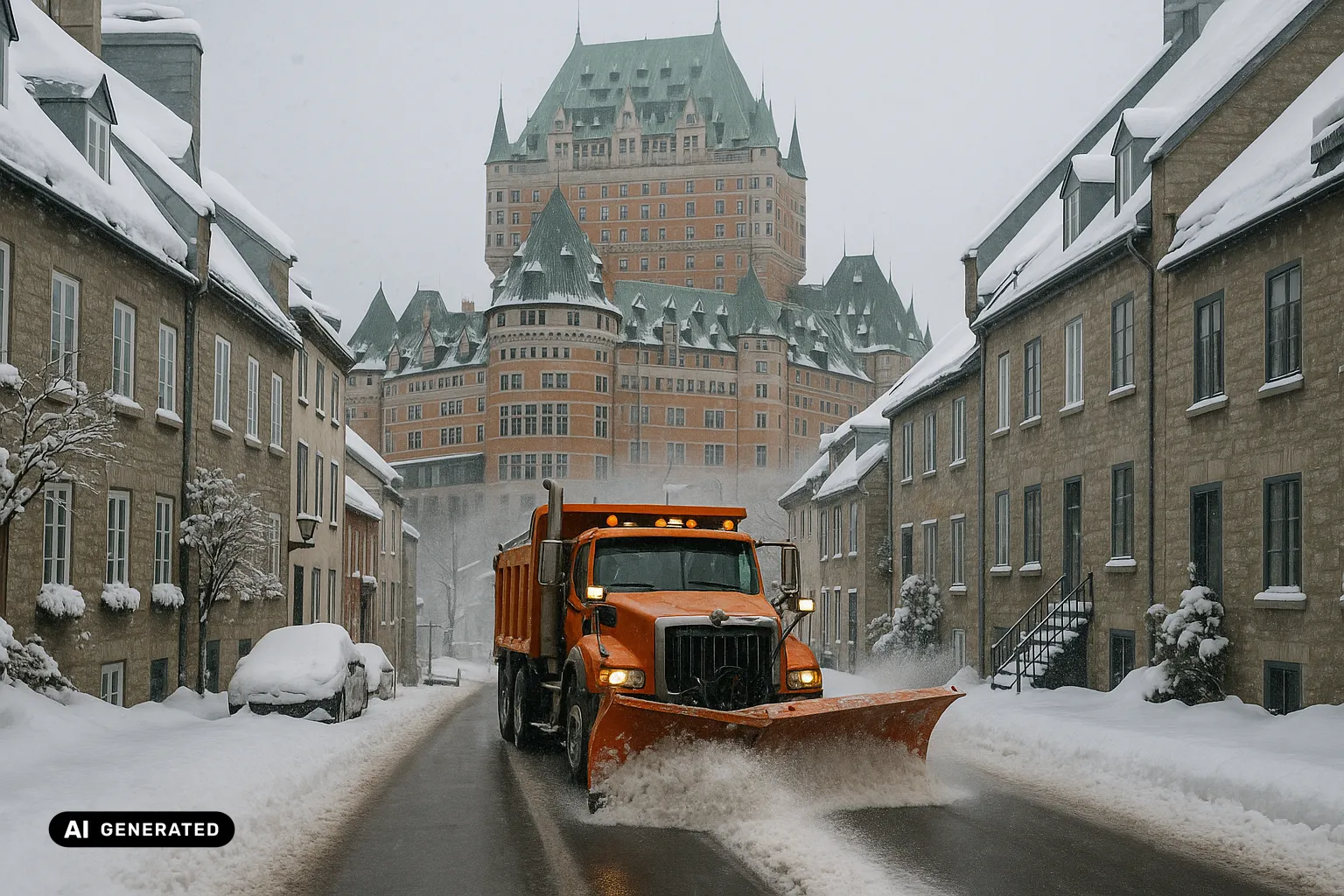
How Quebec City sits, and what winter does here
Quebec City stands on the north bank of the Saint Lawrence, at the point where the river narrows and meets the mouth of the Saint-Charles. It is built on and around Cap-Diamant, the promontory that splits the city into Upper Town (Haute-Ville) on the heights and Lower Town (Basse-Ville) below — a vertical geography, full of steep streets and public stairs, that shapes winter here as much as the cold does. This is the provincial capital, about 549,000 people in the city and 839,000 across the region.
The snow is the headline. Quebec City is regularly counted among the snowiest large cities in the world, and the long-standing 1981–2010 normals put it at around 300 cm a year (303.4 cm at Jean Lesage airport), with snow on the ground roughly 140 days. It is worth being honest about the number: the newer 1991–2020 normals, recorded with different instruments at the same station, come out noticeably lower at about 223 cm — a change widely understood to be mostly about measurement method rather than a real halving of the snow. Either figure describes a city built for deep winter. January is the coldest month, with an average high of −7.9 °C and a low of −17.7 °C, and the snowpack holds from December into early April.
Put the volume and the vertical city together and you get the defining problem: there is far too much snow to leave at the kerb on streets this steep and this historic — so, like Montreal downriver, Quebec City does not just plow the snow aside. It hauls much of it away.
How the system works
Snow clearing here is the City’s responsibility to a degree newcomers often do not expect. According to the City of Québec, it (or its contractor) clears the snow from all cadastred streets except provincial and federal roads, and clearing qualifying sidewalks is part of its basic service. In other words, residents are generally not required to clear the public sidewalk along their property — the City does it.
The work comes in two phases. First is grattage et épandage — crews scrape the roads, sidewalks and bike paths and spread grit or de-icer, pushing the snow to the sides. Then, once the snow stops, comes enlèvement: removing what was banked, either by blowing it onto adjacent land or by loading it into trucks and hauling it to a snow depot (dépôt à neige). Given the volumes, that second phase is routine here, not a rare event.
How fast a given street or walk is cleared depends on its service level. Priority sidewalks (T1) are cleared starting at 3 cm of snow and standard ones (T2) at 5 cm; roads run from continuously-treated main and steep routes (C0) down through arterials and collectors to residential streets (C3) last. The steep stairs and pedestrian links of Cap-Diamant are their own category: those that join two cleared areas and form a substantial shortcut are cleared, which matters a great deal when the alternative is a long way around a hill.
For anyone parking on the street, the key rule is the seasonal parking ban. From 1 November to 15 April, on-street parking is prohibited whenever a snow-removal operation is underway — the exact hours vary by borough and by operation. A vehicle left in place can be ticketed or towed. To keep ahead of it, the Info-Déneigement line (418 641 6666) is updated twice a day, at 7:30 and 17:00, alongside email and SMS alerts and a live blinking-lights map showing where crews are working; if a car is moved, Info-Remorquage helps locate it.
These are the City of Québec’s own policies, and the detail can change season to season — the official pages linked below carry the current version. None of this is legal advice.
Clearing your own property — and the permit
One rule catches people out, especially anyone hiring help: where the snow from your own property may go. According to the City, it is prohibited to deposit snow or ice on the street or sidewalk without a snow-clearing permit (permis de déneigement). That applies not only to a homeowner but to a private contractor you hire to clear a driveway — for them to push snow into the street, the permit is required. A violation can bring a fine of $300 to $4,000. The practical takeaway is simple: snow cleared from a property is meant to stay on that property (or be placed at the kerb before crews pass), not be added to the public road, and anyone arranging private clearing should confirm how their contractor handles it.
On the ground: where it gets tricky
A few things make winter service here distinctive. The Cap-Diamant slopes turn ordinary streets into steep, ice-prone climbs, and the public stairs between the two towns are part of the pedestrian network that has to be kept usable. The narrow, historic lanes of Vieux-Québec — a UNESCO World Heritage site — leave little room for banked snow or large equipment, which is exactly why snow is hauled out rather than stored at the side. And the sheer length of the season, from November into April, means the passes and the haul-away cycles repeat for months.
Over a winter that deep, a dated record of when and where each route was cleared, and under what weather, is far easier to stand behind later than memory — useful whether you run a route or simply want to know what was done and when.
Around Quebec City
The City’s rules cover the city and its boroughs — Sainte-Foy, Beauport and Charlesbourg among them are part of Quebec City itself — but not the separate municipalities nearby. L’Ancienne-Lorette and Saint-Augustin-de-Desmaures are independent towns within the agglomeration, each with its own clearing. And across the river, Lévis on the south shore is a wholly separate city with its own winter rules, reached by the Quebec Bridge, the Pierre-Laporte Bridge or the ferry — those bridges being provincial infrastructure rather than city déneigement. Crossing the water, or a municipal line, can mean different rules and timing, so anyone working across the region is better off checking each one than assuming Quebec City’s system carries over.
Local facts
- Average annual snowfall is around 300 cm in the long-standing 1981–2010 normals (303.4 cm at Québec/Jean Lesage airport) — one of the snowiest big cities anywhere. The newer 1991–2020 normals, measured differently, report a lower figure near 223 cm. Snow lies on the ground roughly 140 days a year.Source
- January is the coldest month, with an average daily high of −7.9 °C and a low of −17.7 °C; snow builds from December and holds into early April.Source
- According to the City of Québec, the City (or its contractor) clears the snow from all cadastred streets except provincial and federal roads, and clearing qualifying sidewalks is part of its basic service — so residents are not required to clear the public sidewalk along their property.Source
- Clearing runs in two phases: first grattage et épandage (scraping the roads, sidewalks and bike paths and spreading grit or de-icer), then enlèvement — removing the snow either by blowing it onto adjacent land or trucking it to a snow depot (dépôt à neige).Source
- Service is tiered by trigger: priority (T1) sidewalks are cleared starting at 3 cm and standard (T2) sidewalks at 5 cm, while roads run from continuously-treated main and steep routes (C0) down to residential streets (C3).Source
- Public stairs and pedestrian links between the Upper and Lower Town are a distinct category in the City's snow policy; stairs that connect two cleared areas and form a substantial shortcut are cleared.Source (PDF)
- From 1 November to 15 April, on-street parking is banned during snow-removal operations; a vehicle left in place can be ticketed or towed. The Info-Déneigement line (418 641 6666) is updated twice a day, at 7:30 and 17:00, alongside email/SMS alerts and a live blinking-lights map.Source
- According to the City, it is prohibited to deposit snow or ice on the street or sidewalk without a snow-clearing permit (permis de déneigement) — this applies to a private contractor you hire too — and a violation can bring a fine of $300 to $4,000.Source
- Quebec City sits on the north bank of the Saint Lawrence where it narrows at the mouth of the Saint-Charles River, built on Cap-Diamant and split into Upper Town (Haute-Ville) and Lower Town (Basse-Ville). It is the provincial capital, with about 549,000 residents (metro 839,000).Source
Official contacts
The City's snow-clearing hub (in French): phases, service levels, schedules and the Info-Déneigement tools.
The on-street parking ban, the Info-Déneigement line (418 641 6666), and Info-Remorquage for a towed vehicle (in French).
Déneigement d'un terrain (permit)
Clearing your own property: where snow may be placed, the permis de déneigement, and the $300–$4,000 fine for dumping snow on the street (in French).
Common questions about winter service in Quebec City
- Do I have to clear the sidewalk in front of my home in Quebec City?
- No — not the public sidewalk. According to the City's snow policy, the City (or its contractor) clears the streets, and clearing qualifying sidewalks is part of its basic service. What you handle is your own private ground — the path, steps and driveway on your property — and, importantly, where you put that snow (see the permit question below).
- How much snow does Quebec City really get?
- A lot — it is regularly listed among the snowiest large cities in the world. The well-established 1981–2010 normals put it around 300 cm a year (303.4 cm at the airport), with snow on the ground roughly 140 days. The newer 1991–2020 normals, recorded with different instruments, come out lower at about 223 cm; the drop is largely a measurement change rather than a real halving. Either way, this is a city built for deep, long winters.
- What are the two phases of déneigement?
- First comes grattage et épandage — crews scrape the roads, sidewalks and bike paths and spread grit or de-icer, pushing snow to the sides. Then, once the snowfall ends, comes enlèvement: the snow is removed, either blown onto adjacent land or loaded into trucks and hauled to a snow depot. With Quebec City's volumes, that haul-away phase is the norm, not the exception.
- When is on-street parking banned, and how do I check my street?
- Between 1 November and 15 April, parking on the street is banned whenever a snow-removal operation is underway — the exact hours vary by borough and by operation. Call the Info-Déneigement line at 418 641 6666 (updated at 7:30 and 17:00), sign up for email or SMS alerts, or watch the live blinking-lights map to see where crews are working.
- Can I — or a contractor I hire — push snow from my property onto the street?
- Not without a permit. According to the City, it is prohibited to deposit snow or ice on the street or sidewalk without a permis de déneigement, and this applies to a private snow-clearing contractor you hire as well. A violation can bring a fine of $300 to $4,000, so anyone clearing a driveway needs to know where the snow may legally go.
- Are the stairs between the Upper and Lower Town cleared?
- Some are. The steep Cap-Diamant split between Haute-Ville and Basse-Ville means public stairs and pedestrian links matter for getting around, and the City's policy treats them as their own category. Stairs that connect two already-cleared areas and form a substantial shortcut are cleared; lesser links may not be, so it is worth knowing which route stays open in winter.
- My car was towed during a snow operation — where is it?
- Vehicles left on the street during an operation are usually relocated rather than impounded far away. The City's Info-Remorquage service helps you locate a towed or moved vehicle; the same Opérations de déneigement page that explains the parking ban links to it.
- Do the same rules apply across the river in Lévis?
- No. Lévis is a separate city on the south shore of the Saint Lawrence, with its own winter rules, reached by the Quebec Bridge, the Pierre-Laporte Bridge or the ferry. Closer in, L'Ancienne-Lorette and Saint-Augustin-de-Desmaures are independent municipalities within the agglomeration, while Sainte-Foy, Beauport and Charlesbourg are boroughs of Quebec City itself.
Documenting winter service in Quebec City
Anyone clearing snow and ice in Quebec City may later need to show when and where a route was treated. Wintertrace is open-source software that records exactly that — time, location and weather for each run — as a calm basis for your own operational records and service proof. It is not a substitute for legal advice.
This overview is for general information and is not legal advice. Local rules on snow and ice clearing vary — the wording of the local rule and the responsible authority always govern.