Winter service · Quebec
Winter service in Montreal
What winter is really like in Montreal: about 217 cm of snow a year, the City's haul-it-away snow-loading operation, the temporary no-parking signs and towing, who clears the sidewalks, and how the 19 boroughs differ.
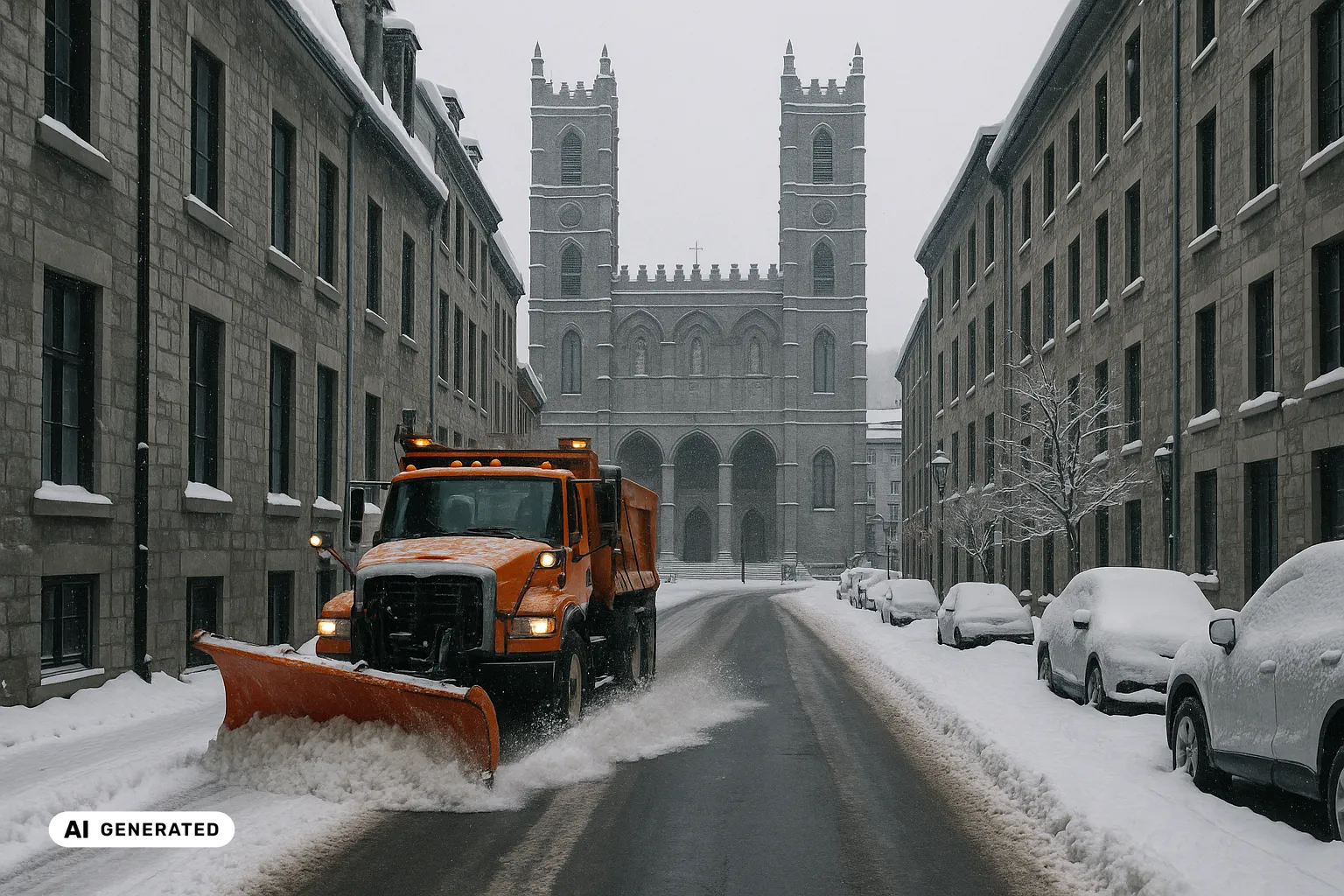
How Montreal sits, and what winter does here
Montreal sits on the Île de Montréal, an island where the Saint Lawrence and Ottawa rivers meet, with Mount Royal — the small mountain the city is named for — rising 232 m right in the middle of it. It is Canada’s second-largest metropolitan area, about 1.76 million people on the island and more than four million across the region, packed into dense, street-parked neighbourhoods. That density is the single fact that shapes its winter more than any other.
The snow itself is serious: an average of about 217 cm a year, measured against Environment and Climate Change Canada’s 1991–2020 normals at Trudeau airport — among the snowiest of any big city in North America, and well above the figures some weather portals quote. Snow falls on roughly 58 days, lies on the ground on about 104, and the season runs from November into April with its weight in December, January and February. January is the coldest month, with a daily mean near −10 °C, nights regularly below −15 °C, and a record low of −37.8 °C. This is a long, cold, genuinely snowy winter — closer in sheer volume to Quebec City downriver than to anything in southern Ontario.
What makes Montreal distinctive is not just how much falls but what the city does with it. On narrow streets lined bumper-to-bumper with parked cars, there is simply nowhere to bank 217 cm of snow — so Montreal does something most of North America does not: after plowing, it hauls the snow away.
How the system works
Snow clearing in Montreal is the City’s job to a degree that surprises newcomers. Through its boroughs, the City clears public streets and public sidewalks itself; what stays with a property owner is only their own private ground — the walkway to the door, the steps and the driveway — and owners are asked not to push that snow back onto the street or sidewalk.
The work comes in stages tied to how much has fallen. Crews salt and grit as surfaces turn slippery, plow once there is 2.5 cm of snow on the ground, and begin loading — the haul-away operation — once 10 to 15 cm has built up. Streets are handled in three priority tiers: major thoroughfares, bus routes and access to hospitals and schools first; collector and local shopping streets next; residential and industrial streets last.
The loading phase is the one residents feel directly, because it needs the street emptied of parked cars. Before crews arrive, temporary “no parking” signs go up — many Montrealers call them the orange signs. For an overnight ban (7 p.m. to 7 a.m.) they appear by 3 p.m. the same day; for a daytime ban (7 a.m. to 7 p.m.), by 8 p.m. the day before. These temporary signs take priority over permanent ones, so a spot that is normally legal can be off-limits that night. According to the City, a car left in place “will be towed and you will be fined” — usually moved a short distance to a cleared street rather than impounded, but you still have to go and find it. The 311 Montréal app tracks operations in real time and can send a reminder to move the car.
One more thing shapes the experience: clearing is run borough by borough. Each of Montreal’s 19 boroughs manages its own operation, with its own blend of city crews and contractors, so timing varies across town. Since 2016, common rules require removal to begin within 12 hours of a snowfall and major roads to be cleared within 36 hours — but a residential street in one borough may still be done noticeably sooner or later than a similar street in the next.
These are the City of Montreal’s own policies, and the detail can change season to season — the official pages linked below carry the current version. None of this is legal advice.
On the ground: where it gets tricky
The haul-away operation is the heart of winter service here, and it is genuinely large: roughly 300,000 truckloads a season move snow to 11 surface dumps and 15 sewer chutes, with the former quarry at Francon alone taking around 40% of it. Running a fleet that size across a snowy four-month season is as much a logistics problem as a clearing one — which is exactly where a clear record of when and where each route was cleared, and where the trucks went, earns its keep.
A few local features add to the job. The bridges over the Saint Lawrence — Champlain, Jacques-Cartier and the rest — cool from above and below and tend to ice before the approaches, a predictable hazard for commuters. The slopes around Mount Royal add gradient. And the spring thaw in March and April brings its own cycle of meltwater, slush and re-freezing as temperatures cross zero day after day — worth tracking against the weather over a long season.
Around Montreal
Montreal’s rules stop at the island’s edge — and, in places, well inside it. Off the island, Laval lies to the north across the Rivière des Prairies, and Longueuil, Saint-Lambert and Brossard to the south across the Saint Lawrence; each is its own city with its own winter clearing. On the island itself, several municipalities are enclaves entirely surrounded by Montreal — Westmount, Côte-Saint-Luc, Montréal-Ouest, Hampstead and the Town of Mount Royal — and they run their own operations too. Crossing a bridge or even a borough boundary can mean different signs, different timing and different rules, so anyone working across the region is better off checking each one than assuming Montreal’s system carries over.
Local facts
- Average annual snowfall about 217 cm, per Environment and Climate Change Canada Climate Normals 1991–2020 (station Montréal–Trudeau) — among the snowiest of North America's big cities. Snow falls on roughly 58 days a year and lies on the ground on about 104 days.Source
- January is the coldest month, with a daily mean around −10 °C and nights regularly below −15 °C; the record low at Trudeau is −37.8 °C. Snow is common from November into April, peaking December–February.Source
- According to the City of Montreal, the City (through its boroughs) clears public streets and public sidewalks itself; property owners are responsible only for their own private walkways, steps and driveways, and must not shovel snow back onto the street or sidewalk.Source
- The City plows once there is 2.5 cm of snow on the ground, and begins loading — hauling snow away by truck — once there is 10 to 15 cm on the ground. Work follows three priority levels, from major thoroughfares and bus routes down to local residential streets.Source
- Rather than only pushing snow aside, Montreal hauls it off the street — roughly 300,000 truckloads a year to 11 surface dumps and 15 sewer chutes that melt it, at a cost of more than C$170 million a year. The Francon dump, a former quarry, takes around 40% of the city's snow.Source
- Snow clearing is run by each of the 19 boroughs, so timing varies by neighbourhood. Since 2016, city-wide rules require removal to begin within 12 hours of a snowfall and major roads to be cleared within 36 hours.Source
- Before a loading operation, temporary 'no parking' signs go up: for an overnight ban (7 p.m.–7 a.m.) by 3 p.m. the same day, and for a daytime ban (7 a.m.–7 p.m.) by 8 p.m. the day before. These temporary signs take priority over permanent parking signs.Source
- According to the City, a vehicle left in place against the temporary signage 'will be towed and you will be fined.' The City's 311 Montréal app tracks operations in real time and can send a reminder to move your car.Source
- Montreal sits on the Île de Montréal at the confluence of the Saint Lawrence and Ottawa rivers, with Mount Royal (232 m) rising in the centre of the city. The city has about 1.76 million residents (metro 4.29 million) and is Canada's second-largest metropolitan area.Source
Official contacts
Ville de Montréal — Snow Removal
The City's winter hub: how plowing and loading work, the 311 Montréal app, and live operations updates.
Snow removal on sidewalks and streets
Who clears what, the 2.5 cm plowing and 10–15 cm loading thresholds, and the three priority levels.
Signage for snow removal operations
How and when the temporary no-parking signs go up, why they override permanent signs, and what happens if you don't move your car.
Common questions about winter service in Montreal
- Who clears the sidewalk in Montreal — the city or me?
- The City does the public sidewalks. Unlike many North American cities that leave the public walk to the adjacent owner, in Montreal the boroughs plow public streets and public sidewalks themselves. What stays with you is your own private ground — the walkway up to your door, your steps and your driveway — and you are asked not to push that snow back onto the street or sidewalk.
- Why does Montreal haul its snow away instead of just plowing it to the side?
- Because there is nowhere to put it. With around 217 cm a year falling on dense streets lined with parked cars, snow banked at the kerb would swallow lanes and parking for months. So after plowing, the City runs a second 'loading' phase — blowers and trucks carry the snow off to dumps and melting chutes, about 300,000 truckloads in a season. It is unusual in North America and is the defining feature of winter here.
- When does plowing start, and when does the hauling start?
- Plowing begins once there is 2.5 cm of snow on the ground. The bigger loading operation — the one that triggers the no-parking signs — begins once 10 to 15 cm has accumulated. Streets are handled in three priority tiers, from major thoroughfares and bus routes first, down to local residential streets last.
- How do I know when to move my car?
- Watch for the temporary 'no parking' signs that crews put out before loading (many Montrealers call them the orange signs). For an overnight ban they go up by 3 p.m. that same day; for a daytime ban, by 8 p.m. the day before. The 311 Montréal app tracks operations in real time and can remind you to move your vehicle.
- What happens if I leave my car during a loading operation?
- According to the City, your vehicle will be towed and you will be fined. The car is usually moved a short distance to a cleared spot nearby rather than impounded far away, but you still have to find it — and the temporary signs override any permanent parking sign on the street, so a normally legal spot can be off-limits that night.
- Why is my street cleared later than my friend's across town?
- Because each of Montreal's 19 boroughs runs its own snow operation, with its own mix of city crews and contractors, so pace and timing differ from one neighbourhood to the next. Since 2016 there are common rules — clearing must begin within 12 hours of a snowfall and major roads be done within 36 hours — but residential streets still come last under the priority system.
- What makes the bridges and Mount Royal tricky in winter?
- The bridges over the Saint Lawrence — Champlain, Jacques-Cartier and others — cool from above and below and tend to ice up before the roads leading to them, a recurring hazard for commuters. The slopes around Mount Royal add gradient to the mix, and the dense, car-lined downtown is exactly why the snow has to be hauled away rather than stored at the side.
- Do Laval, Longueuil or Westmount follow the same rules?
- No. Laval (north, across the Rivière des Prairies) and Longueuil and Brossard (south, across the Saint Lawrence) are separate cities, and several municipalities are enclaves entirely surrounded by Montreal — Westmount, Côte-Saint-Luc, Montréal-Ouest, Hampstead and the Town of Mount Royal. Each runs its own winter clearing, so crossing a bridge or a borough line can mean different signs, timing and rules.
Documenting winter service in Montreal
Anyone clearing snow and ice in Montreal may later need to show when and where a route was treated. Wintertrace is open-source software that records exactly that — time, location and weather for each run — as a calm basis for your own operational records and service proof. It is not a substitute for legal advice.
This overview is for general information and is not legal advice. Local rules on snow and ice clearing vary — the wording of the local rule and the responsible authority always govern.