Winter service · Saskatchewan
Winter service in Regina
What winter is really like in Regina: about 104.6 cm of snow a year, January lows near −20 °C, and the City's Clean Property Bylaw that puts sidewalk clearing on every property owner within 48 hours — 24 in the downtown.
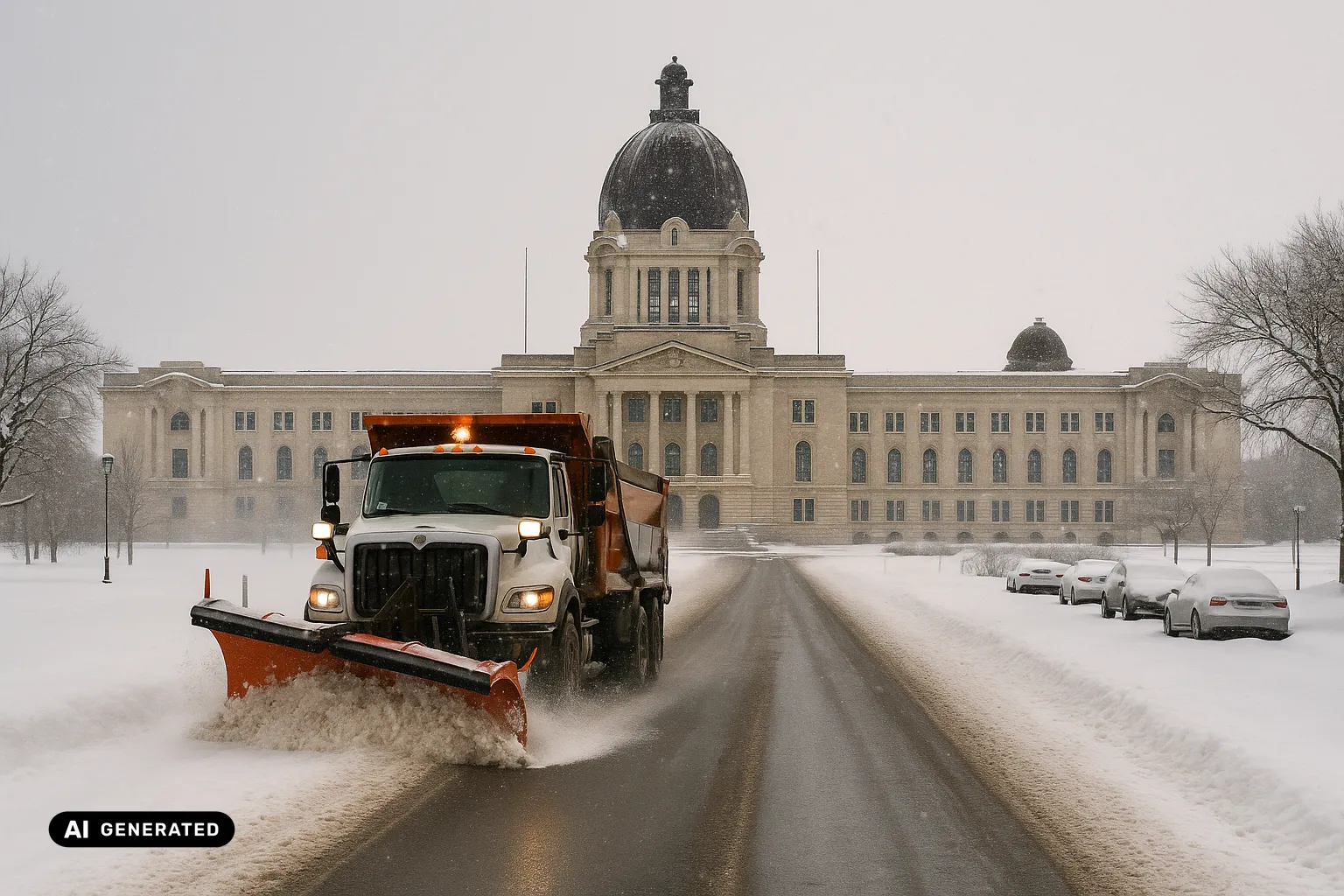
How Regina sits, and what winter does here
Regina stands on a broad, flat, treeless plain in southern Saskatchewan, east of Moose Jaw, at about 577 metres above sea level — noticeably higher and more exposed than Saskatoon a couple of hours north. There are no mountains and no large natural lakes nearby to soften the weather; the only notable water is Wascana Creek, a small spring-runoff stream that was dammed to create the artificial Wascana Lake south of downtown. The climate is a dry, cold, continental one — humid-continental in the textbooks (Köppen Dfb), prairie in practice.
By the numbers it is a hard winter. An average year brings about 104.6 cm of snow — more than the 91 cm a couple of hours away in Saskatoon — with measurable snow on roughly 58 days. The cold is the other half of the story. Daily lows sit near −17 °C in December, −20 °C in January and −18 °C in February, January averages −14.7 °C outright, and the record low is −50.0 °C, set on 1 January 1885. The snow that falls tends to stay, and on open prairie with no natural windbreaks the wind keeps moving it: drifting and blowing snow can put as much back across a cleared surface as the original snowfall did. The work here is less about digging out from one big dump than about keeping ahead of a long, cold, wind-driven season — closer in character to Winnipeg and Saskatoon than to anywhere with a coast to temper it.
What the local rules say
The part of Regina’s winter that most directly lands on a property owner is the sidewalk. According to the City of Regina’s Clean Property Bylaw, clearing the City sidewalks that border a property is the owner’s responsibility, not the City’s — and since 1 January 2022 that obligation applies city-wide to every property owner, after Council extended what had been a narrower rule. The City asks for a safe and even walking surface, cleared to the sidewalk edges and as close to the concrete as possible.
The deadlines depend on where the property sits. Snow and ice must be cleared within 48 hours of a snow event at most properties, and within 24 hours for properties inside Schedule B — in practice the downtown. The bylaw is careful about when the clock starts: it runs from when the snow stops falling, or when the wind stops blowing snow — a telling detail on a prairie where a finished snowfall and a finished drift are not the same moment. Cleared snow is meant to go onto your own property or along the curb next to the sidewalk, so long as it does not obstruct traffic; shovelling or blowing it into the road is a violation.
Enforcement is civil rather than dramatic. For an uncleared walk the City issues a Notice of Non-Compliance; if it is not resolved, the City can have the walk cleared and add the cost to the property’s tax account — a charge based on the labour, equipment and haul-away involved, so it scales with the property. None of this is legal advice, and the wording of the bylaw and the City’s own pages govern.
On the streets, the City runs its own program. A snow event needs at least 5 cm before Category 1–4 routes are cleared, and at least 15 cm before residential (Category 5) streets are plowed at all. Grading then runs by priority: major arterials and hospital routes within 24 hours, minor arterials, transit, cycling routes and the downtown within 36, collectors and busier residential streets within 48, and gravel roads within 60. Quiet residential streets are handled through the Residential Plowing Program, which works sector by sector across more than 500 km of road after a substantial snowfall. When 5 cm falls in a single event, a Snow Route Parking Ban can run 24 hours along a designated route so the graders can clear it curb to curb.
On the ground: where it gets tricky
A few things shape the work here in particular. The flat, open prairie offers no natural windbreaks, so drifting snow is its own problem, redepositing across cleared ground hours after a pass when the wind gets up — which is exactly why the bylaw’s clock waits for the wind to stop, not just the snow. The bridges over Wascana Creek and the exposed stretches of the Ring Road around the city lose heat fast and ice early, making them predictable early-treatment points. And the deep, dry cold changes the chemistry: as temperatures fall well below freezing — January lows near −20 °C, a record of −50 °C — road salt loses its bite and abrasives that add traction start to matter more than melt.
The bylaw’s deadlines turn all of this into a recurring obligation rather than a one-off. Over a season that can run from November into April, an owner is on a rolling 48-hour clock — 24 in the downtown — event after event. For anyone clearing walks or lots across the city as a service, keeping a dated record of when and where each pass was made — and under what weather — is a habit worth building. Across a long winter the passes add up, and a contemporaneous record a contractor can stand behind later is far easier to produce than a reconstruction from memory.
Around Regina
Regina’s bylaw stops at the city limits. The Rural Municipality of Sherwood No. 159 wraps around the city, and the commuting area includes the separate communities of White City, Emerald Park and Pilot Butte to the east, Lumsden to the north in the Qu’Appelle Valley, and Regina Beach out at Last Mountain Lake. Each is its own jurisdiction with its own clearing rules and timelines, so a property just beyond Regina will not automatically follow the City’s Clean Property Bylaw or its 24- and 48-hour deadlines. Anyone working across the region is better off checking each municipality than assuming Regina’s rules travel with them.
Local facts
- Average annual snowfall about 104.6 cm (41.2 in), with measurable snow on roughly 58 days a year, per Environment and Climate Change Canada Climate Normals 1991–2020 at Regina International Airport — more than Saskatoon's 91 cm.Source
- Average daily lows of about −17 °C in December, −20 °C in January and −18 °C in February; January averages −14.7 °C overall and the record low is −50.0 °C (1 January 1885).Source
- Regina sits on a broad, flat, treeless plain at about 577 m elevation — higher than Saskatoon — with no mountains or large natural lakes nearby; its only notable water is Wascana Creek, dammed to form the artificial Wascana Lake.Source
- According to the City of Regina's Clean Property Bylaw, the property owner — not the City — must clear the City sidewalks bordering their property; the rule has applied city-wide to all owners since 1 January 2022.Source
- Sidewalks must be cleared within 48 hours of a snow event, or within 24 hours for properties in Schedule B (essentially the downtown). The clock starts once the snow stops falling or the wind stops blowing snow.Source
- Cleared snow goes onto your own property or along the curb next to the sidewalk; shovelling or blowing snow into the road is a bylaw violation.Source
- For an uncleared walk the City issues a Notice of Non-Compliance; if it is not resolved, the City can have the walk cleared and add the cost to the property's tax account.Source
- On the streets, a snow event needs at least 5 cm for Category 1–4 routes and at least 15 cm before residential (Category 5) streets are plowed; snow routes trigger at 5 cm in a single event.Source
- Priority grading times run from 24 hours for major arterials and hospital routes (Category 1) to 36 hours for minor arterials, transit and downtown (Category 2), 48 hours for collectors (Category 3) and 60 hours for gravel roads (Category 4).Source
- The City's Residential Plowing Program covers more than 500 km of residential roads, plowed sector by sector after a substantial snowfall of about 15 cm; a Snow Route Parking Ban then runs 24 hours along a designated route.Source
Official contacts
City of Regina — Sidewalk Snow Clearing
Who clears which sidewalk, the 24- and 48-hour deadlines, where the snow may go, and how a Notice of Non-Compliance works.
City of Regina — Plowing, Snow and Ice Control
The street program: snow-event thresholds, the Category 1–5 priority order, the Residential Plowing Program and the Snow Route Parking Ban.
City of Regina — Snow & Ice Control
The City's snow-and-ice index page. Call 311 for anything the pages do not answer, or to report an uncleared walk or route.
Common questions about winter service in Regina
- Who has to clear the sidewalk in Regina — the City or the property owner?
- The property owner. Under the City of Regina's Clean Property Bylaw, the owner of a property must clear the City sidewalks bordering it down to a safe, even walking surface, as close to the concrete as possible. Since 1 January 2022 this applies city-wide to every property owner — before that, the obligation was narrower. The City clears its own walks and pathways, but the stretch in front of a house or business is that owner's responsibility.
- How long do I have to clear my sidewalk after it snows?
- Within 48 hours of a snow event at most properties, and within 24 hours if the property falls inside Schedule B — essentially the downtown. The bylaw is specific about when the clock starts: it begins once the snow or rain stops falling, or when the wind stops blowing snow, not from the moment the first flake lands.
- What is Schedule B and why is its deadline shorter?
- Schedule B is the area defined in the bylaw — in practice the downtown core — where heavier foot traffic means a tighter 24-hour deadline rather than the 48 hours that applies elsewhere. If you are unsure whether a property sits inside it, the City's Sidewalk Snow Clearing page and 311 can confirm.
- What happens if I don't clear my sidewalk?
- The City issues a Notice of Non-Compliance. If the walk is still not cleared, the City can arrange the clearing itself and add the cost — based on the labour, equipment and haul-away involved, so it varies with property size — to the property's tax account. The expense attaches to the property, which is the main consequence the bylaw spells out.
- Where am I allowed to put the snow I clear?
- On your own property, or along the curb next to the sidewalk, as long as it does not obstruct traffic. What you cannot do is shovel or blow it into the road — that is a bylaw violation. Clearing your walk by moving its snow onto the street is not a free option.
- When does the City plow residential streets?
- Residential streets — Category 5 — are only plowed after a substantial snowfall of about 15 cm from a single event, and then sector by sector through the Residential Plowing Program, which covers more than 500 km of roads. Smaller snowfalls are handled on the priority network first: major arterials and hospital routes within 24 hours, minor arterials, transit and downtown within 36, collectors within 48 and gravel roads within 60. The exact timings are the City's own and worth checking on its plowing page.
- What is the Snow Route Parking Ban?
- When 5 cm of snow falls in a single event, the City can call a parking ban that runs 24 hours along a designated snow route, so the graders can clear curb to curb. Watching for the ban — and moving a parked vehicle in time — avoids a ticket and helps the route get cleared properly.
- Does Regina really get more snow than Saskatoon?
- Yes — about 104.6 cm a year here against roughly 91 cm in Saskatoon, on the 1991–2020 normals. The cold is comparably severe (both have touched −50 °C), and Regina sits higher and more exposed. As on much of the prairie, the season is long and the wind keeps redistributing snow as drift, so the snowfall total understates the work.
- Does the deep cold change how de-icing works?
- It can. Regina's winters are dry and very cold — January averages around −15 °C with lows near −20 °C and a record of −50 °C — and road salt loses effectiveness as temperatures fall well below freezing. In those conditions abrasives such as sand or grit, which add traction rather than melt ice, tend to matter more than salt alone.
- Are the rules the same in White City, Pilot Butte and the towns around Regina?
- Not necessarily. The Rural Municipality of Sherwood No. 159 surrounds the city, and White City, Emerald Park, Pilot Butte, Lumsden and Regina Beach are separate municipalities in the commuting area, each with its own clearing rules and timelines. A property outside Regina's limits does not automatically follow the City's Clean Property Bylaw or its deadlines.
Documenting winter service in Regina
Anyone clearing snow and ice in Regina may later need to show when and where a route was treated. Wintertrace is open-source software that records exactly that — time, location and weather for each run — as a calm basis for your own operational records and service proof. It is not a substitute for legal advice.
This overview is for general information and is not legal advice. Local rules on snow and ice clearing vary — the wording of the local rule and the responsible authority always govern.