Winter service · Saskatchewan
Winter service in Saskatoon
What winter is really like in Saskatoon: about 91 cm of snow a year, January lows near −21 °C, and the City's Sidewalk Clearing Bylaw that makes property owners clear their own walks within 48 hours.
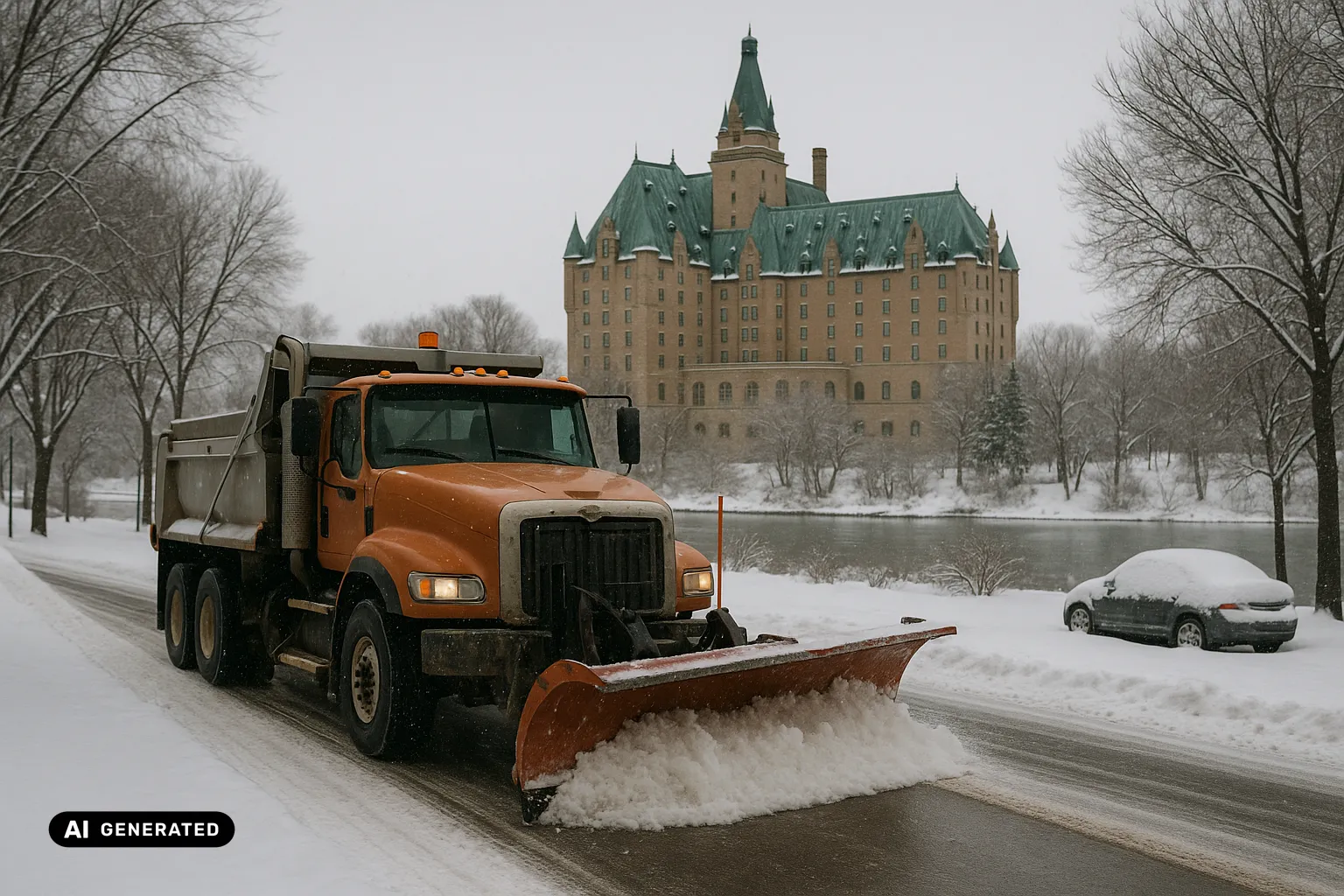
How Saskatoon sits, and what winter does here
Saskatoon stands on the South Saskatchewan River in central Saskatchewan, on the flat aspen-parkland prairie at about 481 metres above sea level. The river and its nine crossings give the city its names — the City of Bridges and Paris of the Prairies — and they shape the winter as much as the season’s snow does. There are no mountains and no large lakes nearby to temper the weather; the climate is a cold, dry, continental one, bordering on semi-arid.
By the numbers it is a colder place than its snowfall suggests. An average year brings about 91 cm of snow — measurably less than the 126 cm a few hours east in Winnipeg — with measurable snow on roughly 57 days. What the totals understate is the cold and its length. Daily lows sit near −18 °C in December, −21 °C in January and −19 °C in February, January averages −15.4 °C outright, and the record low is −50.0 °C, set on 1 February 1893. The snow that falls tends to stay, and on open prairie the wind keeps moving it: drifting and blowing snow can put as much back across a cleared surface as the original snowfall did. The work here is less about digging out from a single big dump than about keeping ahead of a long, cold, wind-driven season — closer in character to the settled cold of Edmonton than to Calgary’s chinook melt-and-refreeze.
What the local rules say
The part of Saskatoon’s winter that most directly lands on a property owner is the sidewalk. According to the City of Saskatoon’s Sidewalk Clearing Bylaw, 2005 (Bylaw No. 8463), clearing the public sidewalk is the adjacent owner’s responsibility, not the City’s. The bylaw puts it plainly:
“The owner or occupant of adjacent property shall be responsible for carrying out the provisions of this Bylaw.”
That is the opposite of how it works in some Canadian cities — in Winnipeg, for instance, the City clears public sidewalks itself. In Saskatoon the City clears only the walks along its own property and its pathways; the stretch in front of a house or business stays with that owner. The deadlines are specific: snow and ice must be cleared within 48 hours at a residential property and within 24 hours at a non-residential one. Cleared snow is meant to go onto private property, and only where that is impractical may it be placed in the roadway — and then without creating a hazard or blocking the road or City infrastructure.
The bylaw also has teeth. Penalties run $100 for a first offence, $200 for a second, and between $200 and $1,000 for a third or later one (up to $2,000 for a corporation). Beyond any ticket, the City can have an uncleared walk cleared and add the cost to the property’s tax roll, so the expense attaches to the property itself.
On the streets, the City runs its own program. Under its published Snow and Ice Management service levels, a Snow Event is declared when snowfall exceeds 5 cm on roadways, and contractor graders are called in as the snow stops. Grading then runs by how heavily a street is used: high-use streets and access routes such as Circle Drive within about 12 hours of the snowfall ending, and medium-use streets and Bus Rapid Transit routes within about 36 hours. Local and neighbourhood streets are not graded after every event — they are addressed when rutting becomes severe or the snowpack builds up. These timings are the City’s own operational targets rather than bylaw text, and the official pages linked below carry the current detail. None of this is legal advice — the wording of the bylaw and the City’s own pages govern.
On the ground: where it gets tricky
A few things shape the work here in particular. The river and its nine bridges are the first places to ice: a bridge deck loses heat from above and below, so it freezes before the roads leading onto it, which makes the crossings predictable early-treatment points. On the open prairie, drifting snow is its own problem, redepositing across cleared ground hours after a pass when the wind gets up. And the deep, dry cold changes the chemistry — as temperatures fall well below freezing, road salt loses its bite and abrasives that add traction start to matter more than melt.
The bylaw’s deadlines turn all of this into a recurring obligation rather than a one-off. Over a season that can run from November into April, a residential owner is on a rolling 48-hour clock and a business on a 24-hour one, event after event. For anyone clearing walks or lots across the city as a service, keeping a dated record of when and where each pass was made — and under what weather — is a habit worth building. Across a long winter the passes add up, and a contemporaneous record is far easier to stand behind later than memory.
Around Saskatoon
Saskatoon’s bylaw stops at the city limits. The Rural Municipality of Corman Park wraps around the city — the most populous rural municipality in Saskatchewan — and the commuting area includes the separate towns of Martensville and Warman to the north and Osler and Dundurn to the south. Each is its own jurisdiction with its own clearing rules and timelines, so a property just beyond Saskatoon will not automatically follow the City’s 48-hour sidewalk deadline or its Snow Event thresholds. Anyone working across the region is better off checking each municipality than assuming Saskatoon’s rules travel with them.
Local facts
- Average annual snowfall about 91.0 cm (35.8 in), with measurable snow on roughly 57 days a year, per Environment and Climate Change Canada Climate Normals 1991–2020 at Saskatoon Diefenbaker International Airport.Source
- Average daily lows of about −18 °C in December, −21 °C in January and −19 °C in February; January averages −15.4 °C overall and the record low is −50.0 °C (1 February 1893).Source
- According to the City of Saskatoon's Sidewalk Clearing Bylaw, 2005 (Bylaw No. 8463), the owner or occupant of the adjacent property — not the City — is responsible for clearing the public sidewalk along that property.Source (PDF)
- Under that bylaw, snow and ice must be cleared from a sidewalk within 48 hours at a residential property and within 24 hours at a non-residential (commercial, institutional or industrial) property.Source (PDF)
- Cleared snow is to be placed on private property; only where that is impractical may it be put in the roadway, and then without creating a hazard or blocking City infrastructure.Source (PDF)
- Penalties run $100 for a first offence, $200 for a second, and $200 to $1,000 for a third or later one ($2,000 for a corporation); the City can also clear the walk itself and add the cost to the property's tax roll.Source (PDF)
- On the streets, the City declares a Snow Event when snowfall exceeds 5 cm on roadways, calling in contractor graders as the snow stops.Source (PDF)
- Per the City's Snow and Ice Management service levels, high-use streets and access routes are graded within 12 hours of snowfall ending and medium-use streets and Bus Rapid Transit routes within 36 hours; local and neighbourhood streets are not graded after every event, only when rutting is severe or the snowpack builds up.Source (PDF)
- Saskatoon sits on the South Saskatchewan River with nine river crossings — earning the names 'City of Bridges' and 'Paris of the Prairies' — on flat aspen-parkland prairie at about 481.5 m elevation.Source
Official contacts
City of Saskatoon — Winter Road Maintenance
The City's street program: how a Snow Event is declared, the priority grading order, and a live Snow and Ice Report.
City of Saskatoon — Sidewalk Clearing
Who is responsible for which sidewalk, and what the City expects of home and business owners.
Sidewalk Clearing Bylaw No. 8463 (PDF)
The full bylaw text, including the 48- and 24-hour deadlines, where snow may go, and the penalty schedule. Call 311 for anything the page does not answer.
Common questions about winter service in Saskatoon
- Who has to clear the sidewalk in Saskatoon — the City or the property owner?
- The property owner. Under the City of Saskatoon's Sidewalk Clearing Bylaw, the owner or occupant of the adjacent property is responsible for the public sidewalk running along it. This is the opposite of cities such as Winnipeg, where the City clears public sidewalks itself. In Saskatoon the City clears only the walks along its own property and its pathways; the stretch in front of a house or business is that owner's job.
- How long do I have to clear my sidewalk after it snows?
- The bylaw sets two deadlines. At a residential property you have 48 hours from when the snow or ice formed; at a non-residential property — commercial, institutional or industrial — you have 24 hours. The clock runs from the snowfall or freezing event, not from when you happen to notice it.
- What happens if I don't clear it?
- The bylaw carries a penalty schedule: $100 for a first offence ($75 if paid early), $200 for a second ($150 early), and between $200 and $1,000 for a third or later one — up to $2,000 for a corporation. Separately, the City can have the walk cleared and add the unpaid cost to the property's tax roll, so the bill follows the property whether or not a ticket is issued.
- Where am I allowed to put the snow I clear?
- On your own property, as the default. The bylaw allows putting it in the roadway only where placing it on private property is impractical — and even then it must not create a hazard or interfere with the road or City infrastructure. Piling a sidewalk's worth of snow onto the street is not a free option.
- When does the City plow the streets?
- The City declares a Snow Event once snowfall passes 5 cm and brings in contractor graders after the snow stops. Streets are then graded by priority: freeways and major arterials such as Circle Drive first (about 12 hours), two-lane arterials and bus routes next (about 36 hours), and collectors and school zones last (about 72 hours). The exact timings are the City's own and worth checking on its winter-road-maintenance page.
- Will my residential street be graded after every snowfall?
- No. After a Snow Event the City concentrates on the priority street network, and residential or local streets are not graded after every event. The City's Priority Street Snow Grading map shows where a given street sits in that order, which is the quickest way to know what to expect on your own block.
- Is Saskatoon's snowfall really lower than Winnipeg's?
- Yes — about 91 cm a year here against roughly 126 cm in Winnipeg. But the raw total understates the work. The cold is just as severe, the season is long, and on open prairie the wind redistributes snow as drift across surfaces that were already cleared, so a quiet snowfall figure does not mean a light winter.
- Does the deep cold change how de-icing works?
- It can. Saskatoon's winters are dry and very cold — January averages around −15 °C with lows near −21 °C and a record of −50 °C — and road salt loses effectiveness as temperatures fall well below freezing. In those conditions abrasives such as sand or grit, which add traction rather than melt ice, tend to matter more than salt alone.
- Are the rules the same in Martensville, Warman and the towns around Saskatoon?
- Not necessarily. The Rural Municipality of Corman Park surrounds the city, and Martensville, Warman, Osler and Dundurn are separate municipalities in the commuting area, each with its own clearing rules and timelines. A property outside Saskatoon's limits does not automatically follow the City's Sidewalk Clearing Bylaw or its 48-hour deadline.
Documenting winter service in Saskatoon
Anyone clearing snow and ice in Saskatoon may later need to show when and where a route was treated. Wintertrace is open-source software that records exactly that — time, location and weather for each run — as a calm basis for your own operational records and service proof. It is not a substitute for legal advice.
This overview is for general information and is not legal advice. Local rules on snow and ice clearing vary — the wording of the local rule and the responsible authority always govern.