Winter service · Ontario
Winter service in Greater Sudbury
What winter is really like in Greater Sudbury, Ontario: about 263 cm of snow a year, January lows near −18 °C, the City's own sidewalk ploughing at 8 cm, the 1 Dec–31 Mar overnight parking ban, the snow-dumping fine and how a huge Shield city is cleared.
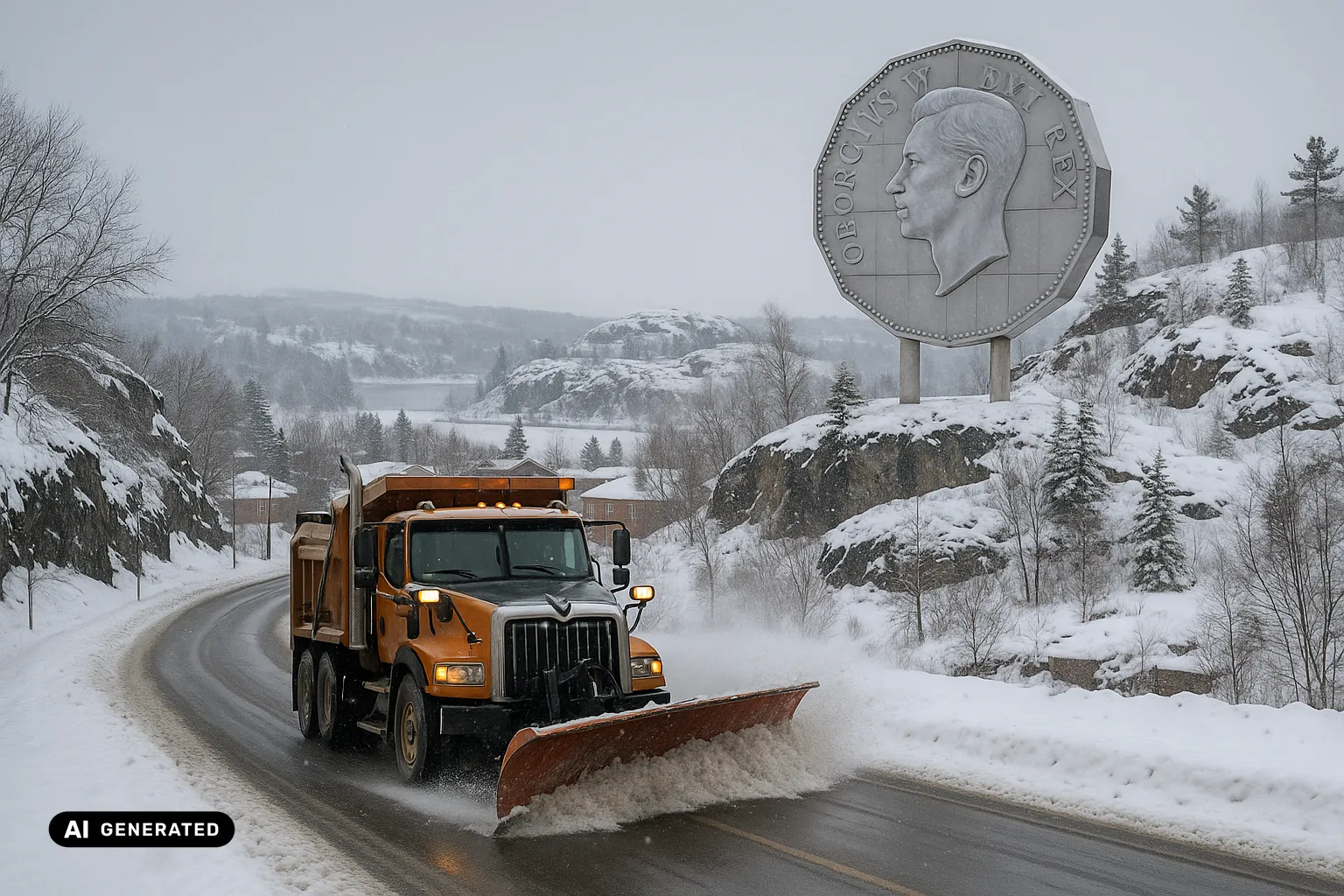
How Greater Sudbury sits, and what winter does here
Greater Sudbury sits on the Canadian Shield in northern Ontario, inside the Sudbury Basin — the eroded remnant of a nearly two-billion-year-old impact crater. The ground shows it: exposed igneous rock, hilly relief, and 330 lakes larger than 10 hectares, among them Lake Wanapitei, one of the largest lakes in the world contained entirely within a single municipality. It is also an unusually large, spread-out city — about 3,186 km² at just 52 people per km² — formed by the 2001 amalgamation of Sudbury with Capreol, Nickel Centre, Onaping Falls, Rayside-Balfour, Valley East and Walden. Those old names still mark the neighbourhoods today.
An average year brings about 263 cm of snow, measured against Environment and Climate Change Canada’s 1991–2020 normals (station Sudbury Airport) rather than the lower figures some weather portals quote — genuine snowbelt territory, roughly double a typical southern-Canadian city. The cold matches it: in January the average high is around −7.8 °C and the low about −17.5 °C, so the heart of winter stays well below freezing day and night. Measurable snow falls on roughly 76 days a year, and the record low is −48.3 °C, set in 1933. This is a long, hard continental winter that runs from about November into April.
What gives the winter its local shape is the size and the terrain. A city this large and polycentric means long routes for the plough fleet, and the Shield relief — rocky cuts, hills, and all those lake shores and river crossings — gives plenty of bridges and shoreline stretches that frost and ice early, plus cold hollows that hold the chill.
What the local rules say
The thing that sets Sudbury apart from much of Canada is simple: the City clears the sidewalks. According to the City of Greater Sudbury, its own crews run a winter sidewalk-maintenance programme — all maintained sidewalks are ploughed and sanded once 8 cm of snow has fallen and/or icy conditions occur, and downtown sidewalks are serviced every business day regardless of the weather. A Track My Plow map shows near-real-time service times for both roads and sidewalks. So unlike places where the owner must clear the public walk in front of their property, in Sudbury the maintained network is the City’s responsibility.
That does not leave property owners with nothing to do. The City does not clear the windrow left across the end of a private driveway, and under Municipal By-law 2011-219 you must not push snow or ice from your property onto a public road or sidewalk. Blocking a fire hydrant breaches By-law 2010-214. Depositing snow or ice on public property can bring a $260 fine, with a maximum penalty reported as high as $5,000. Roads themselves are cleared by priority — major intersections first, then downtown business areas and transit stops, then residential neighbourhoods — and snowbanks are removed only where they obstruct traffic, not by height.
The rule most likely to catch a driver out is the overnight winter parking ban. From 1 December to 31 March, parking is not allowed on any roadway, highway, laneway or side street between midnight and 7 a.m., enforced seven days a week, with towing where a vehicle impedes clearing. There are holiday exceptions — on 25 and 26 December and 1 January, parking is allowed from 12:01 a.m. to 7 a.m. And in a major storm a separate Significant Weather Event ban can apply to all municipal roads until it is lifted, tightening the rules beyond the usual overnight window.
On the ground: where it gets tricky
A few things shape winter service in Sudbury specifically. The sheer size of the place — a city plus several former towns spread over 3,000-plus km² — means long plough routes and a real order-of-work, so residential streets wait while the busy and hazardous spots are cleared first. The Shield terrain and 330 lakes give many shoreline and bridge crossings that ice early and cold hollows that hold frost. And because the City maintains sidewalks only above the 8 cm trigger, the gap between events — and your own driveway and private walks — is still yours, along with the rule against pushing that snow back onto the road.
Across a winter this long, the passes add up, and a dated record of when and where each surface was cleared — and under what weather — is far easier to stand behind later than memory, whether you run a commercial lot or clear for others.
Around Greater Sudbury
Because Greater Sudbury is a single-tier municipality, the City’s by-laws and winter programme apply right across the amalgamated area — Capreol, Nickel Centre, Onaping Falls, Rayside-Balfour, Valley East and Walden are neighbourhoods of the one city now, not separate jurisdictions. The municipalities that adjoin the city from outside run their own clearing, so the City’s overnight parking ban, its fines and its sidewalk programme stop at the municipal boundary. Anyone clearing snow across the wider region is better off checking each one than assuming Sudbury’s rules carry over.
Local facts
- Greater Sudbury sits on the Canadian Shield in northern Ontario, inside the Sudbury Basin — the eroded remnant of a nearly two-billion-year-old impact crater — with exposed rock, hilly relief and 330 lakes larger than 10 hectares, including Lake Wanapitei.Source
- It is an unusually large, polycentric city: about 3,186 km² of land at a density of just 52 people per km², formed by the 2001 amalgamation of Sudbury with Capreol, Nickel Centre, Onaping Falls, Rayside-Balfour, Valley East and Walden. The 2021 population was 166,004.Source
- Average annual snowfall is about 263 cm (104 in), per Environment and Climate Change Canada Climate Normals 1991–2020 (station Sudbury Airport) — genuine snowbelt territory, roughly double a typical southern-Canadian city. Use the official normals rather than weather portals, which can understate snowfall.Source
- In January the average high is about −7.8 °C and the average low about −17.5 °C, so the core of winter stays well below freezing day and night. Measurable snow falls on roughly 76 days a year, and the record low is −48.3 °C, set on 29 December 1933.Source
- Unlike many Canadian cities, the City of Greater Sudbury maintains the sidewalks itself: all maintained sidewalks are ploughed and sanded once a snow accumulation of 8 cm and/or icy conditions have occurred, and downtown sidewalks are serviced each business day regardless of weather.Source
- Snow clearing is prioritised major intersections first, then downtown business areas and transit stops, then residential neighbourhoods. The City is not responsible for the windrow left at the end of a private driveway, and snowbanks are removed only where they obstruct traffic, not by height.Source
- Pushing snow or ice from a driveway onto a public road or sidewalk is prohibited under Municipal By-law 2011-219, and obstructing a fire hydrant breaches By-law 2010-214. Depositing snow or ice on public property can bring a $260 fine, with a maximum penalty reported up to $5,000.Source
- An overnight winter parking ban runs from 1 December to 31 March: parking is not allowed on any roadway, highway, laneway or side street between midnight and 7 a.m., enforced seven days a week, with vehicles towed if they impede clearing. A separate Significant Weather Event ban can apply to all municipal roads when declared.Source
Official contacts
City of Greater Sudbury — Snow Removal
Clearing priorities, the rule against pushing snow onto roads and sidewalks (By-law 2011-219), the fire-hydrant by-law (2010-214), the $260 fine and the private-driveway windrow.
City of Greater Sudbury — Winter Overnight Parking Ban
How the 1 December–31 March overnight ban works, the midnight–7 a.m. hours, the holiday exceptions and towing. For towing questions, call 311.
City of Greater Sudbury — Track My Plow
Near-real-time status of the most recent service times for both roads and sidewalks across the city.
Common questions about winter service in Greater Sudbury
- Who clears the sidewalk in Greater Sudbury?
- The City does — and that is the thing that sets Sudbury apart from many Canadian cities. The City runs its own winter sidewalk-maintenance programme with its own operators: all maintained sidewalks are ploughed and sanded once 8 cm of snow has fallen and/or icy conditions occur, and downtown sidewalks are serviced every business day whatever the weather. So unlike places where the owner must clear the public walk in front of their property, in Sudbury the maintained network is the City's job.
- If the City clears sidewalks, what is still my responsibility?
- Your own driveway and private walkways, and the rule about where the snow goes. The City is clear that it does not clear the windrow left across the end of a private driveway, and under Municipal By-law 2011-219 you must not push snow or ice from your property onto a public road or sidewalk. Between snow events, and below the 8 cm trigger, keeping your own access clear is still on you.
- When does the City plough the streets?
- By priority. Crews work major intersections first, then downtown business areas and transit stops, then residential neighbourhoods. Snow removal is not driven by how tall the snowbanks are — if a bank is not obstructing traffic, it will not be removed. Across a city of more than 3,000 km², that order of work means residential streets can wait while the busiest and most hazardous spots are cleared first.
- What is the overnight winter parking ban, and when does it apply?
- From 1 December to 31 March you cannot park on any roadway, highway, laneway or side street between midnight and 7 a.m. It is enforced seven days a week, and a vehicle that impedes clearing can be towed. There are holiday exceptions — on 25 and 26 December and 1 January, parking on local streets and in municipal lots is allowed from 12:01 a.m. to 7 a.m. For towing questions, the City points people to 311.
- What is a Significant Weather Event parking ban?
- It is a separate, declared ban for big storms. When the City declares a Significant Weather Event, a parking ban can apply to all municipal roads — beyond the regular overnight window — until the declaration is lifted, and vehicles that impede snow removal may be ticketed and towed at the owner's expense. It is worth watching City notices during a major storm, because the rules tighten beyond the usual midnight-to-7 a.m. ban.
- What happens if I dump snow on the road or block a hydrant?
- Both are by-law offences. Pushing snow or ice onto a public road or sidewalk falls under By-law 2011-219, and blocking a fire hydrant breaches By-law 2010-214. Depositing snow or ice on public property can bring a $260 fine, and the maximum penalty has been reported as high as $5,000. The simplest way to stay clear of it is to keep cleared snow on your own property.
- Why does clearing such a large city take so long?
- Greater Sudbury is huge and spread out — about 3,186 km² formed from a city plus several formerly separate towns, with a lot of land in between. That means long routes for the plough and sander fleet. Add the Canadian Shield terrain, with rocky relief and 330 lakes, and you get many shoreline and bridge crossings that ice early. It is a lot of network for the crews to work through after each storm, which is why the priority order matters.
- Are the rules the same across the whole municipality?
- Greater Sudbury is a single-tier municipality, so the City's by-laws and winter programme apply across the amalgamated area — the old communities of Capreol, Nickel Centre, Onaping Falls, Rayside-Balfour, Valley East and Walden are now neighbourhoods of the one city, not separate jurisdictions. Adjoining municipalities outside the city, though, run their own clearing, so the City's parking ban, fines and sidewalk programme stop at the municipal boundary.
Documenting winter service in Greater Sudbury
Anyone clearing snow and ice in Greater Sudbury may later need to show when and where a route was treated. Wintertrace is open-source software that records exactly that — time, location and weather for each run — as a calm basis for your own operational records and service proof. It is not a substitute for legal advice.
This overview is for general information and is not legal advice. Local rules on snow and ice clearing vary — the wording of the local rule and the responsible authority always govern.