Winter service · Prince Edward Island
Winter service in Summerside
What winter is really like in Summerside, PEI: about 278 cm of snow on an open, windy bay, the City ploughing and salting the sidewalks itself, the SS-07 overnight parking ban from 1 Nov to 30 Apr, and the highways the Province keeps — a different split from Charlottetown.
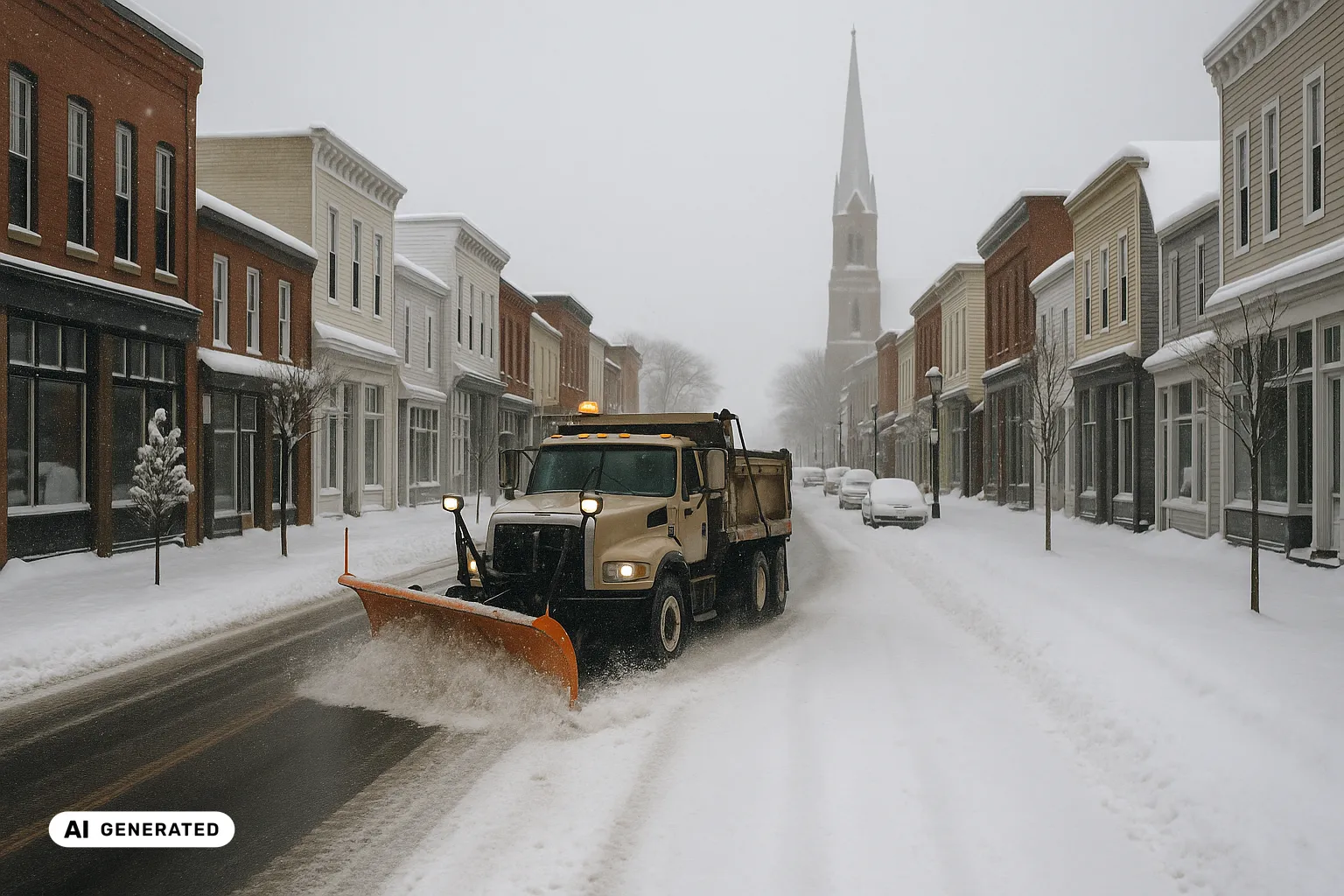
How Summerside sits, and what winter does here
Summerside is the second-largest city in Prince Edward Island and the main service centre for the western part of the island — set in Prince County on Bedeque Bay, off the Northumberland Strait. It is low and flat (0–29 m) and open to the water, and that exposure is the heart of its winter. A bay this broad and a shore this flat mean wind: north-west winds run over open fields and the coastal edge with little to break them, so it is not only how much snow falls but how much of it drifts — loose snow carried back across roads and lots that were just cleared.
The totals are high to begin with. An average year brings about 278 cm of snow on roughly 62 days of snowfall (Environment and Climate Change Canada normals, Summerside Airport), with January averaging a high of −2.9 °C and a low of −11.3 °C — the core months below freezing day and night — and a record low of −32.2 °C set back in 1930. The sea moderates the extremes but feeds a thaw-freeze swing, turning snow to rain or freezing wet at the margins, which is why the City salts ahead of a storm. So the season here is a combination: heavy snow, a maritime freeze-thaw, and blowing snow on top as a clearing problem of its own.
What the local rules say
Summerside runs its winter through its Public Works Division, and the way it splits the work is the headline. Crews are called to salt before the snow starts, or in its first hours, and to plough once about 5 cm has built up on the roadways; after a run, the aim is for all streets to be open about 4.5 hours later and all sidewalks about 10 hours later, adjusted to equipment and staffing. The notable part is the sidewalks: the City ploughs and salts them itself, starting about two hours after road ploughing begins. That is the reverse of Charlottetown, where a Snow Removal Bylaw puts the sidewalk on the commercial owner — and no equivalent owner sidewalk-clearing duty appears in Summerside’s traffic by-law.
The rule a resident most needs to know is the overnight parking ban. Under Section 12 (Overnight Parking) of the City’s Traffic and Parking Bylaw SS-07, from 1 November to 30 April no one may park on a city street or on city-owned property between 1:00 a.m. and 6:00 a.m., so crews can clear snow. The by-law’s penalty schedule runs from a $25 minimum to a $100 maximum fine (a $50 out-of-court settlement), and a vehicle left in the way can be moved — with the cost charged against the vehicle.
One more split matters for anyone driving in and out: the main highways are the Province’s, not the City’s. The Government of PEI says it maintains about 4,450 km of roads and highways each winter, with the Trans-Canada Highway (Route 1) and the Veterans Memorial Highway (Route 2) prioritised for 24-hour service — and it, too, notes that piling snow on public roads is against the law.
On the ground: where it gets tricky
Three things shape winter service in Summerside specifically. The wind and drifting come first — on an open bay, a cleared road can drift back over, so re-clearing and the threat of blowing-snow whiteouts (enough to pause operations) are constant. The divided responsibility is the second: the City does the inner streets, lots and sidewalks, while the Province carries Route 1 and Route 2, so where a problem sits decides who clears it. And the sidewalk model — the City clearing them mechanically rather than leaning on owners — shapes what a property owner actually has to do here, which is mainly the driveway and not pushing snow into the road.
Across a windy, high-snow season like this, a dated record of when and where each surface was cleared or treated — and under what weather — is far easier to stand behind later than memory, whether you manage a lot off Water Street or clear for others through repeated drifting and thaw-freeze.
Around Summerside
Summerside absorbed its near neighbours St. Eleanors and Wilmot when the city was formed in 1995, so those are now city districts rather than separate towns. Beyond the city line, responsibility shifts: the Province keeps the highways across western PEI, and a separate town like Kensington, about 15 km to the north-east, runs its own programme under its own snow-and-ice policy. So anyone clearing across the western island should treat the Province’s highways and each town’s rules separately, rather than assuming Summerside’s carry over. On the same island, the capital plays it differently again: Charlottetown is larger, more sheltered, and leans on commercial owners for its sidewalks — two PEI cities, two winters, two sets of rules.
Local facts
- Summerside is the second-largest city in Prince Edward Island and the main service centre for the western part of the island, in Prince County on Bedeque Bay off the Northumberland Strait. It had a population of 16,001 in 2021 over a land area of 28.21 km², low and flat at 0–29 m elevation.Source
- Average annual snowfall is about 278 cm (109 in) on roughly 62 days of snowfall, with January averaging a high of −2.9 °C and a low of −11.3 °C and a record low of −32.2 °C set in January 1930 (Environment and Climate Change Canada Climate Normals, station Summerside Airport). Use the official normals rather than weather portals, which can understate snowfall.Source
- The open, flat shore on Bedeque Bay makes wind and blowing snow a clearing theme in their own right: north-west winds carry loose snow across exposed ground and can drift a freshly cleared surface back over, on top of already-high snow totals and a maritime thaw-freeze swing.Source
- According to the City of Summerside's Public Works Division, crews are called out to salt before snow starts or in its first hours, and to plough once about 5 cm has built up on the roadways; aimed targets are roughly 4.5 hours after road ploughing for all streets to be opened and about 10 hours for all sidewalks, adjusted to equipment and staffing.Source
- Summerside ploughs and salts the public sidewalks itself — the City states sidewalk ploughing and salting begin about two hours after road ploughing starts. That is the reverse of Charlottetown, where a Snow Removal Bylaw puts the sidewalk in front of commercial properties on the owner; no equivalent owner sidewalk-clearing clause appears in Summerside's traffic by-law.Source
- Under Section 12 (Overnight Parking) of the City's Traffic and Parking Bylaw SS-07, from 1 November to 30 April no one may park on city streets or city-owned property between 1:00 a.m. and 6:00 a.m. to allow snow removal. The by-law's penalty schedule sets a minimum $25 and maximum $100 fine (out-of-court settlement $50), and a vehicle in the way can be moved, its cost a lien on the vehicle.Source (PDF)
- The main highways around Summerside are the Province's, not the City's: the Government of PEI states it maintains about 4,450 km of roads and highways each winter, with high-traffic routes such as the Trans-Canada Highway (Route 1) and the Veterans Memorial Highway (Route 2) prioritised for 24-hour service, and notes that piling snow or ice on public roads is against the law.Source
Official contacts
City of Summerside — Snow Ploughing, Sanding and Salting
The Public Works winter procedure: preventive salting, the 5 cm ploughing trigger, City ploughing and salting of sidewalks, and the rough 4.5-hour (streets) and 10-hour (sidewalks) service windows.
City of Summerside — Traffic and Parking Bylaw SS-07 (PDF)
Section 12, Overnight Parking: the 1 November–30 April, 1 a.m.–6 a.m. ban, its fine schedule, and the removal-of-vehicles provision.
Government of PEI — Winter Safety
The provincial side: about 4,450 km of roads kept each winter, Route 1 and Route 2 on 24-hour service, and the rule against piling snow on public roads.
Common questions about winter service in Summerside
- Who clears the sidewalks in Summerside?
- The City does. According to the City of Summerside, its Public Works crews plough and salt the public sidewalks themselves, starting about two hours after road ploughing begins, with all sidewalks aimed to be opened roughly ten hours after a ploughing run. This is worth flagging because it is the opposite of Charlottetown, where a Snow Removal Bylaw makes the owner of a commercial property clear the sidewalk in front of it. In Summerside, the public sidewalk network is the City's job, and no owner sidewalk-clearing duty appears in its traffic by-law.
- So what am I responsible for as a property owner?
- Your own driveway and private areas, and where the snow goes. The Province is explicit that piling snow or ice on public roads is against the law, so snow cleared from a driveway should not be pushed out into the street or across it. Beyond that, the City carries the public streets and sidewalks, so the main thing on you is keeping your own property clear and not creating a hazard at the road edge.
- When does the City plough and salt?
- Salt goes down early and the plough follows a threshold. The City says crews are called to salt before the snow starts, or in its first hours, and to plough once about 5 cm has accumulated on the roadways. After a run, the aim is for all streets to be open about 4.5 hours later and all sidewalks about 10 hours later, adjusted to equipment and staffing — and operations can be paused outright if a storm brings blinding, blowing-snow conditions that put crews and residents at risk.
- What are the overnight winter parking rules?
- Under Section 12 of the City's Traffic and Parking Bylaw SS-07, from 1 November to 30 April you cannot park on a city street or on city-owned property between 1:00 a.m. and 6:00 a.m., so crews can clear snow. The fine schedule runs from a $25 minimum to a $100 maximum (with a $50 out-of-court settlement), and a vehicle left in the way can be moved — with the cost charged against the vehicle. The window is the small hours, so for most people it is about not leaving a car on the street overnight in winter.
- Who clears the highways — the City or the Province?
- The big routes are the Province's. The Government of PEI maintains about 4,450 km of roads and highways each winter, and the high-traffic routes — the Trans-Canada Highway (Route 1) and the Veterans Memorial Highway (Route 2) — get priority 24-hour service. The City handles the streets, municipal parking lots and sidewalks inside Summerside. So a commuter on the edge of the city may be on a road the Province clears, while the downtown grid around them is the City's.
- Why is blowing snow such a theme here?
- Because Summerside sits open to the wind. It is a low, flat city on Bedeque Bay, off the Northumberland Strait, with little to break the north-west winds that run over the surrounding fields and shoreline. Those winds pick up loose, dry snow and drift it back across roads and lots that have just been cleared, so on top of nearly three metres of snow a year, re-drifting is its own job — and a real reason the City will suspend operations when visibility drops to nothing.
- How is Summerside different from Charlottetown?
- Same small island, different winter and different rules. Summerside is the smaller, western city on an open bay, where wind and drifting lead; Charlottetown is the larger capital on a sheltered harbour in the centre-south. The clearing split is reversed too: Summerside's City ploughs and salts the sidewalks itself, while Charlottetown leans on commercial owners for theirs. Even the parking ban differs — Summerside runs 1 November–30 April from 1 a.m. to 6 a.m. under by-law SS-07, on a 5 cm ploughing trigger — so anyone working both should treat them as two separate regimes.
Documenting winter service in Summerside
Anyone clearing snow and ice in Summerside may later need to show when and where a route was treated. Wintertrace is open-source software that records exactly that — time, location and weather for each run — as a calm basis for your own operational records and service proof. It is not a substitute for legal advice.
This overview is for general information and is not legal advice. Local rules on snow and ice clearing vary — the wording of the local rule and the responsible authority always govern.