Winter service · British Columbia
Winter service in Vancouver
What winter is really like in Vancouver, BC: a mild Pacific city with only about 37 cm of snow a year but heavy rain and rare, paralysing snow events, the Street and Traffic By-law's 10 a.m. sidewalk-clearing duty, and the priority routes the City clears while residential streets wait.
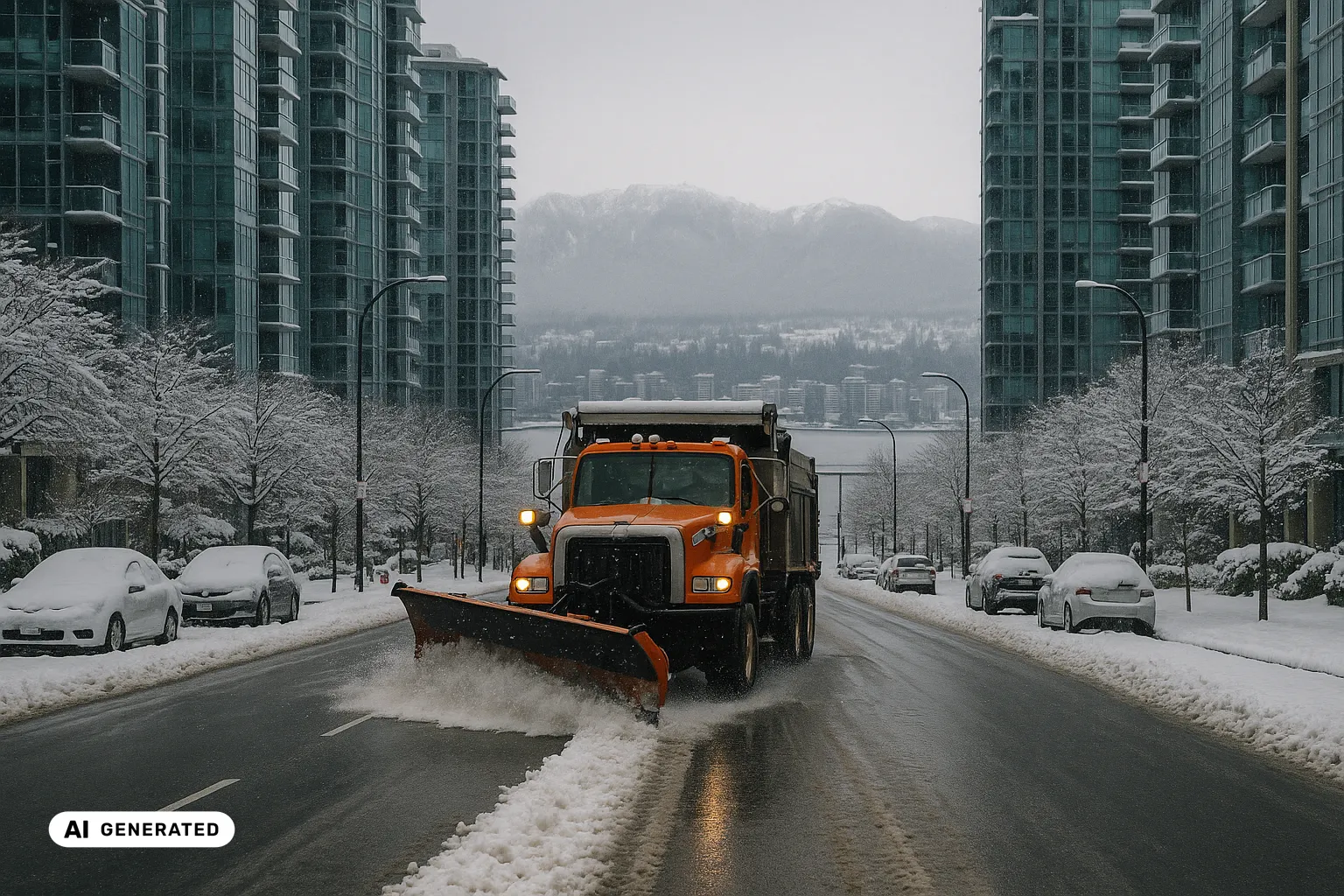
How Vancouver sits, and what winter does here
Vancouver sits on the Burrard Peninsula in BC’s Lower Mainland, between Burrard Inlet and the Fraser River, with the Strait of Georgia to the west shielded from the open Pacific by Vancouver Island. It is mostly low and flat — its highest point, Little Mountain, is just 152 m — and it has a mild oceanic climate. That is the whole key to its winter: this is a rain city, not a snow city, and what makes winter service here distinctive is less the volume of snow than the rarity of it.
The numbers are striking next to the rest of Canada. An average year brings only about 37 cm of snow at the airport (around 44 cm downtown) on just 7 to 10 days of snow, while January averages above freezing — about 4.1 °C at the airport and 5.3 °C on the harbour — and annual precipitation runs to 1,119–1,537 mm, almost all of it rain. Snow at sea level is infrequent and hard to forecast, because the temperature so often sits right on the rain/snow line. Meanwhile the North Shore Mountains, rising immediately north, catch roughly double the airport’s precipitation — about 2,477 mm a year — as mountain snow. So the picture is a city you can ski above and merely get wet in: deep snow on the slopes, rain at the seawall.
The catch is what happens on the rare days the cold and the moisture coincide. Because snow is the exception, the city has little routine or equipment for it, and a modest fall — or a glaze of freezing rain — can bring traffic to a halt. That is the winter Vancouver actually plans for: not a long shovelling season, but a handful of disruptive events.
What the local rules say
Vancouver puts the public sidewalk on the property owner. Under the City’s Street and Traffic By-law (No. 2849, section 76), owners and occupants must remove all snow and ice from the full width of the sidewalk in front of their property — and alongside it on a corner lot — each day by 10 a.m. when there is snow or freezing. The City is specific about the stakes: miss the 10 a.m. deadline the day after a snowfall and you may get a $250 fine; let it sit for over 24 hours and the fine could be $750. A 2023 by-law change made clear the duty is to remove all the snow and ice, not just clear a single path through it.
What the City clears is just as clearly bounded. It treats priority locations — major roads, bus routes, emergency and hospital access routes, bridges and viaducts (including their sidewalks and staircases), school routes, four key seawalls and greenways, and the 16 most-used bike routes — drawing on over 100 vehicles and about 3,000 tonnes of salt. And it states plainly what it does not clear in a snow event: residential side streets, sidewalks next to non-City property, and laneways. In other words, the quiet street and the sidewalk in front of most homes are not the City’s to clear — they are the owner’s.
Two local touches round it out. The Snow Angel program matches volunteers with residents who cannot clear their own sidewalk — seniors and people with limited mobility — arranged through the City’s 311 service. And because this is a coast, the City asks people to use salt sparingly, a nod to the runoff that ends up in the sea.
On the ground: where it gets tricky
A few things define winter service in Vancouver specifically. The rarity is the first — an event-driven season where the hard part is reacting fast to something that happens only a handful of times, often with the city advising people to stay off the roads rather than promising clear streets. The bridges are the early ice points: the exposed crossings over Burrard Inlet and False Creek frost before the streets around them, which is why they top the City’s list. And the rain/snow line itself is the daily uncertainty — the same storm can fall as rain at the seawall and snow a few blocks uphill, and freezing rain can glaze everything in between.
For anyone who clears for others through these short, sharp events, a dated record of when and where each surface was cleared or treated — and under what weather — is far easier to stand behind later than memory, especially when a whole season’s work can land in a few days.
Around Vancouver
Metro Vancouver is a patchwork of municipalities, each with its own by-law — similar in spirit, different in detail. Burnaby, to the east, requires owners and occupants of any property, single-family homes included, to clear the sidewalks around it by 10 a.m. every day, holidays included, under section 31 of its Street and Traffic Bylaw. The District of North Vancouver recently extended its rule so that homeowners must clear the sidewalk in front of the house by 10 a.m. too, with a $150 fine — and being higher and closer to the mountains, the North Shore simply gets more snow than the flat city core. So anyone working across the region should check each municipality rather than assume Vancouver’s rule carries over. And for the sharpest contrast of all, look inland: cold, continental Prince George measures its snow in metres over a long hard winter, where Vancouver measures its in centimetres over a few disruptive days — two BC cities at opposite ends of what “winter service” even means.
Local facts
- Vancouver sits on the Burrard Peninsula in BC's Lower Mainland, between Burrard Inlet to the north and the Fraser River to the south, with the Strait of Georgia to the west shielded from the open Pacific by Vancouver Island. The city is mostly low and flat — its highest point, Little Mountain, is just 152 m — and home to 662,248 people (Metro Vancouver about 2.64 million).Source
- The climate is oceanic (Köppen Cfb): mild, very rainy winters. The North Shore Mountains rise immediately north of the city and catch roughly double the airport's precipitation — about 2,477 mm a year — as mountain snow, while the sea-level city below it more often gets rain.Source
- Average annual snowfall is small — about 36.6 cm at Vancouver International Airport and 43.6 cm at Vancouver Harbour, on only about 7 to 10 days of snow a year — while January averages above freezing (about 4.1 °C at the airport, 5.3 °C downtown) and annual precipitation runs 1,119–1,537 mm, almost all of it rain (Environment and Climate Change Canada Climate Normals 1991–2020).Source
- Snow at sea level is infrequent and notoriously hard to forecast here, because temperatures often sit right on the rain/snow line — so when a cold snap and a rain band do coincide, the city is caught with little routine or equipment for it.Source
- Under the City of Vancouver's Street and Traffic By-law (No. 2849, section 76), property owners and occupants are responsible for removing all snow and ice from the full width of the sidewalk in front of — and, on a corner lot, alongside — their property each day by 10 a.m. when there is snow or freezing conditions.Source
- The City states that if you don't clear snow and ice by 10 a.m. the day after a snowfall you may get a $250 fine, and if it stays for over 24 hours the fine could be $750; a 2023 by-law change and a court ruling confirmed the duty is to remove all the snow and ice, not just shovel a path.Source
- The City treats priority locations only — major roads, bus routes, emergency and hospital access routes, bridges and viaducts (including their sidewalks and staircases), school routes, four key seawalls and greenways, and the 16 most-used bike routes — and states it does not clear residential side streets, sidewalks next to non-City property, or laneways, drawing on over 100 vehicles and about 3,000 tonnes of salt.Source
- Through its Snow Angel program the City matches volunteers with residents who cannot clear their own sidewalk — seniors and people with limited mobility — with requests arranged through the City's 311 service, a neighbourly fill for the gap the owner-clears rule would otherwise leave.Source
Official contacts
City of Vancouver — Winter maintenance on streets and sidewalks
The owner's 10 a.m. sidewalk-clearing duty and fines, the City's priority locations for treatment, and what it does not clear.
City of Vancouver — Street & Traffic By-law (No. 2849)
The by-law behind section 76, the sidewalk snow-and-ice clearing requirement.
City of Vancouver — Snow Angel program
How the City matches volunteers with residents who cannot clear their own sidewalks.
Common questions about winter service in Vancouver
- Who has to clear the sidewalk in Vancouver?
- The property owner or occupant. Under the City of Vancouver's Street and Traffic By-law (section 76), you must remove all snow and ice from the full width of the sidewalk in front of your property — and alongside it on a corner lot — each day by 10 a.m. when there is snow or freezing. The City says that if it is not cleared by 10 a.m. the day after a snowfall you may get a $250 fine, and if it stays over 24 hours the fine could be $750. A 2023 change made clear the duty is to remove all the snow and ice, not just shovel a single path through it.
- What does the City itself clear?
- Priority locations, not everything. The City treats major roads, bus routes, emergency and hospital access routes, bridges and viaducts — including their sidewalks and staircases — school routes, four key seawalls and greenways, and the 16 most-used bike routes, with over 100 vehicles and around 3,000 tonnes of salt. It is just as explicit about what it does not clear in a snow event: residential side streets, sidewalks next to non-City property, and laneways. So your street and your sidewalk are, in most cases, on you — not the City.
- It barely snows here — why does Vancouver seize up when it does?
- Because snow is the exception, not the routine. Vancouver gets only about 37 cm of snow a year on 7 to 10 days, and January averages above freezing, so most winter precipitation is rain. Forecasting snow at sea level is hard because the temperature sits on the rain/snow line, and drivers and the city alike are simply not geared up for it. When a cold snap and a rain band do line up, a relatively small amount of snow or freezing rain can bring things to a halt — which is why the City often advises people to stay off the roads during an event rather than promising cleared streets.
- What is the Snow Angel program?
- It is the City's way of covering the gap the owner-clears rule leaves. Because each owner is responsible for their own sidewalk, residents who physically cannot manage it — seniors and people with limited mobility — can be matched with volunteer neighbours who clear it for them. Requests are arranged through the City's 311 service, and volunteers sign up to a roster and bring their own shovel. It is a small, local feature of how Vancouver handles a snow event.
- Why is there deep snow on the mountains but rain in the city?
- Elevation. The North Shore Mountains — Grouse, Seymour and Cypress — rise immediately north of the city and force moist Pacific air upward, so they catch roughly double the airport's precipitation, about 2,477 mm a year, much of it as snow that feeds the ski hills. Down at sea level, that same weather system usually arrives as rain. The result is the classic Vancouver split: snow you can ski on a few kilometres from a downtown that is merely wet.
- Are the snow rules the same across Metro Vancouver?
- No — each municipality has its own by-law, similar in spirit but different in detail. In Burnaby, for instance, owners and occupants of any property, single-family homes included, must clear the sidewalks around their property by 10 a.m. every day, holidays included, under section 31 of its Street and Traffic Bylaw. The District of North Vancouver recently extended its rule to require homeowners to clear the sidewalk in front of their house by 10 a.m. too, with a $150 fine. So anyone clearing across the region should check each municipality rather than assume Vancouver's by-law carries over the boundary.
- Which spots tend to ice up first?
- The bridges and the few hills. Crossings over Burrard Inlet and False Creek — Lions Gate, Granville, Burrard, Cambie — are exposed and windy, lose heat from both sides, and frost before the streets around them, which is why the City puts them on its priority list. Vancouver is mostly flat, but the grades it does have, around Little Mountain and on the slopes toward the North Shore, are treated as priority routes when snow or ice arrives.
Documenting winter service in Vancouver
Anyone clearing snow and ice in Vancouver may later need to show when and where a route was treated. Wintertrace is open-source software that records exactly that — time, location and weather for each run — as a calm basis for your own operational records and service proof. It is not a substitute for legal advice.
This overview is for general information and is not legal advice. Local rules on snow and ice clearing vary — the wording of the local rule and the responsible authority always govern.