Winter service · Minnesota
Winter service in Duluth
What winter is really like in Duluth: about 90 inches of snow a year on the shore of Lake Superior, on ground that climbs some 800 feet from the water to the hilltop. Why the lake enhances the snow and moderates the cold, how the City's priority-plough policy puts steep business-district grades first when staffing is tight, and the Chapter 45 sidewalk rule with its 24-hour deadline and up-to-$200 fee.
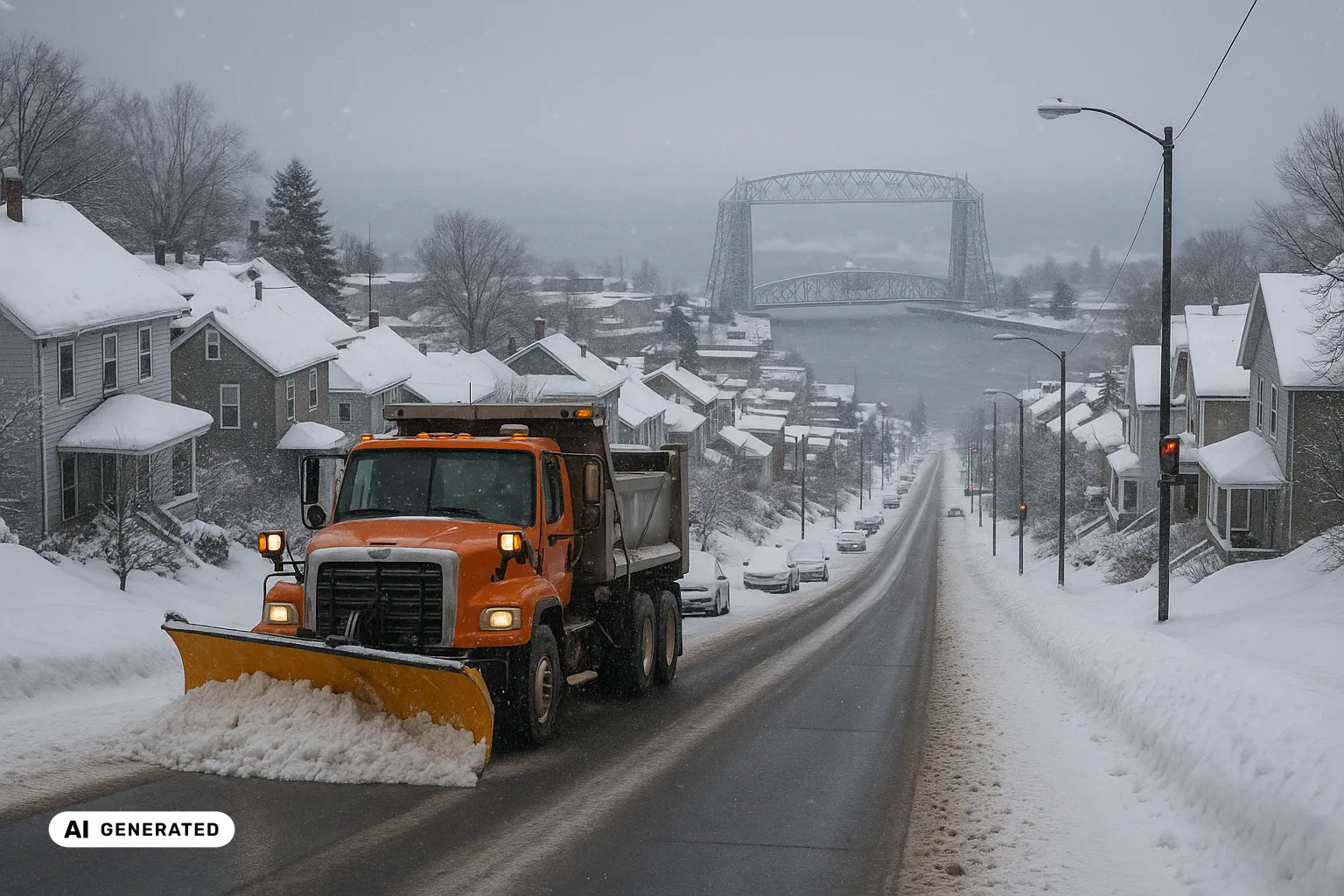
What winter actually does in Duluth
Duluth is a city built on a hillside above a great cold lake, and both of those facts run through its winter. It sits in St. Louis County on the north shore of Lake Superior, at the south-western tip of the largest of the Great Lakes, and it climbs: the lakeside weather station at Sky Harbor Airport sits at 607 feet, while the airport atop the hill is 820 feet higher again, at 1,427 feet. That water-to-hilltop rise — often compared to San Francisco — means a great many of the city’s streets are grades rather than flats, which turns out to shape everything from where the ice forms to which roads the City clears first. Across the state line, Superior, Wisconsin completes the Twin Ports.
Then there is the snow. Duluth averages about 90 inches a season on the 1991–2020 normals, with measurable snow on roughly 62 days a year — nearly double Minneapolis’s ~51 inches, and the reason is Lake Superior. Duluth sits just outside the classic lake-effect belt, but it takes lake-enhanced snow when cold, unstable air blows onshore across the open water, with the eastern half of the city most exposed. The same lake moderates the cold slightly — Duluth’s climate is classed as Dfb where inland Minnesota is the harsher Dfa — though “moderated” is relative in a city whose record low is −41 °F and which once ran 23 straight days below zero. The snow is spread over a long season: December through February each average well over a foot, but March still brings about 13 inches and April around nine, so the clearing work runs deep into spring. The snowiest season on record buried the city under 135.4 inches.
What the local rules say
Duluth sets its sidewalk duty in the City of Duluth Legislative Code, Chapter 45, Article VI. The headline deadline is 24 hours from the end of a snowfall, and it applies to residential and commercial owners alike — there is no gentler clock for homes here. What the City asks for is thorough: the full width of the sidewalk cleared down to the pavement, with all ice removed, and on a corner property the curb cuts and crosswalks down to the gutter as well. The cleared snow must go onto your yard or boulevard — under Sec. 45-73 it is specifically against the law to shovel it into the street or an alley.
Enforcement follows a plain sequence. On a complaint or its own inspection, the City gives the owner a chance to clear; if the walk is still uncleared at a re-check, the City has it cleared and bills the owner, and unpaid bills are added to the property tax. Since 1 January 2023 there is also a possible $200 fee for owners who fail to clear after receiving a notice. Uncleared walks can be flagged through the City’s Resident Problem Reporter. None of this is legal advice — it is simply what the City’s code and guidance set out.
How the City clears the streets — and why the hills come first
On the road side, the Street Maintenance Division works a three-priority policy, and the targets are measured from when the snow subsides: Priority 1 arterials should be passable in two lanes within 36 hours, Priority 2 residential streets in one lane within 48, and Priority 3 alleys within 56. Those windows are long by the standard of a drier city — a reflection of just how much snow a Duluth storm can drop.
The genuinely local rule is what happens when the crews are stretched. When staffing is limited, Priority 1 streets with steep inclines in the business districts get first call. That single line is Duluth’s terrain written into policy: on an 800-foot hillside, a steep, untreated grade in a busy district is a far worse problem than a flat street of the same priority, so it moves to the front of the queue. The fleet is 22 plough trucks and 22 road graders, treating with de-icing chemicals and washed sand rather than salt alone — and the drivers hold the MPCA Smart Salting certification, renewed every three years, a deliberate nod to keeping treatment out of Lake Superior. The City’s own biggest frustration, it says, is illegally parked cars blocking the ploughs; unlike Minneapolis, Duluth leans on parking rules rather than a tow-based snow-emergency system.
The Twin Ports and the hills around them
Duluth’s winter is really several conditions stacked on one slope. Down at the shore — Canal Park, Minnesota Point, the harbour front — the low ground by the open water takes lake-enhanced snow and freezing spray first. Climb the hill and the exposure changes; the eastern neighbourhoods catch more of the lake snow than the west. Above and around the city, Hermantown and Proctor sit higher on the hilltop, and across the state line Superior, Wisconsin is a different jurisdiction entirely — a different state, a different rulebook.
The point for anyone clearing snow here is that the Duluth rules — Chapter 45, the 24-hour deadline, the $200 fee — describe Duluth and stop at the city line; Hermantown, Proctor and Superior each set their own. And within the city itself, a single route can run from a flat hilltop, down a steep, ice-prone grade, to a freezing shoreline — three different clearing problems in one job, which is about as concise a summary of Duluth winter service as you can give.
Keeping the record straight
In a city this steep and this snowy — 90 inches a season, grades that ice before the flats, a 24-hour clock that runs the same for a shop as for a house — the useful thing is being able to show, plainly, what was cleared and when, and against what conditions. Not to win an argument, but because a long, heavy winter generates exactly the questions a vague answer can’t settle: was the hill treated, at what time, before the overnight freeze took hold. A simple, time-stamped record of each plough and treatment, with the hours a crew actually spent on a route and what the weather was doing at the time, turns “we kept the grade clear” into something specific — and makes the scale of a Duluth season easier to plan and price in the first place. That is the documentation support Wintertrace is built to make easy. It changes no local rule; it just means that when someone asks what happened on the hill before the freeze, the answer is on file. Not a substitute for legal advice.
Local facts
- Duluth sits in St. Louis County on the north shore of Lake Superior, in Minnesota's Arrowhead Region, at the south-western tip of the largest of the Great Lakes.Source
- The city climbs steeply from the water: the lakeside weather station at Sky Harbor Airport sits at 607 ft (185 m), while Duluth International Airport, atop the hill, is 820 ft (250 m) higher at 1,427 ft (435 m) — a water-to-hilltop rise often compared to San Francisco.Source
- With Superior, Wisconsin, directly across the state line, Duluth forms the Twin Ports at the western end of Lake Superior — one of the larger cargo ports in the United States.Source
- Average seasonal snowfall is about 90.2 inches (229 cm) on the 1991–2020 normals at Duluth International Airport, with measurable snow on roughly 62 days a year; the older 1981–2010 normal was 86.1 inches.Source
- The snow is spread across a long season — December averages about 18.7 inches, January 16.8, February 15.1, November 14.1, March 12.8 and April 9.1 — so winter runs well into spring.Source
- Duluth is genuinely cold: the record low is −41 °F (2 January 1885), and a run of 23 consecutive days with lows below 0 °F ended on 11 February 2014. The snowiest season on record was 135.4 inches (1995–96).Source
- Its climate is Köppen Dfb (warm-summer humid continental), moderated by Lake Superior; sitting at the lake's south-western tip, Duluth is outside the classic lake-effect belt but takes lake-enhanced snow when cold air blows onshore, with the eastern half of the city more exposed.Source
- Under the City of Duluth Legislative Code, Chapter 45, Article VI, property owners — residential and commercial alike — must clear snow and ice from the abutting sidewalk within 24 hours of the end of a snowfall.Source
- The City requires the full width of the sidewalk cleared down to the pavement with all ice removed; corner properties must also clear curb cuts and crosswalks to the gutter, and snow must go onto the yard or boulevard — it is against the law to shovel it into streets or alleys (Sec. 45-73).Source
- If an owner does not clear after a City notice, the City has the walk cleared and bills the cost; unpaid bills are added to the property tax, and since 1 January 2023 there is a possible $200 fee for owners who fail to clear after notice.Source
- The City's snow-and-ice policy sets three priorities — Priority 1 arterials passable in two lanes within 36 hours, Priority 2 residential streets within 48, Priority 3 alleys within 56 — and gives Priority 1 streets with steep inclines in the business districts first call when staffing is limited.Source
- The road fleet is 22 plough trucks and 22 road graders; the City treats with de-icing chemicals and washed sand, and its drivers hold the MPCA Smart Salting certification, renewed every three years to protect Lake Superior's water.Source
Official contacts
The City's snow home page: requirements, plough policy, priority maps and the problem-reporter.
City of Duluth — Snow Removal Requirements
The sidewalk clearing duty: the 24-hour deadline for residential and commercial owners alike.
City of Duluth — Snow & Ice Control Policy
The Priority 1/2/3 targets, the steep-hill business-district priority, and the de-icing and Smart Salting approach.
City of Duluth Public Works & Utilities — Street Maintenance Division
The division responsible for ploughing and treating the city's streets.
National Weather Service, Duluth — winter climate
Seasonal snowfall, record cold and the snowiest seasons for Duluth.
Common questions about winter service in Duluth
- How long do I have to clear my sidewalk in Duluth?
- Under the City of Duluth Legislative Code, Chapter 45, Article VI, you have 24 hours from the end of a snowfall — and this applies to residential and commercial property owners alike. The City asks for the full width of the sidewalk cleared down to the pavement, with all ice removed; on a corner property you must also clear the curb cuts and crosswalks down to the gutter. The cleared snow goes onto your yard or boulevard, not the street or an alley — that part is specifically against the law (Sec. 45-73). If you do not clear after a City notice, the City can have it done and bill you, unpaid bills are added to your property tax, and since 1 January 2023 there is a possible $200 fee. This is the City's own framework, described here as general information rather than legal advice.
- Why does Duluth get so much more snow than Minneapolis?
- The lake. Duluth averages about 90 inches a season against roughly 51 in Minneapolis — nearly double — and the difference is Lake Superior. Duluth sits at the lake's south-western tip, just outside the classic lake-effect belt, but it takes lake-enhanced snow when cold, unstable air blows onshore across the open water, and the eastern half of the city is the more exposed to it. The same lake moderates the cold a little, which is why Duluth's climate is classed as Dfb where inland Minnesota is the harsher Dfa. The snow is also spread over a long season: December through February each average well over a foot, but March still brings about 13 inches and April around nine, so winter clearing runs deep into spring.
- How does the City decide which streets to plough first?
- By priority, with a local twist for the hills. The policy sets three tiers: Priority 1 arterials should be passable in two lanes within 36 hours of the snow subsiding, Priority 2 residential streets within 48 hours in one lane, and Priority 3 alleys within 56. The Duluth-specific part is what happens when staffing is tight: Priority 1 streets with steep inclines in the business districts get first call. That is a direct answer to the city's terrain — on an 800-foot hillside, a steep, untreated grade in a busy district is a bigger problem than a flat street, so it goes to the front of the queue. The fleet doing the work is 22 plough trucks and 22 road graders.
- What makes clearing snow on Duluth's hills different?
- The topography is the whole job. Duluth climbs some 800 feet from the lakeshore to the hilltop — a rise often likened to San Francisco — so a great many streets are grades, not flats. On a grade, ice and packed snow turn an ordinary street into a traction problem, which is exactly why the City's policy singles out steep business-district hills for priority. Down at the shore, the low-lying areas by the water and the harbour take lake-enhanced snow and freezing spray first. The City treats with de-icing chemicals and washed sand rather than salt alone, and its drivers carry the MPCA Smart Salting certification — a nod to keeping treatment out of Lake Superior. For a contractor, the practical reality is that a route can run from a flat hilltop down a steep, ice-prone grade to a freezing shoreline within a single job.
Documenting winter service in Duluth
Anyone clearing snow and ice in Duluth may later need to show when and where a route was treated. Wintertrace is open-source software that records exactly that — time, location and weather for each run — as a calm basis for your own operational records and service proof. It is not a substitute for legal advice.
This overview is for general information and is not legal advice. Local rules on snow and ice clearing vary — the wording of the local rule and the responsible authority always govern.