Winter service · Minnesota
Winter service in Minneapolis
What winter is really like in Minneapolis: about 51 inches of snow a year and a January that averages a low near 9 °F in the City of Lakes. How the three-day Snow Emergency shifts parking side to side, why homes get 24 hours to clear the walk but apartments and shops get four daytime hours, and why one season can bring 14 inches or nearly 99.
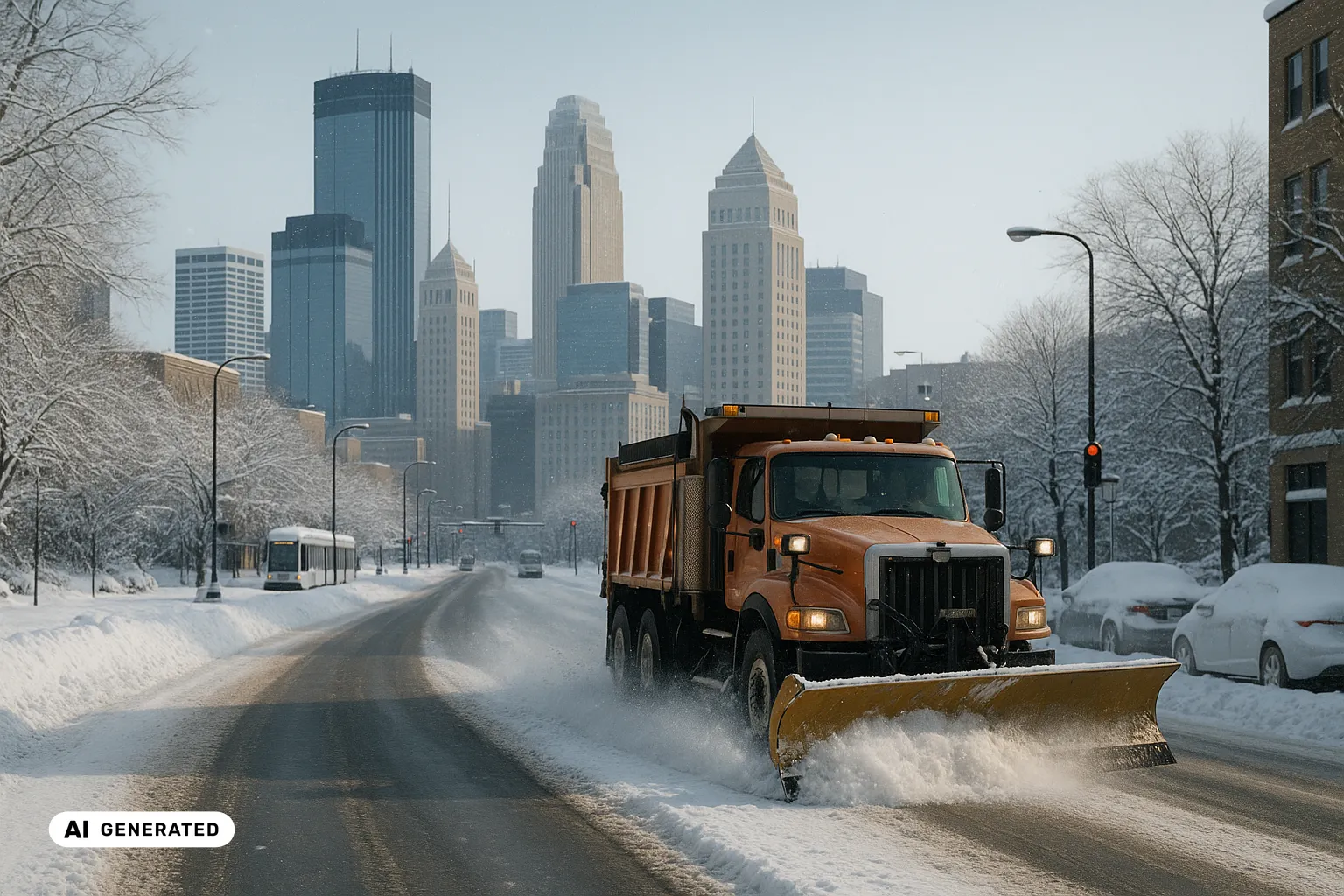
What winter actually does in Minneapolis
Minneapolis stands on both banks of the Upper Mississippi in central Minnesota, the seat of Hennepin County, at about 830 feet on mostly flat ground. It is the City of Lakes — around 13 lakes, the largest being Bde Maka Ska, with Lake Harriet nearby — and the river runs through the middle over St. Anthony Falls, the only natural waterfall on the Mississippi. That watery geography shapes the winter: a map full of bridges, parkways and shaded waterside stretches that ice early, on top of the snow itself. Directly to the east is Saint Paul, the state capital; together the Twin Cities anchor a metro of about 3.7 million, and — this matters all winter — each city runs its own rules.
The climate is continental (Köppen Dfa), and it is both snowy and genuinely cold. About 51 inches of snow falls in an average year on the 1991–2020 airport normals, over roughly 38 days of measurable snow, with December, January and February carrying most of it. And the cold is real: January averages a high of 23.6 °F and a low of 8.8 °F, and the all-time record is −41 °F, set in 1888. Unlike a fast-melting, mile-high city such as Denver, where the sun clears the side streets between storms, Minneapolis snow arrives and stays — it is a place where winter settles in and holds.
The number that best captures the challenge, though, is the variance. The snowiest winter on record, 1983–84, brought 98.6 inches; the least, 1931–32, just 14.2 inches; and a recent season, 2022–23, reached 90.3 inches. A swing from roughly 14 to 99 inches means a winter-service plan here has to survive both a quiet year and one that buries the city — and you often don’t know which you’re getting until it’s underway. The big storms are part of local memory: the 1991 Halloween Blizzard dropped 28.4 inches, and the 1940 Armistice Day Blizzard killed 60 people in Minnesota as the temperature fell nearly 60 °F in a single day.
What the local rules say — two clocks
Minneapolis’s sidewalk rule lives in the City Code of Ordinances, Chapter 445 (Snow and Ice Removal), and its defining feature is that it runs two different clocks. Single-family homes and duplexes have 24 hours after the snow stops. Everything else — apartment buildings, businesses — has just 4 daytime hours, counted between 8 a.m. and 5 p.m. The reasoning is foot traffic: busier sidewalks, tighter standard. If you manage a multi-unit or commercial property, that four-hour window is the number that matters — clearing is a same-day task tied to when the snow stops.
The standard itself is exacting: the whole width of the city sidewalk, cleared to bare pavement, and corner properties must also clear the curb cutouts and crossings to the gutter. Enforcement is systematic. The City inspects sidewalks starting 24 hours after a snowfall; if a walk is still uncleared, City crews clear it and bill the owner, and an unpaid bill is added to the property’s taxes (Chapter 445.35). The City doesn’t publish a set fine on its page, so the honest thing to say is the mechanism, not a dollar figure: clear it yourself, or the City clears it and charges you, ultimately through your property taxes. None of this is legal advice; it is simply what the City’s rules say.
The Snow Emergency — a three-day parking dance
The single most Minneapolis thing about winter here is the Snow Emergency, a formal, three-day system for clearing the streets kerb to kerb by moving parked cars off the roads in sequence. There is no fixed snow-depth trigger — the Director of Public Works weighs the whole picture (recent storms, how much fell, timing, road conditions, the forecast, even the time of year) and declares it, usually before 6 p.m., announced on the City’s website, app and local media.
Once declared, the parking rules shift day by day so crews can plough one set of streets at a time:
- Day 1, from 9 p.m. — no parking on Snow Emergency routes.
- Day 2, from 8 a.m. — no parking on the even-numbered side of non-emergency streets, or on parkways.
- Day 3, from 8 a.m. — no parking on the odd-numbered side.
Tagging and towing begin at 9 p.m. on Day 1. For residents it becomes a learned habit — check whether an emergency is on, then follow the day’s side — because parking on the wrong side means a ticket and a tow. The parkways around the Chain of Lakes get their own treatment in the plan (Day 2 and Day 3), a sign that these curving, lakeside roads are an operational category of their own.
Bridges, lakes and the cold
It helps to picture Minneapolis winter service as a city built around water. The Mississippi splits it down the middle, spanned by many bridges — wind-exposed and quick to ice — and the 13 lakes and their parkways thread shaded, waterside road all through the map. In the city’s continental cold, those are the stretches that turn first and refreeze fastest, and where de-icing salt loses much of its bite — so timing and mechanical clearing carry more of the load than they would in a milder place. The prairie cold it shares with a city like Winnipeg to the north is the backdrop; the waterside geography is what makes the local job specific.
And there is the alley. A lot of Minneapolis property is served from the back, so “the street was ploughed” and “the alley is clear” are two different things — alleys are their own clearing task, worth checking on the City’s snow pages rather than assumed.
The Twin Cities line
The thing to remember across the metro is how often you cross a city line. Minneapolis and Saint Paul are separate cities, and Saint Paul runs its own Snow Emergency system on its own schedule. The suburbs — Bloomington, Edina, St. Louis Park, Richfield, Golden Valley and the rest — each set their own sidewalk and parking rules. So the Minneapolis two-clock sidewalk rule and the three-day parking sequence describe Minneapolis only. In a metro this interwoven, a route or a portfolio that crosses town lines is really working several rulebooks at once — which is exactly why you read the local rule rather than assume Minneapolis’s travels with it.
Keeping the record straight
In a city where one winter brings 14 inches and the next nearly a hundred, and where a Snow Emergency can reshuffle every street over three days, the useful thing is being able to show, plainly, what was done and when. Not to win an argument, but because a winter this variable generates exactly the questions a vague answer can’t settle: was the route cleared, when, in what conditions, before the emergency’s window closed. A simple, time-stamped record of each pass, set against what the weather was actually doing, turns “we were out all storm” into something specific. That is the documentation support Wintertrace is built to make easy — a clear log of where a crew went and when — whether you look after a single duplex on a 24-hour clock or a portfolio of commercial properties on the four-hour one. It does not change any local rule; it just means that when someone asks what happened during the last Snow Emergency, the answer is on file. Not a substitute for legal advice.
Local facts
- Minneapolis occupies both banks of the Upper Mississippi River in central Minnesota — the seat of Hennepin County — at about 830 ft (250 m) of elevation, on mostly flat terrain.Source
- The 'City of Lakes' has around 13 lakes (the largest is Bde Maka Ska, with Lake Harriet nearby) plus St. Anthony Falls — the only natural waterfall on the Mississippi — so its winter map is full of bridges, parkways and shaded waterside stretches that ice early.Source
- It sits directly against Saint Paul, the state capital; together the Twin Cities form the core of a metro of about 3.7 million people, each municipality with its own snow rules.Source
- The climate is continental (Köppen Dfa): about 51.2 inches (130 cm) of snow in an average year on the 1991–2020 normals at Minneapolis–St. Paul International Airport, over roughly 38 days with measurable snow.Source
- The snowiest months are December (about 11.4 in), January (11.0 in) and February (9.5 in); January is the coldest, averaging a high of 23.6 °F and a low of 8.8 °F.Source
- The all-time record low is −41 °F, set on 21 January 1888.Source
- Season-to-season variance is extreme: the snowiest winter on record was 1983–84 with 98.6 inches, the least was 1931–32 with just 14.2 inches, and 2022–23 (90.3 in) ranks third-highest — per the Minnesota DNR State Climatology Office.Source
- The 1991 Halloween Blizzard (31 Oct–2 Nov) dropped 28.4 inches at the airport — the region's greatest early-season storm; the 1940 Armistice Day Blizzard killed 60 people in Minnesota as temperatures fell nearly 60 °F in a day.Source
- Under the City of Minneapolis Code of Ordinances, Chapter 445 (Snow and Ice Removal), property owners must clear the sidewalk: single-family homes and duplexes within 24 hours after snow stops, all other properties within 4 daytime hours (8 a.m.–5 p.m.).Source
- The whole width of the city sidewalk must be cleared to bare pavement, and corner properties must also clear curb cutouts and crossings to the gutter.Source
- The City inspects sidewalks starting 24 hours after a snowfall; if a walk is still uncleared, City crews clear it and bill the owner, and an unpaid bill is added to the property's taxes (Chapter 445.35).Source
- Minneapolis runs a formal three-day Snow Emergency: there is no fixed snow-depth trigger — the Director of Public Works declares it based on the whole picture, usually before 6 p.m., announced on the City's website, app and media.Source
- Snow Emergency parking moves day by day: Day 1 (from 9 p.m.) no parking on Snow Emergency routes; Day 2 (from 8 a.m.) none on the even side of non-emergency streets or on parkways; Day 3 (from 8 a.m.) none on the odd side. Tagging and towing begin at 9 p.m. on Day 1.Source
Official contacts
City of Minneapolis — Snow (Public Works)
The City's snow-season hub: how streets are ploughed, sidewalk rules, and Snow Emergencies.
City of Minneapolis — Sidewalk Snow Clearing Rules
The owner duty, the 24-hour and 4-daytime-hour deadlines, the bare-pavement standard, and how the City clears and bills an uncleared walk.
City of Minneapolis — Snow Emergency Parking Rules & Map
The Day 1/2/3 parking rules and the map of which streets are Snow Emergency routes and parkways.
Minnesota DNR State Climatology Office — snowiest winters (MSP)
The record seasonal snowfall totals for Minneapolis–St. Paul.
Common questions about winter service in Minneapolis
- How long do I have to clear my sidewalk in Minneapolis?
- It depends on the property. Under the City of Minneapolis Code, Chapter 445, single-family homes and duplexes have 24 hours after the snow stops; all other properties — apartments, businesses — have just 4 daytime hours, counted between 8 a.m. and 5 p.m. You have to clear the whole width of the city sidewalk down to bare pavement, and corner properties must also clear the curb cutouts and crossings. The City starts inspecting 24 hours after a snowfall, and if your walk is still uncleared, crews will clear it and bill you — and an unpaid bill gets added to your property taxes. This is general information, not a substitute for legal advice.
- What is a Snow Emergency, and how do I know one has been declared?
- A Snow Emergency is how Minneapolis clears its streets kerb to kerb after a significant snowfall, by moving parked cars off the roads in a set sequence over three days. There is no fixed snow-depth trigger — the Director of Public Works weighs the whole picture (recent storms, how much fell, timing, road conditions, the forecast, the time of year) and declares it, usually before 6 p.m. It is announced on the City's website and app, and through local media. The City even publishes a map of which streets are Snow Emergency routes and parkways, because where you can park changes with each day of the emergency.
- Where can I park during a Snow Emergency?
- The rules shift day by day so crews can plough one set of streets at a time. On Day 1, from 9 p.m., don't park on Snow Emergency routes. On Day 2, from 8 a.m., don't park on the even-numbered side of non-emergency streets, or on parkways. On Day 3, from 8 a.m., don't park on the odd-numbered side. Tagging and towing begin at 9 p.m. on Day 1. The practical habit residents learn is to check whether an emergency has been declared and then follow the day's side — because parking on the wrong side gets you ticketed and towed.
- Why do apartments and businesses get so much less time than houses?
- The City's ordinance simply sets two clocks: 24 hours for single-family homes and duplexes, and 4 daytime hours for everything else. The reasoning is foot traffic — apartment blocks, shops and offices sit on busier sidewalks where uncleared snow and ice affect far more people, so the standard is tighter. If you manage a multi-unit or commercial property in Minneapolis, that four-hour daytime window is the number that matters: clearing is a same-day task tied to when the snow stops, not something for the next morning.
- How much snow does Minneapolis get, and is it the same every year?
- About 51 inches in an average year, on the 1991–2020 normals — but the average hides how wildly it swings. The snowiest winter on record, 1983–84, brought 98.6 inches; the least, 1931–32, just 14.2 inches; and a recent winter, 2022–23, reached 90.3 inches. That range — roughly 14 to 99 inches — is the real story. A winter-service plan here has to cope with both a quiet season and one that buries the city, and you often don't know which you're getting until it's underway.
- What does the extreme cold change about winter service?
- Minneapolis is genuinely continental-cold — January averages a low near 9 °F, and the record is −41 °F. In that kind of cold, de-icing salt loses much of its effect, so timing and mechanical clearing matter more, and refreeze is a constant on bridges and shaded, waterside stretches. The City of Lakes has a lot of those: 13 lakes, the Mississippi cutting through the middle, and the parkways around the Chain of Lakes, all of which ice early and are handled as their own category in the Snow Emergency plan. Deep cold and a lot of waterside road is the local combination.
- Does the City plough the alleys?
- Alleys are part of the picture in Minneapolis — a lot of properties are served from the back — and they are a distinct clearing task from the streets. The City's snow operation covers its streets and, in a Snow Emergency, works to clear them kerb to kerb; alleys and the details of any given winter's plan are worth checking on the City's snow pages rather than assumed. The general point is that 'the street was ploughed' and 'the alley is clear' are two different things here.
- Are Saint Paul and the suburbs under the same rules?
- No. Minneapolis and Saint Paul are separate cities — Saint Paul runs its own Snow Emergency system — and the suburbs (Bloomington, Edina, St. Louis Park, Richfield, Golden Valley and the rest) each set their own sidewalk and parking rules. So the Minneapolis 24-hour / 4-daytime-hour sidewalk clock and the three-day parking sequence describe Minneapolis only. Cross a city line — and in the Twin Cities you cross them often — and you are into a different local rulebook, sometimes with a differently timed emergency of its own.
Documenting winter service in Minneapolis
Anyone clearing snow and ice in Minneapolis may later need to show when and where a route was treated. Wintertrace is open-source software that records exactly that — time, location and weather for each run — as a calm basis for your own operational records and service proof. It is not a substitute for legal advice.
This overview is for general information and is not legal advice. Local rules on snow and ice clearing vary — the wording of the local rule and the responsible authority always govern.