Winter service · Colorado
Winter service in Denver
What winter is really like in Denver: about 49 inches of snow a year at a mile high, but a city where the sun and dry air melt it between storms. Why March is the snowiest month, how the City ploughs main streets but leaves residential ones to a single pass, and the DOTI rule that gives businesses just four hours to clear the walk.
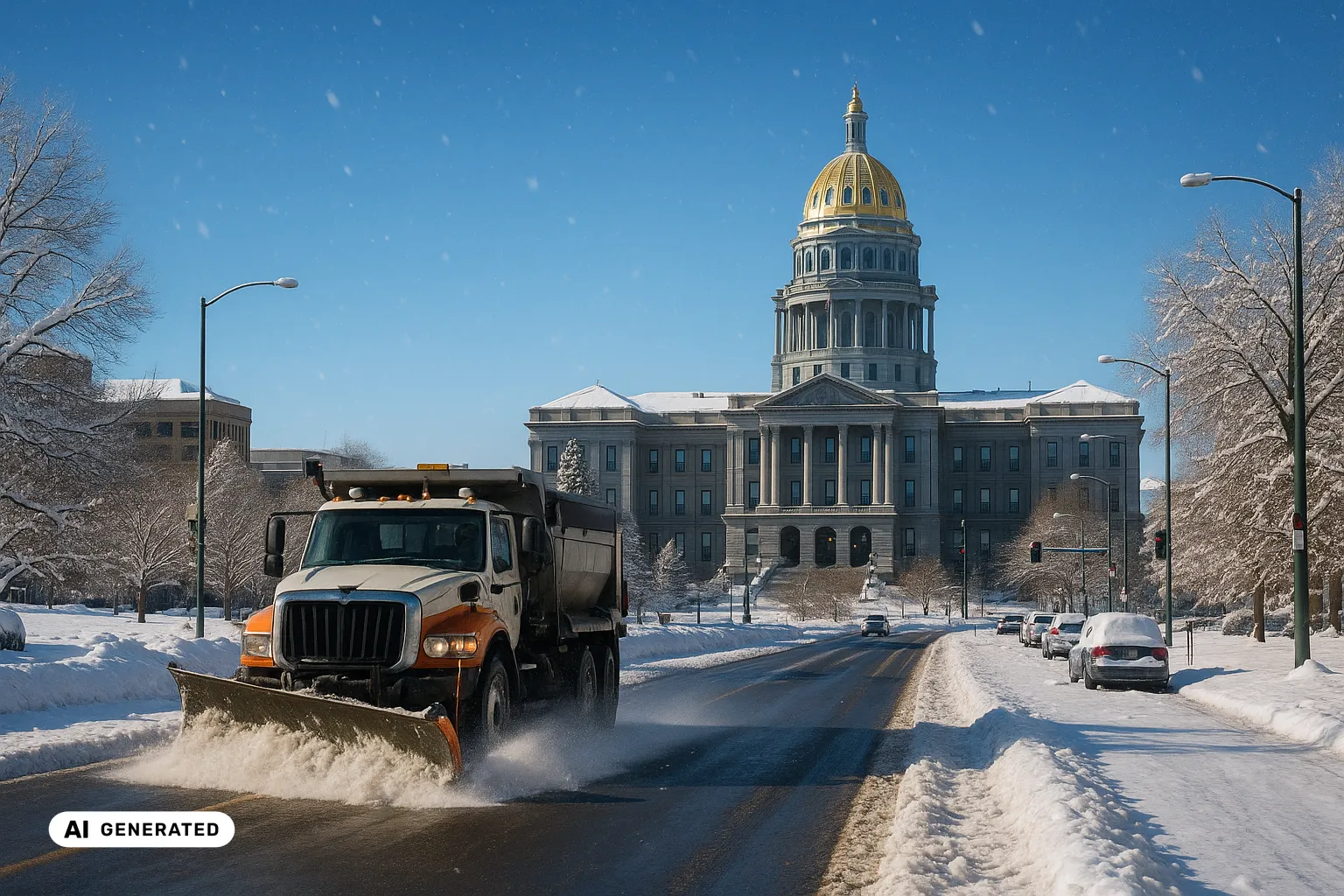
What winter actually does in Denver
Denver sits at the western edge of the High Plains, right where the flat land runs into the Front Range of the Rockies, at about 5,280 feet — a mile high. The South Platte River and Cherry Creek cut through it, and the mountains stand immediately to the west. That setting explains the winter, because Denver’s climate is semi-arid: dry, sunny, and — crucially — a place where the snow often does not stay.
The headline number is about 49 inches of snow a year on the 1991–2020 normal, and the National Weather Service reckons the true seasonal figure is nearer 57 inches once measurement quirks are allowed for. But the total is the least useful thing to know here. What defines a Denver winter is the rhythm: a sharp storm, then a sunny thaw that clears the surfaces on its own, then an overnight refreeze. At a mile up, with intense high-altitude sun and dry air, snow melts fast between storms — and a warm, down-slope Chinook wind off the mountains can push the temperature above freezing in hours and strip a snow cover in a day. This is a freeze-thaw climate far more than a deep-snow one, which is the opposite of a continental snowbelt like Minneapolis, where the snow arrives in autumn and simply stays.
There is one more local quirk worth holding onto: March is the snowiest month, averaging about 8.8 inches — more than December or January. Denver’s heaviest snow comes from spring storms rolling off the Rockies, wet and heavy, and the season runs long at both ends: the average first measurable snow is mid-October, the average last late April, with snow on record as late as June.
What the local rules say — and the four-hour catch
Denver’s sidewalk rule lives in the Denver Revised Municipal Code (Chapter 49, Article XV, §49-551), which requires clearing snow and ice from the adjoining sidewalk “immediately after every snowfall.” The working detail is set by the DOTI regulation PWRR-002.2 (PDF), and the part that catches people out is the split by property type.
The City may issue a notice or citation no sooner than 4 hours after snowfall ends for a business, and 24 hours for a residence. That four-hour commercial window is short: for a storefront, clearing the walk is a same-storm task, not something for the next morning. The duty falls on the owner or occupant of the adjoining public sidewalk — and explicitly on the ADA ramps and bus stops next to it — and you may not push the snow into the street or a bike lane. Miss the deadline and the penalty is $150.
There is one release valve: in an exceptional storm the City can declare a snow emergency and suspend sidewalk enforcement — but such declarations are capped at 72 hours, after which the ordinary deadlines resume. None of this is legal advice; the point is simply what the City’s own code and regulation say. Denver also runs a “Snow Angels” programme, matching volunteers with older residents and people with disabilities who need help clearing their walks.
How the City clears the streets — and why it lets some melt
On the road side, the picture is deliberately two-tier, and it follows straight from the climate. The City ploughs its roughly 2,050 lane miles of main streets — essentially every road with lane markings — with a fleet of 68 large ploughs, de-icing with granular “Ice Slicer” salt and, downtown, liquid magnesium chloride chosen partly for air quality in the core.
Residential streets are a different story: they are not routinely ploughed to bare pavement. In a larger storm the City activates its separate Residential Snow Plow Program — plough-equipped 4x4 pickups covering about 1,260 lane miles, making a single pass down the middle of each street, between 3 a.m. and 3 p.m., with no de-icer. The logic is the mile-high sun: on a quiet street, the snow often melts off within a few days on its own, so the City counts on that natural melt rather than clearing every road.
The catch is what that leaves behind. What melts in the afternoon refreezes overnight and on shaded, north-facing stretches, and busy un-treated side streets get churned into hard ice ruts — frozen ridges that can steer a car and last until the melt catches up. For anyone running winter service on residential routes, that packed, rutted ice is the real hazard, more than fresh snow depth. A treated arterial and an untreated side street a block apart can be in completely different conditions — which is the whole texture of a Denver storm.
The metro, the foothills and the snow line
It helps to picture Denver winter service as several snow climates on one map, sorted mostly by elevation. The city itself, out on the plain, gets the least; climb west into the foothills and the totals rise quickly. Boulder, higher and to the north-west against the foothills, is measurably snowier and windier than Denver and sets its own, stricter sidewalk deadline. Foothill towns like Golden and the mountain suburbs get far more snow again. To the east, Aurora — the metro’s second city — sits at much the same elevation as Denver and shares its climate, but runs its own sidewalk and clearing rules, as do Lakewood, Arvada, Westminster and Thornton to the west and north.
The lesson is the same one that holds anywhere: the local rulebook is the one that counts. A contractor whose routes run from the plains up toward the foothills is working a rising snow line — light and fast-melting in the city, heavier and longer-lying as the ground climbs — and a storm total quoted for “Denver” can badly understate what fell a few miles west.
Keeping the record straight
In a climate this changeable — a heavy fall, a fast thaw, an overnight refreeze, ice ruts on the north side of the street — the useful thing is being able to show, plainly, what was treated and when. Not to win an argument, but because a winter of freeze-thaw generates exactly the questions a vague answer can’t settle: was the lot de-iced, when, in what conditions, before the refreeze. A simple, time-stamped record of each treatment, set against what the weather was actually doing, turns “we were out ahead of the ice” into something specific. That is the documentation support Wintertrace is built to make easy — a clear log of where a crew went and when — whether you look after a single storefront on a four-hour clock or a fleet of routes from the plains to the foothills. It does not change any local rule; it just means that when someone asks what happened before the overnight freeze, the answer is on file. Not a substitute for legal advice.
Local facts
- Denver sits at the western edge of the High Plains against the Front Range of the Rockies, at about 5,280 ft (1,609 m) — the 'Mile High City' — with the South Platte River and Cherry Creek running through it.
- Its climate is semi-arid (Köppen BSk): dry, sunny winters with intense high-altitude sunlight, so snow often melts quickly between storms as the sun and dry air clear the surfaces.
- Warm, föhn-like Chinook winds off the mountains can lift the temperature above freezing within hours and strip a snow cover fast — one reason a Denver snowfall can be gone in days.
- About 49.0 inches (124 cm) of snow falls in an average year, on NOAA's NCEI 1991–2020 normals; the National Weather Service puts the true seasonal average nearer 56.9 inches, noting once-daily measurement tends to undercount.Source
- March is the snowiest month, averaging about 8.8 inches — the season is long at both ends, with November, February and especially March carrying more than midwinter December and January.Source
- The average first measurable snow is 18 October and the average last is 28 April; the record extremes run from 3 September (1961) to 2 June (1951).Source
- Under the Denver Revised Municipal Code (Chapter 49, Article XV, §49-551), snow and ice must be removed from the adjoining sidewalk 'immediately after every snowfall', with the detail set by DOTI regulation PWRR-002.2.Source (PDF)
- The clearing deadlines differ sharply by property type: the City may issue notices or citations no sooner than 4 hours after snowfall ends for businesses, and 24 hours for residences (PWRR-002.2, Section 3).Source (PDF)
- The duty falls on the property owner or occupant for the adjoining public sidewalk — including adjacent ADA ramps and bus stops — and snow may not be pushed into the street or a bike lane; the penalty for missing the deadline is $150.Source
- In an exceptional storm the City can declare a snow emergency and suspend sidewalk enforcement, but such declarations are limited to 72 hours before the ordinary deadlines resume (PWRR-002.2, Section 4).Source (PDF)
- The City ploughs its roughly 2,050 lane miles of main streets with a fleet of 68 large ploughs, de-icing with 'Ice Slicer' granular salt and, downtown, liquid magnesium chloride for air quality.Source
- Residential streets are not routinely ploughed to bare pavement: the Residential Snow Plow Program covers about 1,260 lane miles with plough-equipped 4x4 pickups, activated only for larger storms — a single pass down the middle of each street between 3 a.m. and 3 p.m., with no de-icer.Source
- The City runs a 'Snow Angels' programme that matches volunteers with older residents and people with disabilities who need help clearing their sidewalks (720-913-SNOW).Source
Official contacts
City & County of Denver — DOTI Snow Removal
The Department of Transportation & Infrastructure's snow page: the plough policy, the sidewalk owner duty, the $150 penalty and how to report an uncleared walk.
Denver DOTI — Regulation PWRR-002.2, Snow and Ice Removal from Sidewalks (PDF)
The regulation behind the code: the 4-hour and 24-hour deadlines, and the 72-hour cap on a snow emergency, as a PDF.
National Weather Service, Denver/Boulder — winter statistics
Seasonal snowfall averages and the first/last measurable snow dates for Denver.
Where residents report a sidewalk still uncleared after the deadline: 311, or 720-913-1311 from outside Denver.
Common questions about winter service in Denver
- How long do I have to clear my sidewalk in Denver?
- It depends on whether the property is a business or a home. Under the City's regulation PWRR-002.2, which implements the Denver Revised Municipal Code, the City may issue a notice or citation no sooner than 4 hours after snowfall ends for a business, and 24 hours for a residence. The code's underlying standard is to clear 'immediately after every snowfall'. The duty falls on the owner or occupant for the adjoining public sidewalk — including any ADA ramp or bus stop next to it — and you may not push the snow into the street or a bike lane. Miss the deadline and the penalty is $150. The four-hour business window catches people out most, so if you run a storefront, clearing is a same-storm job. This is general information, not a substitute for legal advice.
- Why doesn't the City plough my residential street?
- By design. Denver concentrates its main fleet — about 68 large ploughs — on roughly 2,050 lane miles of main streets, the ones with lane markings, plus routes around schools. Residential streets are not routinely cleared to bare pavement. In a larger storm the City activates a separate Residential Snow Plow Program: plough-equipped 4x4 pickups make a single pass down the middle of each residential street, between 3 a.m. and 3 p.m., with no de-icing salt. The reasoning is partly the city's climate — at a mile high, with strong sun and dry air, snow on a quiet street often melts off within a few days on its own.
- Does Denver really get much snow?
- About 49 inches a year on the NCEI 1991–2020 normal — and the Weather Service puts the true seasonal figure nearer 57 inches once you account for measurement quirks. But the total is less telling here than the rhythm. Denver's winter is a series of sharp storms with sunny, thawing spells between them, so the snow rarely lingers the way it does in a continental snowbelt. The defining challenge is the swing: a heavy fall, then a fast melt, then a refreeze overnight and in the shade. It is a freeze-thaw climate more than a deep-snow one.
- Why is March the snowiest month?
- Because Denver's heaviest snows come from spring storms rolling off the Rockies, not from midwinter cold. March averages about 8.8 inches, more than December or January, and February and November are also strong. That spring snow tends to be wet and heavy — a different load to clear than the dry powder of a cold January snap. It is why the season runs long at both ends: the average first measurable snow is mid-October and the average last is late April, with record snow recorded as late as June.
- What is a Chinook, and why does it matter for snow clearing?
- A Chinook is a warm, dry down-slope wind off the mountains. It can push the temperature above freezing within hours and strip a snow cover remarkably fast. Combined with Denver's intense high-altitude sun and dry air, it is why a snowfall here can be gone in days without anyone touching it — the City deliberately counts on that natural melt for residential streets. The flip side is refreeze: what melts in the afternoon sun can turn to ice overnight and on shaded north-facing stretches, and busy un-treated side streets develop hard ice ruts.
- What are the ice ruts people talk about?
- On residential streets that get a single plough pass and no de-icer, traffic packs the remaining snow into hard, frozen ridges — ice ruts — that can steer a car and last until the melt catches up. They are the trade-off of Denver's low-intervention approach to side streets: the main roads are cleared and treated, but the quiet streets rely on sun and traffic. For anyone running winter service on residential routes, that packed, rutted ice is the real hazard, more than fresh snow depth.
- How does the City de-ice its streets?
- On main streets the City uses 'Ice Slicer', a granular salt product, and downtown it uses liquid magnesium chloride, chosen partly for air quality in the core. Residential streets, by contrast, get no de-icer at all — just the single plough pass in a bigger storm. So the level of treatment depends heavily on which road you are on: a treated arterial and an untreated side street a block apart can be in completely different conditions.
- Are Aurora, Boulder and the rest of the metro the same as Denver?
- No — each runs its own rules. Aurora, to the east, is the metro's second city and sets its own sidewalk and clearing rules; the climate there is much like Denver's. Boulder, to the north-west and higher against the foothills, is measurably snowier and windier and has its own, stricter sidewalk deadline. Foothill towns like Golden and the mountain suburbs get far more snow than the city itself. So Denver's 4-hour and 24-hour deadlines describe Denver; cross a city line and you are into a different local rulebook — and often a different amount of snow.
Documenting winter service in Denver
Anyone clearing snow and ice in Denver may later need to show when and where a route was treated. Wintertrace is open-source software that records exactly that — time, location and weather for each run — as a calm basis for your own operational records and service proof. It is not a substitute for legal advice.
This overview is for general information and is not legal advice. Local rules on snow and ice clearing vary — the wording of the local rule and the responsible authority always govern.