Winter service · Colorado
Winter service in Fort Collins
What winter is really like in Fort Collins: about 51 inches of snow a year on the northern Front Range, with March the snowiest month and a climate record kept on the same campus since 1889. Why the City ploughs Priority 1–3 streets but never routinely clears residential ones, how a GPS-tracked fleet de-ices with Apex Meltdown rather than salt and sand, and the 2025 sidewalk rule that lets under-two-inch snow lie while ice must always come off.
What winter actually does in Fort Collins
Fort Collins sits on the northern Front Range, in Larimer County, about an hour north of Denver and not far from the Wyoming line. The ground is a touch lower than Denver — about 5,003 feet — but closer to the foothills, which climb sharply to the west toward the mouth of the Poudre Canyon. The Cache la Poudre River runs through town from the north-west, and the city is defined as much by Colorado State University: the student population shapes the traffic, the foot and bike volumes, and a large stock of rental housing where, as we’ll see, the duty to clear the walk lands on tenants and managers rather than a resident owner.
The climate is the semi-arid Front Range winter — dry, sunny, and quick to melt between storms — but Fort Collins has one thing few cities can match: an unusually trustworthy record of it. The CSU campus weather station has logged the daily climate since 1889, one of the longest continuous runs in the western United States. On that record the city averages about 51.4 inches of snow a year, and the season is firmly back-loaded: March is the snowiest month at about 9.4 inches, ahead of every midwinter month, with November, February and even April all carrying more than a quiet December or January. The heaviest snow is the wet, heavy spring kind — a different load to clear than dry powder, and the reason the biggest single clearing jobs of the year often land after the calendar says winter is ending.
What the local rules say — and the 2025 change
Fort Collins sets its sidewalk duty in City Code Sec. 20-102, and at the end of 2025 it changed in a way worth understanding. Under the section as amended by Ordinance No. 203, 2025 (PDF, effective 26 December 2025), owners or occupants of property abutting a public sidewalk must clear it within 24 hours — but the trigger is now two inches or more of snow, or any ice at all.
That two-part threshold is the interesting part. Before the amendment, any accumulation set the clock running; now a light dusting under two inches no longer forces you out, while ice must always be removed, without exception. The City’s stated reasoning was pragmatic: small amounts of snow often resolve on their own within about 48 hours, and the two-inch line brings the rule into step with the point at which many clearing contractors turn out anyway — but ice is a hazard whatever its depth, so it stays covered in full. In a university town the owners or occupants wording matters, because the person on the hook is frequently a student tenant or a property manager, not a resident owner. Enforcement is by Code Compliance Inspectors, and a violation is a civil infraction: if a walk is not cleared in time the City can have the hazard corrected and assess the cost — plus administrative costs — against the property as a lien. That is the City’s own framework, set out here as information, not as legal advice.
How the City clears the streets — and the streets it doesn’t
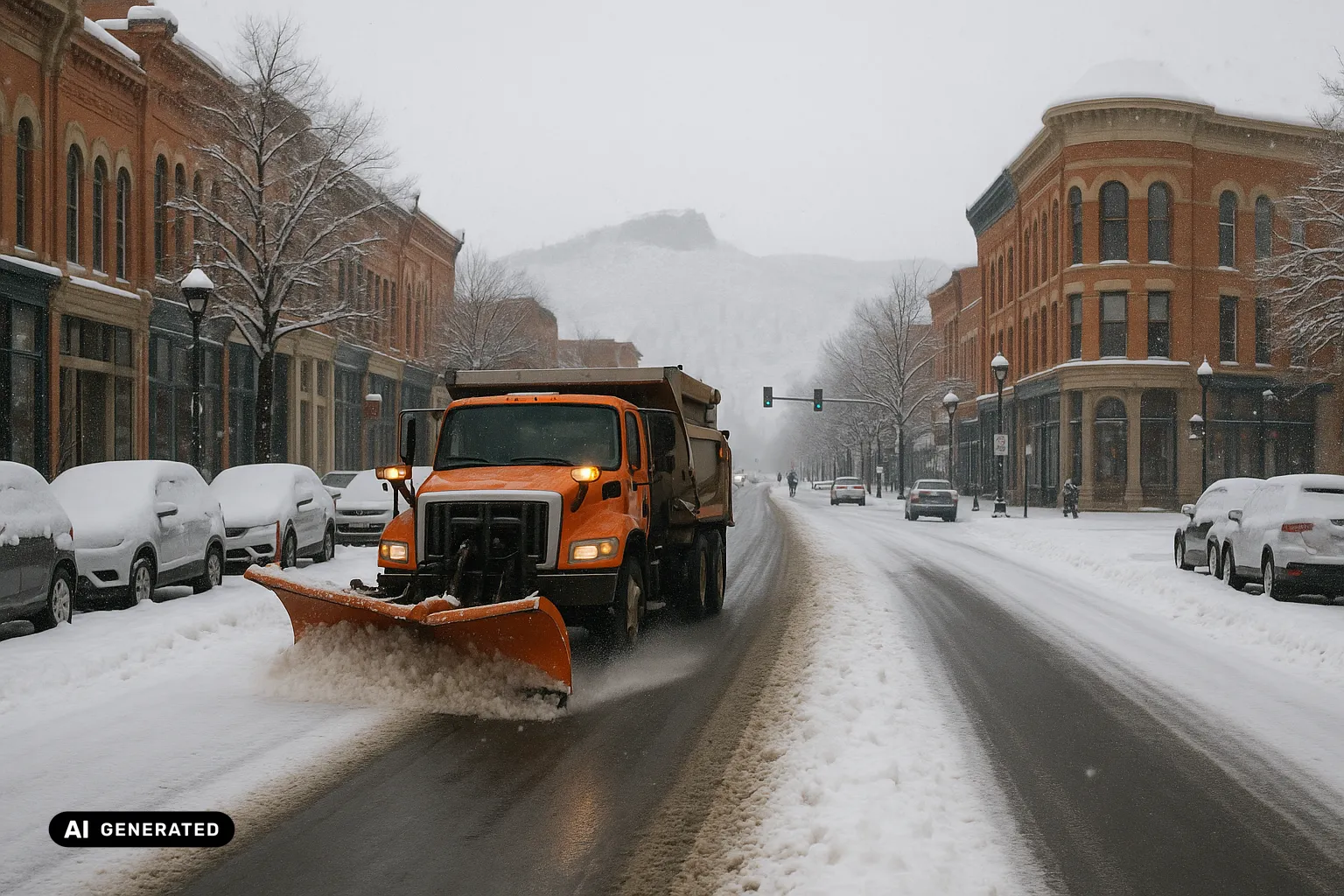
On the road side, the Streets Department works a four-tier priority system, and the honest headline is that Priority 4 — most residential streets — is not routinely plowed at all. Priority 1 is the arterials (College, Prospect and the like), which also serve as the Snow Emergency Routes connecting hospitals, fire and police. Priority 2 is collector streets, Priority 3 is school zones and bus routes, and the City maintains more than 1,980 lane miles across those three tiers. Priority 4 streets are cleared only when snow completely blocks traffic or a Snow Emergency is declared. As on the rest of the Front Range, the reasoning is that quiet streets in strong sun tend to clear themselves, so ploughing them would spend money the weather is about to save.
Two details set the Fort Collins operation apart. First, what it spreads: the City deliberately avoids pure magnesium chloride and sand, citing air quality and the environment. Its main de-icer is Apex Meltdown, an organic-inhibited 30% magnesium-chloride concentrate, alongside salt brine, Ice Buster (salt pre-wetted with Apex Meltdown) and Apogee, kept mostly for the bridges over the Poudre and other concrete that freezes first. Second, how it tracks the work: every plough carries a GPS-based Automated Vehicle Locator, so the City records how much material went down and where. That is a notably data-led way to run a municipal fleet — and a useful reference point for any contractor clearing private lots to a similar standard.
The trade-off of the low-intervention approach is the familiar one: on shaded, north-facing residential blocks and quiet east–west streets, what thaws by day refreezes at night and packs into ice ruts that outlast the next few storms — and after the 2025 change, remember that ice on your own sidewalk is never exempt, whatever the snow depth.
The northern Front Range around it
Fort Collins anchors a string of northern Front Range towns, and each keeps its own winter rulebook. Loveland, immediately south and also in Larimer County, and Windsor, Timnath, Wellington and Greeley out toward Weld County are climatically much like Fort Collins — dry plains winters with the same back-loaded, spring-heavy shape — but each sets its own sidewalk deadline and plough policy. Go west and the picture changes fast: Estes Park and the Poudre Canyon, up in the mountains, carry a multiple of the city’s snow, and Cheyenne, Wyoming, to the north, is a close cousin in climate but windier.
For a contractor whose routes run from town toward the foothills, that is the practical lesson — the snow line rises to the west, a storm total quoted for “Fort Collins” can understate what fell against the mountains, and the moment you cross a municipal boundary you are into a different local rule, whether that is Loveland’s sidewalk deadline or a mountain town’s far heavier clearing job.
Keeping the record straight
In a town of thaws and refreezes, back-loaded spring storms and a sidewalk rule that now hinges on two inches of snow but any ice at all, the useful thing is being able to show, plainly, what was treated and when — down to whether the surface was snow or ice, and what the weather was doing when a crew went out. The City runs its own ploughs on GPS; a contractor can keep the same kind of clear account of private work. A simple, time-stamped log of where a crew went and when, set against the weather record for that address, turns “we cleared it in time” into something specific — and for anyone looking after student rentals or a portfolio of managed properties, it puts the answer on file for each address. That, alongside the same route and location tracking the City uses on its own fleet, is the documentation support Wintertrace is built to make easy. It changes no local rule; it just means that when someone asks what happened before the ice formed, the answer is recorded. Not a substitute for legal advice.
Local facts
- Fort Collins sits on the northern Front Range in Larimer County, of which it is the county seat, about 100 km north of Denver and near the Wyoming line, at roughly 5,003 ft (1,524 m) — a little lower than Denver but closer to the foothills.Source
- The city stands on the Cache la Poudre River, the only river in Colorado designated a National Wild and Scenic River, which rises in Rocky Mountain National Park and runs through town from north-west to east.Source
- Fort Collins is home to Colorado State University, the state's second-largest university by enrolment — which shapes traffic, foot and bike volumes, and a large stock of student rentals where the sidewalk duty falls on tenants or managers.Source
- Average annual snowfall is about 51.4 inches (131 cm) on the 1991–2020 normal, with March the snowiest month at about 9.4 inches — well ahead of midwinter December or January.Source
- The city's climate record comes from the CSU weather station on campus (COOP:053005), one of the longest continuously operating stations in the western United States, with daily records kept since 1 January 1889.Source
- The sidewalk duty lives in City Code Sec. 20-102, which requires owners or occupants of property abutting a public sidewalk to keep it clear of snow and ice; the City's guidance sets the deadline at 24 hours of accumulation.Source
- Ordinance No. 203, 2025 (effective 26 December 2025) changed the trigger: clearing is required within 24 hours after any accumulation of ice, or of two inches or more of snow — so small snowfalls no longer trigger the duty, but ice always does.Source (PDF)
- A violation is a civil infraction: if a walk is not cleared in time the City Manager may have the hazard corrected at once and assess the cost, including administrative costs, against the property as a lien; Code Compliance Inspectors enforce it.Source
- The City's Streets Department works a four-tier priority system; Priority 4 streets — mostly residential — are plowed only when snow completely blocks traffic or a Snow Emergency is declared, and are otherwise not routinely cleared.Source
- The City maintains more than 1,980 lane miles of Priority 1–3 streets (Priority 1 arterials such as College and Prospect double as Snow Emergency Routes), and every City snowplough carries a GPS-based Automated Vehicle Locator to track material use and routes.Source
- Fort Collins deliberately avoids pure salt and sand: its main de-icers are Apex Meltdown (an organic-inhibited 30% magnesium-chloride concentrate), salt brine, Ice Buster (salt pre-wetted with Apex Meltdown) and Apogee for bridges and concrete — chosen for air quality and the environment.Source
Official contacts
City of Fort Collins — Streets Department (Snow & Ice)
The road-clearing side: the Priority 1–4 system and why residential streets are not routinely plowed.
City of Fort Collins — Sidewalk Snow Removal
The 24-hour owner duty, Code Compliance enforcement, and how to report an uncleared walk (Access Fort Collins or the Nuisance Hotline).
City of Fort Collins — De-icing materials
What the City actually spreads: Apex Meltdown, salt brine, Ice Buster and Apogee — and why it avoids pure magnesium chloride and sand.
Ordinance No. 203, 2025 — amending Sec. 20-102 (PDF)
The 2025 amendment itself: the new two-inch snow threshold, the ice-always rule, and the civil-infraction and lien provisions.
Colorado Climate Center — CSU Fort Collins weather station
The campus station that has kept the city's daily climate record since 1889.
Common questions about winter service in Fort Collins
- How long do I have to clear my sidewalk in Fort Collins — and did the rule change?
- It did, at the end of 2025. Under City Code Sec. 20-102 as amended by Ordinance No. 203, 2025 (effective 26 December 2025), you have 24 hours from accumulation to clear the public sidewalk abutting your property — but the trigger is now two inches or more of snow, or any ice at all. In other words, a light dusting under two inches no longer forces you out with a shovel, while ice must always come off. The City explained the change simply: small amounts often melt on their own within about 48 hours, and the two-inch line matches the point at which many clearing contractors turn out anyway. The duty falls on owners or occupants — which in a university town means many student tenants and their managers. Miss it and it is a civil infraction: the City can have the walk cleared and bill the cost back to the property as a lien. General information, not legal advice.
- Will the City plough my street?
- If it is a residential street, almost never as a matter of routine. Fort Collins runs a four-tier priority system. Priority 1 covers the arterials — College, Prospect and the like — which double as the Snow Emergency Routes linking hospitals, fire and police. Priority 2 is collector streets, Priority 3 is school zones and bus routes, and the City maintains more than 1,980 lane miles across those three tiers. Priority 4 — mostly residential streets — is plowed only when snow completely blocks traffic or a Snow Emergency is declared. The City's reasoning is the Front Range sunshine: on a quiet street the snow usually clears itself, so ploughing it would be spending money the weather is about to save. The trade-off is ice ruts on shaded, north-facing residential blocks.
- What does Fort Collins actually spread on the roads?
- Not what you might expect. The City deliberately does not use pure magnesium chloride or sand, citing air quality and the environment. Its main liquid de-icer is Apex Meltdown, an organic-inhibited 30% magnesium-chloride concentrate; it also uses salt brine, Ice Buster (salt pre-wetted with Apex Meltdown) and Apogee, kept mainly for bridges and concrete surfaces that freeze first. Every plough in the fleet carries a GPS-based Automated Vehicle Locator, so the City tracks how much material went down and where — a level of route and material record that is worth knowing about if you clear private lots to a similar standard.
- When is the snowiest time of year, and why does the CSU record matter?
- March, clearly — about 9.4 inches on the long-term normal, ahead of every midwinter month, with the season running long into April. That late, wet spring snow is the heaviest to clear. Those figures are unusually trustworthy here because Fort Collins has one of the longest continuous weather records in the western US: the CSU campus station has logged the daily climate since 1889. For winter service, the practical point is the shape of the season more than the total — a back-loaded winter of thaws and refreezes, with the biggest single loads often arriving in spring.
Documenting winter service in Fort Collins
Anyone clearing snow and ice in Fort Collins may later need to show when and where a route was treated. Wintertrace is open-source software that records exactly that — time, location and weather for each run — as a calm basis for your own operational records and service proof. It is not a substitute for legal advice.
This overview is for general information and is not legal advice. Local rules on snow and ice clearing vary — the wording of the local rule and the responsible authority always govern.