Winter service · Colorado
Winter service in Colorado Springs
What winter is really like in Colorado Springs: about 33 inches of snow a year at the foot of Pikes Peak, yet a city where the Palmer Divide and the mountain's north slopes catch the big totals a few miles away. Why March and April are the snowiest months, how the City ploughs main routes first and leaves residential streets until six inches fall, and the ordinance that makes an uncleared walk 'negligence per se'.
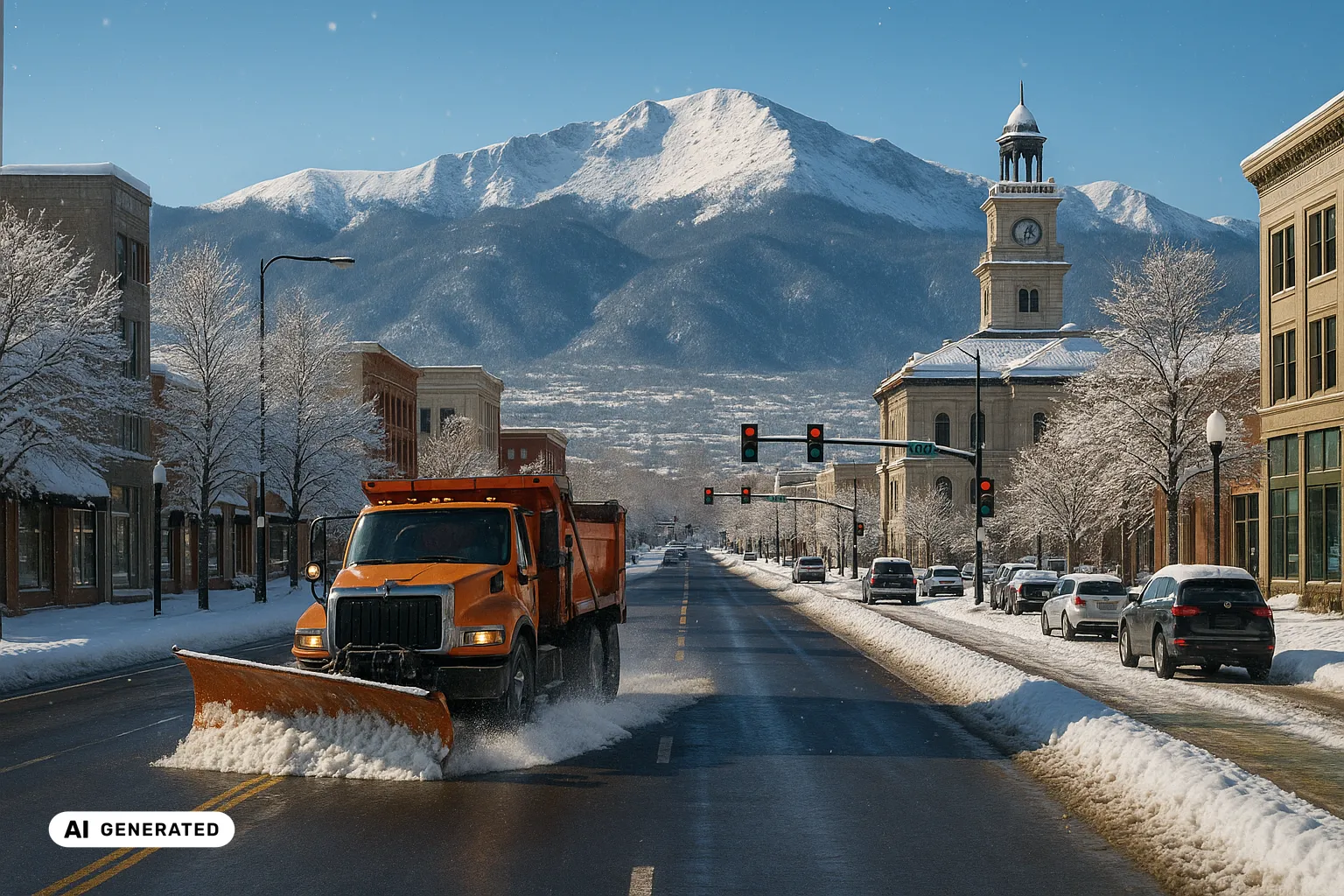
What winter actually does in Colorado Springs
Colorado Springs sits at the eastern foot of the Front Range, right under Pikes Peak, on ground about 6,035 feet up — higher than Denver, and yet a place where the snow totals in town are modest. That apparent contradiction is the whole story of winter here, and it has a name: the Palmer Divide.
The Divide is a low ridge that runs east–west just to the north of the city, separating the Arkansas River basin from the South Platte. It — together with the northern slopes of Pikes Peak to the west — lifts incoming storms just enough to wring the snow out before it reaches downtown. The result is one of the sharpest snow gradients of any American city: in a single storm the centre of town might get an inch or two, while parts of the Divide and the Peak’s north face, less than 18 miles away, take one to two feet with five- to eight-foot drifts. So the airport’s seasonal average of about 33.6 inches (39 inches on the longer record) is not really a number you can plan a route around. A total quoted for “Colorado Springs” can badly understate what fell a few miles north or west, and the swing from year to year is enormous — 89.4 inches in 1956/57, just 12.7 in 2010/11.
As on the rest of the Front Range, the calendar is back-loaded. March is the snowiest month on the 1991–2020 normals, at about 5.7 inches, with April close behind at 5.5 — both ahead of a comparatively quiet midwinter. The heaviest snow comes from spring storms, wet and heavy, a different load to clear than dry January powder. Between storms, the strong high-altitude sun and dry air melt much of it off on their own — which is exactly what the City’s road policy is built around.
What the local rules say — and the word “negligence”
Colorado Springs sets its sidewalk duty in City Code § 3.4.202, and the City’s own snow-shoveling guidance puts the deadlines plainly: a home has 24 hours from the end of a snowstorm, and a business must be clear by 5 p.m. the day after snow stops falling. There is a subtlety in the ordinance worth knowing: snow counts as still falling until it has stopped for more than four hours, so the 24-hour clock only begins once that break has passed.
What sets the Colorado Springs rule apart is less the deadline than the consequence the ordinance names out loud. Where some cities attach a flat fine, § 3.4.202 states that failing the duty “shall constitute negligence per se and an unlawful act,” exposing the owner to civil liability for any injury the failure causes, liability for the cost of the City clearing it, and even criminal prosecution. That is the City’s own language, quoted here as information rather than a legal opinion — and it is worth reading as the City wrote it, because “negligence per se” is a heavier idea than a parking-ticket-style penalty: it frames an uncleared walk as a breach of duty in its own right. The duty falls on the owner and occupant of the adjoining public sidewalk. None of this is a substitute for legal advice; if the exact wording matters to you, read § 3.4.202 directly.
How the City clears the streets — and the six-inch line
On the road side, street clearing is run by the City’s Operations & Maintenance Division — not, as in Denver, a transportation department — across roughly 5,833 lane miles of roadway. The City ploughs in three tiers, in order. Primary routes come first: the multi-lane arterials and hospital access such as Academy Blvd, Union Blvd and Platte Ave. Then Secondary routes — school access and the collector streets that link neighbourhoods to the main roads.
Residential streets sit at the back of the queue, behind a threshold. The City only treats them once at least six inches have accumulated, the Primary and Secondary routes are clear, and the snow has stopped. Below six inches, a quiet street is left to the sun. The published policy is explicit about it, and the logic is the same mile-high calculation Denver makes: with strong sun and dry air, light snow on a low-traffic street usually melts off within a few days on its own, so ploughing every road would be effort the weather is about to undo anyway. The fleet behind all this is 50 large ploughs, 9 small ploughs, 4 graders and 6 loaders, treating with salt, an anti-skid sand-salt mix for very cold spells, and liquid magnesium chloride when it is warm enough to work.
The catch is the familiar Front Range one. What melts in the afternoon refreezes overnight and on shaded north-facing stretches, and a busy untreated side street packs into hard ice ruts before the melt arrives. For anyone running winter service on residential routes, that rutted ice — not fresh depth — is the real hazard, and a treated arterial and an untreated side street a block apart can be in completely different conditions.
The Pikes Peak region — several winters on one map
More than most cities, Colorado Springs is really a cluster of snow climates sorted by elevation and aspect. The airport and the plains suburbs to the east and south — Fountain, Falcon, Cimarron Hills — sit near the moderate town average. Climb north onto the Palmer Divide and everything changes: Monument, Palmer Lake and Black Forest, up around 7,000 feet, get far more snow, far more often, than the city below them. Go west and the same holds — Manitou Springs at the foot of the Peak is snowier and steeper, and Woodland Park, over the Ute Pass at about 8,500 feet, is a genuine mountain town with a mountain town’s winter.
Each of those places runs its own clearing rules and its own plough policy, so the Colorado Springs deadlines describe Colorado Springs and stop at the city line. For a contractor whose routes climb from the plains toward the Divide or the Peak, that elevation gradient is the defining fact of the season — a rising snow line where the same storm is a dusting at one end of a route and a foot-deep clearing job at the other.
Keeping the record straight
In a market this uneven — an inch downtown, a foot on the Divide, a thaw by afternoon and a refreeze by dawn — the useful thing is being able to show, plainly, what was treated and when. Where the local ordinance frames an uncleared walk as a matter of duty rather than a flat fine, that plain account of the work matters all the more: not to win an argument, but because a freeze-thaw winter generates exactly the questions a vague answer can’t settle — was the lot de-iced, when, and in what conditions before the overnight freeze. A simple, time-stamped record of each treatment, set against what the weather was actually doing at that address, turns “we were out ahead of the ice” into something specific — and gives a contractor a straightforward service record to stand behind. That is the documentation support Wintertrace is built to make easy. It changes no local rule; it just means that when someone asks what happened before the ice formed, the answer is on file. Not a substitute for legal advice.
Local facts
- Colorado Springs sits at the eastern foot of the Front Range, directly below Pikes Peak (14,115 ft), with the city itself at about 6,035 ft (1,839 m) — some 755 ft higher than Denver.Source
- The Palmer Divide, a caprock-escarpment ridge running east–west just north of the city, separates the Arkansas River basin from the South Platte basin and forms the weather boundary between Colorado Springs and Denver.Source
- The Divide lifts air enough to multiply snow locally: in a single storm downtown may get 'only an inch or two' while parts of the Palmer Divide and the northern slopes of Pikes Peak, less than 18 miles away, take 1–2 feet with 5–8 foot drifts.Source
- Average seasonal snowfall is about 33.6 inches on the NWS Pueblo 30-year mean; the all-time average since 1948/49 is 39.0 inches.Source
- Year-to-year swings are huge: the snowiest season on record was 89.4 inches (1956/57) and the least was 12.7 inches (2010/11).Source
- On the 1991–2020 airport normals the annual total is about 32.5 inches, and March (about 5.7 inches) is the snowiest month, closely followed by April (about 5.5 inches) — a late-winter peak, not a midwinter one.Source
- Under the City's snow-shoveling guidance, residents must clear the adjoining sidewalk within 24 hours of the end of a snowstorm, and businesses by 5 p.m. the day after snow stops falling.Source
- The ordinance (City Code § 3.4.202) treats snow as still falling until it has stopped for more than four hours, so the 24-hour clock only starts once that four-hour break has passed.Source
- The same ordinance states that a violation of the clearing duty 'shall constitute negligence per se and an unlawful act', exposing the owner to civil liability for injury caused, liability for the costs of removal, and criminal prosecution.Source
- Street clearing is run by the City's Operations & Maintenance Division across about 5,833 lane miles of roadway over a 194-square-mile area (some City pages cite 6,480 lane miles / 202 sq mi).Source
- The City ploughs three tiers in order — Primary routes (multi-lane roads and hospital access such as Academy Blvd, Union Blvd and Platte Ave) first, then Secondary routes (school access and collector streets) — and only treats residential streets once at least six inches have fallen and the higher tiers are clear.Source
- The winter fleet is 50 large ploughs, 9 small ploughs, 4 motor graders and 6 loaders, using treated salt, an anti-skid sand-salt mix for very low temperatures, and liquid magnesium chloride (effective above 0 °F).Source
Official contacts
City of Colorado Springs — Snow Plow Information (Operations & Maintenance)
The City's snow page: the plough fleet, the de-icing materials, and the six-inch residential threshold.
City of Colorado Springs — Snow Plow Routes
How Primary, Secondary and Residential routes are defined and cleared, with the named main streets treated first.
Colorado Springs Neighborhood Services — Snow Shoveling
The sidewalk clearing duty: the 24-hour resident deadline, the 5 p.m.-next-day business deadline, and owner liability.
Colorado Springs City Code § 3.4.202
The ordinance itself: the four-hour 'termination of snowfall' definition and the negligence-per-se consequence.
National Weather Service, Pueblo — Colorado Springs seasonal snowfall
Seasonal snowfall averages and the record snowy and dry seasons for Colorado Springs.
Common questions about winter service in Colorado Springs
- How long do I have to clear my sidewalk in Colorado Springs?
- Under the City's guidance, a home has 24 hours from the end of a snowstorm and a business must be clear by 5 p.m. the day after snow stops falling. There is a wrinkle in the ordinance (City Code § 3.4.202): snow is treated as still falling until it has stopped for more than four hours, so the clock only starts once that break has passed. The duty falls on the property owner and occupant for the adjoining public sidewalk. What makes the Colorado Springs rule notable is the consequence the ordinance spells out — a violation 'shall constitute negligence per se and an unlawful act', which can mean civil liability for any injury caused, liability for the cost of the City clearing it, and even criminal prosecution. That is the City's own wording, not legal advice, and it is a substitute for none: this is general information only.
- Why does Colorado Springs get less snow than Denver when it sits higher?
- Because the big totals are caught just outside the city. Colorado Springs is about 755 feet higher than Denver, but its airport averages only around 33 inches a season against Denver's 49–57. The reason is the Palmer Divide, the ridge running east–west to the north, together with the northern slopes of Pikes Peak: they lift the storms and wring out the snow before it reaches downtown. It is common for the centre of town to see an inch or two while Monument, Black Forest or the Peak's north face — a short drive away — take a foot or more. For anyone clearing snow across the region, the lesson is that a total quoted for 'Colorado Springs' can be almost meaningless: elevation and aspect decide what actually falls at a given address.
- Will the City plough my residential street?
- Only in a real storm. The City concentrates its fleet on Primary routes — the multi-lane roads and hospital access — then Secondary routes such as school access and collector streets. Residential streets are only treated once at least six inches have accumulated, the Primary and Secondary routes are clear, and the snow has stopped. The reasoning is the Front Range climate: with strong sun and dry air, snow on a quiet street often melts off on its own within a few days, so the City deliberately leaves it to the weather. The trade-off is that shaded, north-facing stretches and busy untreated side streets can glaze over and pack into ice ruts before the melt catches up.
- When is the snowiest part of winter here?
- Late winter and early spring. On the long-term normals March averages about 5.7 inches and April about 5.5 — both ahead of a relatively quiet midwinter December (around 4 inches). Colorado Springs' heaviest snow tends to come from spring storms, which bring the wet, heavy kind that is a different load to clear than dry January powder. The season is long at both ends and can deliver its biggest single dumps well after the calendar says winter is over.
Documenting winter service in Colorado Springs
Anyone clearing snow and ice in Colorado Springs may later need to show when and where a route was treated. Wintertrace is open-source software that records exactly that — time, location and weather for each run — as a calm basis for your own operational records and service proof. It is not a substitute for legal advice.
This overview is for general information and is not legal advice. Local rules on snow and ice clearing vary — the wording of the local rule and the responsible authority always govern.