Winter service · Montana
Winter service in Billings
What winter is really like in Billings, Montana: 57.4 inches of snow a season on the 1991–2020 normals but only 55 days with an inch on the ground, measured at an airport on top of the Rims about 450 feet above downtown. A Chinook took the daily high from 52 °F to −3 °F within 48 hours in February 2019. The sidewalk section of the city code was rewritten on 27 October 2025 — occupant first, 24 hours, 36 inches wide, to the surface — and every through street is a snow route from 15 November to 15 March without anyone declaring anything.
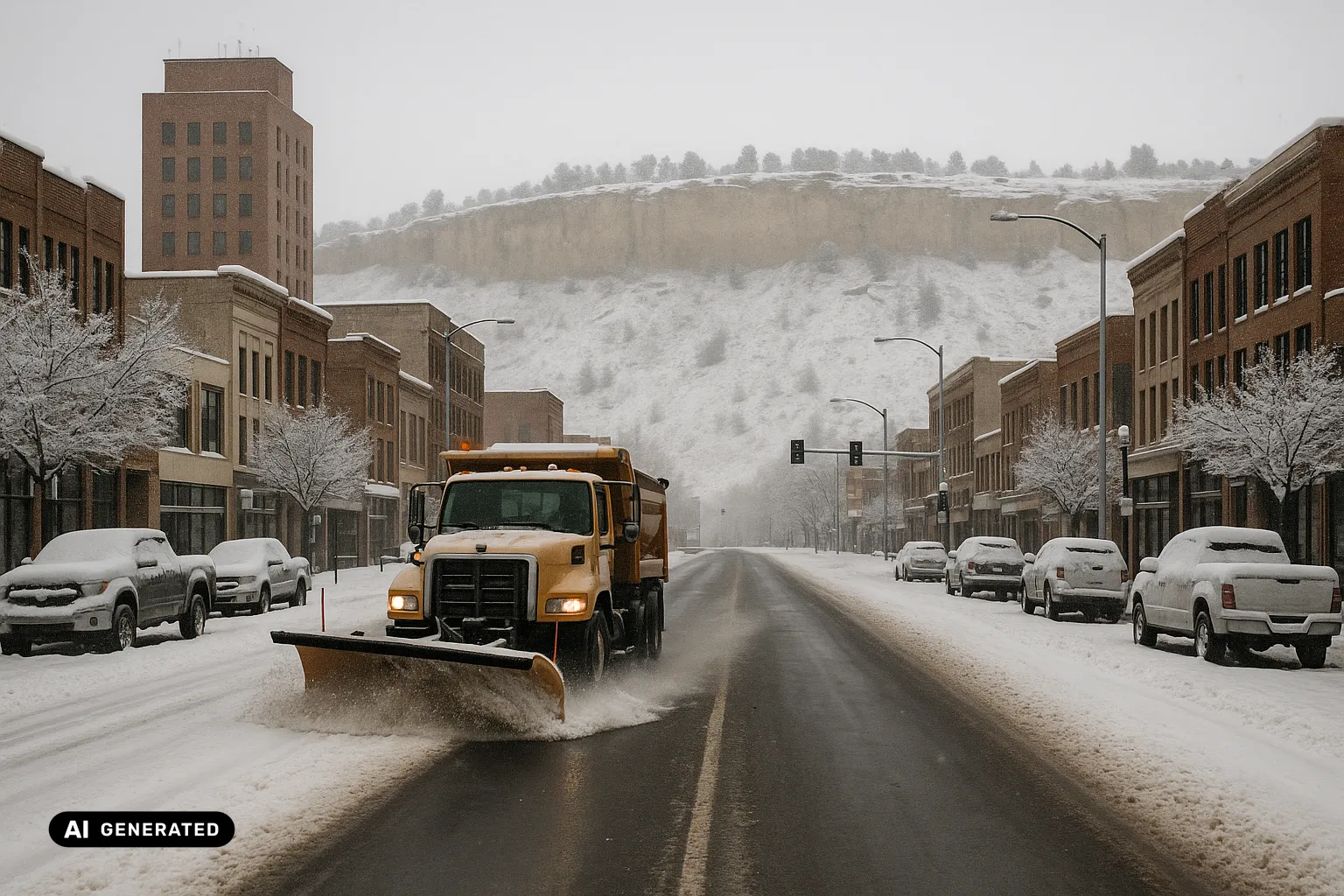
Measured on top of the Rims
Every official snow number for Billings is measured somewhere else. The station behind the 1991–2020 normals is at Billings Logan International Airport, which NCEI lists at 3,581 feet (1,092 m); the airport sits “on top of the Rims, a 500-foot (150 m) cliff overlooking the downtown core”. Downtown lies at 3,126 feet (953 m). Everything that follows about “Billings snow” was recorded about 450 feet (140 m) above the sidewalks most people shovel, on an exposed plateau rather than in the valley of the Yellowstone.
The second number matters more than the first. On those normals Billings receives 57.4 inches (146 cm) of snow a season — but records only 55.2 days a year with an inch or more on the ground. Burlington, Vermont gets 87 inches and keeps snow cover for about 90 days. Billings’ snow does not lie. It comes, and then a west wind takes it away: “because of warm chinook winds that pass through the region during the winter, snow does not usually accumulate heavily”, as the NOAA-based climate summary puts it.
That is the argument of this page. Billings is a thaw-and-refreeze city, a northern cousin of Calgary and Denver rather than of the Great Lakes, and the city’s snow programme says why that matters: “With temperatures continually fluctuating, causing melting and freezing conditions, sanding is a vital part of winter operations.” The rules around that work have two features you will not find written up elsewhere: a sidewalk section rewritten on 27 October 2025, stricter than the guides still circulating, and a snow-route regime that switches on by the calendar.
Fifty-seven inches, from October to April
The monthly normals from the airport station run: January 10.6 inches, February 9.1, March 8.2, April 7.5, May 0.9; then September 0.3, October 4.5, November 6.5, December 9.8. Read April again. It carries almost as much snow as February, and Billings’ largest single-day snowfalls are spring storms: the daily record is 23.7 inches (60 cm) on 4 April 1955, and the most recent large day was 13.9 inches on 12 April 2022. The snow-route window in the city code closes on 15 March. The snow does not.
The season is made of many small days — 38.8 with measurable snow, 18.1 with an inch or more, and on average none with ten. The cold is more persistent than the snow: 141.5 nights a year at or below freezing, 12.9 at or below 0 °F (−18 °C), a January mean of 27.0 °F (−2.8 °C). Annual precipitation is only 14.31 inches (363 mm), a semi-arid climate. Dry cold, thin snow, and a wind that removes it.
The spread between seasons is wide. The National Weather Service office in Billings recorded a seasonal record of 106.1 inches (269 cm) in 2017–18, and the three snowiest Februaries on record — 2014, 2018 and 2019 — fell within six years of one another.
Chinook one week, minus twenty-six the next
The Weather Service describes the mechanism without drama: “In our region on the eastern slopes of the mountains, we are prone to see periods of strong downslope (southwest to west) winds during the winter months.” On 13 January 2021 that wind brought Billings a daily record high of 63 °F (17 °C) and a peak gust of 69 mph (111 km/h), itself a January record, as the office’s review of 2021 (PDF) notes.
The other direction is just as fast. In its review of 2019 (PDF) the office wrote that “the high temperature at Billings on February 2nd was a balmy 52°”. Two days later the daily high was −3 °F (−19 °C): a fall of 55 Fahrenheit degrees in the daytime maximum within 48 hours. The cold then settled in — the period from 3 February to 6 March 2019 was the coldest stretch of that length in the Billings record, with 31.0 inches of snow at the airport.
In the cold wave of January 2024 (PDF) the airport fell to −26 °F (−32 °C), the coldest reading since 1997, with a wind chill of −53 °F (−47 °C) — and only 4.9 inches of snow in nine days. The office’s summary ends the way Billings winters end: “As this summary was being written, much warmer & drier weather returned to our region.”
One more entry belongs to the Rims. On 13 and 14 December 2019 the airport sat in fog for 20 hours while “the Yellowstone River valley itself was mostly fog-free”. The plateau and the valley have different winters on the same day, and the one in the record book is the plateau’s.
A sidewalk rule rewritten last October
The sidewalk duty in Billings is Section 22-406 of the Billings, Montana City Code, and the version in force is younger than most of what has been written about it. It was replaced in full by Ordinance No. 25-5919 on 27 October 2025, and its title changed from “Removal of snow, ice, etc., from sidewalks” to “Removal of impediments from sidewalks”. Local news items from before the rewrite still quote the earlier text — and a fine figure from 2014.
Three things in the new text matter. First, who. Under subsection (b) it is “the duty of the occupant of any premises within the city limits, or in case such premises are unoccupied, then the owner or his or her agent, to keep the sidewalks in front of and adjoining his or her premises clean and safe for pedestrians and wheeled travelers”. The duty falls on whoever lives or trades there; the owner steps in only when the premises are empty.
Second, when and how much. The occupant “shall remove such impediment to safe and convenient travel, within twenty-four (24) hours after such impediment accumulates thereon, and prevent the continuance and accumulation of the same. Removal of impediment shall be no less than thirty-six (36) inches wide and shall be to the surface of the sidewalk.” A shovel-width track through packed snow is not, on the face of that sentence, removal.
Third, what counts. Subsection (a) says impediment “shall be broadly interpreted”, and its list begins with “Snow, ice, or slush that has accumulated and not been removed in a timely manner”.
The city’s resident pages describe the same duty in rounder words: the Code Enforcement snow page says “within 24 hours after the storm event”, the Public Works sidewalks page “within 24 hours of a snow fall”. The ordinance starts the clock when the impediment “accumulates” — not when the storm ends. On a day of on-and-off snow those are different moments, and the code text is the one that binds.
What happens if the walk stays covered
The Billings answer is administrative and civil, not criminal. Under subsection (c), accumulations not removed “may be removed under the direction of the city which shall keep a record of the cost of such removal”; the cost is assessed by council resolution and “shall constitute a lien upon and against such lots and parcels of land”, collected “in the same manner as other taxes”.
Section 22-409 designates violations of the article “as municipal infractions, and punishable by civil penalties as specified in section 18-1304”. The code’s civil-penalty section, Section 18-1304, as published, provides that “for a first violation, a civil penalty of not more than three hundred dollars ($300.00) shall be imposed” and that “for each repeat violation, a civil penalty not to exceed five hundred dollars ($500.00) shall be imposed”. Those are ceilings, not tariffs. How often the city cites a sidewalk is not something its pages say; the Code Enforcement page says only that complaints are inspected and the responsible party notified.
Subsection (d) is the sentence contractors should read twice: “It is unlawful to dispose of or move impediments from private property onto a public street, alley or sidewalk.” The Public Works FAQ restates it for driveways, sidewalks and parking lots. The duty itself is purely municipal: Montana’s sidewalk statute, MCA 7-14-4122, gives a council power over sidewalks and a lien for its costs but contains no snow-clearing rule of its own.
Snow routes that need no declaration
Most cities with a snow-route system declare an emergency and then enforce it. Billings’ code declares it in advance. Division 3 of Article 22-400, “Snow and Ice Emergency” (Sections 22-431 to 22-434), opens: “From November fifteenth through March fifteenth there are climatic conditions which cause accumulations of, snow, ice or sleet, or all three (3). … Such conditions when they exist are declared to be public emergencies.”
Section 22-433 then places the duty directly on the driver: “It shall be the duty of the owner of any motor vehicle to remove the vehicle parked along through streets at any time that accumulations of snow, ice or sleet are greater than two (2) inches.” A “through street” is any street at whose entrances cross traffic must stop or yield — in practice, the arterials and collectors. If the owner fails to move the car, “the city shall impound the vehicle and it will only be released to the owner upon the city being reimbursed for towing charge and the posting of an appearance bond”.
The notice is an autumn ritual rather than a storm-day alert: a newspaper advertisement “on or about October fifteenth and on or about November first” each year, ending “All through streets are designated as snow removal routes for 15 November through 15 March”, and signs “at the main entrances to the city”. Only the last step involves an official — once the two inches are exceeded, “the city administrator or his designee may notify the news media” that removal will begin.
The city’s Snow & Ice Management page describes the same arrangement in softer terms: “During a severe snow storm, the City Administrator may declare a snow emergency. During a snow emergency the City requests that people do not park vehicles on any designated through street.” Both texts are the city’s. The code ties the parking duty to two inches on any through street inside a calendar window; the programme page frames it as a declared emergency and a request. This page cannot tell you how often a car is towed in Billings — only that the ordinance does not wait for a declaration, where Burlington’s does, complete with flashing lights, and Bismarck declares with no inch threshold at all.
656 miles, six zones, $40,000 a day
The Street-Traffic Division “maintains 656 miles of streets and alleys” — 1,056 km — and “monitors street conditions on a 24-hour basis” through the winter, with three graders, eighteen sander-plows and three de-icing units. Plowing starts on “significant existing accumulation from a snow weather event with a forecast of continuing accumulation” — the second condition matters as much as the first.
Arterials and collectors come first. Residential streets are divided into zones plowed “in clockwise sequence, beginning in a different zone with each snow weather event”, each area taking “approximately 24 hours to complete”. The Snow & Ice Management FAQ (PDF) gives the answer on materials that defines the city: a “Sand mixture containing 10% sodium chloride (salt)”, with liquid de-icer and Ice Slicer “for hills and intersections as needed”. How much sand and salt the city uses in a season is not published anywhere this page could find.
Residential streets are not plowed by the city at all. “Public Works has hired a private contractor to plow residential streets,” the FAQ says. The threshold appears only in storm notices: in its alert of 31 January 2025 Public Works said that once snow exceeded 5 inches (13 cm) residential plowing would begin in Area 2 and proceed 2, 3, 4, 5, 6 and finally 1.
The contract’s shape came out in local reporting the same month. As KTVQ reported, quoting the Street Traffic Division manager, the contractor — K2 Civil Inc. — must run at least six plows in 24-hour operation, at about $40,000 per operating day, or “roughly $8 per Billings household”; a full cycle “takes us maybe roughly 10 days”. The manager’s own verdict: “Residential plowing is probably one of our most contentious things that we do.”
A public snow-plowing map shows which streets are the contractor’s, the city’s and the State of Montana’s — a map of responsibility, not of plow positions. For a property manager the consequence is that a residential street may see no plow at all in a three-inch storm, and may wait most of two weeks in a big one. What gets cleared at the kerb, the driveway apron and the walk is whatever somebody arranged.
The ramps through the Rims
The Rimrocks bound the city on the north and east and cut it in two: sandstone cliffs “500 feet (150 m) tall” to the north, and a face that “rises 800 feet (240 m)” east of downtown. The Billings Heights and Lockwood “sit on top of the first rise”. Between the two levels there are only a few roads — North 27th Street and Airport Road up to the airport, Zimmerman Trail through the west Rims, Main Street (U.S. 87) into the Heights — and each is a grade with its own wind and shade. That is the “hills” in the city’s sanding priority.
They do close. On 28 November 2025 Zimmerman Trail was shut after “a crash and multiple slide-offs”, with officials sanding the pass before reopening it. That is one verified closure, not a pattern. The code also knows what the Rims do in a thaw: Section 6-1209 is titled “Storm drainage control in areas north of Rimrocks” and names the “melting of snow and ice” among its concerns.
The interstates and state routes are the Montana Department of Transportation’s. MDT explains its order plainly: “Interstates and roads with the highest traffic volumes are cleared first, followed by routes with progressively lower volumes.” Its chemistry differs from the city’s — magnesium and sodium chloride ahead of sand — so the surface changes where an interstate ramp meets a city street. Bridges are on the city’s sanding list; who plows which one is less clearly published.
Laurel and Lockwood: same river, other rules
Fifteen miles (24 km) west along I-90, Laurel gives its residents the same 24 hours and a very different consequence. Under Section 8.12.030 of the Laurel Municipal Code, adopted in October 2021, it “is a nuisance” to allow “any ice, snow, slush, mud, or other impediment to safe pedestrian travel to accumulate or remain on any sidewalk”, to be removed “within twenty-four (24) hours after its accumulation thereon”. The chapter is titled “Criminal Nuisances”. Section 8.12.100 sets a first offence at “not less than $100.00 and not more than $500.00”, a second at $300 to $500 “or by imprisonment for a term not to exceed thirty days, or both”, each day a separate offence.
Billings: a civil infraction with a ceiling and a lien. Laurel: a criminal nuisance with a floor and, from the second offence, the possibility of jail. Laurel sets no width; Billings sets 36 inches. Same river, same interstate, same deadline, two logics.
Lockwood, across the Yellowstone east of the Heights, is unincorporated and has no city code. Its sidewalks are built and maintained through the Lockwood Pedestrian Safety District (PDF), a county-run special improvement district approved by referendum in 2014. No sidewalk snow-clearing rule comparable to Billings’ Section 22-406 was found for Lockwood, and this page does not assume one. Its roads belong to Yellowstone County Road & Bridge, which maintains about 1,540 miles (2,480 km) of county roads.
Keeping a record when the snow keeps leaving
A thaw-and-refreeze winter produces a particular kind of argument. The snow that fell on Tuesday was gone by Thursday; what remained on Friday morning was ice on a north-facing walk below the Rims, and the question is whether anyone treated it, when, and with what. In Billings the ordinance adds a width and a surface to the usual clock, and the official weather record was made 450 feet above the property. None of that is captured unless the person doing the work captures it.
Wintertrace is self-hosted software for recording winter service work: which site was attended, when, by whom, what material went down and how much, with the weather conditions of the shift captured automatically and a service record with GPS track, weather data and photos that you can produce months later. It runs on your own web hosting, without a subscription, and the data stays with you.
It documents; it does not decide anything. In a city where a 52-degree afternoon can be followed two days later by one that never rises above zero, a record showing that the walk was cleared to the surface at 3 p.m. and sanded again at 7 a.m. is simply a more useful record than “we were there”.
A note on all of the above
This page is general information about winter service in Billings, Montana, drawn from the city’s published material, the National Weather Service and NCEI, and the Billings, Montana City Code as published on Municode in September 2026, codified through an ordinance of 24 August 2026. It is not a substitute for legal advice, and it is not a statement of what applies to any particular property. Section 22-406 was rewritten in October 2025; the Section 18-1304 amounts are quoted from the code as published rather than from a full reading of that chapter; the contractor figures come from January 2025 reporting and the residential threshold from a single storm notice. Check the city’s current pages and the ordinance text before relying on anything here.
Local facts
- The climate station behind every official Billings snow figure is at Billings Logan International Airport, 'on top of the Rims, a 500-foot (150 m) cliff overlooking the downtown core'. NCEI lists the station at 3,581 feet; downtown lies at 3,126 feet — a difference of about 450 feet (140 m).Source
- On the 1991–2020 normals the airport records 57.4 inches (146 cm) of snow a season: January 10.6, February 9.1, March 8.2, April 7.5, May 0.9, September 0.3, October 4.5, November 6.5, December 9.8. The December-to-February quarter accounts for 29.5 inches — barely half the season.Source
- Snow cover is short-lived: 55.2 days a year with an inch or more on the ground, 28.9 with three inches, 15.1 with five and 3.3 with ten. January alone carries 15.8 of the one-inch days.Source (PDF)
- The season is made of small days: 38.8 days with measurable snow, 18.1 with an inch or more, 6.0 with three inches or more, 2.2 with five or more — and 0.0 days a year, on average, with ten.Source (PDF)
- Cold outlasts snow: 141.5 nights a year at or below 32 °F, 39.5 days when the high stays at or below freezing, 12.9 nights at or below 0 °F (−18 °C), a January mean of 27.0 °F (−2.8 °C). Annual precipitation is only 14.31 inches (363 mm).Source (PDF)
- The snowiest season on record is 2017–18 with 106.1 inches (269 cm), a winter that also produced 32.4 inches in seventeen days between 3 and 19 February 2018 and a daily record 7.4 inches on 2 April.Source
- The largest single-day snowfall in the airport series is 23.7 inches (60 cm) on 4 April 1955; the most recent large day was 13.9 inches on 12 April 2022. Billings' biggest snow days are spring days.Source
- On 13 January 2021 a downslope westerly wind brought a daily record high of 63 °F (17 °C) and a peak gust of 69 mph (111 km/h), itself a January record. On 16 November 2021 the airport recorded 70 mph.Source (PDF)
- The high temperature on 2 February 2019 was 52 °F; on 4 February the daily high was −3 °F. The period from 3 February to 6 March 2019 averaged 5.0 °F, the coldest stretch of that length in the Billings record, with 31.0 inches of snow at the airport.Source (PDF)
- February 2021 brought seven consecutive days with highs below zero at Billings — tied for the third-longest run since records began in 1934 and the longest since 1985 — with portions of I-90 closed under the 10 to 15 inches of snow that preceded it.Source (PDF)
- In the cold wave of 11–19 January 2024 the airport reached −26 °F (−32 °C), the lowest since January 1997, with a wind chill of −53 °F — and just 4.9 inches of snow in nine days. The all-time record, −38 °F, dates from February 1936.Source (PDF)
- Section 22-406 of the Billings, Montana City Code was rewritten in full by Ordinance No. 25-5919 on 27 October 2025. The duty falls on the occupant (the owner only when the premises are unoccupied), runs 24 hours from accumulation, and requires removal 'no less than thirty-six (36) inches wide' and 'to the surface of the sidewalk'.Source
- Under subsection (c) of the same section, snow the city removes itself is charged to the parcel by council resolution and 'shall constitute a lien upon and against such lots and parcels of land', collected 'in the same manner as other taxes'. Subsection (d) makes it unlawful to move snow from private property 'onto a public street, alley or sidewalk'.Source
- Section 22-409 designates violations of the article as municipal infractions punishable by civil penalties under Section 18-1304, which as published provides a civil penalty of 'not more than three hundred dollars ($300.00)' for a first violation and 'not to exceed five hundred dollars ($500.00)' for each repeat violation.Source
- The city's resident pages phrase the clock differently from the code: Code Enforcement says 'within 24 hours after the storm event', Public Works says 'within 24 hours of a snow fall'. The ordinance runs from when the impediment 'accumulates'.Source
- Division 3 of Article 22-400, 'Snow and Ice Emergency' (Sections 22-431 to 22-434), designates every through street a snow removal route from 15 November to 15 March and requires vehicles to be moved whenever snow, ice or sleet exceeds two inches — without any declaration. A vehicle left in place is impounded and released only on reimbursement of the towing charge and posting of an appearance bond.Source
- Notice is an autumn ritual: Section 22-434 requires a newspaper advertisement 'on or about October fifteenth and on or about November first' each year and signs 'at the main entrances to the city'. Only the media notification that removal is starting involves the city administrator.Source
- The city's programme page frames the same regime as an emergency 'the City Administrator may declare', during which the city 'requests that people do not park vehicles on any designated through street' and 'may remove these vehicles if conditions warrant'.Source
- The traffic chapter's parking article, Article 24-400 (Sections 24-400 to 24-471), contains no winter rule. A full-text search of the code for 'snow' returns fourteen hits, and only Section 22-406 and Division 3 impose winter duties on residents or drivers.Source
- The Street-Traffic Division maintains 656 miles (1,056 km) of streets and alleys with 'three motor graders, eleven 5-yard sander / plows, seven 10-yard sander / plows and three de-icing units', monitoring conditions 'on a 24-hour basis' through the winter.Source
- De-icing is a 'Sand mixture containing 10% sodium chloride (salt)', with liquid de-icer and Ice Slicer reserved 'for hills and intersections as needed'. Designated sanding areas are 'school crosswalks, controlled intersections, curves, bridges and hills'. Tonnages are not published.Source
- Residential streets are plowed by a private contractor whose graders carry snow gates. In its storm notice of 31 January 2025 Public Works said residential plowing would start once snow exceeded 5 inches (13 cm), beginning in Area 2 and proceeding 2, 3, 4, 5, 6, then 1.Source
- As reported by KTVQ in January 2025, quoting the Street Traffic Division manager, the contract requires at least six plows in 24-hour operation at about $300 an hour per plow — roughly $40,000 per operating day, or about $8 per Billings household — and a full cycle of the six zones takes 'maybe roughly 10 days'.Source
- The city's public snow-plowing map shows which streets are the contractor's, the city's and the State of Montana's. It is a map of responsibility zones, last updated in 2023, not a live plow tracker.Source
- The Rimrocks are '500 feet (150 m) tall' to the north and rise '800 feet (240 m)' east of downtown; the Heights and Lockwood 'sit on top of the first rise', and a second rise brings the total climb from the valley floor to 'over 1,400 feet in places'. Zimmerman Trail, one of the ramps through the west Rims, was closed on 28 November 2025 after 'a crash and multiple slide-offs'.Source
- Fifteen miles west, Laurel's Section 8.12.030 sets the same 24 hours but classes an uncleared walk as a criminal nuisance: a first offence 'not less than $100.00 and not more than $500.00', a second at $300 to $500 'or by imprisonment for a term not to exceed thirty days, or both', each day a separate offence.Source
- Lockwood is unincorporated. Its sidewalks come from the Lockwood Pedestrian Safety District, created by Yellowstone County under MCA 7-11-1001 to 7-11-1029 after a 2014 referendum carried 61 per cent to 39, funded by up to 10 mills. No sidewalk snow-clearing rule comparable to Section 22-406 was found for it.Source (PDF)
- Montana's sidewalk statute, MCA 7-14-4122, gives a city council power over sidewalk construction and repair and lets it recover costs as a lien on the lot, but Part 7-14-41 of the state code contains no snow-clearing rule of its own. The duty in Billings is entirely municipal.Source
Official contacts
Billings Public Works — Snow & Ice Management
The programme page: mileage, fleet, priorities, zone rotation, sand and de-icer practice, and the city's own description of a snow emergency.
Billings Public Works — Snow & Ice Management Program FAQ (PDF)
The department's answers on materials, the residential contractor and snow gates, plow-to-centre streets and the sidewalk rule, revised October 2020.
City of Billings — Snow Removal (Code Enforcement)
How sidewalk complaints are handled and the city's plain-language version of Section 22-406.
Billings, Montana City Code — Section 22-406
The sidewalk section as rewritten on 27 October 2025: who, how soon, how wide, the lien, and the prohibition on pushing snow outward.
Billings, Montana City Code — Division 3, Snow and Ice Emergency
Sections 22-431 to 22-434: the calendar window, the two-inch threshold, impoundment and the autumn notice. Four short sections.
City of Billings — Snow Plowing map (ArcGIS)
Which streets belong to the contractor, city staff and the state. Responsibility zones only — not a live tracker.
National Weather Service Billings — Winter weather
Forecasts, warnings and the office's event reviews for south-central Montana.
Montana Department of Transportation — Road conditions
Current conditions and closures on I-90, I-94 and the state routes into and through the city.
Common questions about winter service in Billings
- I rent in Billings. Is the sidewalk my job or my landlord's?
- Under the ordinance as rewritten in October 2025, yours first. Section 22-406(b) places the duty on 'the occupant of any premises within the city limits, or in case such premises are unoccupied, then the owner or his or her agent'. The owner steps in only when nobody is living or trading there — repairing the sidewalk, by contrast, is placed on the owner in the same subsection. The city's resident pages say 'owners or their agents' and 'property owners or their tenants', which is looser than the code but points the same way. What your lease says about it is a separate matter worth settling before the first storm, because the ordinance will not settle it for you.
- How much do I actually have to clear? A shovel-width path?
- The current text is specific in a way the old one was not. Removal 'shall be no less than thirty-six (36) inches wide and shall be to the surface of the sidewalk' — three feet, down to the concrete. The definition of 'impediment' in subsection (a) is 'broadly interpreted' and lists 'snow, ice, or slush' first, so a hard-packed layer left under a cleared strip is, on the face of the text, still an impediment. The 36-inch width tracks the reference in the same subsection to 'wheeled travelers' and 'those using mobility aids'. Older guides that describe a passable path are describing the pre-2025 wording.
- When does the 24 hours start — when the snow stops, or when it starts?
- The code and the city's own pages give slightly different answers, and it is worth knowing both. Section 22-406(b) runs the clock from when the impediment 'accumulates thereon', and adds a continuing duty to 'prevent the continuance and accumulation of the same'. The Code Enforcement page says 'within 24 hours after the storm event'; the Public Works FAQ says 'within 24hrs after a snow storm'. On a single overnight storm the two readings converge. On a day of intermittent snow, or a Chinook thaw that refreezes overnight, the code's wording is the one that binds, and a walk that was clear at noon can be an impediment by evening.
- What happens if my walk is reported?
- The Code Enforcement page says complaints are inspected and the responsible party notified. Beyond that, the code offers two consequences that can run together. The city may clear the walk itself under subsection (c) and assess the cost against the property by council resolution, where it becomes a lien collected like taxes. Separately, Section 22-409 makes the violation a municipal infraction, and the civil-penalty section of the code, as published, caps a first violation at $300 and repeat violations at $500. Those are ceilings the code names, not a fixed ticket, and how often the city actually cites a sidewalk is not something its pages disclose. The FAQ also mentions a Snow Buddy programme for residents who cannot clear their own walk.
- Can I push the snow from my driveway into the street or the alley?
- No. Subsection (d) of Section 22-406 is one sentence: 'It is unlawful to dispose of or move impediments from private property onto a public street, alley or sidewalk.' The Public Works FAQ restates it in plain words for driveways, sidewalks and parking lots. The alley is named in the ordinance, which matters in Billings' grid, where the alley is often where a contractor would like to put a parking lot's windrow. Laurel has the same prohibition in its own code, with a fine of up to $500.
- Do I have to wait for a snow emergency to be declared before moving my car?
- Not according to the ordinance. Division 3 of Article 22-400 designates every through street a snow removal route from 15 November to 15 March and places a duty on the owner to move the vehicle 'at any time that accumulations of snow, ice or sleet are greater than two (2) inches'. Nothing has to be declared; the notice comes by newspaper advertisement in October and November and by signs at the city entrances. The city's programme page describes it differently — an emergency the City Administrator 'may declare', with a 'request' not to park on through streets — and the code does give the administrator a role, but only in telling the media that removal is beginning. The safe reading is the stricter one: more than two inches on a through street inside the window, and the car should already be gone.
- Why has my street not been plowed three days after the storm?
- Because it is probably residential, and residential streets in Billings are plowed by a contractor on a rotation that starts only above a threshold. In its January 2025 storm notice Public Works said residential plowing would begin once snow exceeded 5 inches, starting in Area 2 and moving through Areas 3, 4, 5, 6 and 1; the programme page says each area takes about 24 hours and that the starting zone changes with every event, so there is no fixed order to check. The department's manager told KTVQ a full cycle 'takes us maybe roughly 10 days'. Below that threshold the notice describes only city crews on arterials and collectors. The city's snow-plowing map will tell you which of the three operators your street belongs to.
- Why does Billings use sand rather than salt?
- The city's answer is temperature. Its snow programme says that 'with temperatures continually fluctuating, causing melting and freezing conditions, sanding is a vital part of winter operations', and its FAQ names the material: a sand mixture with 10 per cent sodium chloride, the salt there mainly to keep the pile from freezing. Liquid de-icer and Ice Slicer go only on hills and intersections. In a semi-arid climate with 14 inches of annual precipitation and a wind that removes much of the snow, what remains on the surface is thin, refrozen ice, and traction rather than melt is the cheaper answer. The state highways are different — MDT uses magnesium and sodium chloride to 'keep snow from firmly sticking to the pavement' — so the road surface changes where the interstate ramp meets the city street.
- Does downtown really get 57 inches?
- Nobody measures it there, so nobody knows. The 57.4-inch normal and every record in the series come from the airport station, which stands on top of the Rims at 3,581 feet, about 450 feet above the downtown grid. In an inversion the plateau can be in fog while the valley is clear, as the Weather Service recorded in December 2019. The airport figures are the only long, consistent series Billings has, and this page uses them. Treat them as the Rims' winter, and the valley's as something close to it rather than identical.
- Is winter over on 15 March?
- The snow-route window is; the snow is not. Division 3 closes on 15 March, so the automatic through-street parking duty lapses then. But April carries 7.5 inches on the normals, almost as much as February, and the two largest snow days in the airport record both fell in April — 23.7 inches on 4 April 1955 and 13.9 inches on 12 April 2022. The sidewalk duty in Section 22-406 has no season at all. A contractor who stands down at the end of March in Billings is standing down before the biggest storms of the record.
- Do the same rules apply in Laurel and Lockwood?
- The deadline is the same in Laurel; the consequence is not. Laurel's Section 8.12.030 also gives 24 hours after accumulation, but files the offence under 'Criminal Nuisances', with a first-offence fine of at least $100, a second offence that can carry up to thirty days in jail, and each day counted separately — where Billings treats it as a civil infraction with a ceiling and a lien. Laurel sets no width; Billings sets 36 inches. Lockwood is unincorporated and has no city code; its sidewalks are built and maintained through a county-run pedestrian safety district, and no clearing rule comparable to Section 22-406 was found for it. Anyone managing property on both sides of the river is working under two regimes, or one and none.
- Who clears Main Street, the interstates and the bridges?
- The state clears its own routes. The Montana Department of Transportation maintains the interstates and state highways through the city on a traffic-volume priority — 'interstates and roads with the highest traffic volumes are cleared first' — and the city's plowing map marks those stretches as the State of Montana's. Bridges appear in the city's list of designated sanding areas. Who plows which bridge is less clearly published: Yellowstone County says its fuel-tax share pays for 'all bridges in the County, including those bridges that are in the City of Billings', which is a statement about funding, not about whose truck crosses first. For a specific bridge, the map is the place to look, not this page.
Documenting winter service in Billings
Anyone clearing snow and ice in Billings may later need to show when and where a route was treated. Wintertrace is open-source software that records exactly that — time, location and weather for each run — as a calm basis for your own operational records and service proof. It is not a substitute for legal advice.
This overview is for general information and is not legal advice. Local rules on snow and ice clearing vary — the wording of the local rule and the responsible authority always govern.