Winter service · Utah
Winter service in Salt Lake City
What winter is really like in Salt Lake City: a high valley floor at 4,300 feet under 11,000-foot Wasatch peaks, about 52 inches of snow downtown but ten times that in the canyons, the Great Salt Lake effect, the cold-air inversions, the City's 24-hour / 42-inch sidewalk rule under Code 14.20.070, how the Streets Division plows in priority order, and why UDOT closes the canyon highways to fire on avalanches.
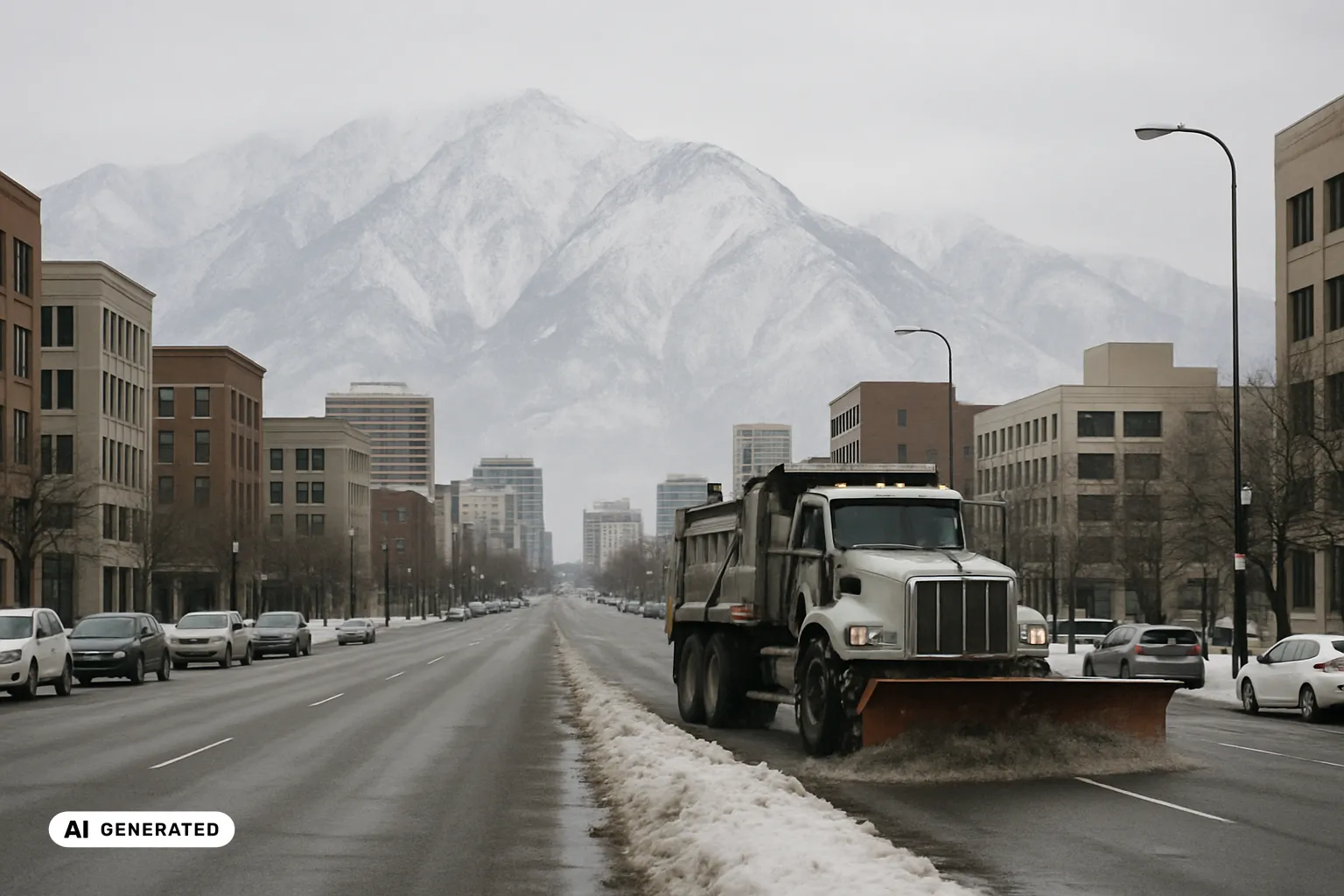
What winter actually does in Salt Lake City
Salt Lake City sits on the floor of the Salt Lake Valley, at about 4,300 feet, in a basin walled in by the Wasatch Range to the east — peaks over 11,000 feet, close enough to fill the windscreen from downtown — and the Great Salt Lake to the northwest. Away from the flat valley floor the city climbs onto the benches, the glacial terraces where the Avenues and the University neighbourhoods stack up the foothills. That wall of mountains and that climb off the valley floor are most of the explanation for a Salt Lake City winter.
The headline snowfall number is almost misleading on its own: about 51.9 inches a year at the airport, on the valley floor, with December the snowiest month at roughly 12.1 inches. For a place this famous for snow, that is modest — drier than Buffalo or Syracuse, less than half of a Great Lakes snowbelt town. But the valley-floor figure is exactly that: the floor. The real winter is measured vertically, and a few miles east it becomes a completely different number.
The mountains, the lake, and the “Greatest Snow on Earth”
Drive east and up into the Wasatch and the snow multiplies. Alta, at the head of Little Cottonwood Canyon above the city, averages on the order of 500-plus inches a season — roughly ten times the valley-floor total — and holds a reputation for collecting the most snow in Utah. The gap between downtown and the canyon rim is one of the steepest snowfall gradients over such a short distance anywhere in the country.
The gradient is not only a ski-area phenomenon; there is a town living on it. Over the ridge to the east, Park City sits at 6,936 feet — about 2,700 feet above the valley floor — and its own NOAA station records 121.2 inches a season against the airport’s 51.9. A settlement of 8,400 people running a municipal winter operation at that altitude writes different rules: an eight-hour sidewalk clock, a coded standard of twenty feet cleared in eight hours for private streets, and an ordinance chapter devoted to where the snow may be put.
Two mechanisms drive it. The first is orographic lift: the Wasatch forces incoming air to rise and cool sharply, and cooling air cannot hold its moisture, so it falls out as snow at altitude — far more of it than reaches the valley below. The second is the Great Salt Lake effect, Utah’s own lake-effect snow. Because the lake almost never freezes, cold air crossing it keeps picking up moisture, and it can add snowfall across a long season — September through May — with, by one study, an average of about 13 lake-effect events a year. Put orographic lift and the lake together and you get the light, dry, deep powder the state trades on as the “Greatest Snow on Earth.” For winter service the lesson is the same as the geography: the number that matters depends entirely on where on the mountain you are standing.
Inversions: the other half of the valley’s winter
The basin has a second winter signature that has nothing to do with how much snow falls. When cold, dense air settles onto the enclosed valley floor with warmer air above it, the normal pattern inverts — it gets warmer as you climb, not colder — and the cold, along with trapped pollution, can sit against the ground for days. During a strong inversion the benches and the mountains bask in clear, milder air while downtown stays grey and frozen below the lid.
That matters for keeping surfaces clear. Under an inversion the valley floor misses the midday thaw the higher ground gets: old snow lingers, meltwater refreezes overnight, and treated pavement stays icy longer than a glance at the temperature aloft would suggest. It is a public-health story too — the trapped smog is a recurring wintertime hazard of the Salt Lake Valley — but on the road it simply means the low, enclosed ground holds its ice.
What the local rules say
Salt Lake City’s sidewalk rule is set out in the City Code, Section 14.20.070. As the ordinance is written, it is unlawful for the owner, occupant, lessor or agent of property abutting a paved city sidewalk to fail to clear the entire length — corners and kerb ramps included — within 24 hours after the snow stops, timed from when it ceases at the Salt Lake City Airport as reported by the National Weather Service. The cleared path has to be at least 42 inches wide — “about 2.5 times the width of a regular snow shovel,” as the City puts it — or the full width where the walk is narrower, with ice taken to bare pavement or made as level as possible and treated with ice melt or sand. Each day the walk is left counts as a new violation.
Enforcement is graduated, and by the City’s own account not punitive on a first slip — it says there is one warning per winter season. After that, the civil penalty at Section 14.20.110, revised in 2025, is tiered by street frontage: for a property with 200 feet of frontage or less, $50 a day if the walk is not cleared within 24 hours, $75 within 48 and $100 within 72; for more than 200 feet, $100, $150 and $200 a day respectively. The money is a backstop; the real point of the rule is a continuous, walkable path through a snowy winter. None of this is legal advice — the point here is simply what the code says. Because the exact figures and section numbers matter, the sensible move is to read the ordinance itself, or the City’s snow-removal page, rather than take a summary’s word for it.
How the city clears — priority order
On the roads, the Salt Lake City Streets Division, part of Public Services, runs the plowing. It covers over 1,900 lane miles of City streets — plus protected bike lanes and the stretches of sidewalk by freeway bridges — and works in three priorities. Priority 1 is the emergency network, hospitals and main roads, cleared first so the city keeps moving. Priority 2 is the busy, high-volume streets. Priority 3 is neighbourhood and residential streets, plowed last. The Division also clears the City’s own sidewalks, trails and lots at parks, public buildings, rec centres and the City Cemetery.
The practical consequence is the same one every priority system produces: a quiet residential street — especially a steep one up on the Avenues or the benches — can stay unplowed for a while after a storm while the crews hold the emergency and arterial routes open. Grade sharpens it. The bench streets climb the foothills straight off the valley floor; they run colder, hold snow and ice longer, and are exactly the Priority 3 roads that wait. A contractor working the Avenues is in a different, steeper microclimate from one on the flat valley floor a mile away.
The canyons and the highways: UDOT and the avalanches
The interstates and the canyon roads are a separate world, run by UDOT, the state department of transportation, not the City: I-15, I-80 and I-215 across the valley, and the canyon highways SR-210 up Little Cottonwood and SR-190 up Big Cottonwood. The canyons carry some of the most avalanche-threatened highway in the country. Little Cottonwood alone has 64 avalanche slide paths, and UDOT says over half of SR-210 is threatened by avalanches.
The way that hazard is managed is one of the more striking sights of a Wasatch winter: UDOT deliberately brings the snow down. Using remote avalanche control systems and artillery, crews trigger slides on purpose during and after big storms — and close the road to the public while they do, sometimes with an “interlodge” order that keeps people indoors at the resorts up top. It is planned, not improvised: a controlled release onto an empty road beats an uncontrolled one onto a full one. For anyone whose winter work touches the canyon mouths, the closures are simply part of the operating picture, the same way a record of what the weather was actually doing is part of understanding a mountain storm.
The benches, the valley cities, and the crest
It helps to picture Salt Lake winter service as several climates stacked on one slope. The valley floor is the driest and warmest of them, and the first to be locked under an inversion. The benches and the Avenues are steeper, colder and slower to clear. The canyon mouths — where Big and Little Cottonwood open onto the valley’s east side — are weather transition zones, with chain and traction requirements and, above them, the avalanche closures. And the airport corridor west on I-80, out toward the lake, catches blowing and lake-influenced snow across open ground.
Every neighbouring town down in the valley is its own municipality with its own snow ordinance — Sandy, Murray, West Valley City, Millcreek, Holladay and Cottonwood Heights among them — so the City of Salt Lake City’s 24-hour rule describes Salt Lake City proper; cross a line and the duty, the deadline and the fines can change. Cottonwood Heights sits right at the canyon mouths, the gateway to Brighton, Solitude, Snowbird and Alta, and runs snowier than downtown. Over the Wasatch crest to the east — via I-80 and Parley’s Canyon — Park City is a separate, higher, far snowier jurisdiction again. This is the same mountain-west winter that reaches Denver and Colorado Springs across the Rockies: a valley or plain in the rain shadow, and a wall of snow just above it.
Keeping the record straight
In a place where the valley floor can hold ice under an inversion while the bench above it thaws, and where the same storm means four inches downtown and four feet in the canyon, the useful thing is being able to show, plainly, what was done and when. Not to win an argument, but because a winter this uneven generates exactly the questions — was the route cleared, at what time, in what conditions — that a vague answer can’t settle. A simple, time-stamped record of each treatment, set against what the weather was actually doing, and a log of where a crew went and when, turns “we were out all day” into something specific. That is the documentation support Wintertrace is built to make easy — whether you look after a single property or a fleet of routes running from the flat valley floor up onto the benches. It does not change any local rule; it just means that when someone asks what happened during the last storm, the answer is on file. Not a substitute for legal advice.
Local facts
- The valley floor is comparatively dry for such a snowy region: about 51.9 inches (about 132 cm) of snow a year at Salt Lake City International Airport, based on the 1991–2020 climate normals, with December the snowiest month at roughly 12.1 inches (about 31 cm).Source
- The defining local fact is vertical: the city sits at about 4,300 feet on the valley floor, hemmed by the Wasatch Range whose peaks top 11,000 feet — so the same storm drops a few inches downtown and a great deal more a few miles east and thousands of feet up.Source
- Alta, at the head of Little Cottonwood Canyon above the city, averages on the order of 500-plus inches (about 548 inches) of snow a season — roughly ten times the valley-floor total — and has a reputation for collecting the most snow in Utah.Source
- The Great Salt Lake almost never freezes, so it can add lake-enhanced snowfall from September through May; a study cited by the National Weather Service literature found an average of about 13 lake-effect events a year, which combined with orographic lift on the Wasatch produces the low-density powder marketed as the 'Greatest Snow on Earth'.Source
- Under Salt Lake City Code Section 14.20.070, the owner, occupant, lessor or agent of property abutting a paved city sidewalk must clear the entire length — corners and kerb ramps included — within 24 hours after the snow stops, timed from when it ceases at the Salt Lake City Airport as reported by the National Weather Service, and each day it is left is a new violation.Source
- The path must be at least 42 inches wide — 'about 2.5 times the width of a regular snow shovel', as the City puts it — or the full width where the walk is narrower, with ice taken to bare pavement or made as level as possible and treated with ice melt, sand or similar.Source
- The civil penalty under Section 14.20.110 — revised in 2025 — is tiered by street frontage: for a property with 200 feet of frontage or less, $50 a day if the sidewalk is not cleared within 24 hours, $75 within 48 and $100 within 72; for more than 200 feet of frontage, $100, $150 and $200 a day respectively.Source
- The Salt Lake City Streets Division plows over 1,900 lane miles of City streets — plus protected bike lanes and the sidewalks by freeway bridges — in priority order: Priority 1 emergency routes such as hospitals and main roads first, Priority 2 busy streets next, and Priority 3 neighbourhood and residential streets last.Source
- The interstates and canyon highways belong to the state, not the City: UDOT maintains I-15, I-80 and I-215 across the valley and the canyon routes SR-210 (Little Cottonwood) and SR-190 (Big Cottonwood).Source
- Little Cottonwood Canyon alone has 64 avalanche slide paths, 'with over half of SR-210 threatened by avalanches'; UDOT uses remote avalanche control systems and artillery to trigger slides deliberately and closes the road to the public during mitigation.Source
Official contacts
Salt Lake City — Snow Removal (Streets Division / Public Services)
The City's own page: who must clear sidewalks, the 24-hour and 42-inch rules, the fine range, and the Priority 1/2/3 plowing order.
Salt Lake City — Sidewalk Maintenance (Transportation)
Background on sidewalk responsibility and maintenance across the City.
Salt Lake City Code, Title 14, Chapter 14.20 (Sidewalks — snow and ice)
The ordinance itself — Section 14.20.070 (removal duty and timing) and Section 14.20.110 (the fine schedule).
UDOT — Cottonwood Canyons avalanche information
How the state manages avalanche hazard on SR-210 and SR-190, including the slide-path count and the road closures for control work.
Common questions about winter service in Salt Lake City
- Do I have to shovel the sidewalk in front of my property in Salt Lake City?
- Yes. Under City Code Section 14.20.070, the owner, occupant, lessor or agent of property abutting a paved city sidewalk must clear it within 24 hours after the snow stops — timed from when it ceases at the Salt Lake City Airport — leaving a path at least 42 inches wide (about two and a half shovel-widths) down to bare pavement, or treated with ice melt or sand if it has frozen. The City says there is one warning per winter season; after that the penalty at Section 14.20.110 (revised in 2025) is tiered by frontage — for 200 feet or less, $50 a day if not cleared within 24 hours, $75 within 48 and $100 within 72; for more than 200 feet, $100, $150 and $200 a day. This is general information, not a substitute for legal advice — read the ordinance itself for the exact wording.
- Why does downtown get only about 52 inches when the resorts get 500?
- Because winter here is measured vertically, not horizontally. The valley floor sits at about 4,300 feet and averages roughly 52 inches a season. Ride a few miles east and several thousand feet up into the Wasatch and the same storms unload an order of magnitude more — Alta, at the top of Little Cottonwood Canyon, averages around 500-plus inches. Two things do it: the mountains force the incoming air to rise and cool, wringing far more snow out of it at altitude (orographic lift), and the powder is unusually light and dry. So a Salt Lake City snowfall figure describes the valley floor only; it badly understates what is falling on the benches above town and in the canyons.
- What is the Great Salt Lake effect?
- It is Utah's version of lake-effect snow. Because the Great Salt Lake almost never freezes, cold air crossing it can pick up moisture and add snowfall to the valley and the mountains beyond — and it can do so across a long season, from September through May. One study put it at an average of about 13 lake-effect events a year. Layered on top of the orographic lift on the Wasatch, it is part of why the range collects such famously light, deep snow. It does not fall evenly, though: where a band sets up depends on the wind, so one part of the valley can get a burst while another stays clear.
- What is a winter inversion, and does it affect winter service?
- An inversion is what happens when cold, dense air pools on the enclosed valley floor while warmer air sits above it, so the usual pattern of 'colder as you go up' is flipped. In the Salt Lake Valley it can lock in for days, trapping cold and pollution against the ground while the benches and mountains above sit in clear, warmer air. For winter service it means the valley floor can stay frozen and grey long after a storm has passed — old snow and ice linger, refreeze overnight, and don't get the midday thaw the higher ground gets. It is a health story as much as a road story, but it shapes how long treated surfaces stay icy down in the basin.
- Who plows my street, and in what order?
- The Salt Lake City Streets Division, part of Public Services, plows more than 1,900 lane miles of City streets. It works in three priorities: Priority 1 is the emergency network — hospitals and main roads — cleared first; Priority 2 is the busy, high-volume streets; and Priority 3 is neighbourhood and residential streets, which are plowed last. So a quiet residential road on the bench can stay unplowed for a while after a storm while the crews keep the emergency and arterial routes open. The interstates and the canyon highways are not the City's — those belong to UDOT.
- Who clears the canyon highways, and why do they close them to shoot at the snow?
- The canyon roads — SR-210 up Little Cottonwood and SR-190 up Big Cottonwood — belong to UDOT, the state department of transportation, as do I-15, I-80 and I-215 across the valley. The canyons are some of the most avalanche-threatened highway in the country: Little Cottonwood alone has 64 slide paths, and UDOT says over half of SR-210 is threatened by avalanches. To manage that, UDOT deliberately triggers slides during and after big storms using remote avalanche control systems and artillery, and closes the road to the public while it does — sometimes with an 'interlodge' order keeping people indoors up top. It is planned, not improvised: bringing the snow down on purpose, safely, beats waiting for it to come down on its own.
- Are the Avenues and the benches harder to keep clear?
- They are the demanding end of the City's map. The Avenues, Federal Heights and the University bench are steep grid streets climbing the foothills straight above downtown — higher, colder and slower to melt than the valley floor, and mostly residential, which puts them in Priority 3, plowed last. Grade is the problem: a steep bench street that hasn't been touched holds snow and ice longer, and traction matters more. Anyone running winter service up there is working a colder, steeper microclimate than a contractor down on the flat valley floor a mile away.
- Do the surrounding valley cities have the same rules as Salt Lake City?
- No — each municipality in the Salt Lake Valley runs its own snow ordinance. Cross a line into Sandy, Murray, West Valley City, Millcreek, Holladay or Cottonwood Heights and the duty, the deadline and the fines can differ from Salt Lake City's 24-hour rule, so it is worth checking the specific city. Cottonwood Heights, for instance, sits right at the mouths of Big and Little Cottonwood, a gateway to the resorts and a snowier spot than downtown. And over the Wasatch crest to the east — via I-80 and Parley's Canyon — Park City is a separate, higher, far snowier jurisdiction again.
Documenting winter service in Salt Lake City
Anyone clearing snow and ice in Salt Lake City may later need to show when and where a route was treated. Wintertrace is open-source software that records exactly that — time, location and weather for each run — as a calm basis for your own operational records and service proof. It is not a substitute for legal advice.
This overview is for general information and is not legal advice. Local rules on snow and ice clearing vary — the wording of the local rule and the responsible authority always govern.