Winter service · Utah
Winter service in Park City
What winter is really like in Park City, Utah: about 121.2 inches a season at the NOAA station on the valley floor of the town itself, against 51.9 at Salt Lake City airport 32 miles away. The Tier I/II/III sidewalk system and its eight hours, the 20-feet-in-eight-hours standard the code sets for private streets and HOAs, the 15 per cent of every hard surface that must be kept free for snow storage, and the pile at Quinn's Junction that reached 55,416 cubic yards.
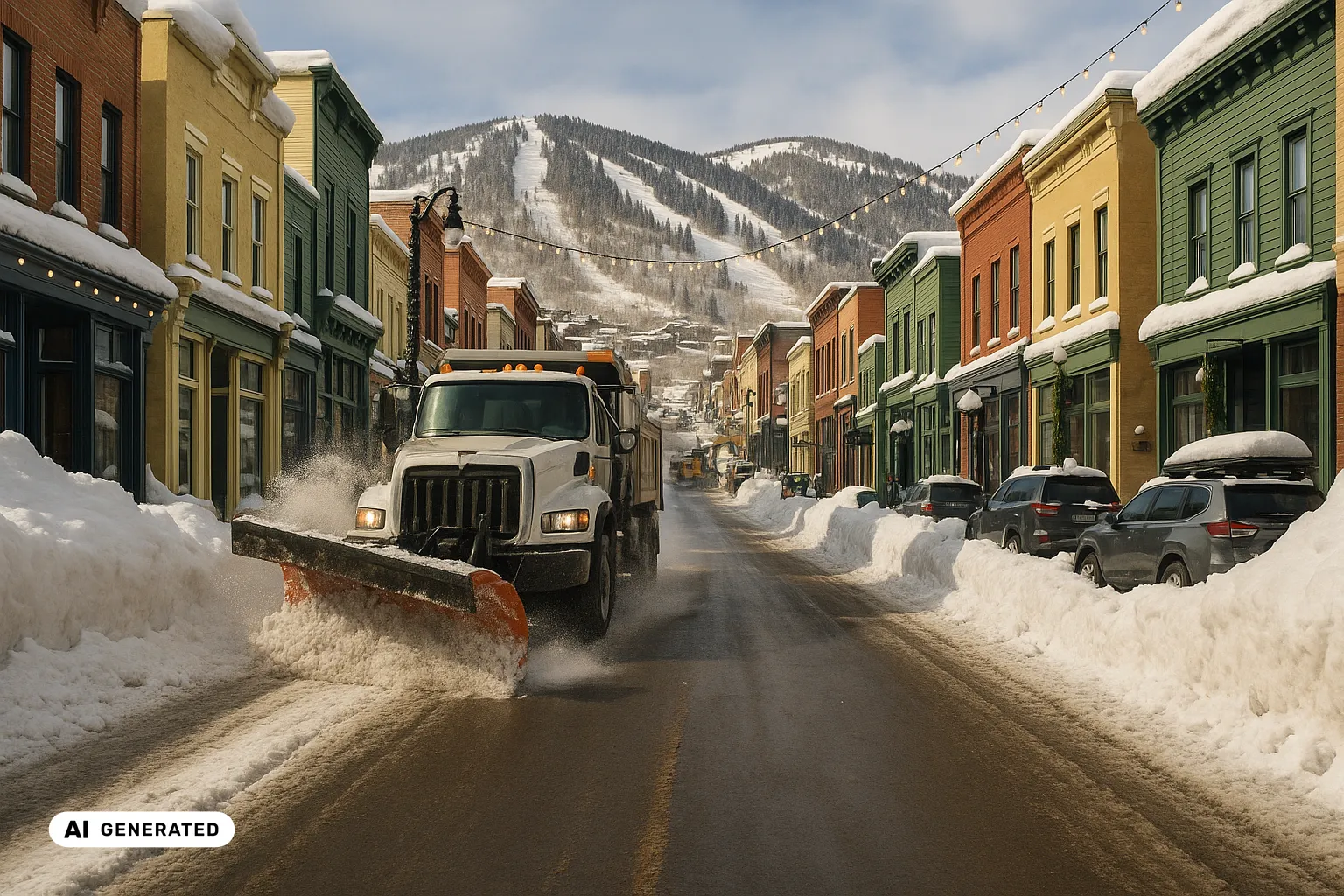
Most mountain-town pages are written as a contrast: the city down in the valley, the ski area up on the hill. Park City does not work that way, because the town itself is the hill. It sits at 6,936 feet at the south end of the Snyderville Basin, on the east flank of the Wasatch, and climbs steeply from there in three directions.
The number that follows from that is 121.2 inches of snow a year, across 43.7 days with measurable snowfall, measured at the NOAA station in the town on the 1991–2020 normals. Salt Lake City International Airport, thirty-two miles away and about 2,700 feet lower, gets 51.9. Same state, same storms, 2.3 times the snow.
And this is a settlement of 8,396 people running its own winter operation, two major ski areas and an Olympic park on that basis.
The gradient, and where the numbers come from
It is worth being careful here, because Park City is one of the places where published snowfall figures are almost meaningless without knowing which altitude they describe. Numbers from 270 to 355 inches circulate freely as “Park City snowfall”.
They are not wrong; they are measured somewhere else. Park City Mountain reports around 355 inches across a ski area that tops out at 10,026 feet. Deer Valley reports under 150 inches at its base at 6,530 feet and 294 inches at its summit at 9,570 feet — the snowfall roughly doubles across 3,040 feet of elevation without leaving one property.
So the honest stack looks like this:
| Elevation | Place | Snow a year | Kind of figure |
|---|---|---|---|
| ~4,226 ft | Salt Lake City airport | 51.9 in | NOAA normals |
| 6,530 ft | Deer Valley base | under 150 in | resort figure |
| 6,900 ft | NOAA station, the town | 121.2 in | NOAA normals |
| 9,570 ft | Deer Valley summit | 294 in | resort figure |
| 10,026 ft | Park City Mountain summit | 355 in (area) | resort figure |
Everything on this page about the town’s climate uses the middle row.
Two further features of that climate shape the work. The season is long at both ends: November alone normals at 17.4 inches and April at 10.0, and together with October and May about 27 per cent of the annual total falls outside the classic December-to-March window. And the basin pools cold air — the local chamber’s climate profile describes cooler air collecting from the surrounding slopes to form “a shallow nocturnal inversion during much of the year, especially in the winter months”. That is a different animal from the days-long valley inversion that settles over Salt Lake City; it is nightly, shallow and drainage-driven.
Three tiers of sidewalk
Park City does not have a sidewalk rule. It has three, and which one applies to a given stretch of pavement is a question of looking it up.
Under Municipal Code § 14-4-9, every stretch is assigned a tier in the city’s published Snow Removal Guide:
Tier I — the City clears it. These are the pedestrian Spine System sidewalks, and the code is explicit that adjacent owners are not responsible for them.
Tier II — the owner clears it, on an eight-hour clock, and the code phrases the standard as a prohibition rather than a duty:
It shall be unlawful for a property owner under a duty to remove snow to permit an accumulation of more than eight inches (8”) of snow to remain on the sidewalks or stairs for more than eight (8) hours at a time.
Stairs are named alongside sidewalks, which in Old Town is not a technicality.
Tier III — nobody clears it, and the reason is the most Park City sentence in the whole code. The City’s guide states it plainly:
Neither the City, nor the property owner is responsible for winter maintenance. The walk is considered to be used for onsite snow storage.
That is not an admission of neglect. It is an allocation. In a town where the snow has to go somewhere and the streets are narrow and old, some sidewalks are formally designated as the somewhere.
Owners who want better than their tier can apply through the city’s request for an elevated level of service, assessed on the seasonality, location and connectivity of the path. And for residents who cannot meet the standard themselves, the City runs a Snow Removal Assistance Program, connecting them with their HOA or with local volunteers.
Where the snow may be put
In most cities the winter ordinance is about clearing. Here, three consecutive sections are about storage — and they are the operational core of the place.
§ 14-4-4 makes it the owner’s responsibility to store the snow that accumulates on their property either on their own premises or, with permission, on someone else’s.
§ 14-4-5 makes it unlawful to deposit, haul, push, blow or otherwise place private snow “within the traveled portion of any public street”.
§ 14-4-6 then defines that phrase, and the definition is narrower than people assume: the traveled portion is the part of the right-of-way “that is paved and maintained for vehicular or pedestrian traffic”. The unpaved verge behind the kerb is not in it.
This distinction is the one most often got wrong, by residents and contractors alike. The rule is not keep snow out of the street. It is keep snow off the paved surface. The City’s guide gives the working version: its right-of-way for snow storage extends five to ten feet back from the kerb, and any landscaping installed there is at the owner’s risk.
It is also worth knowing that a few miles away the definition changes. Summit County defines its traveled way as the paved or gravelled surface plus ten feet on each side. Two neighbouring rulebooks, two different edges to the same prohibition.
Storage is a planning requirement here before it is an operational one. The Land Management Code, at § 15-3-3, requires an owner laying out parking or a driveway to provide non-hard-surfaced, landscaped snow storage areas “equivalent to fifteen percent (15%) of the total Hard-Surfaced Area”, on site and in a usable, readily accessible location — and caps driveways at a 14 per cent slope. A fifteen per cent snow reserve on every hard surface is not a rule that occurs to a flat city.
And when the reserves fill, the snow leaves town. Park City hauls it out of Old Town to a municipal pile at Quinn’s Junction, which in the 2022/23 season reached 55,416 cubic yards, with deliveries beginning on 8 December. Staff named the heap “Quinneth Peak”. It is a joke with a load figure attached: at some point in a Park City winter, clearing stops being about pushing snow and becomes about trucking it away.
A measurable standard for private streets
The city’s plow map carries a legend category that says a great deal: “NO PLOWING/PRIVATE STREET”, and whole neighbourhoods sit inside it.
That is not a gap in the service. It is a transfer of duty, and the code sets out both the duty and the standard.
§ 14-4-2 places the obligation on “every condominium owners association, property owners’ association, corporation, partnership, or other entity having control over a private street system within the corporate limits of Park City”, and on the owners of properties taking access from those streets.
§ 14-4-3 then says what adequate means, in numbers:
… cleared from the roadway to a width of twenty feet (20’) within a period of eight hours from the end of each snow storm
with a matching prohibition on letting more than four inches remain on a private street for more than eight hours after a storm ends.
Twenty feet, eight hours, four inches. Very few municipalities write a performance standard for private snow clearing at all, let alone one this specific. For anyone operating under contract to an association here, that sentence is effectively the service level — and it is public, which cuts both ways.
Where a party is responsible for clearing a public street under a plat restriction, conditional use approval or agreement with the City, § 14-4-8 allows the City at its discretion to do the work itself and recover its costs from the responsible party.
Violations of the chapter are classified as a Class C misdemeanour under § 14-4-16. The chapter states the classification and no dollar figure, so none is given here.
Two further duties catch people out. Hydrants at a property line must be kept clear three feet all round and dug out within 72 hours of being buried by clearing or drifting. Hydrants on private streets must be marked with a pole or sign at least six feet tall, left standing from 15 November to 1 May. And the City does not accept liability for sprinklers, mailboxes, lights or plantings in the public right-of-way damaged by ordinary winter operations — owners may flag their installations, and crews will make reasonable efforts, but flagging is not a guarantee.
Parking on the downhill side
Winter parking rules run 1 November to 30 April, and the central one is shaped by gradient rather than by date:
No parking is allowed on the downhill side of any street south of 12th Street.
The downhill side being the one where the natural slope and drainage run away from the street surface. Main Street, Park Avenue north of Heber Avenue and Swede Alley sit outside that rule, but prohibit parking between 2 a.m. and 6 a.m. In Old Town the City’s advice is blunter still: do not park on the downside slope of any street, and cars that stay put and restrict plowing may be ticketed or towed. During a declared snow removal emergency, parking on any bus route or first-priority street is unlawful and vehicles may be impounded.
Outside the city limits the calendar shifts. Summit County bans on-street parking on county roads from 15 November to 15 April — two weeks later at the start, two weeks earlier at the end — with towing at the owner’s expense, and its right-of-way reaches 30 feet from the centreline. The roads run into each other; the rules do not line up.
The city’s own operation covers 133 lane miles, worked by four crews of four plow drivers across four segments of the city, on four ten-hour shifts when it is not snowing and twelve-hour shifts when it is, with a six-person day crew for car parks and snow banks. Priorities are set in the code itself, at § 14-4-1: arterials first, residential streets second, cul-de-sacs third — with bus routes, Old Town streets, Royal Street and the core business areas named in the guide as the top of that list. Crews are prepared to work around the clock through the season.
One line from the guide is worth quoting for how unglamorously true it is: “A snow storm of four inches over a 24-hour period will require more time and man-hours than a storm of six inches over an eight-hour period.” Duration drives the operation more than depth does.
Getting in and out
I-80 through Parleys Canyon is the year-round road to Salt Lake City, and it is one of three Wasatch Back routes under UDOT’s traction law — the others being US-40 in Summit and Wasatch counties and Marsac Avenue at the south end of SR-224, inside Park City itself. A city street under a state traction requirement is a rare thing. Class 1 applies to vehicles over 12,000 lb gross weight; Class 2 applies to all vehicles.
The Guardsman Pass connection to Brighton is closed every winter. UDOT lists it among its seasonal roads, shut from November through May or June depending on the weather, on the stated grounds that the route is too steep and narrow to plow. In the Cottonwoods on the other side of the range, the state fires artillery at the slopes to keep a road open; here it shuts the gate. Two answers to the same mountain, and the Park City one is the cheaper.
SR-224 runs down from the I-80 interchange at Kimball Junction and through town as Park Avenue, Deer Valley Drive and then Marsac Avenue, and leaving the city northbound there is a runaway truck ramp. Above the town, SR-224 closes for the winter as well.
Ridgelines above Park City fall within the Utah Avalanche Center’s Salt Lake forecast region, which is the place to look before going into the backcountry here. No avalanche mitigation programme on a Park City road is documented — the winter closure of the pass is the local answer.
Salt, and the water underneath it
Park City’s de-icing story turned on a groundwater finding rather than a budget.
As reported in December 2022, the city had used salt harvested from the Great Salt Lake mixed with a little liquid calcium chloride, in quantity. State officials then told city staff that groundwater salt levels were high and needed to come down. The response was equipment: trucks that read air and road temperature and forecast the following eight hours, so the decision to spread — and how much — is made against conditions rather than habit. Salt use fell by about 30 per cent, and the city tests the town’s water for salt weekly and charts the result as a measure of its own performance.
No municipal ordinance on de-icing materials or watershed limits could be found, so this page describes a practice rather than a rule. But it is a practice with a measurement attached to it, which is unusual enough to note.
One further thing has changed about winter here, and it belongs in the past tense: from 1978 through January 2026, Park City hosted the Sundance Film Festival, which laid a second peak on top of the ski season every January. From 2027 the festival is in Boulder. The winter load now rests on the ski season and the city’s own peak-day planning, which has identified as many as 66 peak traffic days in a season.
Keeping the record straight
In a town where the code sets twenty feet in eight hours above four inches for private streets, where a Tier II walk may not hold eight inches for more than eight hours, and where the City may do the work itself and bill the responsible party for it, the useful thing is being able to show plainly what was done and when.
Not to win an argument. Because a season with 27 per cent of its snow falling outside December to March, and storms that are judged by their duration rather than their depth, produces exactly the questions a vague answer cannot settle: was this street cleared to width inside the window, when did the storm actually end, where did the snow from the drive go, and how many passes did it take. A simple, time-stamped record of each treatment, set against what the weather was actually doing, turns “we were up there all night” into something specific — a clear service record whether you look after one Old Town frontage or a private street system in Deer Valley with a twenty-foot standard to meet.
That is the documentation support Wintertrace is built to make easy. It does not change any local rule, and it is not a substitute for legal advice. It just means that when someone asks what happened during the last storm, the answer is on file.
Local facts
- Park City sits at 6,936 feet (2,114 m), at the south end of the Snyderville Basin on the east flank of the Wasatch Range, and climbs steeply from there to the south, south-east and west. It is not a valley town with mountains next to it — the town is already halfway up.Source
- At the NOAA station PARK CITY (USC00426644, elevation 6,900 ft), the 1991–2020 normals give about 121.2 inches (307 cm) of snow a year across 43.7 days with measurable snowfall, a January mean low of 15.6 °F (−9.1 °C), and a record low of −30 °F.Source
- Salt Lake City International Airport, 32 miles away and about 2,700 feet lower, averages 51.9 inches over 31.4 snow days on the same 1991–2020 basis. Park City gets roughly 2.3 times the snow and about twelve more days of it, for a drive of well under an hour.Source
- The gradient is steep enough to show up inside a single ski area. Deer Valley reports under 150 inches of snowfall at its 6,530-foot base and 294 inches at its 9,570-foot summit — roughly double, across 3,040 feet, without leaving one property.Source
- The season is long at both ends. The station's monthly normals give November 17.4 inches and April 10.0 inches; together with October and May, about 32.9 inches — 27 per cent of the annual total — falls outside the usual December-to-March window.Source
- Cold air drains off the surrounding slopes and pools in the basin. The Park City Chamber's climate profile describes it: "Cooler air from surrounding mountain slopes collects in the Snyderville Basin area and forms a shallow nocturnal inversion during much of the year, especially in the winter months."Source (PDF)
- There is no single sidewalk rule here. Park City Municipal Code § 14-4-9 sorts every stretch into one of three tiers set out in the city's Snow Removal Guide: the City clears the Tier I pedestrian Spine System and adjacent owners are not responsible for it; Tier II is the owner's, on an eight-hour clock; Tier III belongs to nobody.Source
- The Tier II standard is written as a prohibition rather than a duty: "It shall be unlawful for a property owner under a duty to remove snow to permit an accumulation of more than eight inches (8") of snow to remain on the sidewalks or stairs for more than eight (8) hours at a time." Stairs are named alongside sidewalks.Source
- Tier III is the line that could only be written in a mountain town. The City's own guide states: "Neither the City, nor the property owner is responsible for winter maintenance. The walk is considered to be used for onsite snow storage." The sidewalk is not being neglected — it has been designated as somewhere to put the snow.Source (PDF)
- Where the snow goes is regulated in its own right. Under § 14-4-4 it is the property owner's responsibility to store snow accumulated on the property either on their own premises or, with permission, on someone else's.Source
- Section 14-4-5 makes it unlawful to deposit, haul, push, blow or otherwise place snow from private property "within the traveled portion of any public street" — and § 14-4-6 defines that term narrowly, as the part of the right-of-way "that is paved and maintained for vehicular or pedestrian traffic". The unpaved verge behind it is not covered.Source
- The City puts the practical version in its guide: "The City right-of-way for snow storage extends five to ten feet back from the curb. Landscaping installed within the right-of-way is at the property owner's risk."Source (PDF)
- Snow storage is a planning requirement before it is an operational one. Land Management Code § 15-3-3 requires an owner to provide non-hard-surfaced, landscaped snow storage areas "equivalent to fifteen percent (15%) of the total Hard-Surfaced Area", on site and readily accessible — and caps driveways at a 14 per cent slope.Source
- When on-site storage runs out, the snow leaves town. In the 2022/23 season the municipal pile at Quinn's Junction reached 55,416 cubic yards of hauled snow, with deliveries starting on 8 December; city staff nicknamed it "Quinneth Peak".Source
- Private streets carry a duty written into the code. Section 14-4-2 places it on "every condominium owners association, property owners' association, corporation, partnership, or other entity having control over a private street system" within the city, and on the owners of properties taking access from those streets.Source
- And the standard is measurable rather than descriptive. Under § 14-4-3, adequate service means the roadway is "cleared from the roadway to a width of twenty feet (20') within a period of eight hours from the end of each snow storm", and it is unlawful to let more than four inches remain on a private street for more than eight hours after a storm ends.Source
- If a party responsible for private clearing on public streets falls short of that standard, § 14-4-8 allows the City at its discretion to do the work itself and obtain reimbursement of its costs from the responsible party.Source
- A violation of the snow removal chapter is classified as a Class C misdemeanour under § 14-4-16. The chapter states the classification and no dollar amount.Source
- Fire hydrants are the property owner's problem too: those at a property line must be kept clear for at least three feet all round and dug out within 72 hours of being buried by clearing or drifting, and hydrants on private streets must be marked with a pole or sign of at least six feet, left standing from 15 November to 1 May.Source
- Winter parking rules run from 1 November to 30 April, and the central one is shaped by the terrain: "No parking is allowed on the downhill side of any street south of 12th Street" — the downhill side being where the natural slope runs away from the street surface. Main Street, Park Avenue north of Heber Avenue and Swede Alley are exempt, but prohibit parking between 2 a.m. and 6 a.m.Source (PDF)
- Just outside the city, Summit County runs a different calendar: no on-street parking on county roads between 15 November and 15 April, with towing at the owner's expense. Its right-of-way also reaches 30 feet from the centreline, and its snow-deposit rules use a wider definition of "traveled way" than Park City's.Source
- One street inside the city is under a state traction law. UDOT lists three Wasatch Back routes: I-80 in Parleys Canyon, US-40 in Summit and Wasatch counties, and Marsac Avenue at the south end of SR-224 in Park City — Class 1 applying to vehicles over 12,000 lb GVW, Class 2 to all vehicles.Source
- The Guardsman Pass link between Park City and Brighton is closed by UDOT every winter, listed under seasonal roads as shut from November through May or June depending on the weather. The reason given is that the route is too steep and narrow to plow in winter — here the state closes rather than clears.Source
- The city runs 133 lane miles with four crews of four plow drivers across four segments, on four ten-hour shifts when it is not snowing and twelve-hour shifts when it is, plus a six-person day crew for car parks and snow banks. Crews are prepared to work around the clock from 1 November to 30 April.Source
- Salt use here was cut after a groundwater finding. As reported in December 2022, state officials had told city staff that groundwater salt levels were high and needed reducing; the city fitted trucks that read air and road temperature and forecast the next eight hours to decide whether and how much to spread, reducing salt use by about 30 per cent, and it tests the town's water for salt weekly as a performance measure.Source
Official contacts
Park City Municipal — Snow Removal (Public Works)
The city's own explanation of the tier system with the reference to § 14-4-9, the hydrant rules, the request process for an elevated level of service, and the Snow Removal Assistance Program.
Park City Snow Removal Map and Guide (PDF)
The map that decides which tier a given sidewalk is in and which roads are first, second or third priority — including the categories for state-maintained roads and "NO PLOWING/PRIVATE STREET". The document to check for a specific address.
Park City Municipal Code, Chapter 14-4 — Snow Removal
The chapter itself, available in full text. Sections 14-4-1 to 14-4-16 cover priorities, the private-street standard, snow storage, hydrants, liability for installations in the right-of-way and penalties.
Summit County — snowplowing and winter parking
For anything outside the city limits, including the Snyderville Basin and Kimball Junction: county plowing hours, the 30-foot right-of-way, the 15 November to 15 April parking ban and the county's own snow-deposit rules.
UDOT — Wasatch Back traction law and seasonal road closures
When the traction law is in force on Marsac Avenue, I-80 through Parleys Canyon and US-40 — and, on the seasonal roads page, the winter closure of the Guardsman Pass connection.
Common questions about winter service in Park City
- How much snow does Park City actually get?
- About 121.2 inches a year in the town itself, over roughly 43.7 days with measurable snowfall, at the NOAA station on the 1991–2020 normals. That figure is worth insisting on, because numbers between 270 and 355 inches circulate as "Park City snowfall" and those are resort measurements taken far higher up. Both are true of different places. Park City Mountain reports around 355 inches across a ski area topping out at 10,026 feet; Deer Valley reports under 150 inches at its 6,530-foot base and 294 at its 9,570-foot summit. The town's own 121.2 inches is still 2.3 times what Salt Lake City International Airport gets 32 miles away, and about twelve more days of snowfall a year.
- Do I have to clear the sidewalk in front of my property?
- That depends entirely on which tier it is in, and the only way to know is to look it up on the city's Snow Removal Guide map. Under Park City Municipal Code § 14-4-9 there are three answers. On Tier I — the pedestrian Spine System — the City clears it and adjoining owners are expressly not responsible. On Tier II the owner is responsible, for sidewalks and stairs at the property line, and the code makes it unlawful to let more than eight inches of snow sit there for more than eight hours at a time. On Tier III neither the City nor the owner has a duty, and the City's guide states that the walk is considered to be used for onsite snow storage. Owners who want a higher level of service can apply through the city's request process, which weighs seasonality, location and connectivity. This is general information rather than legal advice.
- Where am I allowed to put the snow?
- On your own property, or on someone else's with their permission — that is § 14-4-4. What you may not do, under § 14-4-5, is deposit, haul, push, blow or otherwise place private snow "within the traveled portion of any public street". The precision matters: § 14-4-6 defines the traveled portion as the part of the right-of-way that is paved and maintained for traffic, so the prohibition is about the paved surface, not the whole right-of-way. The city's guide adds that its right-of-way for snow storage extends five to ten feet back from the kerb, and that landscaping installed there is at the owner's risk. One warning worth flagging: Summit County uses a wider definition — its "traveled way" is the paved or gravelled surface plus ten feet each side — so the same act can be judged differently a short distance outside the city.
- Who clears private streets and HOA areas?
- The association, and to a standard written into the code rather than into a contract. Section 14-4-2 places the duty on every condominium owners association, property owners' association, corporation, partnership or other entity controlling a private street system in the city, and on the owners of properties taking access from those streets. Section 14-4-3 then defines what adequate means: the roadway cleared to a width of twenty feet within eight hours of the end of each snow storm, and it is unlawful to let more than four inches remain on a private street for more than eight hours after a storm ends. Where a party is responsible for clearing a public street under a plat restriction or permit and falls short, § 14-4-8 lets the City do the work and recover its costs. Violations of the chapter are classified as a Class C misdemeanour; the chapter states the class and no amount.
- What are the winter parking rules?
- They run from 1 November to 30 April, and the main one follows the terrain rather than the calendar: no parking on the downhill side of any street south of 12th Street, the downhill side being the one where the natural slope and drainage run away from the street surface. Main Street, Park Avenue north of Heber Avenue and Swede Alley are outside that rule but prohibit parking between 2 a.m. and 6 a.m. During a declared snow removal emergency it is unlawful to park on any bus route or first-priority street, and vehicles impeding clearing may be impounded. Outside the city the dates change: Summit County bans on-street parking on county roads from 15 November to 15 April, with towing at the owner's expense. Two overlapping systems on roads that run into each other.
- Are the roads in and out ever closed?
- One of them is closed all winter as a matter of routine. UDOT lists the Guardsman Pass connection between Park City and Brighton under seasonal roads, shut from November through May or June depending on the weather, on the stated grounds that the route is too steep and narrow to plow — the state closes it rather than clearing it. I-80 through Parleys Canyon is the year-round link to Salt Lake City, and it is one of three Wasatch Back routes under UDOT's traction law, alongside US-40 and Marsac Avenue at the south end of SR-224. That last one is unusual: a street inside a small city carrying a state traction requirement. Class 1 applies to vehicles over 12,000 lb gross weight; Class 2 applies to everything.
Documenting winter service in Park City
Anyone clearing snow and ice in Park City may later need to show when and where a route was treated. Wintertrace is open-source software that records exactly that — time, location and weather for each run — as a calm basis for your own operational records and service proof. It is not a substitute for legal advice.
This overview is for general information and is not legal advice. Local rules on snow and ice clearing vary — the wording of the local rule and the responsible authority always govern.