Winter service · North Dakota
Winter service in Bismarck
What winter is really like in Bismarck, North Dakota: 50.5 inches of snow a year, within an inch of Fargo's — but 839 feet higher, on the Missouri trench rather than a lake bed, which is why the city's own plan pre-treats 'steep grades'. A 24-hour sidewalk rule that lets you sand instead of clear, a cost recovery that ends in a permanent lien, a snow emergency triggered by judgement rather than a number, and a citizen-initiated ordinance requiring snow gates.
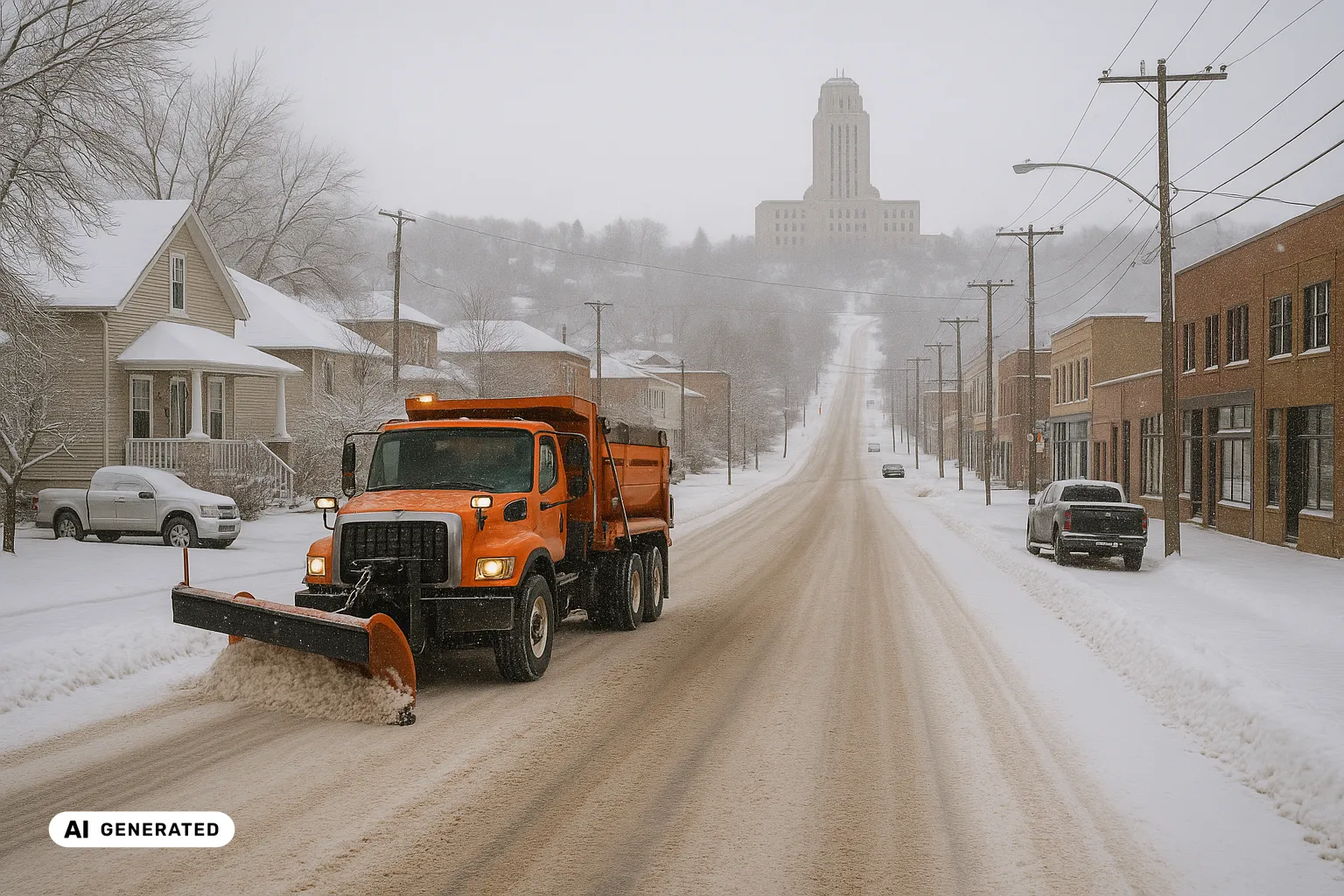
Same snow as Fargo. Different ground entirely.
The expectation about Bismarck is that it is the drier, colder, windier end of North Dakota — the western half, where the plains harden. The normals do not support any of that.
On the 1991–2020 normals Bismarck Municipal Airport records 50.5 inches of snow a season. Fargo, 300 kilometres east on the same table, records 51.4. Nine tenths of an inch apart — and Bismarck has more days with measurable snow, 44.6 to 41.8. Nor is it colder: Bismarck’s January daily mean is 12.8 °F against Fargo’s 8.6 °F, more than two degrees Celsius warmer. On wind, Fargo leads in every month of the same national table.
What is genuinely different is the ground under the snow.
Bismarck sits on the east bank of the Missouri at 1,745 feet. Fargo sits at 906. That is 839 feet — 256 metres — between two cities in one state. Fargo lies on the bed of glacial Lake Agassiz, which is why its page is about flatness and wind. Bismarck lies in the Missouri trench on the Coteau Slope, where the land rolls and the streets run up and down it.
You do not have to take that from a map. It is in the City’s own operating document. Bismarck’s Snow and Ice Control Plan opens its priorities with a category that a flat-country plan has no use for:
PRETREATMENT OF EMERGENCY ROUTES AND MAJOR ROUTES, BRIDGES, AND STEEP GRADE STREETS WITH LIQUID ANTI-ICING SOLUTION
Bridges, steep grades and intersections, treated before the storm. Fargo’s winter plan has no steep-grade category, because Fargo has no steep grades.
The pre-treatment decision is made from a forecast rather than from snow on the ground: staff analyze the National Weather Service predicted air temperature, dew point, relative humidity, predicted snow volume, wind speed, rain and freezing rain potential, and go out if conditions favour ice bonding to the road. That is anti-icing in the proper sense — getting a barrier down before the bond forms, rather than breaking it afterwards.
The season has its weight at the edges
The second real difference is distribution. The same seasonal total lands across more days, and it does not peak where you would expect.
On the monthly normals: December 10.1 inches, January 8.9, March 8.5, November 8.0, February 7.5. Read that order again — November and March both out-snow February. Bismarck’s winter is heaviest at its ends.
The storm record says the same thing more forcefully. The three best-documented events are 2–4 March 1966 (43 consecutive hours of blizzard conditions, gusting to 64 mph at the airport), 4–7 April 1997 (a further 17.5 inches with winds to 65 mph, pushing that season to 101.4 inches and setting the seasonal record that still stands) and 12–14 April 2022. All three are spring storms by the calendar.
And an average season is a poor description of any given one. Across 140 years of record the range runs from 13.6 inches to 101.6. The snowiest three seasons on the list are 1996–97, 2022–23 and 2008–09 — two of the three within living memory of anyone now running a route.
What matters more than the total: it does not thaw
Here is the number that shapes the work. Across a normal December, January and February, the daytime maximum fails to rise above freezing on about 57 of the 90 days.
Nothing melts off in between. What falls stays where it is put until a machine moves it, and what refreezes stays frozen. January’s mean high is 23.2 °F; the NWS record low for both January and February is −45 °F.
That is why Bismarck’s spreader is a sand truck. The City keeps a sand stockpile and states it strives
to obtain an eight percent (8%) salt content in this sand. The salt will keep the sand from freezing so it can be loaded and spread more efficiently.
Read what that says: the salt’s stated job in the mix is to keep the pile workable, not to melt the road. Rock salt is stockpiled separately, “for application as conditions warrant its use”. For much of a Bismarck winter the realistic goal is traction, not melting — the same physics that puts beet juice on the trucks in Rockford, answered with a different tool.
The sanding operation is staffed for it: 14 truck sanders, a two-person crew reporting at midnight through the winter, and someone reachable around the clock with authority to call in whatever help is needed.
How the city gets plowed
Bismarck is divided into seven plowing sections, each worked by a motor grader, a loader and a sander truck — the grader being another quiet sign of the terrain.
The priorities are ordered, and each has a number attached:
- Priority 1 — snow emergency routes. The signed grid that keeps police, fire and ambulance able to reach every part of town. Plowing here generally starts once about 2 inches have accumulated.
- Priority 2 — school routes and major routes, plus the streets around fire stations, hospitals and other emergency services.
- Priority 3 — residential and downtown streets. Residential streets are generally plowed if four or more inches have fallen, and under most conditions cleared within 24 to 36 hours of the storm ending.
- Priority 4 — the sidewalks Public Works owns.
That four-inch figure is worth keeping separate from Fargo’s. In Fargo, four inches in a forecast is what legally defines a snow emergency. In Bismarck it is an operational trigger for sending plows down residential streets. Same number, entirely different function.
Downtown is handled by hauling rather than pushing. A front-end loader moves snow into the parking lanes, and — this is the part worth knowing if you have a business there — the City then encourages downtowners to clean their sidewalks at this time and move that snow into the parking lanes, where it sits until it is blown into trucks and hauled away. A timed, deliberate exception to the general rule against putting snow in the street.
The ordinance the citizens wrote
Every plow city has the same argument about the ridge of snow left across the end of a driveway. Bismarck settled it, and the settlement is in the code.
At the end of § 10-02-05:
The City of Bismarck shall use snow gates or other devices to prevent snow, in an amount that prevents usual access, from being plowed or placed into driveways or their openings to public streets. This section shall cover City employees and contract employees. Any additional costs caused by this ordinance shall be paid by the City Sales Tax of the City of Bismarck.
The amending note reads Ord. 5294, 06-13-00, Initiated Ordinance — the residents put it there themselves, and specified how to pay for it in the same breath.
The contrast with Rockford is exact. There the city answers the same complaint by pointing to more than 60,000 curb cuts and calling individual clearing cost prohibitive. Same problem, opposite resolution, both defensible — and a good illustration of why a local page has to be researched rather than templated.
There is one carve-out, and it is the one that catches people:
This ordinance shall not apply in the event of a snowfall of such magnitude that a snow emergency is declared.
Which is why the City states flatly, in its winter FAQ, that during an emergency snow gates will not be used. When the declaration comes, speed replaces courtesy.
The sidewalk rule, and the unusual thing in it
§ 10-03-04 puts the duty on the abutting owner:
1. The owner of any lot or parcel of land abutting any sidewalk shall: a. Keep the sidewalk clean and unobstructed at all times. b. Remove snow and ice within 24 hours after the snow falls or ice forms, and keep the sidewalk free of ice and snow. Sand may be used to make the area safe for pedestrian travel if removal of ice is impracticable.
Two things stand out.
First, the code and the City say the same thing. That sounds unremarkable until you have read a few of these: in Fargo the ordinance sets a daily 9 p.m. deadline while the City’s own guidance describes a 24-hour clock, and in Bangor the City has announced a winter parking policy the code has not caught up with. Bismarck’s two surfaces agree.
Second, and more interesting: the code permits sanding instead of clearing where removing ice is impracticable. For a city with 57 days of continuous frost in a normal winter, that is realism written into law rather than a loophole. It also creates a small documentation problem for anyone doing this commercially — “we sanded because the ice would not come off” is a defensible position, but only if somebody wrote down the conditions at the time.
The City adds one point the code text leaves implicit: the duty covers the crosswalk of corner lots. A corner property has the crossing to clear too.
Snow may not go the other way either. § 10-03-04(3): A person may not move, dump or deposit by any means any snow or ice accumulated on private property onto any public street, alley, or public right-of-way — with the narrow exception for posted street-cleaning areas that makes the downtown practice above lawful.
What happens if it does not get cleared: a lien, not a ticket
Bismarck’s answer to “and what if I don’t?” is unusual, and worth setting out because almost nowhere explains it.
The ordinance sends the consequence to state law: costs are assessed to the abutting property pursuant to Chapter 40-29, N.D.C.C. That chapter runs an annual cycle:
-
§ 40-29-18 — if snow and ice are not removed as the municipality’s ordinances require, they may be removed under the street commissioner’s direction and the expense charged against the abutting property. Annually, on or before May first, the commissioner files a list showing the amount charged against each lot.
-
§ 40-29-19 / § 40-29-20 — notice is published once a week for two consecutive weeks, the last not less than eight days before the hearing, and the governing body considers and confirms the list at its regular June meeting.
-
§ 40-29-21 — once confirmed, the assessment with interest and penalties
shall be and remain a permanent lien upon the property upon which the assessment is levied until the assessment is paid in full, and it shall have precedence over all other liens except general taxes.
So an uncleared sidewalk in January is not a citation. It is an entry on a list filed in May, confirmed in June, attaching to the property ahead of every other lien but the tax bill. This is a description of the published statute, not legal advice.
Snow emergencies: no threshold, 50 routes
Bismarck’s snow emergency is a judgement call written as one. § 10-02-03:
When the director of public works or designate determines on the basis of existing weather conditions or a forecast by the U.S. Weather Bureau that a snow emergency declaration is necessary it must be broadcast by local radio and television stations and announced in the official newspaper when feasible.
No number anywhere in it. The City describes the decision in practice as taken by the City Administrator with the Director of Public Works and the Chief of Police. And it ends the same way it begins — until terminated or modified by the director of public works by public announcement.
The prohibition is also narrower than Fargo’s city-wide sweep. It applies to designated snow emergency routes, of which § 10-02-01 names exactly 50, each required by § 10-02-02 to be signed at one sign per block or at least every 1,000 feet. The declaration lists the affected routes, or states that it covers all of them.
Once declared, it is illegal to stop or park on any affected route. A stalled vehicle buys its driver half an hour to arrange removal; a vehicle left in violation may be impounded by the police department. The code also carries an evidence rule that is rarer than it should be: proof that the vehicle was parked in violation and that the defendant was the registered owner gives rise to a rebuttable presumption that the owner parked it.
Beyond that, § 10-02-05 lets the director post streets for no parking and tow to clear them, buy goods and services outside the normal procurement rules, and hire temporary snow removal staff — each reportable to the City Commission afterwards.
When the city’s snow closes the state
One consequence Bismarck carries that no other North Dakota city does: it is the capital, and the North Dakota State Capitol — a 19-storey Art Deco tower, the tallest building in the state — sits on the rise north of downtown.
When the city declares a snow emergency, state government stops. After Bismarck declared one effective 7 p.m. on 12 April 2022, the Capitol and other state facilities in the Bismarck area stayed closed until 8 a.m. on the Thursday. The same happened on 10 November 2022 as travel conditions deteriorated across almost the whole state.
The river in winter
Bismarck’s river problem arrives in the middle of winter rather than after it.
On 29 February 2024 an ice jam near Fox Island and the mouth of the Heart River, just south of the city, pushed the Missouri to 14.92 feet, over the minor flood stage of 14.5. The Army Corps of Engineers cut releases from Garrison Dam from 25,000 to 22,000 cubic feet per second with a further reduction to 19,000 planned; the Governor issued an emergency order covering both Burleigh and Morton counties and activated the State Emergency Operations Plan; and the North Dakota National Guard flew a Blackhawk with a Bambi Bucket to drop 660 gallons of river water — around 5,000 pounds — onto the jam’s leading edge.
A regulated river, two counties, a helicopter, in February. Fargo’s river event is a spring melt; this is not the same problem at all.
Across the river, and around it
Mandan sits directly opposite on the west bank — a separate city in a different county, Morton rather than Burleigh, with its own public works and its own ordinances. Lincoln lies to the south-east in Burleigh County. The crossings between Bismarck and Mandan, including the Grant Marsh Bridge carrying I-94, are exactly the exposed decks the City’s plan pre-treats.
Everything on this page describes Bismarck. Cross the Missouri and the rules, the priorities and the phone number all change.
Recording a winter measured in judgement calls
What is distinctive about Bismarck’s rules, taken together, is how much of the winter runs on a decision rather than a number. Whether to pre-treat is a forecast call. Whether to declare a snow emergency is explicitly a call by named officials, with no inch threshold. Whether an owner may sand rather than clear turns on whether removal was impracticable — a judgement, made on a specific morning, about specific ice.
Judgement calls are exactly what nobody can reconstruct three months later, and in Bismarck the consequences do arrive three months later: the assessment list in May, the hearing in June.
Wintertrace is self-hosted software for recording winter service work — what was cleared or treated, when, by whom, with which material, with the weather conditions of the shift attached, producing a service record afterwards. It runs on your own hosting, without a subscription, and the data stays with you. For a contractor working sanded routes under a 24-hour rule on ground that includes graded streets and river bridges, the useful artefact is a timestamped record of the call that was made and the conditions it was made in.
A note on all of the above
This page is general information about winter service in Bismarck, North Dakota, drawn from the City’s published Snow and Ice Control Plan, its Code of Ordinances and the North Dakota Century Code as of August 2026. It is not a substitute for legal advice, and it does not state what applies to any particular property. Ordinances and operating plans are revised — check the City’s current pages and the code text before relying on anything here.
Local facts
- About 50.5 inches (128.3 cm) of snow falls in an average season at Bismarck Municipal Airport on the 1991–2020 normals, spread over roughly 44.6 days a year with measurable snowfall.Source
- The season's weight sits at the edges rather than the middle: November averages 8.0 inches and March 8.5, both ahead of February's 7.5. December leads with 10.1 and January follows with 8.9.Source
- Across a normal December, January and February, the temperature fails to rise above freezing on about 57 of the 90 days (18.7 + 21.2 + 17.0 on the NWS Bismarck monthly normals).Source
- January's daily mean is 12.8 °F (−10.7 °C), with a mean maximum of 23.2 °F and a mean minimum of 2.4 °F. The NWS records a monthly record low of −45 °F for both January and February.Source
- Bismarck sits on the east bank of the Missouri River in Burleigh County at 1,745 feet (532 m) — 839 feet above Fargo, at the other end of the same state.Source
- Seasonal totals across 140 years of record run from 13.6 to 101.6 inches. The three snowiest seasons are 1996–97 (101.6), 2022–23 (101.2) and 2008–09 (100.3).Source (PDF)
- The City's Snow and Ice Control Plan carries a pre-treatment category no flat-country plan needs: 'PRETREATMENT OF EMERGENCY ROUTES AND MAJOR ROUTES, BRIDGES, AND STEEP GRADE STREETS WITH LIQUID ANTI-ICING SOLUTION'.Source
- Pre-treatment is decided from a forecast rather than from snowfall: staff 'analyze the National Weather Service predicted air temperature, dew point, relative humidity, predicted snow volume, wind speed, rain and freezing rain potential'.Source
- The city is divided into seven plowing sections, each with a motor grader, a loader and a sander truck. Plowing of emergency routes generally starts at 2 inches of accumulation; residential streets are generally plowed at four or more inches and cleared within 24 to 36 hours of the storm ending.Source
- The spreader material is sand rather than salt: the City keeps a sand stockpile and 'strive[s] to obtain an eight percent (8%) salt content in this sand', the salt mainly keeping the pile loose enough to load and spread. It runs 14 truck sanders, with a two-person crew reporting at midnight through the winter.Source
- Under § 10-03-04 of the City Code the abutting owner must 'Remove snow and ice within 24 hours after the snow falls or ice forms' — and the same subsection allows that 'Sand may be used to make the area safe for pedestrian travel if removal of ice is impracticable.'Source
- The City adds that the duty includes 'the crosswalk of corner lots' — a corner property clears the crossing as well as the sidewalk.Source
- Cost recovery runs through state law on an annual cycle: under N.D.C.C. § 40-29-18 the street commissioner files the assessment list 'on or before May first', § 40-29-19 and § 40-29-20 put the hearing and confirmation at the June meeting, and § 40-29-21 makes the confirmed assessment 'a permanent lien upon the property … precedence over all other liens except general taxes'.Source (PDF)
- A snow emergency has no inch threshold. Under § 10-02-03 it rests on judgement: 'When the director of public works or designate determines on the basis of existing weather conditions or a forecast by the U.S. Weather Bureau that a snow emergency declaration is necessary…' — and it runs 'until terminated or modified by the director of public works by public announcement'.Source
- The parking prohibition is route-based rather than city-wide: § 10-02-01 designates exactly 50 numbered streets or portions of streets as snow emergency routes, and § 10-02-02 requires them signed at one sign per block or at least every 1,000 feet.Source
- A citizen-initiated ordinance (Ord. 5294, 13 June 2000) requires that the City 'shall use snow gates or other devices to prevent snow … from being plowed or placed into driveways', covering City and contract employees, funded from the City Sales Tax — and expressly not applying when a snow emergency is declared.Source
- The city's snow decisions reach the state government: after Bismarck declared a snow emergency effective 7 p.m. on 12 April 2022, the Capitol and other state facilities in the Bismarck area stayed closed until 8 a.m. Thursday.Source
- On 29 February 2024 an ice jam near Fox Island and the mouth of the Heart River pushed the Missouri to 14.92 feet. The Corps of Engineers cut Garrison Dam releases from 25,000 to 22,000 cfs, an emergency order covered Burleigh and Morton counties, and a National Guard Blackhawk dropped 660 gallons of river water on the jam's leading edge.Source
- The best-documented storms all fall late in the season: 43 consecutive hours of blizzard conditions on 2–4 March 1966, a further 17.5 inches on 4–7 April 1997 that set the standing seasonal record, and the blizzard of 12–14 April 2022.Source
Official contacts
City of Bismarck — Snow Removal
The Public Works hub for winter operations: plowing priorities, snow emergencies, snow gates and what residents are asked to do.
City of Bismarck — Sidewalks & Driveways
The City's statement of the 24-hour sidewalk duty and what happens if the work is not done.
City of Bismarck — Snow and Ice Control Plan (PDF)
The operational plan itself: anti-icing of bridges and steep grades, the four plowing priorities, the seven sections, the sand mix and the seasonal preparation checklist.
Bismarck Code of Ordinances — Title 10 (PDF)
The codified text: the 50 snow emergency routes (§ 10-02-01), the declaration (§ 10-02-03), the snow-gate requirement at the end of § 10-02-05, and the sidewalk duty (§ 10-03-04).
North Dakota Century Code, Chapter 40-29 — Sidewalks (PDF)
The state-law machinery behind the cost recovery: the May assessment list, the June hearing, and the lien priority in § 40-29-21.
National Weather Service, Bismarck — local climate records
The office covering Bismarck: monthly normals, the record extremes and the seasonal snowfall rankings back to 1886.
NDDOT — road conditions and winter travel information
State highway treatment, travel advisories and interstate closures on I-94 and US 83.
Common questions about winter service in Bismarck
- Does Bismarck get less snow than Fargo?
- Essentially no, and this is worth correcting because it is widely assumed. On the 1991–2020 normals Bismarck records 50.5 inches to Fargo's 51.4 — a difference of nine tenths of an inch, which is noise rather than a difference. Bismarck actually has more days with measurable snowfall, 44.6 against 41.8, and over the full period of record it comes out slightly ahead. Nor is it colder: Bismarck's January daily mean is 12.8 °F against Fargo's 8.6 °F. What separates the two cities is the ground. Bismarck sits at 1,745 feet in the Missouri River trench on the Coteau Slope; Fargo sits at 906 feet on the bed of a glacial lake, on what geologists describe as one of the flattest expanses on Earth. Same snow, different landform, and that changes the work.
- How long do I have to clear my sidewalk in Bismarck?
- Twenty-four hours. § 10-03-04 of the City Code requires the owner of any lot abutting a sidewalk to 'Remove snow and ice within 24 hours after the snow falls or ice forms, and keep the sidewalk free of ice and snow'. Unusually, the code and the City's public guidance say the same thing, which is not something you can assume elsewhere. The City adds one detail the code text does not spell out: the duty includes the crosswalk of corner lots, so a corner property has the crossing to clear as well. This is general information rather than legal advice — read the section for your own property.
- What if the ice will not come off?
- The code anticipates that, which is rare and sensible for a city where the temperature stays below freezing on roughly 57 days of a normal December-to-February. The same subsection continues: 'Sand may be used to make the area safe for pedestrian travel if removal of ice is impracticable.' So sanding is an accepted alternative where clearing is genuinely not achievable — not a general substitute for clearing, but a recognised answer to bonded ice. If you do winter service commercially, that distinction is worth recording at the time: what you found, and why sand was the treatment.
- What actually happens if the sidewalk does not get cleared?
- Not a ticket — an annual cycle that ends on the property's title. § 10-03-04(2) says the work may be done under direction of the director of public works or city engineer, with costs assessed to the abutting property 'pursuant to Chapter 40-29, N.D.C.C.'. That state chapter sets out the rest: under § 40-29-18 the street commissioner files a list of the amounts chargeable against each lot 'on or before May first'; §§ 40-29-19 and 40-29-20 put the notice and the hearing at the governing body's regular June meeting; and § 40-29-21 provides that the confirmed assessment 'shall be and remain a permanent lien upon the property … until the assessment is paid in full, and it shall have precedence over all other liens except general taxes'. So the winter's uncleared sidewalk becomes a spring assessment and then a lien ranking behind only general taxes. Not legal advice — the chapter is linked above and it is short.
- How does a snow emergency get declared here?
- By judgement, not by a number — which is the sharpest contrast with Fargo, where the code fixes it at a forecast of four or more inches. Bismarck's § 10-02-03 reads: 'When the director of public works or designate determines on the basis of existing weather conditions or a forecast by the U.S. Weather Bureau that a snow emergency declaration is necessary it must be broadcast by local radio and television stations and announced in the official newspaper when feasible.' The City describes the decision as taken by the City Administrator together with the Director of Public Works and the Chief of Police. It stays in effect 'until terminated or modified by the director of public works by public announcement' — again, no fixed end. So there is no inch count to watch: you watch the announcement.
- Where can't I park during a snow emergency?
- On the designated snow emergency routes named in the declaration — and only those, unless the declaration states it applies to all of them. This is route-based rather than city-wide: § 10-02-01 lists exactly 50 numbered streets or portions of streets, and § 10-02-02 requires them to be signed 'at intervals of one per block or at least one sign each 1000 feet', so the signage is the practical guide. Once declared, 'it is illegal to stop or park on any affected route'; a stalled vehicle gives its driver half an hour to arrange removal, and a vehicle left in violation 'may be impounded by the police department'. The code also carries an evidence rule: proof that the vehicle was parked in violation and that the defendant was its registered owner 'gives rise to a rebuttable presumption' that the owner parked it.
- Is it true the city has to keep the plow out of my driveway?
- Yes, and the provenance is the interesting part. At the end of § 10-02-05 the code states that the City 'shall use snow gates or other devices to prevent snow, in an amount that prevents usual access, from being plowed or placed into driveways or their openings to public streets', that this covers City and contract employees alike, and that any additional costs 'shall be paid by the City Sales Tax'. The amending note records it as Ord. 5294 of 13 June 2000, an Initiated Ordinance — meaning the citizens put it there. There is one carve-out, and it is the one that matters: the section 'shall not apply in the event of a snowfall of such magnitude that a snow emergency is declared'. Which is why the City states plainly during an emergency that snow gates will not be used. Worth comparing with how the same complaint is answered in Rockford, where the city cites more than 60,000 curb cuts and calls clearing them cost prohibitive — same problem, opposite settlement.
- Why sand rather than salt?
- Because of what the temperature does to salt's usefulness, and Bismarck's plan reflects it. The City keeps a sand stockpile mixed with salt, and states it strives 'to obtain an eight percent (8%) salt content in this sand' — with the salt's stated job being to keep the sand from freezing so it loads and spreads efficiently, rather than to melt the road. Salt is stockpiled separately 'for application as conditions warrant its use'. In a city where the daytime high stays below freezing for the better part of three months, the realistic goal for much of the winter is traction rather than melting. The fleet reflects that too: 14 truck sanders, with a two-person crew reporting at midnight through the winter and someone on call around the clock.
- What gets plowed first, and when will my street be done?
- The city is divided into seven plowing sections, each worked by a motor grader, a loader and a sander truck. Priority 1 is the snow emergency route network — the grid that keeps police, fire and ambulance moving — and plowing there generally starts once about 2 inches have accumulated. Priority 2 is school routes and major routes, including the streets around fire stations and hospitals. Priority 3 is residential and downtown streets: the City generally plows residential streets 'if four or more inches of snow have fallen', and under most conditions clears them 'within 24-36 hours after the end of the storm'. Note that the four inches here is an operational trigger for plowing, not a legal threshold — unlike Fargo, where the same number is what defines a snow emergency.
- How is downtown handled differently?
- Downtown snow is hauled away rather than pushed aside, and the sequence is worth knowing if you have a business there. As the plows move into residential areas, a front-end loader with a plow moves downtown and pushes snow into the parking lanes. The City then explicitly encourages downtown occupants to clear their sidewalks at that point and move the snow into the parking lanes too, where it stays 'until the snow is loaded into trucks with a snow blower and hauled away'. That is a deliberate, timed exception to the general rule against putting snow in the street — so it is worth doing it when the loader has been through, not before.
- Does the Missouri cause winter problems as well?
- It does, and in a way that has no counterpart in the Red River Valley. Fargo's river problem is the spring melt of a north-flowing river; Bismarck's is an ice jam in the middle of winter on a river regulated by a dam upstream. On 29 February 2024 a jam near Fox Island and the mouth of the Heart River pushed the Missouri to 14.92 feet. The Army Corps of Engineers cut releases from Garrison Dam from 25,000 to 22,000 cubic feet per second with a further reduction planned, the Governor issued an emergency order covering both Burleigh and Morton counties, and the National Guard flew a Blackhawk with a Bambi Bucket to drop 660 gallons of river water — around 5,000 pounds — on the leading edge of the jam.
- When is the worst of the winter here?
- Later than most people expect, and the numbers and the storm record agree. On the monthly normals November (8.0 inches) and March (8.5) both out-snow February (7.5); the season's weight sits at its edges. The three best-documented storms are all late: 43 consecutive hours of blizzard conditions on 2–4 March 1966; 4–7 April 1997, when a further 17.5 inches with winds to 65 mph pushed that season to 101.4 inches and set the seasonal record that still stands; and 12–14 April 2022, the blizzard that closed the Capitol. If you contract winter service in Bismarck, an April storm is not an outlier to be surprised by.
Documenting winter service in Bismarck
Anyone clearing snow and ice in Bismarck may later need to show when and where a route was treated. Wintertrace is open-source software that records exactly that — time, location and weather for each run — as a calm basis for your own operational records and service proof. It is not a substitute for legal advice.
This overview is for general information and is not legal advice. Local rules on snow and ice clearing vary — the wording of the local rule and the responsible authority always govern.