Winter service · Washington
Winter service in Spokane
What winter is really like in Spokane, Washington: 45.4 inches a season on the dry side of the Cascades, roughly seven times Seattle's, and snow lying on the ground about 48 days a year. The ordinance says 'free and clear' and sets no clock at all; the 9 a.m. everyone quotes is a request. And the city picks its de-icer around a sole-source aquifer with no protective layer above it.
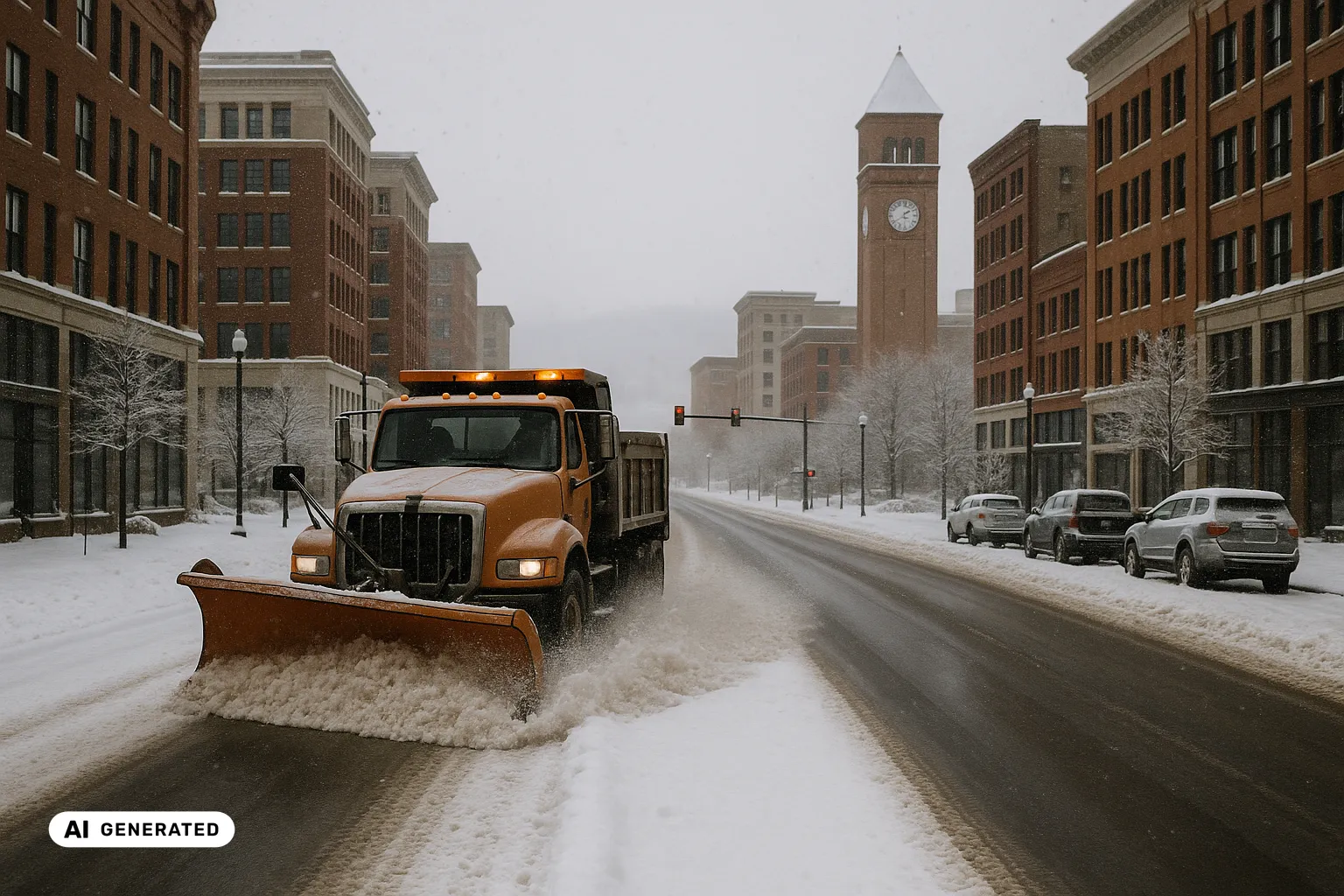
Two Washingtons, and this is the other one
Say “Washington” to someone who has never been, and they picture rain. Spokane is 229 miles east of Seattle, on the far side of the Cascades, at 1,843 feet — and on the 1991–2020 normals it averages 45.4 inches of snow a year against Seattle’s 6.3. Roughly seven times as much. Yakima, also east of the mountains but lower and drier, manages 20.3. Spokane is the snowiest large city in the state, and it is not close.
The city sits on the Spokane Valley outwash plains where the Columbia Plateau gives way to the northern Rockies, 18 miles west of the Idaho line. The Spokane River runs out of Lake Coeur d’Alene, cuts through the middle of downtown in a basalt gorge and carries on to the Columbia. Ground level inside the city limits ranges from about 1,608 feet at the river in Riverside State Park to 2,591 feet up in the north-east — nearly a thousand feet of relief without leaving town, in a dry-summer continental climate that is rainless in July and unambiguously continental in January.
What matters is not the depth, it is the persistence
Forty-five inches is a respectable but not remarkable total. The number that describes the work is a different one: snow lies on the ground in Spokane about 48 days a year. Twenty-eight of those days it is three inches or more, and on 17.5 of them five inches or more. Winter service here is not a sequence of storms with clear ground in between; it is a season spent managing a standing snowpack.
The season is compressed. December and January together carry 26.1 of the 45.4 inches — 58 %, with November and March supplying most of the rest and the shoulders very nearly empty.
The temperatures explain what happens on the surface. January’s mean is 29.6 °F (−1.3 °C) and its mean daily maximum 34.5 °F (1.4 °C). Spokane hovers around freezing rather than sitting below it: about 132 nights a year drop to 32 °F or lower, but only about two reach 0 °F. That is a very different problem from Fargo or Bismarck, where deep cold locks the surface in place for weeks. Around the freezing point, the same snow melts and refreezes repeatedly, and ice is a daily rather than an occasional matter.
Year to year the spread is wide. The NWS office here has run the numbers on La Niña winters: they average 59.0 inches against the 45.4-inch normal and five have exceeded 80 — but 1967/68 and 1970/71 delivered only 30 to 32 under the same signal, which the office sums up as “not a guarantee”.
The rule everyone quotes has no clock in it
Here is the part worth reading slowly, because the internet has it wrong.
Spokane Municipal Code 12.02.010, “Snow Removal – Owner, Occupant Duties”, says:
“Owners and occupants of premises shall keep the sidewalk areas adjacent to any portion of the real property (including corners) free and clear of snow and/or accumulations of snow or ice.”
That is the duty, in full. There is no deadline in it. No time of day, no number of hours after the snow stops, no depth that triggers it. The obligation is phrased as a standing condition — keep it clear — rather than as a countdown. The section was passed on 13 February 2012 and has not acquired a clock since.
The “9 a.m.” that dominates search results comes from the City’s own winter pages, and the City is careful about how it puts it: it “asks the community to clear a 36-inch path to allow pedestrians to travel effectively, with a goal of completion by 9 a.m. after a snowfall.” Both words matter. Asks, and goal. It is the City’s statement of what good practice looks like, and it is a reasonable target to work to — but it is not a deadline in the ordinance, and it is not what you would be measured against. The City also asks that ADA ramps be cleared, and that a walking path be opened even where no sidewalk exists.
An older document confuses this further. A City FAQ dated December 2013 is still easy to find and describes a different regime altogether — “clear sidewalks of snow within 24 hours”, a two-inch trigger, and Stage 1 and Stage 2 snow events. None of it appears in the snow response plans from 2020 onwards. If you find the 24-hour figure quoted somewhere, that is where it came from.
There is one further wrinkle. On the same winter page the City cites two different code sections for the sidewalk obligation: 12.02.010 in one place, and 12.01.010 in the FAQ and the parking summary. The second is a different animal — headed “Sidewalk Maintenance – Owner’s Responsibility”, it requires the sidewalk be kept “in good and safe condition and repair at all times”, and it carries the enforcement route: after written notice, the Director of Engineering Services may remove or repair the condition “at the owner’s and/or occupant’s sole expense and liability”. It was passed on 9 February 2026, so it is newer than most of what is written about Spokane. Which section governs a particular situation is not a question this page can answer; both are linked below, and both are short.
Alongside that, the City states on the same page that “liability issues rest with the adjacent property owner, not the City”. That is the City’s characterisation, quoted here as such.
What happens if the walk stays covered
Not very much, most of the time — and that is a more useful thing to know than the theoretical maximum.
Chapter 12.02 carries no penalty of its own, so the code’s general penalty provision applies in the abstract. But reporting from November 2020 describes how the system actually runs: the city does not patrol for uncleared sidewalks. A complaint through 311 generates an advisory postcard to the owner, and someone goes back to look only “unless we’re really hearing a lot about it”. In the season before that reporting, 41 postcards went out and no citation had been issued in several years, on a stated approach of “always trying to get voluntary compliance.”
Read that in both directions. The duty exists, and so does the exposure that comes with an icy walk; neither depends on whether a citation is likely. What is absent is the enforcement machine that would otherwise set the tempo.
Where the snow is allowed to go
Most cities tell you where snow may not go. Spokane also tells you where it may.
The code prohibits pushing snow from private premises into the street or public right of way — the City’s brochure puts it as “Please DO NOT push or throw snow into the streets”. But the same section continues: snow from sidewalks and driveway approaches “may be placed in planting strips, or added to berms created by municipal plowing operations”, provided it does not obstruct a clear view of stop signs or signals or otherwise create a hazard. Adding your shovelled snow to the berm the plow already left is expressly allowed.
That section is also unusual in naming commercial operators outright: its scope runs through homeowners of single-family homes, duplexes and triplexes, then “persons in business of plowing or clearing snow”, then business, commercial and multiunit premises. Contractors written into the text as their own category, rather than into a guidance note, is rare enough to flag.
Four inches, three days, nineteen gates
Winter operations run 15 November to 15 March. Through the season, street crews switch to 10-hour shifts covering 20 hours a day, seven days a week, with weather watched continuously.
A couple of inches brings a maintenance plow on regular weekday day shifts: arterials first, then hills in residential areas, then identified vehicle routes around schools and medical facilities. At four inches or more, the department moves to 24/7 operations for a Full-City Plow — roughly 2,100 lane miles, completed in about three days. A 2017 release, the only one to break the network down, put 760 of those miles in the arterial classes; roughly a third being arterial is why priority routes run in hours while the whole city takes days.
Two details make the residential wait fairer than it first appears. The first residential area to be plowed is rotated each time the City plows, so the same neighbourhood is not perpetually last, and hill areas are always plowed before flat ones. Cul-de-sacs are handled separately, with different equipment, so they will not follow the published route order.
The most visible piece of equipment, from a driveway, is the snow gate. The City runs 19 of them, up from 17 in the 2021/22 season; they let a driver avoid dropping a berm across a driveway entrance. The City does not oversell them — they “don’t completely eliminate driveway berms”, particularly on arterials, and arterial plowing does not use gates at all.
Parking is part of the plowing plan rather than separate from it. Residents are asked to park on the odd-numbered side of the street for the whole season, and the stated reason is about sidewalks: one clear side lets plows move away from the kerb, “reducing the amount of snow and ice that ends up on sidewalks”. Downtown is stricter — no on-street parking midnight to 6 a.m. on snowy days in the strip “Maple to Division and I-90 to the Spokane River”. That boundary is itself topography: a river bend north, a freeway south, and no spare ground between them to put snow.
The de-icer question is a water question
This is the part of Spokane’s winter that exists nowhere else in quite this form.
Spokane and Coeur d’Alene draw all of their drinking water from the Spokane Valley–Rathdrum Prairie Aquifer, which the US EPA designated a Sole Source Aquifer in 1978 — meaning there is no other economically feasible source. The geology offers no protection: there is no known layer of rock, silt or clay to slow percolation from the surface, and in places groundwater moves faster than 50 feet a day. What goes on the ground here reaches the water quickly, and spreads.
The city has acted on that repeatedly. In 2014 it barred its own departments from knowingly purchasing products containing PCBs; in 2015 it sued Monsanto over PCB contamination of the Spokane River. When it tested de-icing products in 2016 the results were uncomfortable: magnesium chloride came out cleanest at about 0.0004 ppb against rock salt’s 0.025, but the city’s own surface water standard is 0.00017 ppb — below even the best option available. It “doesn’t quite reach the levels we require if you’re testing the water, but it’s the lowest out of all the options,” the council president said at the time. The city stayed with magnesium chloride.
The operational consequence is the thing to take away. Crews treat arterial streets and bridges with liquid de-icers, salt and sand mixtures, using liquid down to around 15 °F and granular salt below that, with sand for traction on grades. On flat residential streets they treat nothing: “But flat residential areas, we’re not putting de-icer down.”
That is the gap in which private winter service in Spokane operates. On a flat residential block, the traction on the surface is whatever the property owner or their contractor put there.
Ice is the worse half of the story
The most destructive winter event in the city’s modern record involved almost no plowing. On 19 November 1996 up to four inches of snow was followed by freezing rain, leaving as much as 1.5 inches of ice on trees, roads and power lines. Around 100,000 homes and businesses across Spokane and Kootenai County lost power, some for up to two weeks, and four people died; the National Weather Service lists it among Washington’s top 25 weather events of the twentieth century.
For snow, the benchmark is December 2008: 61.5 inches in 20 days, the snowiest month since records began, including 19.4 inches in 24 hours on 17–18 December. The calendar year total of 132.6 inches still leads the series.
The two ask for opposite things. One is a plowing problem; the other cannot be plowed at all, and turns entirely on treatment, access and knowing what was done when.
One pattern worth knowing: Spokane’s characteristic cold-season condition is temperature inversion, not the warm downslope wind some accounts attribute to it. Cold air pools on the valley floors under winter high pressure, which tends to hold frost and damp longer at river level than up on the hills.
Cross a city line and the rules change
The Spokane area is unusually good at demonstrating that these rules are local. Within about twenty miles of downtown there are four different answers to “must I shovel?” — and one of them is in a different state.
Spokane Valley, incorporated in 2003 and sharing a continuous urban fabric with Spokane, took the opposite approach on every axis. Its duty applies only to owners in Tier I priority areas — designated safe routes to schools, plus commercial, retail and industrial zones — only to accumulations exceeding three inches, and then within a hard 48 hours after the event stops, clearing a minimum 36-inch path. Violations are civil infractions on an escalating scale. But it also has what Spokane has no need for: a codified amnesty, which the city manager may announce with public notice when immediate removal is impracticable, stating the circumstances and the exact date and time it ends; and a defence for a resident aged 65 or over, or with a doctor-verified physical disability, who can show documented but unsuccessful efforts to obtain snow removal services. Its street operation is proportionally smaller — 646 lane miles, about 48 hours for a full residential plow — and its contracted graders, the city says, “do not own graders with gates”.
One city with no deadline and no formal exceptions, relying on voluntary compliance; the next one over with a hard deadline, a threshold, an escape valve and a written defence. Same weather, adjoining streets.
Coeur d’Alene, in Idaho, requires clearing “within a reasonable time after a snowfall, considering all the circumstances” — like Spokane, no clock — but backs it far harder, with citations escalating to a misdemeanour and cost recovery secured by a lien on the property. It also requires something Spokane’s code does not: where snow or ice is so compacted that removing it would damage the sidewalk, the owner must apply sand or other traction material instead.
Cheney, south-west of the city, appears in the state municipal research centre’s statewide overview only for its prohibition on dumping snow in public space — no sidewalk deadline is listed there. What it has instead is an automatic parking ban: each time two or more inches accumulate on public streets, and for as long as that snow remains uncleared, parking in the street and right of way is prohibited, with impoundment at the owner’s cost. Nobody has to declare it; the snow itself triggers it.
Immediately outside the city, Spokane County runs Washington’s largest county road system at more than 5,100 lane miles, graded into four priorities. The fourth is called “Not Plowed” — for a property just beyond the line, the single most important category on this page.
Where the grades are
Spokane’s relief is real but concentrated. The South Hill, the Victorian-era districts rising immediately south of downtown, is where slick mornings show up first — which is why the City plows residential hills before flat ones. To the west the West Hills climb from around 1,800–1,900 feet to about 2,300 feet, with I-90 crossing Sunset Hill, where a jackknifed truck at the top of the grade is a recurring way for the morning commute to stop. Latah Valley drops from about 1,900 to 1,720 feet where Latah Creek meets the river. The best-known named climb, Doomsday Hill on Pettet Drive, gains 120 feet in under three-quarters of a mile — famous as the hard part of the Bloomsday road race rather than for being exceptionally steep. Bridges are a treatment category of their own, named in the plan alongside arterials.
Keeping a record where the city asks rather than orders
Spokane is an unusual place to document winter work, because so little of it is prescribed. There is no clock in the ordinance to work back from, enforcement is complaint-driven and rarely formal, and on flat residential streets the city treats nothing at all — so whatever traction exists there came from an owner or a contractor. Each of those gaps is filled by somebody’s records, or by nobody’s.
Wintertrace is self-hosted software for recording winter service work: which site was cleared, when, by whom, what material went down and how much of it, with the weather conditions of the shift captured automatically and a service record you can produce months later. It runs on your own web hosting, without a subscription, and the data stays with you.
Where a duty is a standing condition rather than a deadline, the question after an incident is not “were you inside the window” but “what was the state of this walk, and when was it last attended to”. That is a question about records. And in a city that has spent a decade choosing its de-icer by what it does to the aquifer, being able to show what went down, where and at what rate is worth having on both sides of the conversation.
A note on all of the above
This page is general information about winter service in Spokane, Washington, drawn from the City’s published material and the Spokane Municipal Code as of September 2026. It is not a substitute for legal advice, and it is not a statement of what applies to any particular property. Two code sections are cited by the City for the sidewalk obligation, one of them adopted in February 2026, and operational figures such as lane miles and gate counts change between seasons — so check the City’s current pages and the ordinance text before relying on anything here.
Local facts
- About 45.4 inches (115 cm) of snow falls in an average season at Spokane International Airport on the 1991–2020 normals, over roughly 34.7 days with measurable snowfall. December and January carry 26.1 of those inches between them — 58 % of the season.Source
- That is roughly seven times Seattle's 6.3 inches on the same normals, and more than twice Yakima's 20.3. Spokane is the snowiest large city in Washington.Source
- The more useful figure is how long it stays: about 48 days a year with at least an inch of snow on the ground, 27.8 days with three inches or more, and 17.5 with five or more.Source
- January's mean is 29.6 °F (−1.3 °C) with a mean daily maximum of 34.5 °F (1.4 °C) — Spokane sits around the freezing point rather than below it, which is the range that produces the most freeze–thaw. About 132 nights a year fall to 32 °F or lower, but only about two reach 0 °F.Source
- Spokane Municipal Code 12.02.010 requires owners and occupants to keep adjacent sidewalks 'free and clear of snow and/or accumulations of snow or ice'. It sets no deadline, no time of day and no depth threshold. Passed 13 February 2012, ORD C34832.Source
- The 9 a.m. figure that circulates is not in the code. The City's own wording is that it 'asks the community to clear a 36-inch path to allow pedestrians to travel effectively, with a goal of completion by 9 a.m. after a snowfall'.Source
- The same ordinance names commercial operators as their own category. Its limits on where snow may be put apply to 'homeowners of single family residences, duplexes or triplexes', to 'persons in business of plowing or clearing snow', and to business, commercial and multiunit premises.Source
- Snow may not be pushed into the street or the public right of way, but the code does say where it may go: snow from sidewalks and driveway approaches 'may be placed in planting strips, or added to berms created by municipal plowing operations', provided it does not block the view of stop signs or signals.Source
- The City's winter pages cite a second section for the same duty — SMC 12.01.010, 'Sidewalk Maintenance – Owner's Responsibility', which requires sidewalks be kept 'in good and safe condition and repair at all times' and lets the Director of Engineering Services act at the owner's expense after written notice. It was passed on 9 February 2026, ORD C36835.Source
- Enforcement is complaint-driven rather than patrolled. A 311 complaint triggers a postcard to the owner; the city reported 41 postcards in the previous season and no citation issued for several years, on a stated policy of 'always trying to get voluntary compliance'.Source
- A snowfall of a couple of inches brings a 'maintenance plow' on regular weekday day shifts. At four inches or more the Street Department moves to 24/7 operations for a Full-City Plow, which takes about three days across roughly 2,100 lane miles.Source
- Arterials go first, then hills in residential areas, then identified routes around schools and medical facilities. Which residential area is plowed first is rotated each time, though hill areas are always plowed before flat ones, and cul-de-sacs are worked separately because they need different equipment.Source
- The fleet carries 19 'snow gates' that let drivers avoid leaving a berm across a driveway, up from 17 in 2021/22. They are not used on arterial routes, and the City says plainly that they do not eliminate driveway berms.Source
- Residents are asked to park on the odd-numbered side of the street for the whole snow season, 15 November to 15 March. The stated reason is that it lets plows move away from the kerb, 'reducing the amount of snow and ice that ends up on sidewalks'.Source
- Downtown, on-street parking is prohibited from midnight to 6 a.m. on snowy days so parking bays can be cleared. The zone is 'Maple to Division and I-90 to the Spokane River' — a strip closed in by a river bend to the north and a freeway to the south.Source
- The Spokane Valley–Rathdrum Prairie Aquifer supplies the entire drinking water of the Spokane and Coeur d'Alene areas and was designated a Sole Source Aquifer by the US EPA in 1978. There is no protective rock or clay layer above it, and in places groundwater moves faster than 50 feet a day.Source
- In 2014 the city barred its departments from knowingly purchasing products containing PCBs, and in 2015 it sued Monsanto over PCB contamination of the Spokane River. Testing in 2016 found magnesium chloride the cleanest de-icer at about 0.0004 ppb against rock salt's 0.025 — still above the city's own surface water standard of 0.00017 ppb.Source
- Crews treat arterial streets and bridges with liquid de-icers plus salt and sand mixtures. On flat residential streets they treat nothing at all — a City spokeswoman put it as 'But flat residential areas, we're not putting de-icer down.'Source
- December 2008 brought 61.5 inches in 20 days, the snowiest month since records began, including 19.4 inches in 24 hours on 17–18 December. The calendar year 2008 total of 132.6 inches is the highest in the NWS Spokane series.Source
- La Niña winters average 59.0 inches in Spokane against the 45.4-inch normal, and five of them have exceeded 80 inches — but 1967/68 and 1970/71 delivered only 30 to 32. The NWS calls it 'not a guarantee'.Source
- The city's worst modern winter event was not snow. On 19 November 1996 freezing rain left up to 1.5 inches of ice, cutting power to around 100,000 homes and businesses in Spokane and Kootenai County, some for up to two weeks.Source
- Across the city line the rule changes completely. Spokane Valley requires clearing only in Tier I priority areas, only above three inches, and then within 48 hours — with a codified amnesty the city manager can declare and a defence for residents aged 65 or over.Source
- Spokane County's road system runs to more than 5,100 lane miles — the largest in Washington — and grades its network in four priorities, of which the fourth is 'Not Plowed'.Source
Official contacts
City of Spokane — Snow Removal
The Street Department's winter hub: plowing procedures, the four-inch trigger, parking rules, the sidewalk request and the plow progress map.
Spokane Municipal Code 12.02.010 — Snow Removal, Owner and Occupant Duties
The sidewalk clearing duty in full, including who it binds and where cleared snow may legally be placed. Short enough to read in a minute.
Spokane Municipal Code 12.01.010 — Sidewalk Maintenance, Owner's Responsibility
The second section the City cites on its winter pages: condition and repair, written notice, and work carried out at the owner's expense.
City of Spokane — Code Enforcement, snow removal topic
Who the rule applies to and who it does not, in the city's own summary.
The route for reporting a snow or ice concern and for parking restriction notices. There is no separate snow information office.
City of Spokane Valley — Sidewalk Snow Removal
The neighbouring city's very different rule: priority areas only, a three-inch threshold and a 48-hour deadline.
Spokane County — Winter Roads Maintenance
For property outside the city limits: 5,100+ lane miles, four priority levels, and what the fourth one means.
Common questions about winter service in Spokane
- When exactly does a Spokane sidewalk have to be clear?
- The ordinance does not say. SMC 12.02.010 requires owners and occupants to keep the adjacent sidewalk 'free and clear of snow and/or accumulations of snow or ice', and that is the whole of the obligation — no hours, no time of day, no depth that triggers it. It reads as a standing condition rather than a countdown, which makes it unusual: Madison works to noon the following day, Spokane Valley next door to 48 hours. The 9 a.m. that turns up in search results is the City asking, not the code requiring.
- So where does the 9 a.m. come from, and does it bind me?
- From the City's own winter pages, and it is phrased as a request throughout: the City 'asks the community to clear a 36-inch path to allow pedestrians to travel effectively, with a goal of completion by 9 a.m. after a snowfall'. Both the verb and the noun are worth reading carefully — 'asks' and 'goal'. It is the City's stated expectation of what good practice looks like, and it is a sensible target, but it is not a deadline written into the ordinance. The City also asks that ADA ramps be cleared and that a walking path be opened even where no sidewalk exists. An older FAQ document from 2013 saying 'within 24 hours' and naming a two-inch trigger is still findable online; that system does not appear in the snow response plans from 2020 onwards.
- Why does the City cite two different code sections for the same thing?
- Both appear on its winter pages, in different places. The snow duty proper is SMC 12.02.010, headed 'Snow Removal – Owner, Occupant Duties'. Elsewhere on the same page the City cites SMC 12.01.010, which is headed 'Sidewalk Maintenance – Owner's Responsibility' and requires the sidewalk be kept 'in good and safe condition and repair at all times'. That second section sits in the chapter on maintaining public ways, carries the enforcement route — written notice, then the Director of Engineering Services may act at the owner's expense — and was newly passed on 9 February 2026. Which one governs a given situation is not something this page can answer for you; both are linked below, and the ordinance text is short enough to read.
- What actually happens if a sidewalk stays covered?
- In practice, a postcard. Chapter 12.02 carries no penalty of its own, so the general penalty section applies in the abstract, but that is not how the city works. Reporting from 2020 describes a complaint-driven system: the city does not patrol for uncleared walks, a 311 complaint generates an advisory postcard to the property, and follow-up happens only 'unless we're really hearing a lot about it'. In the season before that reporting, 41 postcards went out and no citation had been issued in several years. The stated aim is voluntary compliance. That is worth knowing in both directions — the duty is real and the liability exposure is real, but enforcement is not the mechanism driving it.
- Where am I allowed to put the snow I clear?
- Not in the street or the public right of way — that much is explicit. But unlike many cities, Spokane's code also says where snow may go: snow from sidewalks and driveway approaches 'may be placed in planting strips, or added to berms created by municipal plowing operations', as long as it does not obstruct a clear view of stop signs, other traffic signs or signals, or otherwise create a hazard. Adding to the berm the plow already left is expressly permitted, which is a genuinely useful thing to know before you start.
- I run a snow removal business here. Does the ordinance treat me differently?
- It names you. The section listing who the placement rules bind runs through homeowners of single-family homes, duplexes and triplexes; then 'persons in business of plowing or clearing snow'; then business, commercial and multiunit premises. Commercial operators being called out as their own category, in the text rather than in a guidance note, is not common. In practice it means the same limits on pushing snow into the right of way apply to your work as to a homeowner with a shovel, and the permitted alternatives — planting strips, existing berms — apply too.
- When will my street get plowed?
- It depends on the depth, and on which quadrant's turn it is. A couple of inches brings a maintenance plow on regular weekday day shifts: arterials first, then hills in residential areas, then identified routes around schools and medical facilities. Four inches or more moves the department to round-the-clock operations for a Full-City Plow, which covers roughly 2,100 lane miles in about three days. Two details make the wait fairer than it looks: the first residential area to be plowed is rotated each time, and hill areas always go before flat ones. Cul-de-sacs are worked separately because they need different equipment, so they will not track the published route order.
- Will the plow leave a berm across my driveway?
- Less often than it used to, but yes, sometimes. The City runs 19 snow gates — up from 17 in 2021/22 — which let a driver avoid depositing a berm at a driveway entrance. They are not used on arterial plowing, and the City is direct that they do not eliminate driveway berms, particularly for people living on arterials that get plowed more often. Across the line in Spokane Valley the situation is different again: the city says its contracted graders 'do not own graders with gates', and that lifting blades at driveways 'would significantly delay completion of plowing'.
- Which side of the street do I park on?
- The odd-numbered side, for the whole snow season from 15 November to 15 March. The reasoning is worth following, because it connects directly to the shovelling: with one side kept clear, drivers can pull away from the kerb, which reduces the amount of snow thrown onto the sidewalk that the property owner then has to clear. Downtown is separate — on snowy days, on-street parking is prohibited from midnight to 6 a.m. between Maple and Division, and between I-90 and the river, so the parking bays can be cleared. Under the ordinance covering parking during street work, a prohibition takes effect after public notice by press, radio, television or other notice to the neighbourhood.
- Why does so little get salted on my street?
- Because of what is underneath the city. Spokane and Coeur d'Alene draw all of their drinking water from the Spokane Valley–Rathdrum Prairie Aquifer, designated a Sole Source Aquifer by the EPA in 1978, with no protective rock or clay layer above it and groundwater moving faster than 50 feet a day in places. The city barred itself from knowingly buying PCB-containing products in 2014 and sued Monsanto over PCBs in the river in 2015; when it tested de-icers in 2016 the cleanest option still came in above its own surface water standard. The operational result, in a spokeswoman's words, is that treatment goes on arterials, bridges and hills — 'But flat residential areas, we're not putting de-icer down.' If you need traction on a flat residential street, you are making it yourself.
- Is Spokane's winter like Seattle's?
- No, and the gap is larger than most people outside the state expect. On the same 1991–2020 normals Spokane averages 45.4 inches of snow a year to Seattle's 6.3 — roughly seven times as much — and more than twice Yakima's 20.3. Spokane sits at 1,843 feet on the dry, continental side of the Cascades, with a warm-summer humid continental climate. The practical difference is not only the total but the persistence: snow lies on the ground here about 48 days a year, so winter service works against a standing snowpack rather than against isolated events.
- What is the worst that winter does here?
- Historically, ice rather than snow. On 19 November 1996 up to four inches of snow was followed by freezing rain that left as much as 1.5 inches of ice on trees, roads and power lines; around 100,000 homes and businesses across Spokane and Kootenai County lost power, some for up to two weeks, and four people died. For snow, the benchmark is December 2008 — 61.5 inches in 20 days, the snowiest month on record, including 19.4 inches in a single 24-hour period. Both matter for planning, but they ask for different things: a plow is no use against an inch and a half of ice.
Documenting winter service in Spokane
Anyone clearing snow and ice in Spokane may later need to show when and where a route was treated. Wintertrace is open-source software that records exactly that — time, location and weather for each run — as a calm basis for your own operational records and service proof. It is not a substitute for legal advice.
This overview is for general information and is not legal advice. Local rules on snow and ice clearing vary — the wording of the local rule and the responsible authority always govern.