Winter service · North Dakota
Winter service in Fargo
What winter is really like in Fargo: about 51 inches of snow a year at Hector International, on land the geologists call one of the flattest expanses on Earth — so the work is fighting drift, not depth. Ground blizzards with no falling snow, salt that stops working below zero, a snow emergency triggered by a 4-inch forecast, and a sidewalk rule where the code says 9 p.m. and the City says 24 hours.
A city with no terrain at all
Fargo sits on the west bank of the Red River of the North, at 906 feet, on the bed of glacial Lake Agassiz — ground that geologists describe as one of the flattest expanses of land in the world. The USGS measures the river’s fall at less than half a foot per mile. There are no hills, no valleys and, across the farmland that reaches to the edge of town, very few trees.
How much that is worth stating becomes clear at the other end of the same state. Bismarck gets essentially the same snow — 50.5 inches to Fargo’s 51.4 on the same normals — but sits 839 feet higher, in the Missouri trench. Its winter plan pre-treats “bridges, steep grades, and intersections”. Fargo’s has no such category, because there is nothing here to put in it.
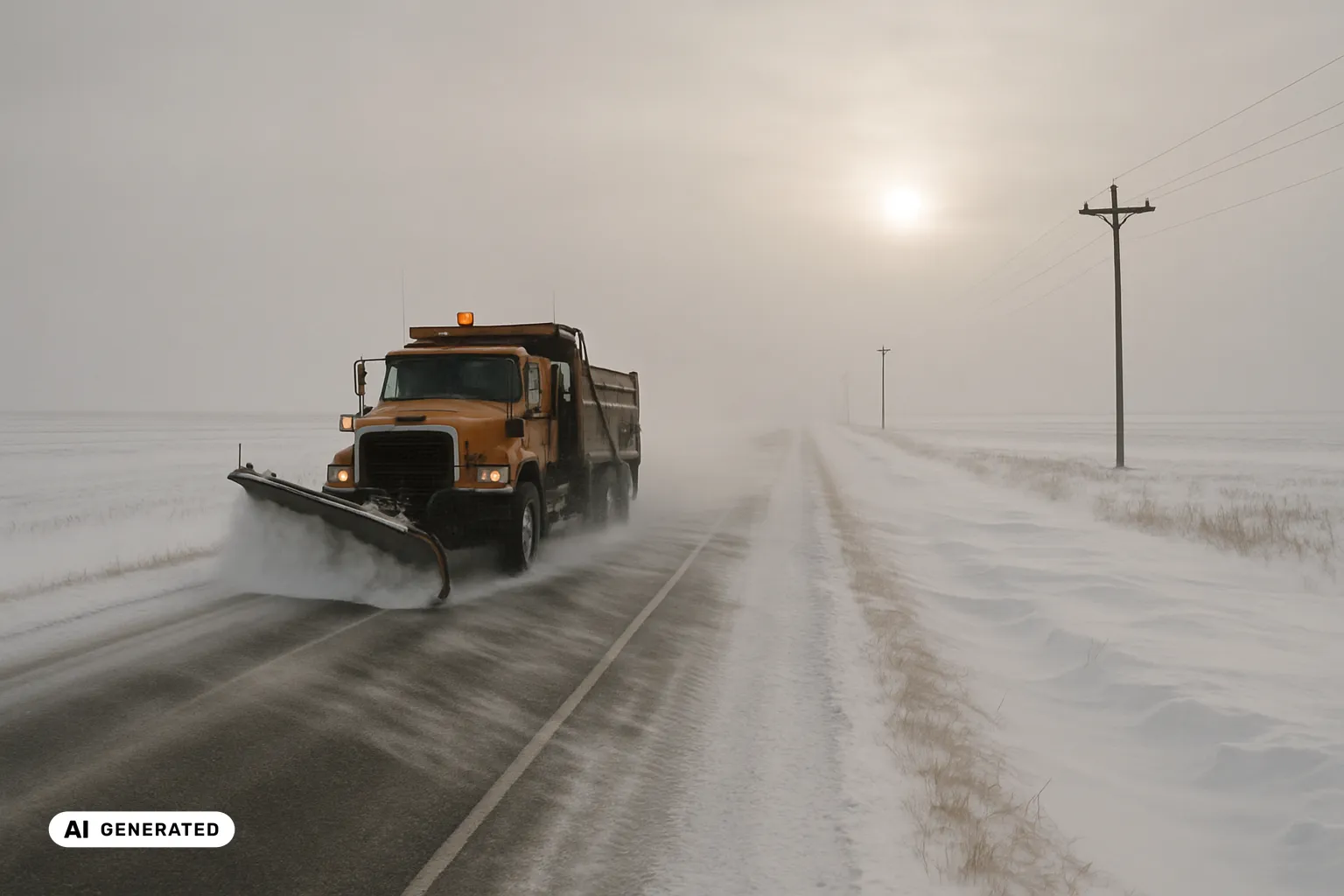
That single fact organises everything about winter here. Without relief and without windbreaks, snow does not stay where it lands. It is picked up off open fields and laid back down across roads, driveways and junctions as drift — which means the same stretch of road can close in more than once in a day, long after the last flake has fallen. The work is not primarily about volume. It is about wind, redrifting and visibility.
The city’s own plowing plan says so obliquely but unmistakably: the target is to reach all streets within 24 hours of the end of snowfall, with the explicit caveat that additional snow and wind can extend that. Wind is named as an operational variable, not as weather.
The numbers: a season that is late, cold, and wildly inconsistent
Fargo averages about 51.4 inches of snow a season at Hector International Airport on the 1991–2020 normals, over roughly 41.8 days with measurable snowfall, running October through May. That is a genuinely snowy figure — more than Chicago and comparable to Minneapolis.
Two things about the shape of it matter more than the total.
First, the winter ends late. On the monthly normals, March (9.2 inches) out-snows February (8.1), and April still averages 4.1 inches. Only December (11.7) and January (10.3) rank higher. A March storm here is not a freak event; it is the third-snowiest month arriving on schedule.
Second, the average is close to meaningless. Across the full record at Hector International, seasonal totals run from 9.3 inches to 117.0 inches. The two most recent seasons came in at 27.9 and 40.3. Planning against a mean of 51 inches describes almost no actual winter — which is a different problem from a city whose snowfall is merely heavy but consistent.
Underneath both is the cold, and it is relentless. Fargo averages 43 days a year at 0 °F (−18 °C) or lower. The mean January low is 1.2 °F (−17.1 °C) against a mean high of 18.2 °F — a month that, on average, does not reach 20 °F. The record low is −48 °F, set on 8 January 1887. The regional NWS office has its own thresholds to match: an Extreme Cold Warning at −40 °F and a Cold Weather Advisory at −30 °F, by temperature or wind chill.
Blizzards that need no snow
The Red River Valley of the North averages 2.6 blizzards a year, measured by the NWS office at Grand Forks across 39 winters from 1979/80 to 2017/18. The record season, 2021/22, had twelve.
The part that matters operationally is what counts as one. The office’s warning criteria describe sustained wind or frequent gusts of at least 35 mph with falling and/or blowing snow, cutting visibility below a quarter mile for three hours or more — and then states plainly that “blizzard conditions do not require snow to be falling i.e., ground blizzards.”
On this landscape, with loose old snow lying across open fields, wind supplies the rest by itself. A clear sky and an empty forecast are not the same thing as an open road. The event of 18 December 2025 shows the compound version: gusts of 63 mph at Fargo’s airport, wind chills in the thirties below zero, and freezing rain ahead of the cold front producing a widespread flash freeze.
Salt that stops working
At Fargo’s temperatures the standard tool loses its grip on the problem, and NDDOT publishes the arithmetic rather than leaving it to intuition: one pound of salt melts about 46.3 pounds of ice at 30 °F, but only 3.2 pounds at −6 °F.
With 43 days a year at or below zero, that is a routine condition and not a curiosity. The opposite case is instructive: Spokane, on the dry side of the Cascades, records about two such nights a year, and its trouble is not that salt stops working but that a January spent hovering around freezing refreezes whatever it melts. The response is to stop trying to melt and start trying to scrape and grip: more down-pressure on the blades, abrasives for traction, and pre-wetting material with brine so it stays on the road instead of blowing off it — an obvious concern where wind is the dominant variable. The City’s own spreaders run a sand and salt mixture, and Fargo warns drivers that it leaves the sanding trucks at speed across a span of about 30 feet, asking for at least 50 feet of clearance.
What the local rules say — and the one place they disagree
Fargo’s sidewalk duty is set out in the Fargo Municipal Code, § 18-0301, “Removal of snow and ice from sidewalks.” As codified, the owner or occupant of any building or grounds fronting a street “shall clear the sidewalk … of snow and ice to the width of such sidewalk on or before nine o’clock p.m.” — the full width, and a daily deadline. If they do not, the director of public works may have it removed, and the necessary costs and expenses “shall be chargeable and assessed against, and shall be a lien upon such premises,” assessed under article 3-17.
The City’s public guidance describes the same duty differently. On fargond.gov, the requirement is to clear the sidewalk — including the stretch running through the driveway and any crosswalks — within 24 hours of the end of a snowfall, with enforcement running: report, inspection with a notice left, a further 24 hours, then a contractor doing the work and billing the owner.
Both statements come from the City. We are not going to pick a winner between them — which one governs in a given case is a question for the City or a lawyer, and nothing here is legal advice. What is worth saying plainly is that the two exist, because almost every summary you will find online quotes one and not the other. If you are deciding when to send someone out, the earlier deadline is the safe one to work to.
The remaining sidewalk rule is unambiguous: snow cleared from private ground does not go into the roadway. The City warns that placing snow in the street or in cul-de-sacs can bring a fine of up to $500. Snow goes in your own yard or boulevard.
Three parking rules stacked on top of each other
This is where Fargo differs most sharply from other snow cities, and where the local detail actually earns its keep. There are three separate restrictions, and they operate independently.
One — the seasonal route ban. Under § 8-1702, no vehicle may park or stop on any roadway designated a snow emergency route “at any time between November 1 and April 15.” No declaration required, no snow required. It simply applies for five and a half months.
Two — the night parking restriction. Under Ordinance 8-1009, defined zones are closed to parking between 1 a.m. and 7 a.m. across the same season, alternating by day of the week according to whether the street runs north–south or east–west.
Three — the snow emergency itself. Under § 8-1701(5), a snow emergency means “when four (4) or more inches of snow is forecast by the National Weather Service” — a forecast trigger, so it can begin before anything has fallen. When the mayor declares one, § 8-1703 prohibits parking or remaining stopped “on any portion of any roadway in the city of Fargo.” Everything comes off the street; there is no odd/even rotation of the kind Minneapolis runs. It ends either by the mayor’s announcement or, road by road, once that road “has been cleared of snow from curb to curb for the length of the entire block.” A vehicle left out during a declaration faces $100, and is towed only where police judge it a hazard. Announcements go out through the county alert system, broadcast media, the City’s website and social accounts, and the news media.
How the city clears, and where the snow goes
Plowing runs on four priorities: during a storm, crews work snow emergency and Priority 2 routes around the clock; Priority 3 covers residential streets and avenues; Priority 4 covers the alleys. The stated goal is every street within 24 hours of the end of snowfall, wind permitting.
Downtown is the exception, and it is a real one. In the Central Business District, snow is not piled — it is hauled out of the city, overnight between 2 a.m. and 7 a.m., on a fixed alternation: streets on Tuesday, Thursday and Saturday, avenues on Monday, Wednesday, Friday and Sunday. Owners are asked to have their sidewalk snow out to the street before hauling starts, because Public Works will not haul piles its crews did not create. It is the one part of Fargo where snow physically leaves.
Beyond the city, NDDOT takes over, and its winters are measured in closures rather than delays. On 18 December 2025 it closed Interstate 29 “from border to border.” The agency runs a graded scale — a Travel Alert, then a No Travel Advisory, then closure when a road is “no longer considered safe for public travel” — and it will pull its own plows off the road entirely when conditions leave zero visibility. For anyone running routes between towns here, a closed interstate is a recurring operational fact, not a once-a-decade story.
The neighbours, and the state line through the middle
Fargo’s metropolitan area is split by a state border, which makes the local comparison unusually sharp. Moorhead lies directly opposite on the east bank — in Minnesota, under its own city code, where § 3-3-10 requires snow and ice off the sidewalks before 9 p.m. each day, with costs plus an administrative fee charged to the abutting property where the city clears. West Fargo, adjoining to the south-west and on the North Dakota side, allows 48 hours after a storm before notice is given and the walk may be cleared at the owner’s expense — and salts only its emergency routes and main arteries, using no sand at all.
Three adjoining cities, three clocks, two treatment philosophies, and a state line that changes the entire legal frame in the middle of one built-up area. Crossing a bridge over the Red River is crossing between rulebooks — on structures that, being exposed steel over water, tend to ice before the approaches do.
Why the melt is part of the winter
One last thing that makes this place unusual: because the Red River flows north, the thaw arrives in the wrong order. As the USGS describes it, snow and ice in the headwaters melt first while areas downstream remain largely frozen, so ice jams form and water backs up as flow moves north toward a still-frozen channel. The 1997 flood followed a record 117 inches of snow in Fargo, an April blizzard and a fast melt.
For anyone clearing snow through a Fargo winter, that turns the question “where do we put it?” into something with a second answer months later. Both Fargo and Moorhead have invested heavily in flood protection since 2009 — but where a winter’s snow is stacked is still a meltwater decision as well as a storage one.
Keeping the record straight
On a plain where the same road drifts shut three times from one snowfall, the useful thing is being able to show plainly what was done and when. Not to win an argument — but because a route that was genuinely cleared at 6 a.m. and impassable again by nine is the hardest kind of work to describe after the fact, and the easiest to be doubted on. A simple, time-stamped record of each pass, set against what the weather was actually doing, turns “we were out all night” into something specific — and on a route measured in open miles, a log of where the vehicle actually went says more than a tally of hours. That is the documentation support Wintertrace is built to make easy — a clear record of where a crew went and when — whether you run a single site or the streets of a whole municipality. It changes no local rule; it just means that when someone asks what happened during the last ground blizzard, the answer is on file. Not a substitute for legal advice.
Local facts
- About 51.4 inches (around 131 cm) of snow falls in an average season at Fargo Hector International Airport on the 1991–2020 normals, spread over roughly 41.8 days a year with measurable snowfall, from October through May.Source
- The winter ends late rather than early: on the monthly normals March (9.2 inches) out-snows February (8.1), and April still averages 4.1 inches — behind only December (11.7) and January (10.3).Source
- An average season is close to a fiction here. Over the station's full record at Hector International, seasonal totals run from 9.3 inches to 117.0 inches — and the two most recent seasons alone came in at 27.9 and 40.3 inches.Source
- The cold is the constant. Fargo averages 43 days a year with a minimum of 0 °F (−18 °C) or lower, a mean January low of 1.2 °F (−17.1 °C) against a mean January high of 18.2 °F, and holds a record low of −48 °F (−44 °C) set on 8 January 1887.Source
- Fargo sits on the west bank of the Red River of the North at 906 feet, on the bed of glacial Lake Agassiz — described as one of the flattest expanses of land in the world. The USGS puts the river's fall at less than half a foot per mile.Source
- The National Weather Service office at Grand Forks records that the Red River Valley of the North averages 2.6 blizzards per year, measured across 39 winters from 1979/80 to 2017/18. The record season, 2021/22, had 12.Source
- Crucially, the same office notes in its warning criteria that 'blizzard conditions do not require snow to be falling i.e., ground blizzards' — wind of 35 mph or more with blowing snow, cutting visibility below a quarter mile for three hours or more, is enough on its own.Source
- The region has its own cold thresholds: the NWS issues an Extreme Cold Warning at temperatures or wind chills at or below −40 °F, and a Cold Weather Advisory at or below −30 °F.Source
- Under Fargo Municipal Code § 18-0301, the owner or occupant must clear the sidewalk 'to the width of such sidewalk on or before nine o'clock p.m.'; if they do not, the director of public works may have it removed and the costs 'shall be chargeable and assessed against, and shall be a lien upon such premises'.Source
- The City's own public guidance states the duty differently: sidewalks, including the stretch running through the driveway and any crosswalks, are to be cleared 'within 24 hours of the end of a snowfall', with enforcement running report → inspection → a further 24 hours → contractor clearance billed to the owner.Source
- Snow cleared from private property may not go into the roadway: the City warns that residents or businesses who place snow in the street or in cul-de-sacs 'may face a fine of up to $500'.Source
- A snow emergency is defined by forecast, not by measurement: under § 8-1701(5), it means 'when four (4) or more inches of snow is forecast by the National Weather Service'.Source
- When one is declared, the ban is city-wide rather than odd/even: § 8-1703 prohibits parking or remaining stopped 'on any portion of any roadway in the city of Fargo', and it lifts either by the mayor's announcement or once that individual roadway 'has been cleared of snow from curb to curb for the length of the entire block'.Source
- Separately and independently of any declaration, § 8-1702 bars parking or stopping on any designated snow emergency route 'at any time between November 1 and April 15' — a standing seasonal ban, layered under a further night parking restriction (1 a.m. to 7 a.m. in defined zones) under Ordinance 8-1009.Source
- Salt stops doing much work in a Fargo cold snap, and NDDOT quantifies it: one pound of salt melts about 46.3 pounds of ice at 30 °F, but only 3.2 pounds at −6 °F. Below that, the strategy shifts to more down-pressure on the scraping blades and abrasives for grip rather than melting.Source
- Interstate closures are a recurring operational reality rather than a once-a-decade event: on 18 December 2025, NDDOT closed Interstate 29 'from border to border', noting that travel on a closed road is prohibited and extremely dangerous.Source
- The City's plowing plan works in four priorities — snow emergency and Priority 2 routes around the clock during a storm, then Priority 3 residential streets and avenues, then Priority 4 alleys — targeting all streets within 24 hours of the end of snowfall, with the explicit caveat that additional snow and wind can extend that.Source
Official contacts
City of Fargo — Snow Removal (Public Works)
The operational hub: the 4-inch snow emergency threshold, the city-wide parking prohibition, the four plowing priorities and the 24-hour clearing target.
City of Fargo — Resident Responsibilities
The City's own statement of the sidewalk duty, the 24-hour framing, the ban on putting snow in the street, and how far to stay back from a sanding truck.
Fargo Municipal Code § 18-0301 — Removal of snow and ice from sidewalks
The codified text: full sidewalk width by nine o'clock p.m., abatement by the director of public works, costs assessed as a lien on the property.
Fargo Municipal Code Article 8-17 — Snow emergency routes and declaration
Definitions and rules behind the snow emergency: the four-inch forecast trigger, the seasonal route ban from 1 November to 15 April, and the city-wide prohibition.
National Weather Service, Grand Forks — warning criteria and blizzard climatology
The office covering Fargo: blizzard criteria including ground blizzards, and the −40 °F and −30 °F cold thresholds.
NDDOT — Snow and ice control, road conditions and travel information
How the state treats highways in deep cold, why salt gives way to abrasives, and where interstate closures and travel advisories are published.
Common questions about winter service in Fargo
- Can you really have a blizzard here with no snow falling?
- Yes, and it is one of the defining features of winter on this plain. The National Weather Service office at Grand Forks states in its warning criteria that 'blizzard conditions do not require snow to be falling i.e., ground blizzards'. What the criteria require is sustained wind or frequent gusts of at least 35 mph with falling and/or blowing snow, frequently reducing visibility to under a quarter mile for three hours or more. On open, treeless country with old snow lying loose, wind alone supplies all of that. It is why a clear forecast is not the same as a safe road here, and why crews can be working a route that has had no new accumulation for days.
- How long do I have to clear my sidewalk in Fargo?
- Two different answers are in circulation, and both come from the City, so it is worth knowing each. The codified text, Fargo Municipal Code § 18-0301, requires the owner or occupant to clear the sidewalk to its full width 'on or before nine o'clock p.m.' — a daily deadline rather than a countdown. The City's public guidance on fargond.gov instead describes the duty as clearing within 24 hours of the end of a snowfall, and sets out enforcement in those terms: a report, an inspection with a notice left, a further 24 hours, then a contractor doing the work at the owner's cost. We are not in a position to say which governs in a given case — that is a question for the City or a lawyer. The practical reading is that the earlier of the two is the safe one. Nothing here is legal advice.
- What happens if the sidewalk does not get cleared?
- Under § 18-0301 the director of public works may have the snow and ice removed, and the necessary costs and expenses 'shall be chargeable and assessed against, and shall be a lien upon such premises', assessed in line with article 3-17 of the code. In other words the exposure is not a ticket in the ordinary sense — it attaches to the property. The City has described the practical side in press coverage: a minimum charge in the region of $75 depending on what the work involved, with nine properties billed against roughly 100 complaints by early December in the 2025/26 season. Treat those operational figures as reported rather than as a published fee schedule.
- What triggers a snow emergency, and what changes when one is declared?
- The trigger is a forecast, not a measurement. Under § 8-1701(5), a snow emergency means 'when four (4) or more inches of snow is forecast by the National Weather Service' — so the clock can start before the first flake. Once the mayor declares one, § 8-1703 prohibits parking or remaining stopped on any portion of any roadway in the city. Note what that is not: it is not an odd/even or alternate-side system of the kind Minneapolis and St Paul use. Everything comes off the street. The prohibition lifts either when the mayor announces its end, or, for an individual road, once that road has been cleared curb to curb for the length of the entire block — so it can end street by street. A vehicle left parked during a declaration faces a $100 penalty, and is towed only if police judge it a hazard.
- So is there a parking ban only when a snow emergency is declared?
- No — Fargo stacks three separate rules, and they are easy to conflate. First, § 8-1702 bars parking or stopping on any designated snow emergency route 'at any time between November 1 and April 15', whether or not anything has been declared and whether or not it has snowed. Second, Ordinance 8-1009 adds a night parking restriction between 1 a.m. and 7 a.m. across the same season in defined zones, alternating by day of the week according to whether the street runs north–south or east–west. Third, on top of both, the city-wide prohibition applies during a declared snow emergency. Checking only the third is the common mistake.
- Why does the city put down sand rather than more salt?
- Because below a certain temperature salt largely stops working, and NDDOT publishes the arithmetic: a pound of salt melts about 46.3 pounds of ice at 30 °F, but only 3.2 pounds at −6 °F. With an average of 43 days a year at or below 0 °F, that is not an edge case in Fargo — it is a regular condition. The response is to stop trying to melt and start trying to grip and scrape: more down-pressure on the blades, abrasives for traction, and pre-wetting with brine so material stays on the road instead of blowing off it. The City's own crews spread a sand and salt mixture, and warn that it leaves the sanding trucks at speed across a span of about 30 feet, which is why they ask drivers to stay at least 50 feet back.
- Does Moorhead have the same rules — it is right across the river?
- No. Moorhead is in Minnesota, a different state with its own city code, and the deadline differs: under Moorhead City Code § 3-3-10, snow and ice must be off the sidewalks before 9 p.m. each day, with the city able to clear and charge the costs plus an administrative fee to the abutting property. West Fargo, on the North Dakota side, allows 48 hours after a storm before notice is given and the sidewalk may be cleared at the owner's expense, and it salts only its emergency routes and main arteries without using sand at all. Three adjoining cities, three different clocks and two different treatment philosophies — inside one metropolitan area that the weather treats as a single place.
- Why does downtown work differently?
- Because in the Central Business District the snow does not get piled — it gets removed from the city. Crews haul it away overnight between 2 a.m. and 7 a.m. on a fixed alternation: streets on Tuesday, Thursday and Saturday; avenues on Monday, Wednesday, Friday and Sunday. Businesses and building owners are asked to get their sidewalk snow out to the street before hauling begins, because Public Works will not haul piles its own crews did not create. If you operate downtown, that timetable — not the general plowing priority list — is the one that governs your evening.
- Why does spring melt matter to a winter service question?
- Because the Red River flows north, and that reverses the usual order of a thaw. As the USGS explains, snow and ice in the headwaters begin to melt first while areas downstream remain largely frozen, so ice jams form and water backs up as flow moves north toward a still-frozen channel. The consequence for anyone clearing snow all winter is that where you put it is also a meltwater decision, not only a storage one. The record illustrates the link: the 1997 flood followed a record 117 inches of snow in Fargo combined with an April blizzard and a fast melt.
- How much snow does Fargo actually get in a typical winter?
- About 51.4 inches on the 1991–2020 normals at Hector International — but 'typical' does a lot of work in that sentence. Across the station's full record, seasons range from 9.3 inches to 117.0. The two most recent came in at 27.9 and 40.3. The seasonal shape is unusual too: March normally out-snows February, and April still averages over four inches, so the winter has a long tail. Planning around the mean is the mistake this climate punishes — the useful question is not what an average winter needs, but what the wind will do to whatever falls.
Documenting winter service in Fargo
Anyone clearing snow and ice in Fargo may later need to show when and where a route was treated. Wintertrace is open-source software that records exactly that — time, location and weather for each run — as a calm basis for your own operational records and service proof. It is not a substitute for legal advice.
This overview is for general information and is not legal advice. Local rules on snow and ice clearing vary — the wording of the local rule and the responsible authority always govern.