Winter service · Illinois
Winter service in Chicago
What winter is really like in Chicago: about 38 inches of snow a year at O'Hare — almost exactly what Rockford gets 90 miles inland, because the city sits upwind of Lake Michigan, not downwind. The real winter here is area and cold: 9,400 lane miles, six weeks of days that never rise above freezing, two separate parking bans, and a sidewalk rule under Municipal Code 10-8-180 with deadlines set to the hour.
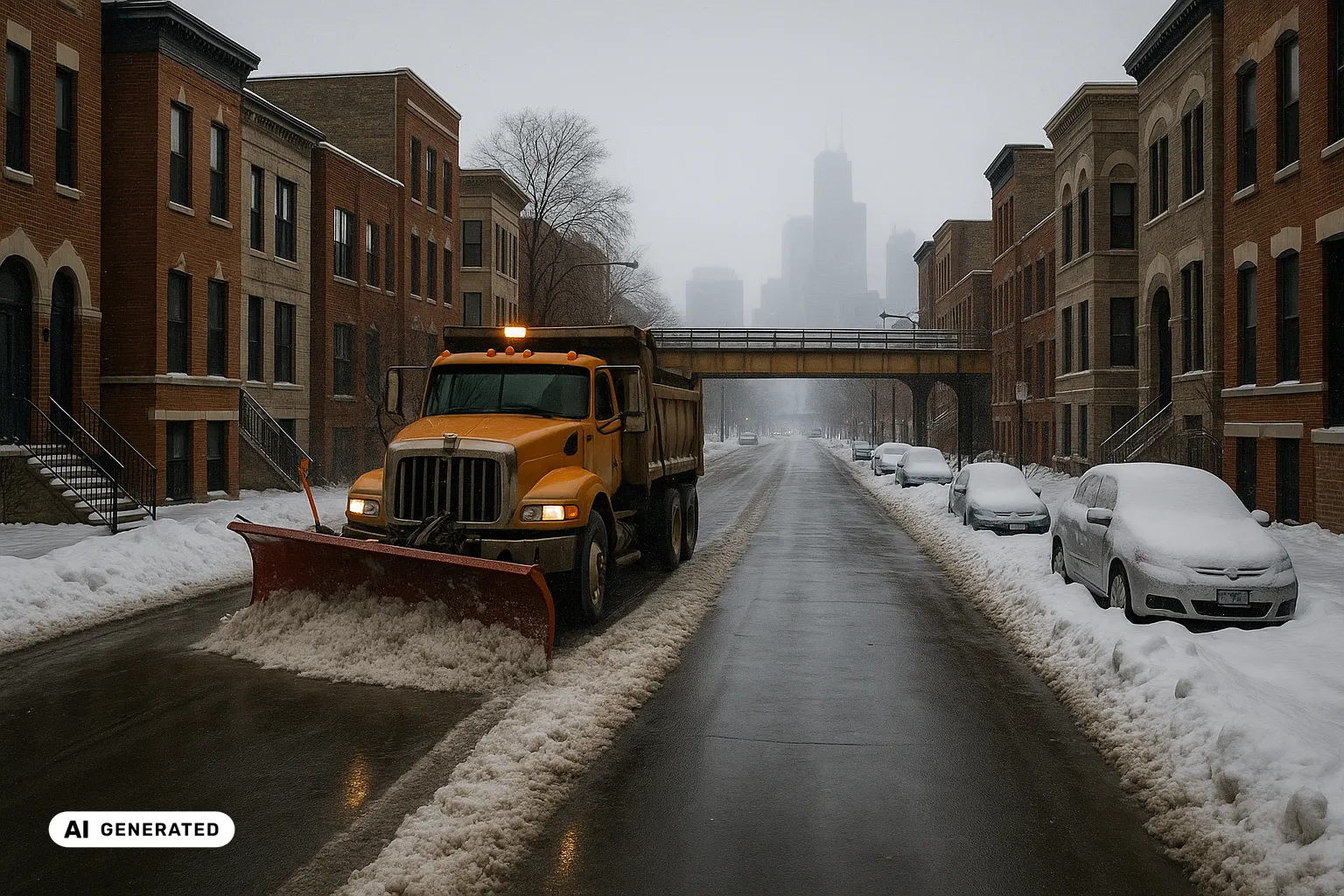
The city that everyone assumes is a snowbelt
Chicago has a reputation for brutal winters, and the reputation is earned — but not for the reason most people assume. The city averages about 38.4 inches of snow a year at O’Hare on the 1991–2020 normals. That is a solid figure. It is also, almost exactly, what Rockford gets: 37.1 inches, ninety miles inland, with no lake anywhere near it. Both numbers sit on the same National Weather Service page, and the comparison is the fastest way to understand a Chicago winter.
The lake is right there, so why isn’t it making snow? Because of which end of it the city sits on. Chicago is at the south-western tip of Lake Michigan, and the prevailing winter winds are westerly and north-westerly — which means the air arrives over the city having crossed land, and only reaches open water on its way out. The Illinois State Climatologist states it without hedging: Chicago “does not experience as much lake-effect snow as areas on the downwind lake coast, like western Michigan.” The snow that a lake-effect setup would produce falls on the Michigan shore instead. Only when the flow swings round to the north or north-east does the mechanism turn towards Chicago, and that is the exception.
The same geometry holds ninety miles up the same shore. Milwaukee is also on the upwind side, and the National Weather Service reckons lake-effect reaches the western shore of Lake Michigan only three to six times in a typical winter. Milwaukee does get 48.7 inches to Chicago’s 38.4 — but that is latitude, not the lake.
What the lake does do here is moderate temperature — cooler summers, slightly milder winters near the water, layered on top of an urban heat island worth roughly two degrees Fahrenheit. So the honest framing for winter service in Chicago is that this is a city with a snowbelt’s reputation and a plains city’s snowfall, and its real winter problem lies elsewhere.
That moderation is easiest to see by looking at the city the snow figures match. Rockford gets the same snow without the lake — and pays for it on the thermometer: a January mean low of 14.5 °F against Chicago’s 18.8, 135.8 frost nights against 121.3, and 11.5 nights at or below zero against 6.5. In the polar vortex of January 2019 the two airports, ninety miles apart, recorded −31 °F and −23 °F. The lake is not buying Chicago less snow. It is buying warmer nights.
Where the difficulty actually is: flat, vast, and frozen solid
Start with the ground. Chicago sits on the Chicago Plain, the bed of glacial Lake Chicago, and it has, in the words of the geographic description, “very little topographical relief.” The average height of land is 579 feet; the highest natural point inside the city limits, in Beverly, is 672 feet. The whole city spans about thirty metres of elevation. The only ridges worth the name are old sandbars — Clark Street and Ridge Boulevard trace them on the North Side. There are no hills to prioritise, and equally no slope to carry meltwater away.
Then the cold, which is where Chicago’s numbers get serious. On the same normals: 43.4 days a year never rise above 32 °F, 121.3 days a year reach freezing or below, and 6.5 days a year fall to 0 °F (−17.8 °C) or lower, with a mean January low of 18.8 °F. Six weeks of days that never thaw is a different operational picture from a snowier city with milder afternoons. What melts refreezes, salt loses efficiency as the pavement temperature drops, and the same crossing gets treated repeatedly through a single cold spell.
And then scale. The Department of Streets and Sanitation is responsible for more than 9,400 lane miles, divided into six Snow Districts. There is no clever terrain-based triage available. There is only surface, and a lot of it.
What the local rules say
Chicago’s sidewalk duty sits in the Municipal Code of Chicago, Section 10-8-180 — Snow and ice removal. It is unusually specific, and worth reading in the ordinance itself rather than in summary, because most of what circulates online is out of date.
Every owner, lessee, tenant, occupant or other person in charge of a building or lot abutting a public way is responsible for removing snow and ice from the abutting sidewalk and the sidewalk ramps intersecting it, “creating a clear path of at least 5 feet in width.” The timing is set to the clock rather than to a countdown: snow falling between 7 a.m. and 7 p.m. must be removed “no later than ten p.m. of the same day”; snow falling overnight between 7 p.m. and 7 a.m. must be gone “no later than ten a.m. of the same day.” There is no Sunday exemption in the current text — a number of advice pages still describe the older three-hour rule, and those should be ignored.
Two further provisions matter in practice. Where ice is frozen too hard to remove without damaging the pavement, subsection (a)(3) requires sand or abrasive material to be strewn within the same time window, and the walk cleaned properly once the weather permits — so a hard freeze does not suspend the duty, it changes what discharges it. And subsection (a)(4) addresses parking lots: owners of multiple dwelling unit buildings and townhouse developments with surface parking lots may not push that snow onto the public way, and where there is nowhere on site to store it, “such owner shall contract for private snow and ice removal.”
The penalty is “not less than $50.00 nor more than $500.00 for each offense,” and each day the condition continues is a distinct and separate offence. Figures of $500 for homes and $1,000 for businesses circulate widely; they are not in the section. The code also carries an exemption from that penalty for residential property inside an active pilot area under the Chicago Plow the Sidewalks Pilot Program — a scheme the city has debated for years, with a working group reporting in 2024 and funding argued over since. The exemption is in the text; whether any pilot area is active is a separate question worth checking locally.
Directly after the duty comes its counterpart, 10-8-190, which is easy to miss. Anyone who removes snow or ice from a public sidewalk or street “shall not, as a result of his acts or omissions in such removal, be liable for civil damages,” except where they violate Section 8-4-120 or where the conduct amounts to wilful or wanton misconduct. That is what the section says. How it lands in any real dispute is a question for a lawyer — none of this is legal advice.
Two parking bans, constantly confused
Chicago runs two winter parking prohibitions, and mixing them up is the most common local mistake.
The Winter Overnight Parking Ban is a calendar rule. It covers 107 miles of arterial streets, 3 a.m. to 7 a.m., from 1 December to 1 April — and the City is explicit that it is enforced “regardless of snow.” A clear, dry night in December changes nothing; those streets are permanently signed. Getting it wrong is expensive: a minimum $150 towing fee, a $60 ticket, and $25 per day of storage.
The snow route ban is a trigger rule. On another 500 miles of main streets, parking can be prohibited once there are at least two inches of snow on the street, “no matter the time of day or the calendar date.” That last clause is the part people miss — it reaches outside the December-to-April window entirely.
How the city clears
Road work is coordinated from Snow Command, which draws on a network of cameras and pavement sensors, radar, and GPS on every truck to deploy crews across up to over 280 snow routes, main and arterial streets first, residential streets after. The narrowest side streets are handled by a fleet of over 20 smaller plows, including 4x4 pick-ups. For a major storm the City can equip as many as 200 garbage trucks with “quick hitch” plows — and because those have no salt-spreading capability, they are run in tandem with trucks that do.
The expressways are not the City’s at all: they belong to IDOT, which is why the orange trucks look different from the City’s. During an event, the City publishes its fleet’s live positions through the Plow Tracker on the Chicago Shovels hub — which means “was my street done?” is a question with an answer rather than an argument.
Uncleared sidewalks are a different channel again: those go to 311, under “Snow – Uncleared Sidewalk or Bike Lane” — expressly not the route for streets, alleys or parking lots. The volumes are real: the Chicago Sun-Times reported that between 1 November and 10 December 2025 the City logged over 12,000 snow-related 311 requests, about half of them about uncleared sidewalks — more than four times the previous high for that window since 2019.
Dibs, and the line it draws
After a heavy snowfall, dug-out kerbside spaces across the city sprout chairs, cones and ironing boards. “Dibs” is Chicago’s best-known winter custom, and it has never been legalised — Streets and Sanitation announces collection sweeps once the thaw arrives, running the normal refuse routes with an eye on 311 complaints, and tells residents to retrieve anything they want back.
It is worth mentioning here not as folklore but because of what it reveals. Chicago allocates winter work property by property: the City takes the roadway, the abutting owner takes the sidewalk in front of it, to a five-foot width, by ten o’clock. Dibs is what happens when residents apply that same logic to the parking space they personally cleared. Understand the division of labour and the custom stops being strange.
Cross a line and the rulebook changes
Chicago’s ordinance stops at the city limits, and Greater Chicago’s suburbs diverge in both directions. Evanston asks for a 36-inch path within 24 hours of the end of snowfall — narrower than Chicago, far more time. Naperville allows 48 hours after an event exceeding two inches. Skokie inverts the model altogether and plows its sidewalks itself once four inches have fallen, with alleys at six. Schaumburg requires nothing of residents at all, while still forbidding snow pushed into the roadway.
For anyone running routes across the metropolitan area, that is four different standards inside an hour’s drive — different widths, different clocks, and in Skokie’s case a different party doing the work. The band of weather overhead does not notice any of it.
The storms people still measure winters against
Three events anchor the local memory. 26–27 January 1967 remains the largest single storm on record at 23.0 inches, with gusts of 48–53 mph at Midway piling drifts across the city and leaving roughly 50,000 abandoned cars and 800 CTA buses where they stopped. January 1979 brought 20.3 inches onto an already deep snowpack, and the clearing operation went on to dominate that year’s mayoral primary — Michael Bilandic lost it to Jane Byrne, which is the bluntest illustration available that snow clearance in Chicago is a political subject. In the Groundhog Day Blizzard of 2011, 21.2 inches at O’Hare and 60–70 mph gusts stranded around 700 people on Lake Shore Drive, which stayed shut for 33 hours.
Keeping the record straight
In a city where the duty is written to the hour and split property by property, the useful thing is being able to show plainly what was done and when. Not to win an argument — but because deadlines of 10 p.m. and 10 a.m., a five-foot width, and a freeze that holds for six weeks at a stretch generate exactly the questions a vague answer cannot settle. A simple, time-stamped record of each treatment, set against what the weather was actually doing, turns “we were out all night” into something specific, and a note of what was spread and where does the same for a long cold spell. That is the documentation support Wintertrace is built to make easy — a clear log of where a crew went and when — whether you look after one property or a set of routes that crosses from the city into Evanston, Skokie and Oak Park in a single shift. It changes no local rule; it just means that when someone asks what happened before ten o’clock, the answer is on file. Not a substitute for legal advice.
Local facts
- About 38.4 inches (around 98 cm) of snow falls in an average year at Chicago O'Hare, based on the National Weather Service 1991–2020 climate normals. The snowiest months are January (11.3 inches) and February (10.7 inches), followed by December (7.6) and March (5.5).Source
- Chicago is not a lake-effect city in the way Buffalo or Cleveland are. On the same NWS normals page, Rockford — about 90 miles inland, with no lake at all — averages 37.1 inches, within an inch and a half of Chicago's total.Source
- The reason is geometry: Chicago sits at the south-western tip of Lake Michigan, so under the prevailing winter west and north-west winds the city is upwind. The Illinois State Climatologist puts it plainly — Chicago 'does not experience as much lake-effect snow as areas on the downwind lake coast, like western Michigan'. Only northerly or north-easterly flow turns that around.Source
- Cold, not snow depth, is the defining number: an average of 43.4 days a year never rise above 32 °F, 121.3 days a year drop to freezing or below, and 6.5 days a year fall to 0 °F (−17.8 °C) or lower. The mean January low is 18.8 °F (−7.3 °C).Source
- The city is almost without relief. The average height of land is 579 feet, and the highest natural point anywhere inside the city limits — in Beverly, on the far South Side — is 672 feet. That is about 30 metres of range across the whole of Chicago.Source
- Under the Municipal Code of Chicago, Section 10-8-180, every owner, lessee, tenant or occupant of a building or lot abutting a public way must clear snow and ice from the sidewalk and from the sidewalk ramps that intersect it, 'creating a clear path of at least 5 feet in width'.Source
- The same section sets the deadlines to the hour: snow falling between 7 a.m. and 7 p.m. must be removed 'no later than ten p.m. of the same day', and snow falling overnight between 7 p.m. and 7 a.m. 'no later than ten a.m. of the same day'. The current text has no Sunday exemption — older guides still quoting one are out of date.Source
- Where ice is frozen too hard to lift without damaging the pavement, 10-8-180(a)(3) requires sand or abrasive material to be strewn within the same time window, and the walk cleaned properly once the weather allows.Source
- Subsection (a)(4) closes the parking-lot loophole: owners of multiple dwelling unit buildings and townhouse developments with surface parking lots may not push that lot's snow onto the public way, and if they cannot store it clear of the public way, they 'shall contract for private snow and ice removal'.Source
- The penalty is 'not less than $50.00 nor more than $500.00 for each offense', with each day the condition continues counting as a separate offence. Widely repeated figures of $500 for homes and $1,000 for businesses do not appear anywhere in the section.Source
- The section immediately after it, 10-8-190, is its counterpart: anyone who removes snow or ice from a public sidewalk or street 'shall not, as a result of his acts or omissions in such removal, be liable for civil damages' — except where they violate Section 8-4-120, or where the acts or omissions amount to wilful or wanton misconduct.Source
- Chicago runs two separate winter parking bans that are constantly confused. The Winter Overnight Parking Ban covers 107 miles of arterial streets from 3 a.m. to 7 a.m., 1 December to 1 April, 'regardless of snow'. Violations carry a minimum $150 towing fee, a $60 ticket and $25 per day of storage.Source
- The second ban is event-based: on another 500 miles of main streets, parking can be prohibited once there are at least two inches of snow on the street, 'no matter the time of day or the calendar date' — so it applies outside the December-to-April window as well.Source
- The Department of Streets and Sanitation is responsible for more than 9,400 lane miles of roadway, split into six Snow Districts and up to over 280 snow routes, coordinated from Snow Command using a network of cameras, pavement sensors and GPS on every truck. The expressways through the city belong to IDOT, not the City.Source
- For the biggest storms the City can equip as many as 200 garbage trucks with 'quick hitch' plows; because those cannot spread salt, they are run in tandem with trucks that can. Over 20 smaller plows, including 4x4 pick-ups, handle the narrowest side streets.Source
- The biggest single storm on record remains 23.0 inches on 26–27 January 1967, with gusts of 48–53 mph at Midway driving huge drifts and leaving roughly 50,000 abandoned cars and 800 CTA buses stranded.Source
Official contacts
City of Chicago — Winter Snow Clearing (Streets & Sanitation)
How the City plows: 9,400 lane miles, six Snow Districts, Snow Command, the truck fleet and the quick-hitch surge capacity.
City of Chicago — Winter Snow Parking Restrictions
Both bans in one place: the 107-mile overnight ban (3–7 a.m., 1 Dec – 1 Apr) and the 500-mile two-inch snow route ban, with the towing and ticket costs.
Municipal Code of Chicago — § 10-8-180 (Snow and ice removal)
The sidewalk section itself: the 5-foot path, the 10 p.m. and 10 a.m. deadlines, the abrasive-material duty, the parking-lot rule and the $50–$500 penalty.
City of Chicago — Plow Tracker
Live positions of the City's snow fleet during an event, reached through the Chicago Shovels winter hub.
CHI311 — Service requests ('Snow – Uncleared Sidewalk or Bike Lane')
Where an uncleared sidewalk or bike lane is reported. Not the channel for streets, alleys or parking lots.
National Weather Service Chicago — 1991–2020 climate normals
The official monthly and yearly normals for O'Hare, with Rockford alongside for the inland comparison.
Common questions about winter service in Chicago
- How long do I actually have to clear the sidewalk in Chicago?
- It depends on when the snow fell, and the deadlines are set to the hour rather than as a number of hours. Under Municipal Code 10-8-180, snow that falls or accumulates between 7 a.m. and 7 p.m. has to be removed as soon as practicable and no later than 10 p.m. the same day. Snow that falls overnight, between 7 p.m. and 7 a.m., has to be gone by 10 a.m. In practice that means an evening storm buys you until the following morning, while a mid-afternoon storm does not. Older advice pages still describe a three-hour rule with a Sunday exemption; that is the previous version of the section and no longer what the code says. This is general information, not a substitute for legal advice.
- How wide does the cleared path have to be?
- At least five feet, and the duty covers the sidewalk ramps that intersect your sidewalk as well as the walk itself. A single shovel-width track down the middle does not meet the wording of the section — five feet is roughly two shovel widths, and it is the figure the ordinance names. The ramps matter because they are where a cleared walk stops being useful if they are left packed: a wheelchair, a pushchair or anyone unsteady on ice meets the kerb there.
- Does Chicago get lake-effect snow like Buffalo or Cleveland?
- Not really, and this is the most useful thing to understand about winter here. Lake-effect snow falls downwind of open water, and Chicago sits at the south-western tip of Lake Michigan — so under the prevailing winter westerlies and north-westerlies the city is on the upwind side, and the heavy bands come down over western Michigan instead. The Illinois State Climatologist says so directly. The clearest evidence is on the NWS normals page: Rockford, 90 miles inland with no lake anywhere near it, averages 37.1 inches against Chicago's 38.4. Only when the wind swings round to the north or north-east does the lake start producing snow for Chicago, and that is the exception rather than the pattern.
- If Chicago is not a snowbelt city, what makes winter service hard here?
- Area and cold, rather than depth. The City alone maintains more than 9,400 lane miles across six Snow Districts, on a street grid so flat that the entire city spans about 30 metres of elevation — there is no terrain to shelter anything or to drain meltwater away. And the cold is persistent: 43.4 days a year never climb above freezing, which is roughly six weeks in which whatever melts in the afternoon refreezes overnight. That makes de-icing and the freeze–thaw cycle a bigger operational theme than the seasonal snowfall total suggests.
- What is the difference between the two winter parking bans?
- One is a calendar; the other is a trigger. The Winter Overnight Parking Ban applies to 107 miles of arterial streets from 3 a.m. to 7 a.m. between 1 December and 1 April, and the City is explicit that it applies regardless of snow — those streets are signed permanently and an empty, dry road on a mild December night is still a ban. Separately, another 500 miles of main streets can be closed to parking once at least two inches of snow lie on the street, no matter the time of day or the calendar date, which means the two-inch ban can catch you in November or in April. On the overnight ban, the City lists a minimum $150 towing fee, a $60 ticket and $25 per day of storage.
- Am I liable if someone slips on a sidewalk I shovelled?
- The code addresses this directly in the section right after the clearing duty. Municipal Code 10-8-190 provides that a person who removes snow or ice from a public sidewalk or street is not, as a result of their acts or omissions in that removal, liable for civil damages — with two carve-outs: it does not apply to someone violating Section 8-4-120, and it does not apply to acts or omissions amounting to wilful or wanton misconduct. That is what the section says; how it applies to any particular situation is a question for a lawyer, and nothing here is legal advice.
- Can I push the snow from my building's parking lot into the street?
- Not if the property is a multiple dwelling unit building or a townhouse development with a surface parking lot. Subsection (a)(4) of 10-8-180 says such owners may not shovel, plow or otherwise place parking-lot snow onto the public way, and must store it where it does not impede or restrict the public way at all. If there is nowhere on site to put it, the section says the owner shall contract for private snow and ice removal. The reasoning is practical: snow pushed into the roadway refreezes into a ridge, blocks the plows and ends up costing the City the work twice.
- What is 'dibs', and is it allowed?
- Dibs is the Chicago habit of marking a parking space you dug out with a chair, a cone, an ironing board — whatever is to hand — and treating it as claimed until the snow goes. It is a custom, not a rule: the City has never legalised it, and the Department of Streets and Sanitation announces collection sweeps once the thaw comes, along the normal refuse routes and with an eye on 311 complaints, telling residents to retrieve anything they want to keep. It is worth understanding as a symptom rather than a quirk. Chicago divides winter work property by property — the City takes the roadway, the abutting owner takes the sidewalk — and dibs is the informal extension of that logic to the kerbside space in front of a house.
- Do the suburbs have the same rules?
- No, and the differences are large in both directions. Evanston asks for a 36-inch path within 24 hours of the end of snowfall — narrower than Chicago's five feet, but with a much longer clock. Naperville allows 48 hours after an event of more than two inches. Skokie goes the other way entirely and plows its sidewalks itself once four inches have fallen, with alleys at six. Schaumburg does not require residents to clear at all, though it does forbid pushing snow into the roadway. Since a route across Greater Chicago crosses municipal lines constantly, the rulebook can change several times in a single working day even though the weather does not.
- Who clears the expressways, and how do I see where the plows are?
- The expressways running through Chicago are maintained by the Illinois Department of Transportation, not the City — those are the orange trucks. The City's own fleet works its six Snow Districts and up to over 280 snow routes, coordinated from Snow Command with camera and pavement-sensor feeds and GPS on every truck, main and arterial streets first and residential streets after. During an event the City publishes the fleet's live positions through its Plow Tracker, reached from the Chicago Shovels winter hub, so you can see when a street was last worked rather than guess.
Documenting winter service in Chicago
Anyone clearing snow and ice in Chicago may later need to show when and where a route was treated. Wintertrace is open-source software that records exactly that — time, location and weather for each run — as a calm basis for your own operational records and service proof. It is not a substitute for legal advice.
This overview is for general information and is not legal advice. Local rules on snow and ice clearing vary — the wording of the local rule and the responsible authority always govern.