Winter service · Wisconsin
Winter service in Milwaukee
What winter is really like in Milwaukee, Wisconsin: 48.7 inches of snow a season on the upwind shore of Lake Michigan, where the lake usually takes snow away from the lakefront and hands it to the western suburbs — until the wind turns east and the gradient reverses inside one city. A 24-hour sidewalk rule with no fine attached but a lien that lands on the tax roll, three separate authorities clearing roads within the same block, and an ordinance requiring a licence and liability cover before anyone plows a public walk for payment.
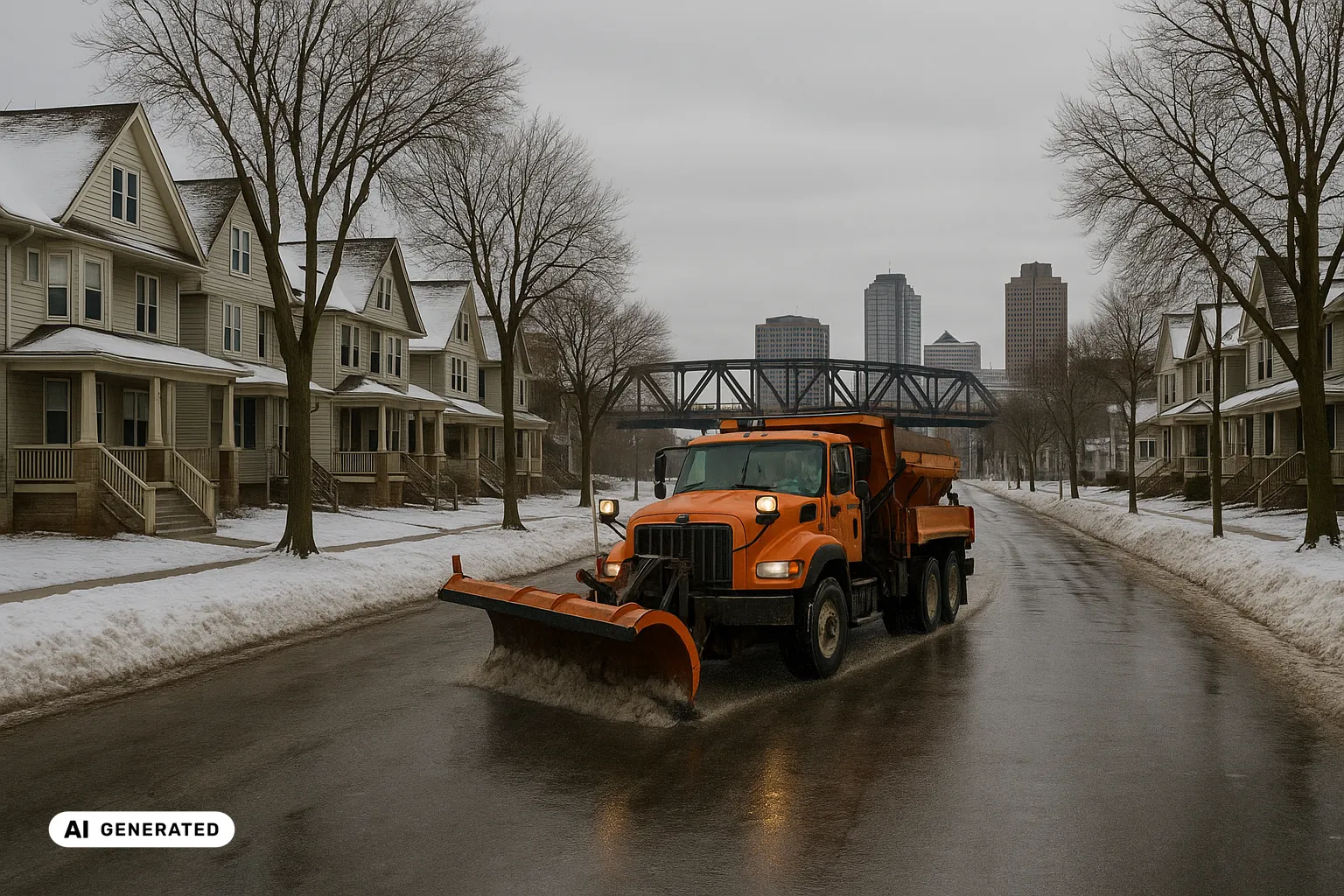
The lake takes snow away, until the day it doesn’t
Almost every assumption about a large city on Lake Michigan is wrong for Milwaukee, and the reason is which shore it sits on.
Lake-effect snow forms when cold air crosses open water and unloads on the far side. Milwaukee is on the near side. The prevailing winter wind here is out of the north-west, which makes the city upwind, and the National Weather Service puts the frequency plainly: perhaps three to six lake-effect events reach the western shore of Lake Michigan in a typical winter. Across the water, Grand Rapids averages 77.6 inches a season. Milwaukee averages 48.7.
What the lake mostly does here is the reverse. In early winter the water is warmer than the land, and the last mile of a snowflake’s fall is through air the lake has warmed — so the lakefront gets less, and wetter, than ground a few miles inland. On 29–30 November 2025 the county saw 6 to 12 inches, but the totals east of I-43/94 came in at 6 to 8 inches while West Allis, Greenfield and Wauwatosa reported 9 to 12.
Then the wind turns east, and everything inverts. On 15–16 February 2021 the lakeshore counties took 10 to 16 inches, Mitchell airport measured 9.6, and the Weather Service noted “a sharp cut off … with locations north of Milwaukee and west of Interstate 41 reporting snowfall totals that ranged from 1 to 4 inches”.
This is the operational fact that separates Milwaukee from every other Great Lakes city in this collection. Chicago is flat and uniform. Grand Rapids sits in a snow belt and knows it. Milwaukee has a snow line that runs north–south through its own service area and changes sides with the wind — and the spread across the city can exceed the difference between two cities. On 13 March 2017 an easterly gave Milwaukee a storm total of 11.2 inches and Madison, eighty miles inland, 4.2.
Less snow than the inland capital, in a shorter season
Milwaukee’s normal is 48.7 inches — a figure the NWS, the Wisconsin State Climatology Office and the NOAA-based tables agree on exactly, which is not always the case. Madison, with no lake to speak of, gets 51.8. The city on the water gets less.
The season is compressed. December, January and February carry 37.1 of those 48.7 inches — about 76 %, with January alone at 14.9 over ten snow days. On the long-term averages the first inch falls on 2 December and the last on 22 March, with a first trace around 2 November. Roughly 35 days a year see measurable snow. The record low is −26 °F (−32 °C), reached in January 1982 and again in February 1996.
Two record figures are worth stating carefully, because the sources disagree. The NWS lists the largest daily fall as 16.7 inches on 10 February 1960; the Wisconsin State Climatology Office, working from a series that begins earlier, gives 17.9 inches on 3 March 1881. Both are cited here rather than one being quietly chosen. The snowiest season on record, on both counts, is 1885–86 at 109.8 inches.
Twenty-four hours, and the entire paved surface
Milwaukee’s sidewalk rule is in § 116-8 of the Code of Ordinances (PDF). The “owner, occupant or person in charge” of property abutting a paved public sidewalk or crosswalk must
“remove and clear away all snow and ice on the entire paved surface within 24 hours after the snow or ice has ceased to fall”
Two details in that sentence do the work. Entire paved surface rules out the shovel-width path, and the 24 hours run from the end of the snowfall, not from when it started or from any point on the clock. And treating is a fallback rather than a choice: sand, abrasive or a melting product comes in only “whenever ice has so formed on any sidewalk that it cannot be removed” — and then, again, across the whole surface.
There is one clause that runs the other way, in the property owner’s favour. Where city plows throw excessive snow into the crosswalks, § 116-8-1 makes the Commissioner of Public Works responsible for clearing those piles mechanically; only after that does the abutting owner take over “any needed hand-clearing of the crosswalk opening”. Given that the city counts roughly 42,000 corners and crosswalks, that division of labour matters.
No fine — a charge that ends up on the tax roll
Here is where Milwaukee differs from most cities of its size: § 116-8 contains no fine at all.
What it contains is special charges. The ordinance sets $75 for the violation, a further $100 where the condition is not abated, and $125 for a repeat in the same calendar year, plus any costs the city incurs in abatement. Note a live discrepancy: those are the ordinance figures, while the DPW’s own snow operations page still quotes $50 / $75 / $100, which appears to be the 2015 schedule. Both are current published statements by the city, so treat the higher figures as the ordinance text and check the amount that actually applies before budgeting for it.
The mechanism behind the charge is the serious part. Charges are due 30 days after billing, and if unpaid they “become a lien on the subject property as provided in s. 66.0627, Wis. Stats.”, carry a $25 administrative charge, and are “shall automatically be extended upon the current or next tax roll as a delinquent tax”. After that, the whole apparatus for collecting delinquent real estate taxes applies to an uncleared sidewalk.
That this is deliberate rather than an omission is easy to demonstrate: the next section of the same chapter, § 116-9 on rain gutters draining onto sidewalks, sets an ordinary fine of not less than $5 nor more than $10. The code knows how to write a fine. For snow it chose a lien instead.
The enforcement rhythm is quick. Residents are asked not to report a walk until 24 hours have passed since the snow stopped; after that, reports go to 414-286-CITY or an online request, and properties in violation “will be posted, when possible, and referred to an abatement contractor on the same day”. If the snow is still there when the contractor arrives, the owner pays for that too. The city is equally direct about the limit of its help: asked whether it clears sidewalks for residents, the answer is “No.” It keeps a list of contractors, verified annually, endorsing none of them.
If you plow for money here, you need a licence
This is the provision most likely to be missed, and it sits two sections further on in the same chapter.
§ 116-12 states that no person, firm or corporation may “engage in the business of removing snow or ice from the public sidewalks or public alleys of the city by means of motorized sweepers or plows or receive compensation for doing such work” without a Snow Plowing Equipment License. It is issued by the City Clerk on the approval of the Commissioner of Public Works, and the Clerk “shall publish to the city’s website a list of all snow plowing equipment license holders”.
The fee is almost nothing — $10, valid one year from issue, under § 81-114. The substantive requirement is insurance. No licence is granted without a public liability policy “in the sum of at least $5,000”, conditioned on paying for damage to any tree, pavement, street, sidewalk, utility pole or other city property, “whether the damage shall be inflicted by the person or his or her employees or workers”, and indemnifying the city against liability arising from the licence. Operating without one “shall forfeit to the city a penalty of not less than $50 nor more than $100 for each offense”, with imprisonment of up to 60 days in default of payment.
Read the scope carefully before drawing conclusions from it: this covers public sidewalks and alleys, worked with motorised equipment or for payment. It is not a general licence to clear private car parks, and it is not triggered by a hand shovel. But for a contractor with a sidewalk machine and a route of downtown frontages, it is the first thing to get right — and the insurance condition, extending expressly to damage caused by employees, is a reasonable prompt to keep a record of who worked which route.
Three authorities inside one block
Milwaukee splits winter road work three ways, and the seams run through ordinary neighbourhoods.
Sidewalks are the abutting owner’s. City streets are the DPW’s. And freeways, expressways and other county- and state-owned roads within the city are cleared by Milwaukee County Public Works — the city says so itself. The reason is a state arrangement the county describes as “unique to Wisconsin”: the state contracts all 72 county highway departments to maintain the state highway system. On top of that, the Marquette Interchange, where I-43, I-94 and I-794 meet downtown, is WisDOT’s.
For anyone working across those lines, the practical consequence is that the standard and the timing change with the ownership of the pavement, not with the weather.
A valley that cuts the city in half
The other structural fact is geological. The Menomonee Valley — a glacially carved trench about four miles long and half a mile wide — “effectively cuts Milwaukee in half, limiting access to a handful of viaducts that span the chasm”. Industry reshaped it: the valley floor was raised by an average of 22 feet and the north rim cut down by as much as 60. The crossings that remain are the 6th, 16th, 27th and 35th Street viaducts, and their approach ramps are the classic grades of the inner city. Any one of them out of service pushes its traffic onto the other three.
North of downtown, the ground does something else: steep bluffs begin about a mile up the shore, giving the lakefront streets their own gradients. The city’s own answer to elevated ground is chemical rather than mechanical — brine pre-treatment “is most frequently used on bridges/elevated surfaces”. Local reporting has documented closures of the Hoan Bridge, the high I-794 crossing over the harbour, for icing.
What the plows are actually promising
The city publishes two different standards, and the gap between them explains most complaints.
Main streets: “wet/bare pavement within 12 hours after the snow has stopped falling.” Residential streets: “safe and passable at speeds reasonable for conditions” within 24 to 48 hours — followed by the sentence that answers the question before it is asked: “safe and passable is not bare pavement and some hardpack can be expected.”
A complete pass over the city takes 18 to 24 hours or longer, with four to six passes per street to open it kerb to kerb — which is also why a driveway apron fills in again after it has been cleared. Because someone has to be last, the city rotates which end of each residential route the plows start from each year. Pre-treatment is a 23.3 % salt brine, and the DPW says it can brine all 1,475 miles of city streets. Salt “works best when pavement temperatures are above 15°” F. Alleys are not plowed at all — the city classes them as “quasi rear driveways” rather than public right-of-way, which is a sharp contrast with Chicago — and in bike lanes “residual snow and ice should be expected”.
Parking: two regimes and a 72-hour override
Milwaukee’s winter parking rules sit on top of a year-round system rather than replacing it.
All year, there is no parking on city streets between 2 a.m. and 6 a.m., Monday to Saturday, without an overnight permit, and most residential streets alternate sides by date parity — even dates, even house numbers. From 1 December to 1 March, night parking is additionally prohibited on through highways and bus routes; the red, green and blue colour zones are how the city encodes which rule applies to a given street.
A declared snow emergency overrides all of it: alternate side parking moves to 10 p.m.–6 a.m., and the declaration runs 72 hours or until plowing is declared complete. There is no published snowfall threshold — the Commissioner of Public Works declares one where snowfall “during any period of 24 hours or less” constitutes “a serious public hazard”. Neighbouring West Allis does name a number: three inches. Tickets run $50, $100, then $150 and tow eligible, and Milwaukee Public Schools opens some playgrounds for overnight parking while an emergency is in effect.
Cross a municipal line and check again
Milwaukee County holds 19 municipalities, and the sidewalk deadline is not portable across them. Shorewood requires clearing “within 12 hours after the snow or ice has stopped falling” under § 466-27 — half of Milwaukee’s window — to full width, down to the surface, including corner ramps. Whitefish Bay (§ 7.08), Wauwatosa and West Allis all use 24 hours, but the consequences differ: Wauwatosa inspects only on complaint and charges a $100 dispatch fee plus $0.25 per linear foot cleared, while West Allis issues both an invoice and a citation.
Salt that does not leave in spring
One last piece of local knowledge, because it is increasingly what the conversation about de-icing turns on here.
The DPW does not soften it: “salt is a pollutant that impacts our water.” What makes the southeast Wisconsin version distinctive is the timescale. UW–Milwaukee research on the Root River found chloride concentrations remaining relatively constant as flow rose — the signature of salt stored in groundwater discharging into the river all year, including in summer, long after the last application. Winter, in other words, writes itself into the water table and stays there.
Documenting work in a city with three rulebooks
Milwaukee asks a contractor to hold several things at once: a 24-hour deadline measured from the end of the snowfall, an entire-paved-surface standard, a licence and an insurance condition covering the actions of employees, and a service area where the snow total can differ by inches between its eastern and western halves in the same storm.
Wintertrace is self-hosted software for recording winter service work: what was cleared, when, by whom, with which material, with the weather conditions of the shift attached and a service record you can produce weeks later. It runs on your own hosting, without a subscription, and the data stays with you.
For a 24-hour rule, the useful evidence is a timestamp against the end of the snowfall rather than a recollection of a busy night. For a licence conditioned on covering damage caused by your employees, a record of which route each of them ran is worth having before anyone asks for it. And in a city where the west side got 12 inches and the lakefront got 6, being able to show what the conditions actually were on a given site is the difference between an invoice that stands up and one that gets argued about.
A note on all of the above
This page is general information about winter service in Milwaukee, Wisconsin, drawn from the City’s published material and its Code of Ordinances as of September 2026. It is not a substitute for legal advice, and it is not a statement of what applies to any particular property or business. Note in particular that the city’s own sources currently give two different sets of special charge amounts for § 116-8, and that the surrounding municipalities set their own deadlines. Check the current ordinance text and the relevant municipality’s pages before relying on anything here.
Local facts
- About 48.7 inches (123.7 cm) of snow falls in an average season at Milwaukee Mitchell International Airport on the 1991–2020 normals, over roughly 35.1 days a year with measurable snowfall. The NWS, the Wisconsin State Climatology Office and NOAA-based tables all give the same figure.Source
- The season is compressed: December, January and February carry 37.1 of the 48.7 inches — about 76 %. January alone averages 14.9 inches over 10.0 snow days.Source
- The operational window is narrower than the calendar suggests. On the long-term averages the first inch of snow falls on 2 December and the last on 22 March, with a first trace around 2 November and a last around 16 April.Source
- Milwaukee sits on the west — upwind — shore of Lake Michigan, and the NWS is explicit about how rarely that produces lake-effect snow: 'Perhaps LES events affect the western shore of Lake Michigan including southeast Wisconsin 3-6 times during a typical winter.'Source
- The usual effect runs the other way. On 29–30 November 2025 the county saw 6 to 12 inches, but the totals east of I-43/94, nearest the lake, were 6 to 8 inches, while West Allis, Greenfield and Wauwatosa to the west reported 9 to 12.Source
- When the wind turns east the gradient inverts. On 15–16 February 2021 the lakeshore counties took 10 to 16 inches and Mitchell airport 9.6, while 'locations north of Milwaukee and west of Interstate 41 report[ed] snowfall totals that ranged from 1 to 4 inches'.Source
- The same mechanism separates Milwaukee from inland Wisconsin within a single storm: on 13 March 2017 an easterly wind gave Milwaukee a storm total of 11.2 inches and a daily record of 8.7, against 4.2 inches in Madison.Source
- Ordinance 116-8-1 requires the 'owner, occupant or person in charge' of property abutting a paved public sidewalk or crosswalk to 'remove and clear away all snow and ice on the entire paved surface within 24 hours after the snow or ice has ceased to fall'.Source (PDF)
- Treating is a fallback, not an alternative: sand, abrasive or a melting product may be applied 'whenever ice has so formed on any sidewalk that it cannot be removed' — and then to the entire paved surface.Source (PDF)
- Where city plows throw excessive snow into crosswalks, § 116-8-1 puts the mechanical clearing on the Commissioner of Public Works — after which the abutting owner is responsible only for 'any needed hand-clearing of the crosswalk opening'.Source (PDF)
- There is no fine in the sidewalk ordinance. § 116-8-4 works with special charges — $75, a further $100 if the condition is not abated, $125 for a repeat in the same calendar year — plus the city's abatement costs. The DPW's own guidance page still quotes the older $50 / $75 / $100.Source
- Unpaid charges become a lien under s. 66.0627, Wis. Stats., carry a $25 administrative charge, and 'shall automatically be extended upon the current or next tax roll as a delinquent tax against the property'.Source (PDF)
- Anyone clearing snow or ice from public sidewalks or public alleys with motorised sweepers or plows, or for payment, needs a Snow Plowing Equipment License under § 116-12 — granted by the City Clerk on the approval of the Commissioner of Public Works, and published as a public list of licence holders.Source (PDF)
- The licence costs $10 a year under § 81-114, but it is not issued without public liability insurance 'in the sum of at least $5,000' covering damage to trees, pavement, streets, sidewalks and utility poles, including damage caused by employees. Operating without one forfeits $50 to $100 per offence.Source (PDF)
- Three authorities clear roads inside the city: property owners take the sidewalks, City DPW takes city streets, and Milwaukee County Public Works clears 'highways and the freeway system and other County/State-owned streets in the City' — because Wisconsin contracts all 72 county highway departments to maintain the state system, an arrangement the county itself calls 'unique to Wisconsin'.Source
- The city's service targets are explicitly unequal: main streets to 'wet/bare pavement within 12 hours after the snow has stopped falling', residential streets merely 'safe and passable at speeds reasonable for conditions' within 24 to 48 hours — and 'safe and passable is not bare pavement and some hardpack can be expected'.Source
- Plowing the whole city takes 18 to 24 hours or longer, and each street needs four to six passes to clear it kerb to kerb. To spread the disadvantage, the city changes which end of each residential route the plows start from every year.Source
- Pre-treatment uses a 23.3 % salt brine, concentrated on bridges and elevated surfaces, and the city says it can brine all 1,475 miles of city streets. Salt itself 'works best when pavement temperatures are above 15°' F, and the DPW states plainly that 'salt is a pollutant that impacts our water'.Source
- Alleys are not plowed — the city classes them as 'quasi rear driveways' rather than public right-of-way — and bike lanes are worked with smaller equipment, where 'residual snow and ice should be expected'.Source
- Winter parking layers onto a year-round rule: no parking on city streets 2 a.m. to 6 a.m. Monday to Saturday without a permit, alternating by house-number parity. From 1 December to 1 March night parking is also banned on through highways and bus routes, under a red / green / blue colour-zone system.Source
- A snow emergency has no published inch threshold. The Commissioner of Public Works declares one where snowfall 'during any period of 24 hours or less' constitutes 'a serious public hazard'; it runs 72 hours or until plowing is declared complete, and shifts alternate side parking to 10 p.m.–6 a.m. Neighbouring West Allis, by contrast, names three inches.Source
- Deadlines vary sharply across Milwaukee County's 19 municipalities. Shorewood requires clearing 'within 12 hours after the snow or ice has stopped falling' under § 466-27; Whitefish Bay, Wauwatosa and West Allis all use 24 hours. Wauwatosa charges a $100 dispatch fee plus $0.25 per linear foot cleared.Source
- The Menomonee Valley 'effectively cuts Milwaukee in half, limiting access to a handful of viaducts that span the chasm' — the 6th, 16th, 27th and 35th Street crossings. Industrialisation raised the valley floor by an average of 22 feet and cut the north rim down by as much as 60.Source
- The road salt does not leave in spring. UW–Milwaukee research on the Root River found chloride concentrations staying relatively constant as flow rose, meaning salt stored in groundwater feeds the river year-round, long after the last application.Source
- The city's heaviest recorded events: the blizzard of 28–30 January 1947 shut down much of the city for more than a week, stranding over 400 streetcars; the Groundhog Day blizzard of 1–2 February 2011 delivered 19.8 inches over three days with gusts of 40–50 mph; and the winter of 1978/79 held a 33-inch snowpack from 17 January to 19 February.Source
Official contacts
City of Milwaukee DPW — Snow and Ice Control Operations
Service targets, the sidewalk duty and how to report one, brine and salt practice, bus stops, hydrants and corners.
City of Milwaukee DPW — Snow Resources
The snow removal guide, the text-alert sign-up and the city's list of snow removal contractors.
City of Milwaukee — Winter parking regulations
The colour zones, the 1 December – 1 March rules, and what changes in a declared snow emergency.
Milwaukee Code of Ordinances, Chapter 116 (PDF)
The source text of § 116-8 on sidewalks and § 116-12 on the snow plowing equipment licence.
Milwaukee County — Snow and Ice Control
Who clears the freeways and the state and county roads inside the city, and how the county limits salt use.
NWS Milwaukee/Sullivan — Snow climatology
Normals, records, and the average dates of the first and last measurable snow of the season.
City of Milwaukee — DPW online service request
Where an uncleared sidewalk is reported, once 24 hours have passed since the snow stopped.
Common questions about winter service in Milwaukee
- Does Milwaukee get lake-effect snow?
- Rarely, and that surprises people. Lake-effect snow forms when cold air crosses open water, so it falls on the downwind shore — and Milwaukee is on the upwind one, with the prevailing winter wind out of the north-west. The National Weather Service puts it at perhaps three to six events in a typical winter for the entire western shore of Lake Michigan. Most of the time the lake does the opposite: in early winter it is warmer than the land, and snow reaching the lakefront arrives wetter and lighter than snow falling a few miles inland. The city's 48.7-inch normal against Grand Rapids' 77.6 on the Michigan side of the same lake is the scale of the difference.
- Why does one side of Milwaukee get more snow than the other?
- Because the snow line often runs through the city rather than around it. On 29–30 November 2025 the totals nearest the lake, east of I-43/94, came in at 6 to 8 inches while West Allis, Greenfield and Wauwatosa to the west reported 9 to 12. When the wind swings to the east the pattern reverses completely: on 15–16 February 2021 the lakeshore took 10 to 16 inches and areas west of I-41 got 1 to 4. For an operation serving one city, that is a planning problem — the spread within the service area can be larger than the difference between two cities.
- How long do I have to clear a sidewalk in Milwaukee?
- Twenty-four hours after the snow or ice stops falling, under Ordinance 116-8-1. The duty falls on the 'owner, occupant or person in charge', and what must be cleared is 'the entire paved surface' — not a shovel-width path. Sanding or de-icer is not an alternative to clearing: the ordinance allows it only where ice 'has so formed on any sidewalk that it cannot be removed', and then across the whole paved surface as well. Neighbouring municipalities differ, sometimes sharply: Shorewood allows only 12 hours.
- What does it cost if the sidewalk is not cleared?
- Not a fine — the sidewalk ordinance does not contain one. § 116-8-4 uses special charges instead: $75 for the violation, a further $100 if the condition is not abated, and $125 for a repeat within the same calendar year, plus whatever the city's abatement costs come to. Be aware of a discrepancy: those are the figures in the ordinance text, while the DPW's own snow operations page still quotes $50 / $75 / $100, apparently the 2015 schedule. Check the current amount with the city rather than relying on either page.
- What happens to an unpaid charge?
- It stops being a bill and becomes a property matter. Under § 116-8-4b the charges are due 30 days after billing, and if unpaid they become a lien under s. 66.0627 of the Wisconsin Statutes, with a $25 administrative charge added, which 'shall automatically be extended upon the current or next tax roll as a delinquent tax against the property'. From that point the collection machinery for delinquent real estate taxes applies. That is a deliberate design, not an oversight — the very next section of the same chapter, on rain gutters, does set an ordinary fine of $5 to $10.
- How quickly does the city act on a complaint?
- Same day, once the clock has run. The city asks residents not to report a sidewalk until 24 hours have passed since the snow stopped; reports go to 414-286-CITY or an online request. After that, properties in violation are posted where possible and referred to an abatement contractor on the same day, and if the walk is still covered when the contractor arrives, the owner pays that cost as well. The city is also direct about what it will not do: it does not provide help clearing private sidewalks, though it maintains a list of snow removal contractors that it verifies annually without endorsing.
- Do I need a licence to plow snow commercially in Milwaukee?
- For public sidewalks and public alleys with motorised equipment, yes. Ordinance 116-12 says no person, firm or corporation may engage in the business of removing snow or ice from public sidewalks or alleys 'by means of motorized sweepers or plows or receive compensation for doing such work' without a Snow Plowing Equipment License, issued by the City Clerk on the approval of the Commissioner of Public Works. The fee is $10 a year and the licence runs a year from issue. The real requirement is the insurance: at least $5,000 of public liability cover, indemnifying the city for damage to trees, pavement, streets, sidewalks, utility poles and other city property, including damage caused by employees. The Clerk publishes the list of licence holders. Operating without one forfeits $50 to $100 per offence, with imprisonment of up to 60 days in default of payment.
- Who actually clears the road outside a given property?
- It depends which road. Sidewalks belong to the abutting owner or occupant. City streets are the City DPW's. But freeways, expressways and other county- and state-owned roads inside the city are cleared by Milwaukee County Public Works, because Wisconsin contracts all 72 county highway departments to maintain the state highway system — an arrangement the county describes as unique to Wisconsin. The Marquette Interchange, where I-43, I-94 and I-794 meet downtown, sits with WisDOT. Three standards and three sets of timings can meet within a few hundred metres.
- When will my residential street be plowed, and why is it still white afterwards?
- Because it is meant to be. The city's targets are openly two-tier: main streets to 'wet/bare pavement within 12 hours after the snow has stopped falling', residential streets to 'safe and passable at speeds reasonable for conditions' within 24 to 48 hours. It then says the quiet part outright — 'safe and passable is not bare pavement and some hardpack can be expected'. A full pass over the city takes 18 to 24 hours or longer, and each street needs four to six passes to open it kerb to kerb, which is also why snow reappears at the end of a driveway that was already shovelled. Alleys are not plowed at all; the city treats them as rear driveways rather than public right-of-way.
- How do the winter parking rules work?
- There are two layers. Year-round, there is no parking on city streets between 2 a.m. and 6 a.m., Monday to Saturday, without an overnight permit, and most residential streets alternate sides by date parity — even dates on the even-numbered side. From 1 December to 1 March, night parking is additionally banned on through highways and bus routes, which is what the red, green and blue colour zones encode. A declared snow emergency moves alternate side parking to 10 p.m.–6 a.m. and runs 72 hours or until plowing is complete. Milwaukee Public Schools opens some playgrounds for overnight parking during emergencies and clean-up. Winter parking tickets run $50, then $100, then $150 and tow eligible.
- At what snowfall is a snow emergency declared?
- There is no published number, which is itself the local fact worth knowing. The Commissioner of Public Works may declare one where snowfall 'during any period of 24 hours or less' constitutes 'a serious public hazard' — a judgement rather than a threshold. Neighbouring West Allis does name a figure: its Public Works Director can declare an emergency at three inches or more. So two adjacent municipalities, minutes apart, decide the same question on different bases, and a contractor working across the line has to watch both.
- Is road salt still a problem here in summer?
- Yes, and there is local research on exactly that. UW–Milwaukee work on the Root River in Racine County found that chloride concentrations stayed relatively constant as river flow rose, which indicates salt held in groundwater discharging into the river year-round rather than washing through in spring. The DPW does not hedge about the source, stating that 'salt is a pollutant that impacts our water' and that it tries to use only the amount needed. In practice that shows up as brine pre-treatment — a 23.3 % solution, with capability to cover all 1,475 miles of city streets — and as a 15 °F pavement temperature below which salt stops being the useful tool.
Documenting winter service in Milwaukee
Anyone clearing snow and ice in Milwaukee may later need to show when and where a route was treated. Wintertrace is open-source software that records exactly that — time, location and weather for each run — as a calm basis for your own operational records and service proof. It is not a substitute for legal advice.
This overview is for general information and is not legal advice. Local rules on snow and ice clearing vary — the wording of the local rule and the responsible authority always govern.