Winter service · Michigan
Winter service in Grand Rapids
What winter is really like in Grand Rapids, Michigan: about 77.6 inches of snow a year at the edge of the West Michigan snow belt, where a narrow westerly wind corridor decides whether the bands reach the city at all. The 24-hour sidewalk rule under § 4.89, the 48-hour notice that follows, the city licence required to plow public ground, and who clears what.
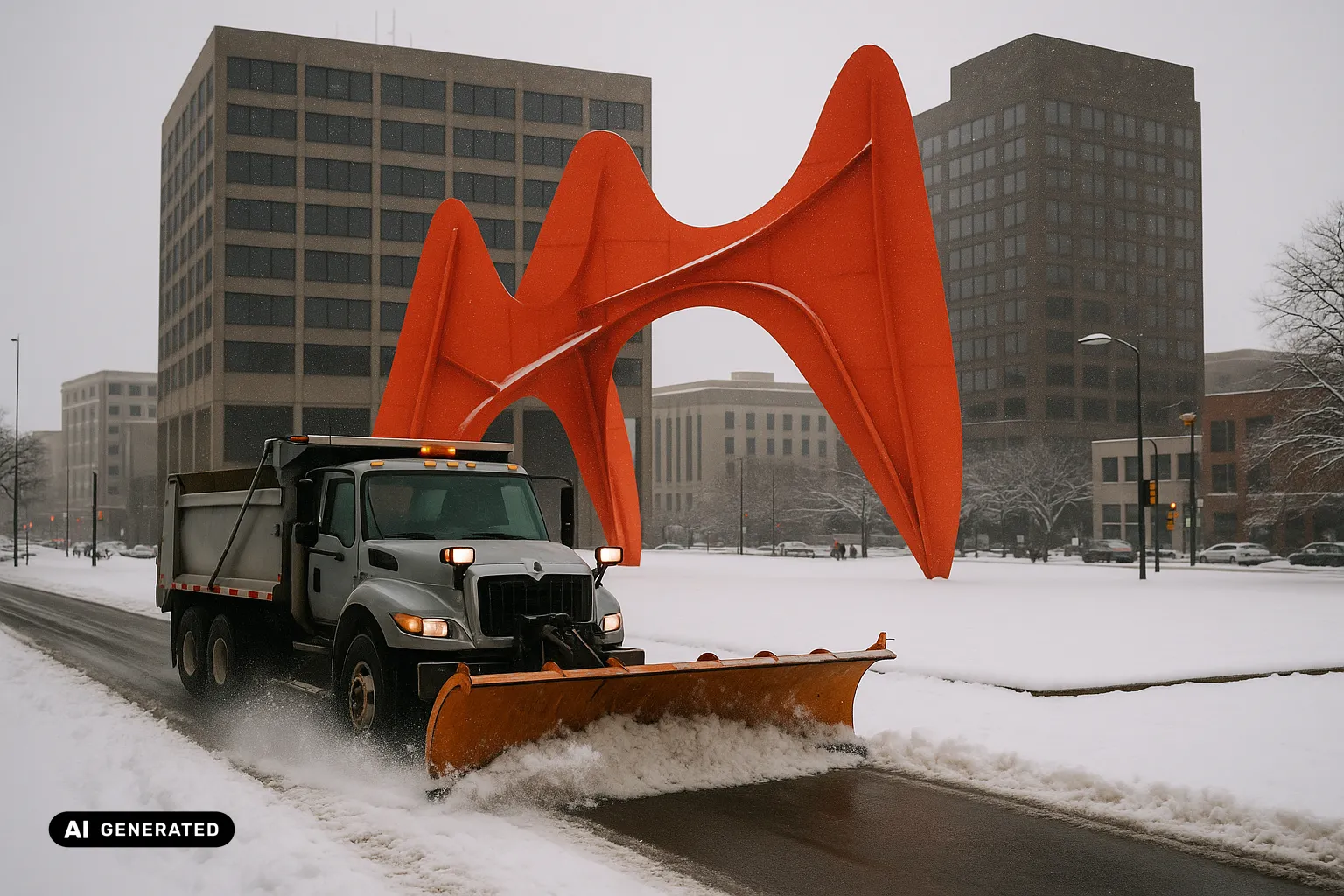
Grand Rapids sits on the Grand River at about 610 feet, in a valley the survey record describes as flat and narrow, surrounded by steep hills and bluffs. That sentence does more work than it looks. The downtown core is on the valley floor; the older residential districts — Heritage Hill on the east-bank bluff, Belknap Lookout to the north-east — sit on the high ground above it. What connects them are short, steep ramp streets, and those are where ice becomes a problem first, well before anyone worries about depth of snow.
The other number that shapes the winter here is 25 miles. That is how far the city lies east of Lake Michigan — close enough to be in lake-effect country, far enough that it is at the inland edge of the belt rather than inside it.
For the scale of what the side of the lake is worth, look straight across it. Milwaukee sits on the western, upwind shore and averages 48.7 inches a season against Grand Rapids’ 77.6 — roughly 30 inches less, on the same water, at much the same latitude.
The wind corridor that decides the season
Most cities in snow-belt country can expect their lake to deliver on a broad range of wind directions. Grand Rapids cannot, and this is the single most useful thing to understand about its winter.
Lake Michigan is elongated north to south, and south-west lower Michigan lies along its eastern side. So lake-effect snow here needs a wind with a westerly component — and the National Weather Service office in Grand Rapids is unusually specific about which one. In its breakdown of wind direction against snow footprint, the city is named for a westerly flow of roughly 260 to 280 degrees, which puts the heaviest bands “from Grand Haven to South Haven and inland to Grand Rapids”.
Move the wind and the snow moves with it. On a north-westerly flow (280–305°) or a north-north-westerly one (305–325°) the focus shifts to Ottawa, Allegan, Van Buren and Kalamazoo counties. Swing it to the north (325–350°) and it is Allegan and Van Buren. Come round to the south-west (215–235°) and the target is Mason County, well to the north. In each of those cases the bands are running past the city, not over it.
The practical consequence is a winter of sharp contrasts over short distances. The January 2024 storm shows it plainly: the Weather Service logged 27.5 inches at one Grand Rapids station and 22.4 at another, 21.9 at East Grand Rapids, 31.6 at the Lowell wastewater plant and 21.0 at Big Rapids. A totals map for a single event can vary by ten inches inside one service area. Anyone quoting “what Grand Rapids got” from a single gauge is quoting one point on a steep gradient.
Across a full season the normals are 77.6 inches at Gerald R. Ford International Airport for 1991–2020, over roughly 50.9 days with at least a tenth of an inch of new snow. January carries 22.6 inches, December 20.8, February 17.2 — and the Weather Service’s own seasonal report gives the December-to-February normal as 60.6 inches, which is exactly those three months added together. The record for a calendar year is 143.7 inches, set in 2008; the largest single day is 16.1 inches, on 26 January 1978. Set against Marquette, on Lake Superior, which averages 149.1 inches over the same normals, the figure says plainly where the city stands: at the edge of the belt, not inside it.
It is also, reliably, a grey winter. The climate record notes the maritime influence of the lake to the west produces a high number of cloudy days through late autumn and winter — which matters less for how much falls than for how slowly anything melts off a north-facing walk.
What the local rules say
Grand Rapids works on two clocks, and confusing them is the most common mistake.
The first is the duty itself. As § 4.89 of the City Code is written, “the occupant or occupants of every property within the City, or the owner or owners of the property, shall clear any accumulation of ice or snow from the public sidewalks adjoining such property within twenty-four (24) hours of the accumulation or placement of snow or ice on said sidewalks.” Two details in that sentence are worth pausing on. The section names occupants as well as owners, so a tenant can be the addressee — the City’s shorter guidance usually says “property owner”, which is a simplification of the text. And the clock runs from the accumulation, not from the end of the storm.
The second clock starts only after the City gets involved. Under § 4.89(2), if the walk is still not clear forty-eight hours after being notified of the violation, the City may have the snow removed. Subsection (3) sets out how that notice can be given — in person, by telephone, by mail, or by written notice left at the property — and adds that mailed notice counts as received two mail delivery days after posting. In practice the City asks complainants to wait the first 24 hours before reporting at all, since it cannot cite a property while it is still snowing.
If the City does the work, § 4.89(4) governs the bill: the cost of removal, determined by the bids the City receives for that work, plus an administrative fee set by resolution of the City Commission. The amount becomes a personal debt owed to the City and may be assessed as a lien against the property until paid. The ordinance deliberately names no figure. For a sense of scale, local reporting in February 2025 put the charge at 183 dollars for the administrative fee and first quarter-hour, 44 dollars per further quarter-hour and 10 dollars a bag of salt, with an average bill near 290 dollars — but those are reported figures from one season, not a published tariff. Violations of Chapter 52 are municipal civil infractions.
None of this is legal advice, and because the wording of the section carries the detail, the sensible move is to read § 4.89 itself rather than rely on a summary.
The licence most cities don’t require
Here is where Grand Rapids differs sharply from its neighbours in the snow belt, and the difference matters to anyone plowing for money.
Article 2 of Chapter 52 licenses snowplow operators. Under § 4.91, “no person shall operate any vehicle or cause any vehicle to be operated within, over or upon any street, sidewalk, highway or right-of-way of the City of Grand Rapids for the purpose of plowing, moving or removing any snow or ice without having first obtained a licence”. The carve-out is narrow: no licence is needed for a plow worked solely on ground the operator owns, or on the right-of-way immediately adjacent to it. Clear your own lot, and you are outside it. Take on a customer’s frontage, and you are inside it.
What the licence involves is set out across the following sections. § 4.92 requires an application to the City Clerk with one or more certificates of public liability and property damage insurance co-insuring the applicant and the City of Grand Rapids, in amounts fixed by the City Commission and in a form approved by the City Attorney. § 4.93 lets the Clerk investigate whether the applicant is fit “to serve the public in a fair, honest, safe and competent manner”, and provides that a separate tag, insignia, licence or number is issued for each vehicle. § 4.94 then requires that each licensed vehicle display the licensee’s name on both sides, clearly visible, in figures at least three inches high, with the tag positioned so it can be read at all times while the vehicle is plowing.
Two more sections shape the risk. § 4.96 makes plow operators responsible for repairing damage to the public right-of-way caused by their work; if the repair does not restore the prior condition, the City may do it and recover the cost as a debt. § 4.97 lists failure to repair damage — public or private — as a ground for denial, suspension or revocation of the licence. And § 4.98 allows the City Manager, with City Commission approval, to set equipment requirements and operational limits for licensed vehicles, rules which “shall have the force and effect of law”.
For a contractor, that adds up to a season where the condition of a kerb, an apron or a driveway approach before and after your visit is not a private matter between you and the customer. It is tied to the licence you work under.
Where the snow may go
§ 4.99 applies to everyone clearing private ground — “whether by use of a shovel, snowblower, or any other method” — and sets three limits. Snow may not be deposited or spread into sidewalks, alleys or streets. It may not be placed so as to obstruct fire hydrants or mailboxes. And it may not be placed so as to create a visual obstruction impairing safe use of the sidewalk, alley or street.
The hydrant clause is the one that catches people out, because a bank does not start out covering anything — it grows over three storms until it does.
How the city clears, and why the salt stops
On the road side the Public Works Department runs 19 “first attention” routes: the streets with the heaviest traffic and the highest speed limits, among them Leonard, Fulton, Burton, Michigan, Hall and Plymouth, and Monroe, Division, Kalamazoo and Eastern avenues. Secondary streets, residential neighbourhoods, cul-de-sacs and alleys are treated once more than three inches have fallen, weighed against the forecast and traffic, with a stated aim of clearing all roads within 24 to 36 hours of an event.
The salting practice is more deliberate than most. Salt goes on all 19 first-attention routes — and generally not on local streets, which the City explains in terms of protecting its watersheds and holding down cost, with exceptions for hills, sharp curves and special locations. Calcium chloride goes down on bridges and curves ahead of an event. The trucks carry liquid tanks for pre-wetting the salt, which keeps it on the road instead of bouncing off and has, by the City’s account, cut salt use by as much as 30 per cent. The plows run side wings that take an extra half lane at a pass.
For residents, the visible instrument is seasonal odd–even parking, in force from 12:01 a.m. on 1 November to 11:59 p.m. on 1 April. Park on the odd-numbered side on odd calendar days, the even side on even days, between 1 a.m. and 6 p.m.; both sides are open from 6 p.m. to 1 a.m., the idea being that the car has moved to the new date’s side by one in the morning. Some streets are signed for one-side parking, where the marked side is barred at all times. The City ties the rule not only to clearing but to keeping catch basins open — a blocked basin during a thaw is how a cleared street floods.
The programme that does not lift the duty
Since December 2020 the City has run a Sidewalk Snow Support Program: a contractor pre-clears more than 200 of the 922 miles of sidewalk in Grand Rapids whenever three or more inches of new snow falls, leaving no more than half an inch behind. To qualify, a sidewalk must be public, at least 48 inches wide, and free of obstructions such as trees grown into the path. The model came from similar schemes in East Grand Rapids and Wyoming.
It is easy to read that as the City taking the job over. It has not. Its own wording is blunt — “We haven’t changed the City Code” — and it states that when the contractor finishes, property owners and residents are still responsible for removing any remaining snow and ice. The programme buys a head start on a fifth of the network. The duty under § 4.89 is untouched, and so is the 24-hour clock.
Around the city
Grand Rapids is the core of Kent County and of the Grand Rapids–Kentwood metropolitan area — Kent, Ottawa, Allegan and Barry counties, more than 1.07 million people at the 2020 count, and Michigan’s second-largest metro after Detroit.
That matters for winter work because each municipality keeps its own rulebook. East Grand Rapids and Wyoming were already running their own sidewalk clearing before the City copied the idea, which means a route crossing those lines crosses between different expectations of who has already been through. Kentwood, Walker and the surrounding townships each run their own roads. And the state trunklines through the area — US-131, I-96, I-196 and M-6 — are MDOT’s responsibility, not the City’s, so a single route can pass through three operations in one storm.
Geography reinforces the split. The lakeshore communities 40 miles west are hit on far more wind directions than the city is; on a north-westerly they can be buried while downtown Grand Rapids sees flurries. Cross a county line here and you have often crossed a weather boundary as well as a legal one.
Keeping the record straight
In a city that licenses the people who plow it, ties that licence to the condition of the ground they work on, and bills for clearing that arrives with a lien attached, the useful thing is being able to show plainly what was done and when.
Not to win an argument. Because a season built on a 24-hour clock, a 48-hour notice period and a narrow wind corridor produces exactly the questions a vague answer cannot settle: was this walk cleared inside the window, what did the approach look like before the blade touched it, how much snow was actually on the ground when the crew arrived. A simple, time-stamped record of each treatment, set against what the weather was actually doing, turns “we were out all night” into something specific — a clear service record whether you look after one property on a bluff street or a route that runs from the valley floor out to Kentwood.
That is the documentation support Wintertrace is built to make easy. It does not change any local rule, and it is not a substitute for legal advice. It just means that when someone asks what happened during the last band, the answer is on file.
Local facts
- Grand Rapids averages about 77.6 inches (roughly 197 cm) of snow a season at Gerald R. Ford International Airport, based on the 1991–2020 climate normals, spread over about 50.9 days a year with at least a tenth of an inch of new snow.Source
- The snowiest months are January (about 22.6 inches), December (about 20.8 inches) and February (about 17.2 inches); the National Weather Service office in Grand Rapids gives the December–February normal as 60.6 inches for the same 1991–2020 period.Source
- The city sits on the Grand River at about 610 feet of elevation, roughly 25 miles (40 km) east of Lake Michigan, in a river valley the US Geological record describes as flat and narrow, surrounded by steep hills and bluffs.Source
- Whether lake-effect bands reach the city depends on a narrow wind corridor: the National Weather Service names Grand Rapids only for a westerly flow of 260–280°, which brings the heaviest snow from Grand Haven to South Haven and inland to Grand Rapids. On north-westerly or northerly winds the bands fall on Ottawa, Allegan and Van Buren counties instead.Source
- Under the City of Grand Rapids Code, § 4.89, the occupant or occupants of every property, or the owner or owners, must clear any accumulation of ice or snow from the adjoining public sidewalks within twenty-four hours of the accumulation or placement of snow or ice.Source
- If the walk is still not clear forty-eight hours after the City gives notice of the violation, the City may have the snow removed; the cost is set by the bids the City receives for that work, plus an administrative fee fixed by resolution of the City Commission, and becomes a personal debt that may be assessed as a lien against the property.Source
- Anyone plowing, moving or removing snow or ice on a street, sidewalk, highway or right-of-way in the city needs a licence from the City Clerk under § 4.91 — no licence is required for plowing solely on ground the operator owns, or the right-of-way immediately adjacent to it.Source
- A licensed contractor must carry public liability and property damage insurance co-insuring the City, receives a separate tag or number for each vehicle, and must display the licensee's name on both sides of every plow vehicle in figures at least three inches high.Source
- Snow cleared from private property may not be deposited or spread into sidewalks, alleys or streets, nor placed so as to obstruct fire hydrants or mailboxes, nor so as to create a visual obstruction (§ 4.99). Violations of Chapter 52 are municipal civil infractions.Source
- Since December 2020 the City has had a contractor pre-clear more than 200 of the 922 miles of sidewalk in Grand Rapids whenever three or more inches fall, leaving no more than half an inch behind — but the City states plainly that it has not changed the City Code, and owners and residents remain responsible for what is left.Source
- The City runs 19 'first attention' plow routes — among them Leonard, Fulton, Burton, Michigan, Hall and Plymouth, and Monroe, Division, Kalamazoo and Eastern avenues — and treats secondary streets and alleys only once more than three inches have fallen, aiming to clear all roads within 24 to 36 hours of an event.Source
- Salt goes on all 19 first-attention routes but generally not on local streets, which the City explains as protecting its watersheds and controlling cost; exceptions are hills, sharp curves and special locations, calcium chloride goes down on bridges and curves ahead of an event, and pre-wetting the salt has cut usage by as much as 30 per cent.Source
- Seasonal odd–even parking runs from 12:01 a.m. on 1 November to 11:59 p.m. on 1 April: park on the odd-numbered side on odd calendar days and the even side on even days between 1 a.m. and 6 p.m., with both sides free from 6 p.m. to 1 a.m. The City ties the rule to street clearing, to keeping catch basins from causing winter flooding, and to emergency access in deep snow.Source
Official contacts
City of Grand Rapids Code — § 4.89, Sidewalks to Be Cleared
The sidewalk section itself: the 24-hour duty on occupants or owners, the 48-hour notice, how notice may be given, and how costs become a debt and a lien.
City of Grand Rapids Code — Article 2, Snowplow Operators (§§ 4.91–4.98)
The licence requirement for commercial plowing, the insurance and vehicle-marking rules, liability for damage, and the grounds for suspension or revocation.
City of Grand Rapids — Report a Snow or Ice Covered Sidewalk
How the City handles complaints: the 24-hour wait, written notice to the owner, 48 hours to comply, then a contractor at the owner's expense.
City of Grand Rapids — Snow Plowing (Public Works)
The first-attention route system, the three-inch threshold for secondary streets, and the City's salt, brine and calcium chloride practice.
City of Grand Rapids — Sidewalk Snow Support Program
Which sidewalks the City pre-clears, the three-inch trigger, the eligibility rules, and the City's own statement that the owner's duty is unchanged.
National Weather Service, Grand Rapids — wind direction and lake-effect snow
The forecast office's breakdown of which wind directions put the lake-effect bands over which counties — and the narrow corridor that reaches the city.
Common questions about winter service in Grand Rapids
- How long do I have to clear my sidewalk in Grand Rapids?
- Twenty-four hours. Under § 4.89 of the City Code, the occupant or occupants of a property, or the owner or owners, must clear any accumulation of ice or snow from the adjoining public sidewalk within twenty-four hours of that snow or ice accumulating or being placed there. Note the wording: the clock runs from the accumulation, not from the end of the storm, and the section names occupants as well as owners, so a tenant can be the addressee. The City's own guidance describes it as clearing the full width down to the concrete. This is general information, not a substitute for legal advice — read the section itself for the exact wording.
- What happens if I don't clear it?
- There is a second clock. If the walk is still not clear forty-eight hours after the City notifies you of the violation, the City may have the snow removed. Notice can be given in person, by telephone, by mail, or by written notice left at the property — and if it goes by mail it counts as received two mail delivery days after posting. The cost is whatever the City's contracted bids come to, plus an administrative fee set by resolution of the City Commission, and it becomes a personal debt that may be assessed as a lien against the property until paid. As of February 2025 local reporting put the charge at 183 dollars for the administrative fee and first quarter-hour, 44 dollars for each further quarter-hour and 10 dollars a bag of salt, with the average bill around 290 dollars; those are reported figures from that season, not a published tariff, and they can change.
- Do I need a licence to plow snow commercially in Grand Rapids?
- Yes, if you are working on public ground. Section 4.91 of the City Code requires a licence for operating any vehicle on a street, sidewalk, highway or right-of-way in the city for the purpose of plowing, moving or removing snow or ice. The exception is narrow: no licence is needed for a plow operated solely on property the person, firm or corporation doing the plowing owns, or on the right-of-way immediately adjacent to it. Applications go to the City Clerk with a certificate of public liability and property damage insurance that co-insures the City, the Clerk may investigate whether the applicant is fit to serve the public, and a separate tag or number is issued for each vehicle. Every licensed vehicle must carry the licensee's name on both sides in figures at least three inches high, with the tag displayed so it can be read whenever the vehicle is plowing.
- What happens if a plow damages a kerb or a driveway approach?
- Section 4.96 puts that on the operator: all snowplow operators are responsible for repairing damage to the public right-of-way caused by plowing. If the repair is not made well enough to restore the property to its prior condition, the City may do the work and recover the cost as a debt. Failure to repair damage — to public or private property — is also listed in § 4.97 as a ground for denying, suspending or revoking a licence. In practice that makes a dated record of the condition you found and left a piece of ground in worth keeping.
- Why does Grand Rapids get less lake-effect snow than the lakeshore towns?
- Because it sits at the inland edge of the belt rather than in it. Lake Michigan is elongated north to south, and south-west lower Michigan lies along its eastern side, so lake-effect snow here needs a wind with a westerly component. The National Weather Service names Grand Rapids specifically for one corridor — a westerly flow of roughly 260 to 280 degrees, which drives the heaviest snow from Grand Haven to South Haven and inland to the city. Turn the wind to the north-west and the bands unload on Ottawa, Allegan, Van Buren and Kalamazoo counties; turn it further north and it is Allegan and Van Buren. Forty miles west the lakeshore communities get hit on far more wind directions than the city does.
- Does the City clearing sidewalks mean I no longer have to?
- No, and the City says so directly. Since December 2020 a contractor has pre-cleared more than 200 of the 922 miles of sidewalk in Grand Rapids whenever three or more inches of new snow falls, leaving no more than half an inch behind. To be included, a sidewalk has to be public, at least 48 inches wide and free of obstructions such as trees growing into it. But the City's own wording is that it has not changed the City Code, and that once the contractor finishes, property owners and residents remain responsible for removing any snow and ice still there. The programme is a head start, not a transfer of the duty.
- Which streets get plowed first, and does everything get salted?
- The City runs 19 'first attention' routes — the streets carrying the most traffic at the highest speed limits, among them Leonard, Fulton, Burton, Michigan and Hall streets and Monroe, Division, Kalamazoo and Eastern avenues. Secondary streets, residential neighbourhoods, cul-de-sacs and alleys are treated once more than three inches have fallen, depending on the forecast and traffic, with a stated goal of clearing all roads within 24 to 36 hours of an event. Salt is a different question: it goes on all 19 first-attention routes, but generally not on local streets. The City gives two reasons — protecting its watersheds and controlling cost — and makes exceptions for hills, sharp curves and special locations. Calcium chloride goes down on bridges and curves ahead of an event, and pre-wetting the salt on the truck has cut usage by as much as 30 per cent.
- Where can I put the snow I clear off my own property?
- Not on the public way. Section 4.99 applies to everyone removing snow from private property, whether by shovel, snowblower or any other method, and sets three limits: snow may not be deposited or spread into sidewalks, alleys or streets; it may not be placed so as to obstruct fire hydrants or mailboxes; and it may not be placed so as to create a visual obstruction that impairs the safe use of sidewalks, alleys or streets. Violations of Chapter 52 are municipal civil infractions. The hydrant point is easy to overlook when a bank builds up over a long storm.
- How does winter parking work here?
- Grand Rapids runs a seasonal odd–even system rather than declaring individual snow emergencies. From 12:01 a.m. on 1 November to 11:59 p.m. on 1 April, you park on the odd-numbered side of the street on odd calendar days and the even-numbered side on even days, between 1 a.m. and 6 p.m. Between 6 p.m. and 1 a.m. both sides are open — the point being that by 1 a.m. the car should have moved to the side matching the new date. Some streets are signed for one-side parking, where the marked side is off limits at all times. The City ties the rule to three things: letting crews clean and clear the street, keeping catch basins clear so winter melt does not flood, and keeping access open for emergency vehicles when the snow is deep.
Documenting winter service in Grand Rapids
Anyone clearing snow and ice in Grand Rapids may later need to show when and where a route was treated. Wintertrace is open-source software that records exactly that — time, location and weather for each run — as a calm basis for your own operational records and service proof. It is not a substitute for legal advice.
This overview is for general information and is not legal advice. Local rules on snow and ice clearing vary — the wording of the local rule and the responsible authority always govern.