Winter service · Michigan
Winter service in Marquette
What winter is really like in Marquette, on the south shore of Lake Superior: about 149 inches of snow a season, the third-snowiest spot in the contiguous United States, on a lake that rarely freezes over so the lake-effect runs all winter. The city and DDA clear 6.5 miles of downtown sidewalks, the winter parking ban that opens the streets at night, and a lakeshore road the lake keeps reclaiming.
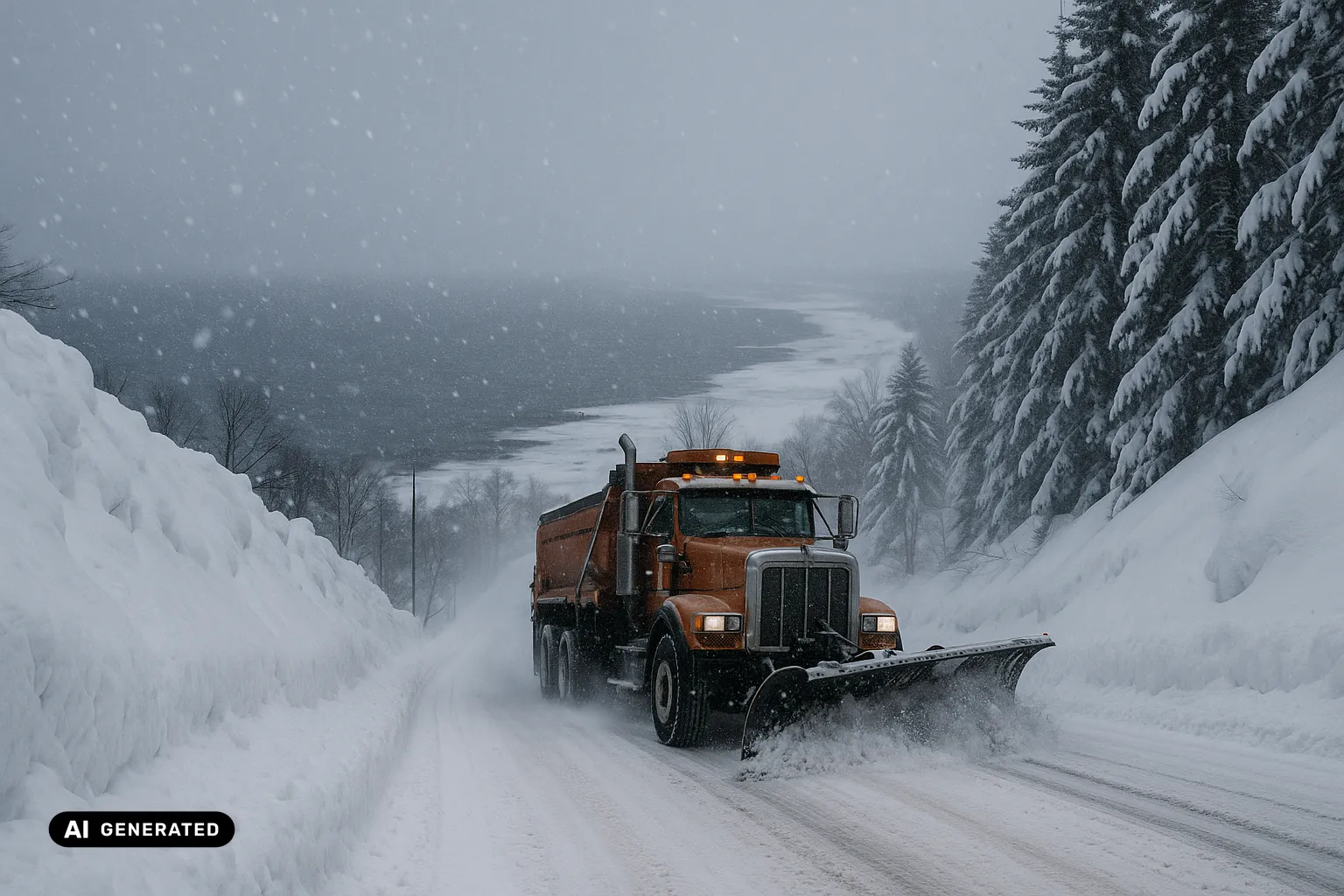
What winter actually does in Marquette
Marquette is the largest city in Michigan’s Upper Peninsula and the seat of Marquette County, set on the south shore of Lake Superior at the base of the Huron Mountains. It is a hilly place — a 600-foot vertical difference from the top of the city to the bottom, from a downtown near the water up to residential streets on the slopes behind. That combination, an open, cold, deep lake on one side and rising ground on the other, is the setup for one of the snowiest winters anywhere in the country.
The number is extraordinary: about 149.1 inches — nearly 3.8 metres — of snow in an average season, which makes Marquette the third-snowiest location in the contiguous United States. And it does not arrive in a few big storms; it accumulates across a long season, from an inch or so in October through more than eight inches in April, peaking near 25 inches in January. Roughly 65 days a year see snow. Winter service here is not a series of events to brace for — it is a months-long operation to sustain.
The reason the totals run so high sits in the lake itself. Lake Superior rarely freezes over completely. Where the shallower lower Great Lakes ice over by mid-winter and switch their lake-effect snow off — as Lake Erie does for Erie and Buffalo — Superior stays open and keeps feeding the bands all winter. Cold air crossing that open water turns unstable fast: in one documented event the Weather Service in Marquette measured a 20 °C difference between the air aloft and the lake surface, with snow falling at 1 to 2 inches an hour. This is a different animal from the deep-freeze of the Minnesota interior at Minneapolis, and even from Duluth across the same lake — Duluth on the north shore averages far less than Marquette does on the south.
A city that clears its own downtown
The most distinctive thing about winter service in Marquette is who does the clearing — and it works on two levels. The city ordinance (Sec. 42-42) puts the legal duty on the occupant or owner of property adjoining the sidewalk in the designated downtown snow-removal districts — the core of Washington, Main, Front and Spring Streets, Baraga Avenue and the Lakeshore Boulevard frontage listed in Sec. 42-41. There the deadline is quick: clear the walk within two hours if the snow stops during the day, or by 10 a.m. the following morning if it stops overnight. On top of that, the city and its Downtown Development Authority actually clear 6.5 miles of downtown sidewalk and the public parking lots themselves, all winter, funded out of downtown parking income. But the code is explicit that owners are “not relieved” of their own duty where that assistance is provided — the city’s clearing is a service laid over the obligation, not a replacement for it. Outside those districts there is no district ordinance, and officials simply ask residents and businesses to keep their own sidewalks clear.
The city’s own plowing priorities follow the same logic of keeping people moving: the heavily-used pedestrian areas and downtown sidewalks come first, then the roads that are vital for emergency and school-bus access, and dead-end streets are cleared last. With season totals near 149 inches, streets routinely need clearing more than once in a single storm, so a quiet cul-de-sac waits while the main routes stay open. It is the kind of operation a municipal winter service plans around capacity, not around any single snowfall.
The parking ban and where the snow goes
Two rules keep that operation workable, and both are worth knowing before winter.
The first is the winter parking ban. From 1 November to 1 April, there is no parking on any city street between 1 a.m. and 6 a.m. The overnight window exists so crews can plow and haul snow from the streets and downtown lots with no cars in the way. The fine is $75, and a vehicle that obstructs the clearing can be towed. It is an active instrument, not a formality — and several neighbours run their own versions, so the hours can change across a town line.
The second is where the snow goes. Under Sec. 22-25 of the City Code, snow or ice removed from private property may not be placed on any public property — streets, sidewalks, crosswalks or gutters — where it refreezes and blocks the plows (there is a narrow allowance for piling driveway snow along the city’s own plow bank, within limits). The city’s fee schedule lists a street or sidewalk obstruction at $105. On the steep lots that Marquette’s terrain produces, with a great deal of snow to move, that turns where the snow goes into a genuine planning question. None of this is legal advice; it is simply how the city runs its winter.
The lake, the hills, and the towns around
It helps to picture Marquette winter service as several exposures on one steep map. The lakeshore is the most exposed to the lake itself — Lakeshore Boulevard has been flooded so often that the city is moving parts of it 100 yards inland, and the open water brings freezing spray, wave wash and ice before the higher streets see them. Presque Isle Park, the wooded peninsula to the north, and the campus of Northern Michigan University each carry their own winter footfall. And the hills mean that many residential and business streets are grades — hard to climb once they glaze over.
Around the city, the neighbours keep their own winters and their own rules. Negaunee and Ishpeming sit to the west, up along the old iron range on higher interior ground; Harvey lies to the south; Marquette Charter Township wraps part of the city. Because that higher inland ground lifts the incoming lake air, the interior communities often see even more snow than the lakeshore — and each runs its own operation. So Marquette’s downtown clearing and its parking ban describe the city itself; cross a boundary and both the snow and the rulebook change. The state trunk highways through town, US-41 and M-28, are a separate responsibility again, maintained by MDOT.
Down in the Lower Peninsula the same lake logic produces a much smaller winter. Grand Rapids averages 77.6 inches — roughly half Marquette’s total — because it sits 25 miles inland from Lake Michigan and the Weather Service names it for only one narrow westerly corridor, 260 to 280 degrees. It also licenses every firm that plows its public ground, which is worth knowing if you take work in both peninsulas.
Keeping the record straight
Across a five-month season that can bury a steep street more than once in a day, the useful thing is being able to show, plainly, what was done and when. Not to win an argument, but because a winter this long and this heavy generates exactly the questions — was the route cleared, at what time, in what conditions — that a vague answer can’t settle. A simple, time-stamped record of each pass, with where the crew actually went and how long each route took, turns “we were out all winter” into something specific. That is the documentation support Wintertrace is built to make easy — whether you run a downtown route, a hillside of driveways, or a municipal fleet working from October to April. It does not change any local rule; it just means that when someone asks what happened during the last storm, the answer is on file. Not a substitute for legal advice.
Local facts
- Marquette averages about 149.1 inches (3.79 metres) of snow a season, based on the 1991–2020 climate normals — making it the third-snowiest location in the contiguous United States.Source
- The snow is spread across a long season: measurable falls from October (about 0.9 inch) through April (about 8.4 inches), peaking in January (about 25.1 inches), with December (21.1) and February (20.9) close behind and roughly 65 days a year seeing snow.Source
- The mean January low is about 12.4 °F (−10.9 °C); the coldest reading on record is −33 °F (−36 °C), set on 8 February 1861, and the greatest measured snow depth is 36.1 inches (92 cm).Source
- Marquette's snowiest season on record brought 194.7 inches (the year ending 31 December 1893), and its one-day record is 23 inches, on 5 February 1944.Source
- Marquette is the largest city in Michigan's Upper Peninsula and the seat of Marquette County, set on the shore of Lake Superior at the base of the Huron Mountains, on hilly terrain with a 600-foot (180 m) vertical difference from top to bottom (city elevation about 666 feet).Source
- Because Lake Superior rarely freezes over completely, lake-effect snow persists throughout the winter here — the mechanism that drives Marquette's exceptional totals, unlike the shallower lower Great Lakes that ice over and shut their snow off.Source
- In a documented lake-effect event, the National Weather Service in Marquette measured a difference between the 850 mb and lake temperatures of nearly 20 °C — the instability that fuels the snow — with snowfall rates approaching 1–2 inches an hour in the convective cores.Source
- Under the City Code (Sec. 42-42), in the designated downtown snow-removal districts listed in Sec. 42-41 — the core of Washington, Main, Front and Spring Streets, Baraga Avenue and the Lakeshore Boulevard frontage — the occupant or owner of an adjoining property must clear the sidewalk within two hours if the snow stops during the day, or by 10 a.m. the next morning if it stops overnight, and the code states owners are 'not relieved' of that duty where the public works department or Downtown Development Authority also clears snow.Source
- On top of that duty, the city and its Downtown Development Authority actually clear 6.5 miles of downtown sidewalk and multiple parking lots of snow all winter, funded from downtown parking income; the city's stated plowing priorities put heavily-used pedestrian areas and downtown sidewalks first, then routes vital for emergency and school-bus access, with dead-end streets cleared last.Source
- A winter parking ban runs from 1 November to 1 April: no parking on any city street between 1 a.m. and 6 a.m., a $75 fine, and towing for vehicles that obstruct the clearing.Source
- Under Sec. 22-25 of the City Code, snow or ice removed from private property may not be placed on any public property — streets, sidewalks, crosswalks or gutters (with a narrow allowance for piling driveway snow along the city's own plow bank, within limits); the city's fee schedule lists a street/sidewalk obstruction at $105.Source
- Lake Superior is powerful enough to reshape the city's edge: portions of Lakeshore Boulevard, repeatedly flooded by the lake, are being moved 100 yards (91 m) inland.Source
Official contacts
City of Marquette — Street Maintenance (Public Works)
The city department responsible for plowing and maintaining public streets.
City of Marquette Code of Ordinances (Municode)
The sidewalk-clearing duty and snow-removal districts (Secs. 42-41 / 42-42), the ban on depositing snow on public property (Sec. 22-25), and the winter parking ban (Ch. 46).
Downtown Marquette (DDA) — winter parking ban
The 1 November–1 April overnight parking ban (1 a.m.–6 a.m.), the $75 fine and towing.
Downtown Marquette (DDA) — permit parking and downtown snow clearing
How the DDA clears 6.5 miles of downtown sidewalk and the parking lots all winter, funded from parking income.
National Weather Service, Marquette — seasonal snowfall maps
The forecast office's seasonal snowfall mapping for Marquette and the wider Upper Peninsula.
MDOT — MiDrive live road conditions (US-41 / M-28)
State road and winter conditions for the trunk highways through Marquette, maintained by MDOT.
Common questions about winter service in Marquette
- Do I have to shovel my own sidewalk in Marquette?
- It works on two levels. In the designated downtown snow-removal districts — the core of Washington, Main, Front and Spring Streets, Baraga Avenue and the Lakeshore Boulevard frontage — the city ordinance (Sec. 42-42) puts the duty on the occupant or owner of the adjoining property: clear the walk within two hours if the snow stops during the day, or by 10 a.m. the next morning if it stops overnight. The city and its Downtown Development Authority also clear 6.5 miles of downtown sidewalk themselves, funded from parking income — but the code says owners are 'not relieved' of their duty where that assistance is provided, so the two run together rather than one replacing the other. Outside those districts there is no district ordinance, and officials simply ask residents to keep their own sidewalks clear. This is general information, not a substitute for legal advice — check the City Code for the exact wording.
- Why does Marquette get so much snow?
- Because of Lake Superior. Cold air crossing the open water picks up heat and moisture, turns unstable, and falls out as lake-effect snow — and the crucial detail is that Lake Superior, the coldest and deepest of the Great Lakes, rarely freezes over completely. Where the shallower lower lakes ice over and switch their snow off by mid-winter, Superior stays open and keeps feeding the bands right through the season. That, plus the hills rising behind the city, is why Marquette averages about 149 inches a year and ranks as the third-snowiest place in the contiguous United States.
- How long does winter last in Marquette?
- Long. Measurable snow falls from October — about an inch in the average October — through April, which still averages more than eight inches. The peak is January at about 25 inches, with December and February close behind, and roughly 65 days a year see snow. In practice winter service here is not a handful of events but a months-long operation, which is part of why the city runs its downtown clearing and its parking ban across a full five-month window.
- What is the winter parking ban, and when does it apply?
- From 1 November to 1 April there is no parking on any city street between 1 a.m. and 6 a.m. The overnight window exists so crews can plow and haul snow from the streets and downtown lots without cars in the way. The fine is $75, and a vehicle that obstructs the clearing can be towed. Several neighbouring communities — Ishpeming, Negaunee and Michigamme among them — run their own winter parking bans too, so the rule and its hours can change the moment you cross into the next town.
- Where am I allowed to put the snow I clear?
- Not on public property. Under Sec. 22-25 of the City Code, snow or ice removed from private property may not be placed on any public property — streets, sidewalks, crosswalks or gutters — though there is a narrow allowance for piling driveway snow along the city's own plow bank, within limits. Doing it wrong can bring a ticket, and the city's fee schedule lists a street or sidewalk obstruction at $105. On steep lots with a lot of snow to move, that makes where the snow goes a real planning question, not an afterthought.
- When does the city plow my street after a storm?
- In priority order, and the timing depends on when the storm ends. The city clears the heavily-used pedestrian areas and downtown sidewalks first, then the roads that are vital for emergency and school-bus access, and dead-end streets are the last to be plowed. Given season totals near 149 inches, streets often need clearing more than once in a storm, so a quiet cul-de-sac may wait while the main routes are kept open.
- Why does Lakeshore Boulevard keep getting moved?
- Because Lake Superior keeps reclaiming it. Portions of Lakeshore Boulevard have been repeatedly flooded by the lake, and the city is moving them about 100 yards inland. The road runs right along the open, cold water, which makes it one of the first places to see freezing spray, wave wash and ice in winter — an exposure the higher streets inland do not share. It is a vivid reminder that on this shore the lake is not just the snow source; it shapes the ground the roads sit on.
- Do Negaunee, Ishpeming and the townships have the same rules as Marquette?
- No. Marquette is one city; Negaunee and Ishpeming to the west, Harvey to the south, and Marquette Charter Township around it are separate communities, each with its own roads and its own winter rules — several, like Ishpeming and Negaunee, run their own overnight parking bans. Because the higher inland ground toward the old iron range and the Huron Mountains lifts the incoming lake air, those interior communities tend to see even more snow than the lakeshore. So Marquette's downtown clearing and its parking ban describe the city itself; cross a boundary and both the snow and the rulebook change.
Documenting winter service in Marquette
Anyone clearing snow and ice in Marquette may later need to show when and where a route was treated. Wintertrace is open-source software that records exactly that — time, location and weather for each run — as a calm basis for your own operational records and service proof. It is not a substitute for legal advice.
This overview is for general information and is not legal advice. Local rules on snow and ice clearing vary — the wording of the local rule and the responsible authority always govern.