Winter service · Pennsylvania
Winter service in Erie
What winter is really like in Erie, Pennsylvania: about 104 inches of snow a year, deep in the Lake Erie snow belt on the shallowest of the Great Lakes. The Christmas 2017 lake-effect storm that dropped 48.9 inches at the airport and set a state record, the City of Erie's three-hour sidewalk rule under § 717.01, odd–even snow-emergency parking, and who clears what.
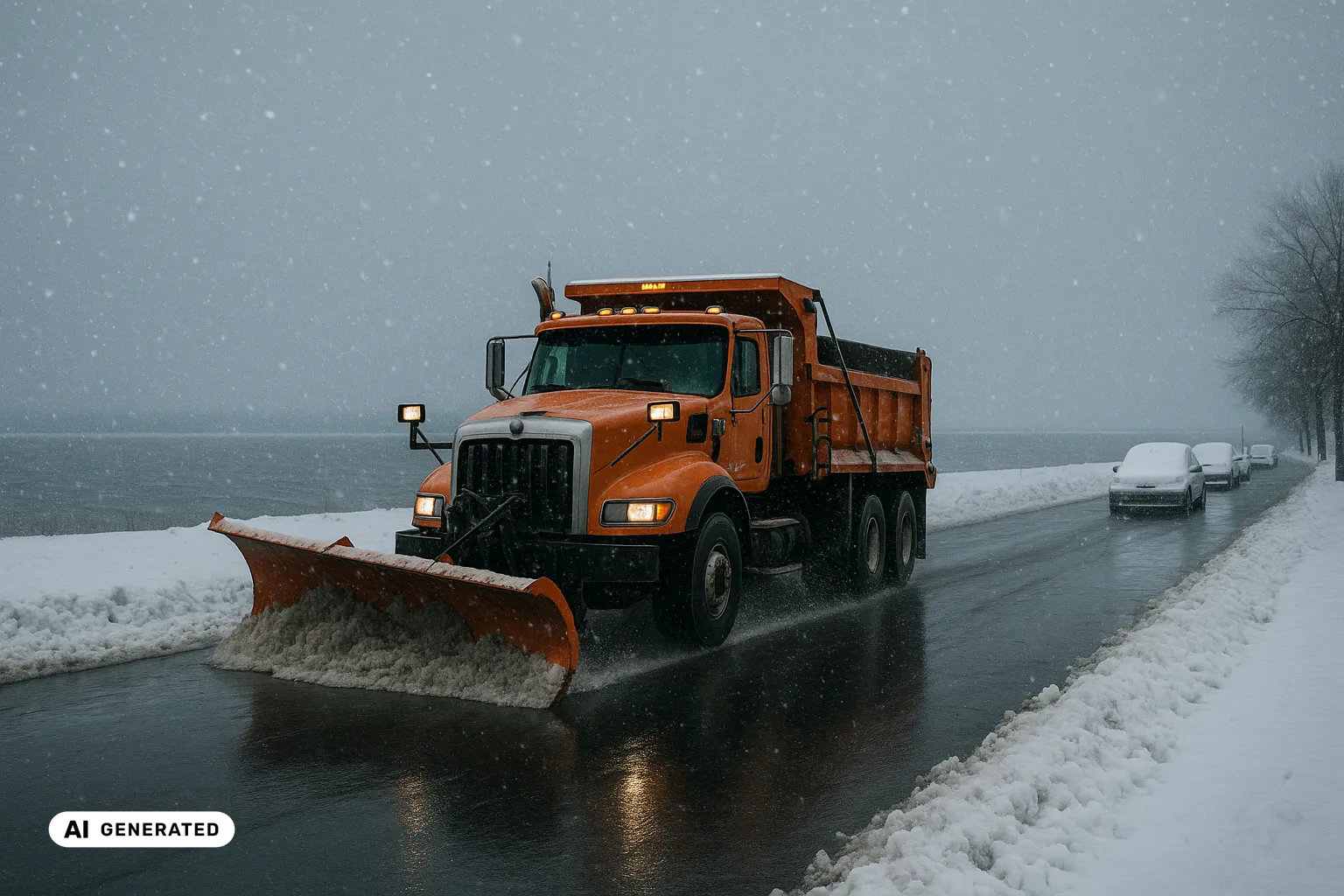
What winter actually does in Erie
Erie sits on the south shore of Lake Erie in the north-western corner of Pennsylvania — about 90 miles south-west of Buffalo and 100 miles north-east of Cleveland, the middle link in a chain of snowy lakefront cities. The lake surface is at about 571 feet; the city stands near 728 feet and keeps rising to the south, so the built-up area climbs away from the water. Reaching into the lake is Presque Isle, a curving sandspit that gives Erie a fine natural harbour and shelters Presque Isle Bay, the city’s bayfront. That geography — an open, shallow lake to the north and rising ground behind — is the whole setup for an Erie winter.
The headline number tells you most of the story: about 104.3 inches of snow a season at the airport, one of the highest totals of any sizeable city in the United States and well above what falls on the same lake at Buffalo or Cleveland. Erie’s snow is lake-effect: cold air crossing the open water of Lake Erie picks up heat and moisture, turns unstable, and organises into narrow, intense bands that unload on the shore and, especially, on the higher ground behind it. Erie lies squarely in the snow belt that runs from Cleveland through Erie to Syracuse and Watertown.
There is a quirk that makes Erie the extreme case on this lake. Lake Erie is the shallowest of the Great Lakes and the only one that regularly freezes over completely. While it stays open, it is — in the words of one account — the “least spectacular” Great Lake behaving as a devastating snow machine. So the season has a rhythm: an open lake in early winter delivers the heaviest, most relentless snow, and once the lake ices over, the classic lake-effect supply shuts down.
The Christmas 2017 storm
If one event defines Erie’s reputation, it is the Christmas 2017 storm. From 24 to 27 December, a near-stationary lake-effect band parked over the city and simply did not move. Erie International Airport recorded a storm total of 48.9 inches, with around 21 inches on Christmas Day alone, and the higher ground inland did worse still — Colt Station reached 59 inches. The numbers were extreme enough that a State Climate Extremes Committee was convened to authenticate them, and the event broke Pennsylvania’s two-day snowstorm record.
It is worth separating the official figure from the ones that circulated in the news. The National Weather Service total for the 24–27 December window is the 48.9 inches at the airport; some media counts, measured over a different window beginning on Christmas Eve, ran higher. For anyone planning winter work, the lesson of Christmas 2017 is less about the exact record than about the mechanism: a single band, stationary for days, can bury one part of the area while a few miles away the total is far lower — the same gap the 48.9-inch airport reading and the 59-inch Colt Station reading show in one storm.
What the local rules say
Erie’s sidewalk rule is unusually quick off the mark. As the City of Erie’s Codified Ordinances, § 717.01 (Snow and Ice Removal) is written, the occupant of a building fronting a sidewalk is to remove snow, ice or sleet within three hours after it stops falling or forming — where many cities give until the next morning, Erie counts in hours. If the ice has frozen too hard to lift without damaging the walk, the ordinance calls for treating it with sand or sawdust to make the surface safe until it can be cleared, and in a building with several occupants the duty falls on the ground-floor occupant.
If the work is not done, the City can have the walk cleared at the owner’s expense, and a violation is a summary offence carrying, on conviction, a fine of $300 or up to 90 days, or both. That is a firmer penalty than some cities attach to the same duty — but the point here is simply what the code says, not a warning. None of this is legal advice, and because the three-hour window and the exact wording matter, the sensible move is to read the ordinance itself rather than rely on a summary.
The contrast at the other end of the state is worth knowing if you work both ends of it. Pittsburgh allows 24 hours under its § 419.03 and names tenants first among those who owe the duty, where Erie counts in hours and addresses the occupant. Same state, same code publisher, two very different clocks.
How the city clears — and the snow-emergency parking
On the road side, the Bureau of Streets, in the Department of Public Works, plows and salts the public city streets. The interstates and state routes — I-79, I-90 and the state highways — are maintained separately by PennDOT, so a route that runs off a city street onto a state road crosses from one operation to another mid-storm.
The instrument that keeps the streets clearable is the snow emergency. When conditions warrant, the City can declare one and restrict parking on its snow-emergency routes so crews can clear them end to end. Under Article 512 of the Codified Ordinances the Mayor or Director of Public Works can put the restriction in place and, when a storm demands, extend the inner-city odd–even parking rule to include Saturday and Sunday. Each designated route is posted with a sign that spells out the deal — “No Parking During Emergency. Snow Tires or Chains Required. Tow-Away Zone” — and the Police Bureau is authorised to tow vehicles that obstruct the clearing or stall for want of snow tires or chains. When an emergency is in force, moving off the route is what actually lets the plow through. It is the same practical idea as the driving bans further along the lake at Buffalo, scaled to a city that expects to do this many times a winter.
Presque Isle, the bayfront, and the townships
It helps to read Erie winter service as more than one exposure on one map. The bayfront and the Presque Isle frontage are wind-open and close to the lake, where freezing spray and wind arrive first. The higher ground to the south and east is where the snow belt does its heaviest work — the elevated bands, the totals that outrun the airport figure, as Colt Station’s 59 inches did in 2017.
Around the city, the neighbours each keep their own winter. Millcreek Township, Erie’s largest neighbour with around 55,000 residents, wraps the city to the west and south; Harborcreek, Lawrence Park and Wesleyville sit to the east; North East and Fairview lie further out. Every one is a separate township or borough inside Erie County, with its own roads and its own rules, and because the snow belt favours the higher inland ground, the more southerly and easterly of them often carry more snow than the bayfront. So the City’s three-hour rule and its snow-emergency routes describe Erie proper; cross a township line and the rulebook changes, even though the lake-effect band does not.
Keeping the record straight
In a place where a single stalled band can drop four feet on the airport and five on the ground just inland, the useful thing is being able to show, plainly, what was done and when. Not to win an argument, but because a winter this intense generates exactly the questions — was the route cleared, at what time, in what conditions — that a vague answer can’t settle. A simple, time-stamped record of each treatment, set against what the weather was actually doing, turns “we were out all night” into something specific — a clear service record whether you look after one property or a route that climbs from the bayfront into the snow belt. That is the documentation support Wintertrace is built to make easy. It does not change any local rule; it just means that when someone asks what happened during the last band, the answer is on file. Not a substitute for legal advice.
Local facts
- Erie averages about 104.3 inches (around 265 cm) of snow a season at Erie International Airport, based on the 1991–2020 climate normals — one of the highest totals of any sizeable city in the United States, and well above its neighbours along the same lake.Source
- The snowiest months are January (about 31.8 inches), December (about 26.3 inches) and February (about 19.4 inches), with roughly 28 days a year seeing at least an inch of new snow.Source
- Erie's snowiest season on record was 2017–2018, which set a local record with 198.5 inches — nearly twice the average.Source
- The city sits on the south shore of Lake Erie in north-western Pennsylvania, about 90 miles south-west of Buffalo and 100 miles north-east of Cleveland; the city stands near 728 feet of elevation while the lake surface is about 571 feet, so the built-up area climbs away from the water to the south.Source
- Presque Isle — a curving sandspit peninsula reaching into the lake — gives Erie a fine natural harbour and shelters Presque Isle Bay, the city's bayfront; Presque Isle State Park is a National Natural Landmark.Source
- Erie lies squarely in the snow belt that runs from Cleveland through Erie to Buffalo, Syracuse and Watertown — the arc of lake-effect country downwind of the lower Great Lakes.Source
- Lake Erie is the shallowest of the Great Lakes and the only one that regularly freezes over completely; while it stays open it is an intense snow machine, so a late or incomplete freeze lengthens Erie's lake-effect season.Source
- In the Christmas 2017 lake-effect event (24–27 December), a near-stationary band dropped a storm total of 48.9 inches at Erie International Airport — around 21 inches on Christmas Day alone — with nearby Colt Station reaching 59 inches; a State Climate Extremes Committee was convened, and the event broke Pennsylvania's two-day snowstorm record.Source
- Under the City of Erie's Codified Ordinances, § 717.01 (Snow and Ice Removal), the occupant of a building fronting a sidewalk is to remove snow, ice or sleet within three hours after it stops falling or forming.Source
- Where the ice has frozen too hard to remove without damaging the walk, the same ordinance calls for it to be treated with sand or sawdust to make the surface safe until it can be cleared; in a multi-occupant building the duty falls on the ground-floor occupant.Source
- If the work is not done, the City can have the snow removed at the property owner's expense; a violation is a summary offence carrying, on conviction, a fine of $300 or up to 90 days, or both.Source
- During a declared snow emergency the City restricts parking on its designated snow-emergency routes; under Article 512 of the Codified Ordinances it can extend the inner-city odd–even parking rule to include Saturday and Sunday, and the Police Bureau is authorised to tow vehicles that obstruct the clearing.Source
- The City of Erie's Bureau of Streets, in the Department of Public Works, is the body responsible for plowing and salting the public city streets; the interstates and state routes (I-79, I-90) are maintained separately by PennDOT.Source
Official contacts
City of Erie Codified Ordinances — § 717.01 (Snow and Ice Removal)
The sidewalk ordinance: the three-hour rule, the ground-floor-occupant duty, sand or sawdust on frozen ice, cost recovery, and the summary-offence penalty.
City of Erie — Bureau of Streets (Department of Public Works)
The city body responsible for snow plowing and salting on public city streets.
City of Erie Codified Ordinances — Snow Emergency
How the City declares a snow emergency and runs odd–even parking on emergency routes so crews can clear them.
National Weather Service, Cleveland — snow climatology for Erie
Seasonal and monthly snowfall history for Erie, with the period of record back to 1893.
National Weather Service — Erie record snowfall, 24–27 December 2017
The forecast office's write-up of the Christmas 2017 storm, the 48.9-inch airport total and the state record.
Common questions about winter service in Erie
- Do I have to clear the sidewalk in front of my property in Erie?
- Under the City of Erie's Codified Ordinances, § 717.01, the occupant of a building fronting a sidewalk is to remove snow, ice or sleet within three hours after it stops falling or forming — a notably short window compared with the morning deadlines many cities use. If the ice has frozen too hard to lift without damaging the walk, the ordinance calls for treating it with sand or sawdust until it can be cleared, and in a building with several occupants the duty falls on the ground-floor one. If it is not done, the City can have the walk cleared at the owner's expense, and a violation is a summary offence carrying a fine of $300 or up to 90 days, or both. This is general information, not a substitute for legal advice — read the ordinance itself for the exact wording.
- Why does Erie get so much snow?
- Because of the lake. Cold air crossing the open, relatively warm water of Lake Erie picks up heat and moisture, turns unstable, and organises into narrow, intense lake-effect bands that unload on the shore and the higher ground behind it. Erie sits in the snow belt that runs from Cleveland to Buffalo and on to Syracuse, and it has a particular quirk: Lake Erie is the shallowest of the Great Lakes and the only one that regularly freezes over completely. While it stays open it is a genuine snow machine — which is why Erie's roughly 104 inches a year is among the highest totals of any city its size in the country.
- What actually happened in the Christmas 2017 storm?
- A near-stationary lake-effect band parked over Erie from 24 to 27 December 2017 and did not move. Erie International Airport recorded a storm total of 48.9 inches, with around 21 inches on Christmas Day alone, and nearby Colt Station reached 59 inches. The totals were extreme enough that a State Climate Extremes Committee was convened to authenticate the measurements, and the event broke Pennsylvania's two-day snowstorm record. It is the clearest illustration of what a single stalled band can do here — and of why a storm total for 'Erie' can vary sharply between the airport and the higher ground just inland.
- Does the snow stop once Lake Erie freezes over?
- Largely, for the lake-effect kind. Lake-effect snow needs open water for the cold air to draw heat and moisture from. Lake Erie is shallow and freezes earlier and more completely than the deeper Great Lakes, so once it ices over the relentless bands ease, and Erie's fiercest lake-effect stretch tends to fall in early and mid-winter, before the freeze. Broad synoptic storms — the systems that snow on everyone at once — can still arrive afterwards, but the signature Erie burial needs an open lake.
- What is Erie's snow emergency, and how does the odd–even parking work?
- When conditions warrant, the City can declare a snow emergency under Article 512 of its Codified Ordinances and restrict parking on its designated snow-emergency routes so crews can clear them end to end. Erie runs an odd–even parking system in the inner city, and the Mayor or Director of Public Works can extend that rule to include Saturday and Sunday when a storm demands. Designated routes are posted with signs reading 'Snow Emergency Route — No Parking During Emergency — Snow Tires or Chains Required — Tow-Away Zone', and the Police Bureau is authorised to tow vehicles that obstruct the work or stall for want of snow tires or chains. When an emergency is in force, moving your car off the route is what lets the street actually get cleared.
- Who plows the roads in Erie — the city or the state?
- It is split. The City of Erie's Bureau of Streets, part of the Department of Public Works, plows and salts the public city streets. The interstates and state routes through the area — I-79, I-90 and the state highways — are maintained separately by PennDOT. So a route that runs from a city street onto a state highway crosses from one operation to another, each with its own equipment and priorities, even in the same storm.
- Is the bayfront or the higher ground the snowier part of Erie?
- The higher ground, generally. The city climbs from a lake surface near 571 feet to about 728 feet and keeps rising to the south and east, and lake-effect snow feeds on exactly that lift — the bands wring out more over the elevated snow belt inland than over the bayfront on the upwind edge. The Christmas 2017 event showed it plainly: 48.9 inches at the airport, but 59 inches at Colt Station a short way inland. The exposed, wind-open Presque Isle Bay frontage has its own problem, closer to freezing spray and wind than to the deepest totals.
- Are Millcreek and the surrounding townships part of the City of Erie?
- No. The City of Erie is one municipality; Millcreek — its largest neighbour, with around 55,000 residents — along with Harborcreek, Lawrence Park, Wesleyville, North East and Fairview are separate townships and boroughs within Erie County, each running its own roads and its own winter rules. Because the snow belt sits on the higher ground, the more southerly and easterly townships often carry more snow than the bayfront. So the City's three-hour sidewalk rule and its snow-emergency routes describe Erie proper; cross a township line and you are into a different local rulebook, even though the band overhead does not stop at it.
Documenting winter service in Erie
Anyone clearing snow and ice in Erie may later need to show when and where a route was treated. Wintertrace is open-source software that records exactly that — time, location and weather for each run — as a calm basis for your own operational records and service proof. It is not a substitute for legal advice.
This overview is for general information and is not legal advice. Local rules on snow and ice clearing vary — the wording of the local rule and the responsible authority always govern.