Winter service · Pennsylvania
Winter service in Pittsburgh
What winter is really like in Pittsburgh, Pennsylvania: about 44.1 inches of snow a year — a third of Erie's — but 113.6 frost nights against only 31.7 days that stay below freezing. A freeze–thaw city where grade matters more than depth, six named streets are closed pre-emptively before a storm, and § 419.03 gives tenants, occupants and owners 24 hours.
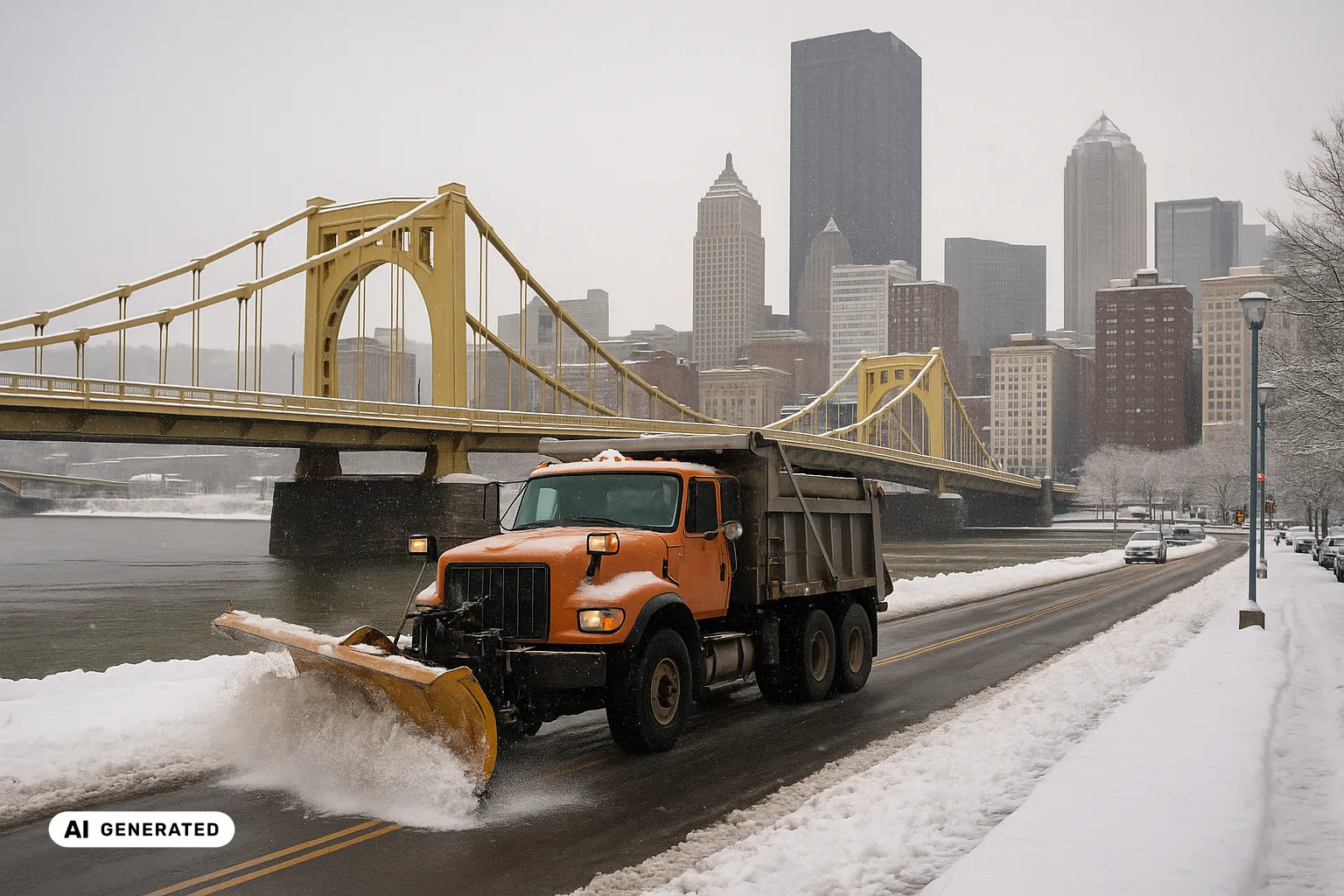
Pittsburgh gets 44.1 inches of snow in an average season. Erie, at the other end of the same state, gets 104. If snowfall totals were the whole story, this would be the easier city to work in.
They are not the whole story, and the reason is in a different pair of numbers. Across the 1991–2020 normals at Pittsburgh International Airport, 113.6 nights a year drop below freezing — but only 31.7 days stay below freezing. Subtract one from the other and you get roughly 82 days a year when the temperature crosses zero in both directions: meltwater running in the afternoon, refreezing after dark.
Now put that on a city with 200 metres of relief inside its own boundary, and you have the actual shape of winter service in Pittsburgh. The problem is not moving volume. It is ice on gradients, over and over.
A city built on the wrong angle for winter
Pittsburgh sits where the Allegheny and the Monongahela meet to form the Ohio, with downtown — the Golden Triangle — in the wedge between them. From those river levels the ground climbs hard. Elevations inside the city limits run from 710 feet to 1,370 feet, and more than a quarter of the city’s 90 neighbourhood names carry a reference to a hill, a height or a mount.
The steepness is not incidental; it is documented in the street network itself. Canton Avenue in Beechview carries a 37 per cent grade over a 21-foot stretch and is generally regarded as the steepest street in the continental United States — the claim to be the world’s steepest is contested by streets in New Zealand, San Francisco and Hawaii, so it is worth stating carefully. There is a bicycle race, the Dirty Dozen, that exists purely because these gradients do.
Pedestrian infrastructure tells the same story. The city owns nearly 800 sets of public steps, with 44,645 risers climbing a combined 24,108 vertical feet. Many are not paths at all in the legal sense: they are classified as city streets — “paper streets” — and are the only pedestrian connection between one hillside neighbourhood and the next. The Duquesne and Monongahela inclines exist for the same reason: the switchback trails up Mount Washington were, as the record puts it, barely passable to a team of horses pulling a loaded wagon.
Then there are the crossings. A widely cited 2006 study counted 446 bridges in the city, a figure that has been disputed and that covers every bridge in the city limits rather than the smaller number the City itself maintains. Either way, bridges freeze before roadways do, and this city has an unusual number of them.
What actually falls
The seasonal normal of 44.1 inches breaks down as 13.3 in January, 11.7 in February and 7.7 in December — with 7.6 in March and 2.4 in November. Only 32.7 inches falls in the meteorological winter, meaning roughly a quarter of the season’s snow arrives outside it.
More telling is how it arrives. Snow falls on about 40.2 days a year, but only 14.5 of those bring an inch or more, 3.2 bring three inches and 1.1 brings five. Set that against winter precipitation days generally — around seven days a month with a tenth of an inch or more through December, January and February — and the pattern is clear: most winter precipitation days in Pittsburgh do not produce meaningful snow. They produce rain, freezing rain, sleet, or a mix.
This is a wintry mix city, not a lake-effect one. There is no reliable published figure for freezing-rain hours here, so it is better to describe the mechanism than invent a number for it — and the mechanism is exactly what the frost-and-thaw counts above describe.
The range across seasons is wide. The Weather Service’s own record document for Pittsburgh puts seasonal totals anywhere between 8.8 and 82.0 inches. Planning for the average is planning for a season that rarely happens.
What the local rules say
Pittsburgh’s sidewalk duty is short, and unusually broad in who it names.
As § 419.03 of the City Code is written: “Every tenant, occupant or owner having the care or charge of any land or building fronting on any street in the city, where there is a sidewalk paved with concrete, brick, stone or other material shall, within twenty-four (24) hours after the fall of any snow or sleet, or the accumulation of ice caused by freezing rainfall, cause the same to be removed from the sidewalk.”
Two features stand out. Tenants are named first — this is not framed as an owner’s duty with occupants as an afterthought. And the section expressly covers ice from freezing rainfall, not only snow, which matters a great deal in a city where the freezing rain is often the event.
What the section does not do is set a minimum width. Where Worcester and several of Pittsburgh’s own neighbouring boroughs specify a path in feet or inches, § 419.03 simply requires removal. Etna Borough, a few miles up the Allegheny, requires 24 hours and a path of at least 24 inches — so the width requirement is one of the things that changes when you cross a municipal line here.
One practical note on sources: Pittsburgh’s code is now published through eCode360, and the City’s old Municode library page no longer hosts the ordinances at all. Older Municode deep links to § 419.03 are dead. The current text sits in Chapter 419.
The clause most cities don’t have
Enforcement in Pittsburgh has a mechanism that is worth knowing about, because it is unusual and because it changes who can act.
Section 101.11 provides that “any private person is hereby authorized to institute a criminal proceeding in a summary case by filing a complaint … with a City Magistrate where the action arises under Chapter 419.03, removal of Snow and Ice” — alongside a handful of other provisions covering weeds, refuse, graffiti, zoning and building.
It is hedged. The Magistrate may not issue process where the City already has a pending action on the same or a similar complaint. Proof of service on the defendant must be made, thirty days must have passed from that date, and the condition must remain unabated. The complaint must be served together with a notice about the availability of alternative dispute resolution, and the Magistrate decides whether to issue process at all; the summons then comes from Housing Court.
Set beside the fact that no reliable published penalty figure for § 419.03 could be established — the figures that circulate locally do not trace back to the code — this paints a fairly clear picture of how the duty is actually enforced here: through notices, complaints and neighbours, rather than through a standard ticket.
None of this is legal advice, and the wording carries the detail — read the section rather than a summary of it.
How the city clears
On the road side, the Department of Public Works works to keep traffic moving on the city’s more than 1,200 miles of streets. The City sets out its priorities in plain order: public safety first — maintaining passable routes to hospitals, schools, fire and police stations — then commerce, ensuring access to businesses large and small, then convenience, meaning travel on residential streets and alleyways. In heavy events, crews can fall back to the primary and emergency routes before picking up the secondary and tertiary network again.
The distinctly Pittsburgh part of the operation happens before the snow. Ahead of forecast wintry weather, DPW pre-emptively closes six named streets known to be hazardous: Capitol Avenue (Brookline), Newett Street and Copperfield Street (Carrick), South Negley Avenue (Squirrel Hill), Suffolk Street (Perry South) and Rialto Street (Troy Hill). They reopen when the weather permits, on a case-by-case basis, and until then the City asks drivers not to go around the barricades. Planning around gradient is not a special measure here; it is the routine.
The City also runs a public Snow Response Dashboard showing plow vehicle locations and route history, with a separate route coverage map alongside it. What deserves credit is how candidly it is labelled: the City states that the dashboard is still under construction, that it shows only a selection of vehicles rather than all of them, that locations are delayed and not real time, and that some already-treated routes — Brookline, Highland Park and Squirrel Hill are named — do not appear at all because of data limitations. A city publishing its own gaps is more useful than one publishing a clean-looking map.
For residents, the City’s shovelling guidance is straightforward: snow should not be moved into the roadway, but onto lawn areas or close to the kerb, and in heavy snow parking spaces should be given up to pile it. Reports of an untreated street are asked for only 24 hours after snowfall ends, on 412-255-2621 or through 311.
When conditions warrant, the Mayor can declare a snow emergency, with streets designated and marked as snow emergency routes where entry, use and parking are restricted once the declaration is made; a vehicle left on such a route more than one hour after the declaration is in breach. On a narrow street cut into a hillside, one parked car is often the whole difference between a route finished and a route abandoned.
Across the line, sometimes a few hundred metres away
Pittsburgh’s municipal geography is fragmented in a way that shows up directly in winter work.
Mount Oliver Borough is the clearest case: 0.34 square miles, about 3,394 residents, and surrounded entirely by the City of Pittsburgh, having resisted annexation. It sits on a ridge ringed by the city neighbourhoods of South Side Slopes, Arlington, Carrick, Knoxville and Allentown. Two separate winter operations, two rulebooks, a few hundred metres apart on the same hilltop.
The others each differ in their own way. Mt. Lebanon in the South Hills requires clearing within 24 hours of snowfall ending. Etna Borough requires 24 hours and a path at least 24 inches wide. Shaler Township prohibits depositing snow onto streets and highways. Wilkinsburg, which borders Regent Square, Point Breeze and Homewood South, runs its own. Dormont, Swissvale, Edgewood, Forest Hills, Churchill and Penn Hills complete the ring.
Above them, Allegheny County maintains its own road network and PennDOT District 11 the interstates and state routes. A route that runs from a city street onto a state highway and through a borough crosses three operations without leaving the metropolitan area.
Keeping the record straight
In a city where the temperature crosses freezing in both directions on something like 82 days a year, where six streets are closed before the first flake, and where a neighbour has a route to a City Magistrate, the useful thing is being able to show plainly what was done and when.
Not to win an argument. Because a winter of repeated freeze–thaw on steep ground produces exactly the questions a vague answer cannot settle: was this hillside treated before the overnight refreeze, how many times during a three-day mix event, what was actually falling at the time. A simple, time-stamped record of each treatment, set against what the weather was actually doing, turns “we were out all night” into something specific — a clear service record whether you look after one property on a slope street or a route that climbs from the river flats to Troy Hill.
That is the documentation support Wintertrace is built to make easy. It does not change any local rule, and it is not a substitute for legal advice. It just means that when someone asks what happened during the last thaw, the answer is on file.
Local facts
- Pittsburgh averages about 44.1 inches (112 cm) of snow a season at Pittsburgh International Airport under the 1991–2020 climate normals — roughly a third of what Erie gets at the other end of the same state. Only 32.7 inches of that falls in December to February, so about a quarter of the season's snow arrives outside meteorological winter.Source
- The number that matters more than depth: 113.6 nights a year drop below freezing, but only 31.7 days stay below freezing. On roughly 82 days a year the temperature crosses the freezing point in both directions — meltwater by day, refreeze by night.Source
- Snow falls on about 40.2 days a year, but only 14.5 of those bring an inch or more, 3.2 bring three inches and 1.1 bring five. Most winter precipitation days here are rain, freezing rain, sleet or a mix rather than measurable snow.Source
- The city sits where the Allegheny and Monongahela meet to form the Ohio, and it climbs: elevations inside the city limits run from 710 feet to 1,370 feet, about 200 metres of relief within the municipal boundary. More than a quarter of its 90 neighbourhood names contain a reference to a hill, height or mount.Source
- Pittsburgh has nearly 800 sets of city-owned public steps with 44,645 risers and 24,108 vertical feet; many are formally classified as city streets — 'paper streets' — and are the only pedestrian link between hillside neighbourhoods.Source
- Ahead of forecast snow the Department of Public Works pre-emptively closes six streets known to be hazardous: Capitol Avenue in Brookline, Newett Street and Copperfield Street in Carrick, South Negley Avenue in Squirrel Hill, Suffolk Street in Perry South and Rialto Street on Troy Hill. They reopen when the weather permits, and drivers are asked not to go around the barricades.Source
- Canton Avenue in Beechview carries a 37 per cent grade over a 21-foot stretch and is regarded as the steepest street in the continental United States; the claim to be the world's steepest is contested by streets in New Zealand, San Francisco and Hawaii.Source
- Under the City Code, § 419.03, every tenant, occupant or owner having the care or charge of any land or building fronting on a street where there is a paved sidewalk must clear it within twenty-four hours after the fall of any snow or sleet, or the accumulation of ice caused by freezing rainfall. The section names tenants alongside owners and sets no minimum width.Source
- The City Code also lets a private person start a summary criminal proceeding over an uncleared sidewalk: § 101.11 authorises any private person to file a complaint with a City Magistrate under Chapter 419.03, provided the City has no parallel action pending, proof of service is made, thirty days have passed and the condition remains unabated.Source
- Pittsburgh's code is published through eCode360; the city's former Municode library page no longer hosts the ordinances at all, so older Municode deep links to § 419.03 are dead.Source
- The Department of Public Works aims to keep traffic moving on the city's more than 1,200 miles of streets, with a stated priority order of public safety first — hospitals, schools, fire and police stations — then commerce, then residential streets and alleyways.Source
- The City runs a public Snow Response Dashboard showing plow vehicle locations and route history, and says plainly that it is still under construction, shows only a selection of vehicles, and reports locations on a delay rather than in real time — some already-treated routes in Brookline, Highland Park and Squirrel Hill do not appear at all.Source
- Mount Oliver Borough is an enclave surrounded entirely by the City of Pittsburgh — 0.34 square miles with about 3,394 residents — so two separate winter regimes meet within a few hundred metres on a hilltop ridge.Source
Official contacts
City of Pittsburgh Code — Chapter 419 (includes § 419.03, Removal of Snow and Ice)
The sidewalk section in the city's current published code: the 24-hour duty on tenants, occupants and owners, and the explicit inclusion of sleet and freezing rain.
City of Pittsburgh Code — § 101.11 (private right to prosecute)
The provision letting a private person bring a summary complaint over § 419.03, with the service, thirty-day and no-parallel-action conditions.
City of Pittsburgh — Snow & Ice (Department of Public Works)
The City's snow and ice control programme, its priority order, the shovelling guidance, and the number to report an untreated street.
City of Pittsburgh — Snow Response Updates
The Snow Response Dashboard with vehicle locations and route history, the route coverage map, and the City's own caveats about what the data does not show.
National Weather Service, Pittsburgh — snowfall records and climatology (PDF)
The forecast office's record document: largest storms, daily records and the range of seasonal totals from 8.8 to 82.0 inches.
PennDOT Engineering District 11
The state agency responsible for the interstates and state routes through Allegheny County — a different operation from the city's.
Common questions about winter service in Pittsburgh
- How long do I have to clear my sidewalk in Pittsburgh?
- Twenty-four hours. As § 419.03 of the City Code is written, every tenant, occupant or owner having the care or charge of any land or building fronting on a street where there is a sidewalk paved with concrete, brick, stone or other material shall, within twenty-four hours after the fall of any snow or sleet, or the accumulation of ice caused by freezing rainfall, cause it to be removed. Two things are worth noting. The section names tenants first, so this is not only an owner's duty. And it explicitly covers ice from freezing rainfall — which in a freeze–thaw city is the more common problem. This is general information, not a substitute for legal advice; read the section itself for the exact wording.
- Does the ordinance say how wide the path has to be?
- No. Unlike Worcester or many of Pittsburgh's own neighbours, § 419.03 sets no minimum width — it requires the snow and ice to be removed from the sidewalk without specifying a figure. Some surrounding municipalities do set one: Etna Borough, for instance, requires clearing within 24 hours to a path at least 24 inches wide. If you work across the borough lines, the width requirement is one of the things that changes at the sign.
- Can a neighbour actually take me to court over an uncleared sidewalk?
- The code provides for it. Section 101.11 authorises any private person to institute a summary criminal proceeding by filing a complaint with a City Magistrate where the action arises under Chapter 419.03, among other provisions. There are conditions: the City must not already have a pending action on the same or a similar complaint, proof of service on the defendant must be made, thirty days must have passed since that date, and the condition must remain unabated. The complaint has to include a notice about the availability of alternative dispute resolution, and the Magistrate decides whether to issue process. It is an unusual mechanism, and it helps explain why enforcement here has tended to run through notices and complaints rather than routine fines.
- Pittsburgh doesn't get that much snow. Why is winter service still demanding?
- Because the difficulty here is grade and refreeze, not depth. The seasonal normal is about 44.1 inches — roughly a third of Erie's, at the other end of the same state — and only 14.5 days a year bring an inch or more of new snow. But 113.6 nights a year fall below freezing while only 31.7 days stay below freezing. That leaves something like 82 days a year when the temperature crosses zero in both directions: meltwater running across a sidewalk or a hillside street in the afternoon, freezing again after dark. Add gradients up to 37 per cent and the operational problem becomes treating ice on slopes, repeatedly, rather than moving large volumes of snow a few times a winter.
- Which streets does the city close before a storm?
- Six, and they are named. Ahead of forecast snow the Department of Public Works pre-emptively closes Capitol Avenue in Brookline, Newett Street and Copperfield Street in Carrick, South Negley Avenue in Squirrel Hill, Suffolk Street in Perry South and Rialto Street on Troy Hill — streets known to be hazardous in bad weather. They reopen when conditions allow, on a case-by-case basis, and the City asks drivers not to drive around the barricades in the meantime. Closing roads before the snow arrives rather than after something goes wrong is a fair summary of how topography shapes winter operations in this city.
- What is the city's snow plow tracker, and can I rely on it?
- Partly, and the City says so itself. The Snow Response Dashboard shows plow and salt truck locations along with route history on an interactive map. But the City states directly that it is still under construction, that it shows only a selected number of vehicles rather than all active ones, and that locations are delayed rather than real time. It also notes that some already-treated routes — Brookline, Highland Park and Squirrel Hill are the examples given — will not appear because of data limitations, and points to a separate route coverage map for a fuller picture. It is a useful signal, not a record of what was done.
- Who plows what — the city, the county or the state?
- All three, on the same map. The City of Pittsburgh's Department of Public Works handles the city streets, aiming to keep traffic moving on more than 1,200 miles of them, with a priority order the City sets out plainly: public safety first, meaning routes to hospitals, schools and fire and police stations, then access for business, then residential streets and alleyways. Allegheny County maintains its own road network. The interstates and state routes are PennDOT's, through Engineering District 11. A single route across town can therefore pass through three separate operations in one storm, each with its own equipment and priorities.
- What happens during a declared snow emergency?
- The City's code provides for the Mayor to declare a snow emergency, and for streets to be designated and marked as snow emergency routes where entry, use and parking are restricted once that declaration is made. Under the same provisions, vehicles left parked on a designated snow emergency route more than one hour after a declaration are in breach. The practical point is the familiar one on narrow hillside streets: a single parked car can stop a plow finishing a route, and moving it is what lets the street actually get cleared.
- Are the surrounding boroughs under the same rules?
- No, and the geography makes that unusually visible. Mount Oliver Borough is an enclave surrounded entirely by the City of Pittsburgh — a third of a square mile on a ridge, ringed by the city neighbourhoods of South Side Slopes, Arlington, Carrick, Knoxville and Allentown — so two winter regimes meet within a few hundred metres. Mt. Lebanon in the South Hills requires clearing within 24 hours of snowfall ending. Etna Borough requires 24 hours and a path at least 24 inches wide. Shaler Township prohibits depositing snow onto streets and highways. Wilkinsburg, Dormont, Swissvale, Edgewood, Penn Hills and the rest each set their own. A route that crosses those lines crosses between rulebooks, even though the weather does not notice.
Documenting winter service in Pittsburgh
Anyone clearing snow and ice in Pittsburgh may later need to show when and where a route was treated. Wintertrace is open-source software that records exactly that — time, location and weather for each run — as a calm basis for your own operational records and service proof. It is not a substitute for legal advice.
This overview is for general information and is not legal advice. Local rules on snow and ice clearing vary — the wording of the local rule and the responsible authority always govern.