Winter service · Massachusetts
Winter service in Worcester
What winter is really like in Worcester, Massachusetts: about 72.9 inches of snow a year at 479 feet, nearly 24 inches more than Boston 40 miles away, because the coastal storms that fall as rain there fall as snow here. The ten-hour rule under Chapter 12 § 23, the four-foot path that must reach the crosswalk button, the $75-a-day penalty, and what Papadopoulos v. Target means for contractors.
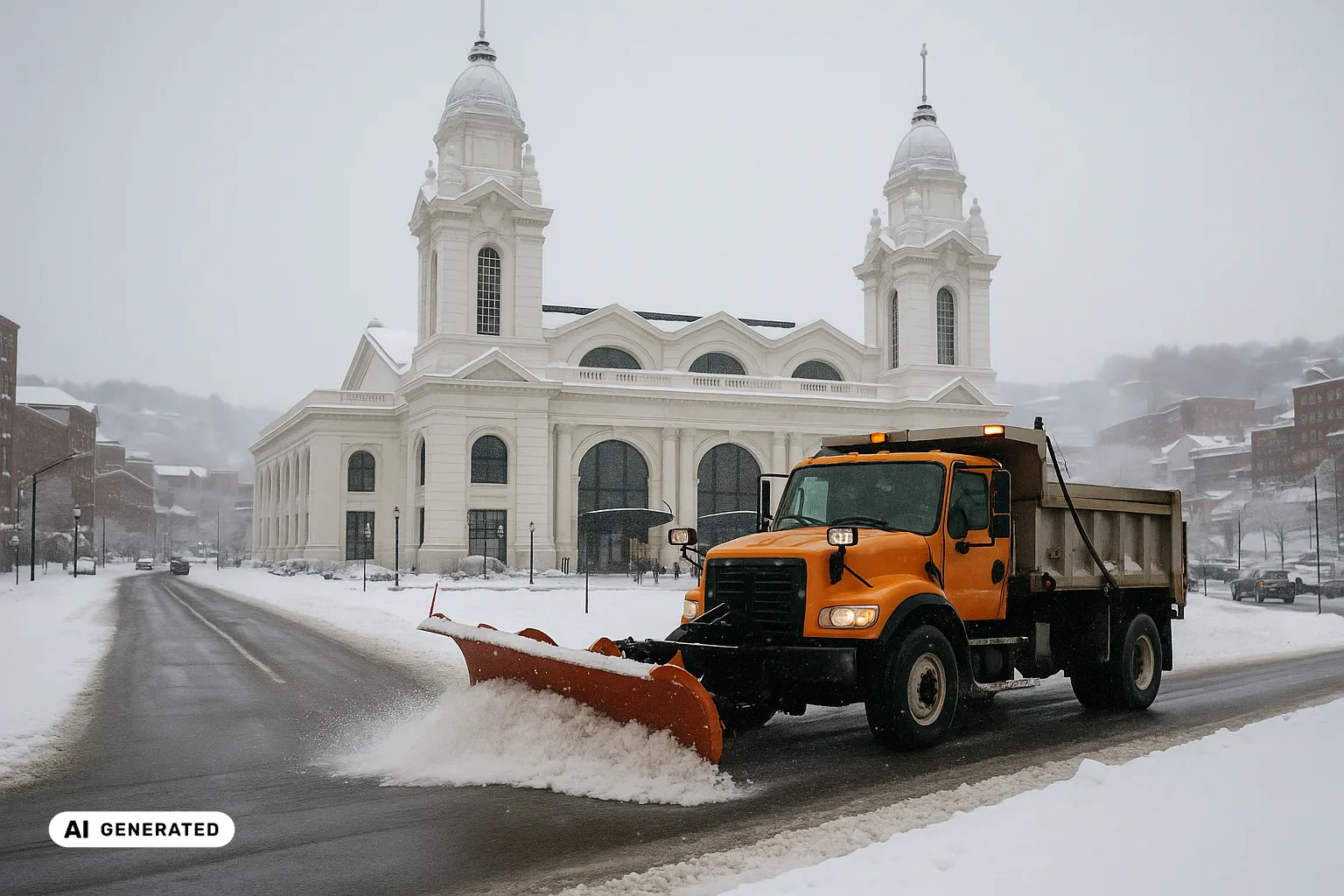
Worcester is only 40 miles west of Boston, and it may as well be a different climate. The city sits at 479 feet in central Massachusetts, on high ground that locals have long called the City of Seven Hills. That elevation, and the distance from salt water, decide almost everything about winter here.
The numbers make the case better than any description. Over the 1991–2020 normals, Worcester Regional Airport records about 72.9 inches of snow a season. Boston Logan, in the same state, over the same period, at the same kind of airport station, records 49.2. The gap is nearly 24 inches — about 48 per cent more snow, for a drive of well under an hour.
Why the hills change the storm
The mechanism is worth understanding, because it explains why Worcester’s winter is not simply “Boston plus a bit”.
New England’s big winter producers are nor’easters — coastal storms that draw moisture off the Atlantic. In most of them the decisive feature is the rain–snow line, and it usually sets up somewhere near the coast. Worcester lies inland and higher, which puts it on the snow side of that line far more often than not. The changeover to snow arrives earlier here, and the switch back to rain comes later, or does not come at all. The same storm that gives Boston six hours of heavy rain on a slushy base gives Worcester the whole event as snow.
The USDA puts the city on the boundary of hardiness zones 5b and 6a — the inland classification, not the milder coastal one. It is a small detail that confirms the pattern from an entirely different direction.
The seasonal distribution has a sting in it. February is the snowiest month at roughly 21.2 inches, which is unsurprising. March, though, still averages about 13.7 inches — very nearly as much as December. A heavy March storm here is ordinary weather. Anyone writing a seasonal contract that ends in early March is writing out a real part of the winter.
Geography adds the rest. The Blackstone River forms in the middle of the city from the confluence of the Middle River and Mill Brook, and Lake Quinsigamond runs four miles along the Shrewsbury border. But the feature that governs winter work is the relief: a downtown in a hollow with residential streets climbing away from it in every direction. On those grades, the difference between a cleared walk and a treated one is the difference between passable and not.
What the local rules say
Worcester’s sidewalk rule is set out in the Revised Ordinances, Chapter 12 § 23, published as a document by the City Clerk. It is more detailed than most.
The core duty: the owner or occupant of land bounded by a street with a sidewalk shall, within ten hours after any winter storm, cause all snow, ice or other forms of freezing precipitation to be removed to a width of not less than four feet for the entire distance the sidewalk abuts the land. Note that the section names occupants as well as owners — a tenant can be the addressee — and that ten hours is markedly more generous than Boston’s three, while four feet is wider than Boston’s 42 inches.
Two further requirements make this ordinance unusual, and both concern access rather than tidiness. Where a sidewalk would, in the absence of snow, give access to a crosswalk, the owner or occupant must clear a path at least four feet wide from the sidewalk to that crosswalk. And where the crossing has an electronic crosswalk system activated by pedestrians, they must clear a similar path to the button or switch that operates it. A cleared walk that dead-ends at a snowbank in front of a pedestrian signal does not satisfy the section.
Then the part that is easy to miss: treating. After shovelling, to the extent snow, ice or freezing precipitation remains on any area required to be cleared, the owner or occupant shall treat it with sand, salt or other suitable material. This is a clearing and treating duty. On Worcester’s grades that distinction is the whole point — a scraped walk on a north-facing hillside can refreeze into something worse than the snow it replaced.
The ordinance also defines sidewalk broadly: any paved area immediately adjacent to the area of a public or private way designated for vehicular travel, whether or not a green strip or planting area separates it from the traveled way.
What happens if it isn’t done
The penalty is $75.00 per calendar day on which the snow is left uncleared or untreated, under Chapter 15 § 2(b)(8)(A), with the Commissioner of Public Works & Parks named as the enforcing person. Complaints go to Police Dispatch on 508-799-8600 once the ten hours have run; the Department of Public Works refers them to the Police Department as the enforcing agency.
But the daily penalty is not the whole of it, and the ordinance is unusually direct about this. The City may also remove the snow itself and require reimbursement of the expense, and it may impose a municipal charges lien on the property under G.L. c. 40 § 58. The section states that the civil penalty, the removal expense and the lien are cumulative remedies, exercised at the discretion of the city — they are not a ladder the City has to climb one rung at a time.
None of this is legal advice, and because the wording carries the detail, the sensible move is to read the ordinance itself (PDF) rather than rely on a summary.
The 2010 decision behind all of it
There is a piece of Massachusetts case law that anyone clearing snow commercially in this state tends to hear about eventually, and it is worth stating accurately.
In Papadopoulos v. Target Corp., 457 Mass. 368 (2010), the Supreme Judicial Court wrote that it was abolishing “the distinction between natural and unnatural accumulations of snow and ice”, and applying “to all hazards arising from snow and ice the same obligation of reasonable care that a property owner owes to lawful visitors regarding all other hazards”.
The rule it discarded had a long history. It descended from nineteenth-century landlord-and-tenant cases — a landlord was liable only for obstructions he had placed himself, and naturally fallen snow was not one — and had survived, as the court put it, as “a relic of abandoned landlord-tenant law” resurrected as an exception to the ordinary standard of care. After 2010 there is no separate snow-and-ice test: the question is simply whether reasonable care was used in the circumstances.
Two details of the case matter more than the doctrine for anyone reading this page. The fall happened in the parking lot of a shopping centre, not on a public sidewalk — so this is not only a sidewalk-ordinance question. And the defendants were both the retailer that controlled the lot and the landscaping company contracted to clear it. The obligation and the exposure reach the contractor, not just the landowner.
That is a description of a court decision, not legal advice, and it is not a substitute for it.
How the city clears, and where to put the car
On the road side, the Department of Public Works & Parks runs the plowing operation, with treatment beginning at around an inch of accumulation and a large contracted fleet supplementing city equipment. The City also publishes practical detail that matters at property level: plows are fixed and angled to the right, so snow will end up across the driveway you just cleared, and clearing a driveway opening is the property owner’s job — which is why it usually pays to do it once the plowing has finished rather than during. Pushing snow from a driveway or sidewalk back into the street is prohibited by ordinance. There are more than 6,000 fire hydrants in the city, and the DPW asks residents to keep the nearest one dug out.
Parking runs on two regimes that stack. The permanent winter parking ban is in force from 1 December to 30 April — to 1 April on residential streets — on emergency arteries, WRTA bus routes and other traffic-critical streets: no parking between 2 a.m. and 6 a.m., and none at any time while a snow emergency is declared. On top of that, when snow is forecast, the City can declare an additional ban across the rest of the network: no parking at all on main arteries, emergency and bus routes and downtown streets, and parking only on the odd-numbered side of other streets unless posted otherwise. Vehicles that violate a ban or otherwise hinder snow removal are ticketed and towed at the owner’s expense. Because some streets fall in more than one zone, the City publishes a map rather than a list.
Above both sits the Winter Weather Emergency, declared by the City Manager. That closes the public schools, the libraries, City Hall and the Residential Drop-Off Center, shifts trash and recycling a day later for the rest of the week, and opens five municipal garages — Union Station, Worcester Common, Pearl Elm, Federal Plaza and Major Taylor — for free parking. On streets where the houses are close and the hills are steep, those free garages are what makes a street clearable.
Across the town line
Worcester is bordered by eight municipalities: Auburn, Grafton, Holden, Leicester, Millbury, Paxton, Shrewsbury and West Boylston. Each sets its own rules, and the sharpest illustration is right on the water.
Shrewsbury shares the Lake Quinsigamond border with Worcester. Its own snow removal page does not set a deadline — it states that property owners or occupants are requested to keep the sidewalk in front of and adjacent to their property clear of snow and ice, and points to the Massachusetts State Sanitary Code for walkways, stairways and exits on private property. It is listed elsewhere as a community without a snow clearing ordinance at all.
So: one side of the lake, a ten-hour duty, a four-foot path to the crosswalk button, a treating obligation and $75 a day with a lien behind it. The other side, a polite request. The storm crosses the water without noticing; the rulebook does not. For anyone running a route through more than one of these towns, that boundary is a real operational line — and the case law described above applies across all of them regardless of what the local ordinance says.
Keeping the record straight
In a city that counts in calendar days, that requires the path to reach a pedestrian button and not merely the kerb, and where the standard of care no longer turns on whether anyone piled the snow up, the useful thing is being able to show plainly what was done and when.
Not to win an argument. Because a winter of ten-hour windows, March storms and hillside refreeze produces exactly the questions a vague answer cannot settle: was this frontage cleared inside the window, was it treated afterwards or only shovelled, what was falling at the time. A simple, time-stamped record of each treatment, set against what the weather was actually doing, turns “we were out all night” into something specific — a clear service record whether you look after one three-decker on a hill or a route that runs out to Shrewsbury.
That is the documentation support Wintertrace is built to make easy. It does not change any local rule, and it is not a substitute for legal advice. It just means that when someone asks what happened during the last storm, the answer is on file.
Local facts
- Worcester averages about 72.9 inches (roughly 185 cm) of snow a season at Worcester Regional Airport, based on the 1991–2020 climate normals — against 49.2 inches at Boston Logan for the same period and the same kind of station. That is nearly 24 inches, or about 48 per cent, more snow than the coast just 40 miles away.Source
- The city sits at 479 feet (146 m) in central Massachusetts, about 40 miles west of Boston and 38 miles north-west of Providence, and the USDA places it straddling hardiness zones 5b and 6a — the inland side of the line, not the milder coastal zone.Source
- February is the snowiest month at about 21.2 inches, and March still averages about 13.7 inches — nearly as much as December. The winter here runs late.Source
- Under the City of Worcester Revised Ordinances, Chapter 12 § 23, the owner or occupant of land bounded by a street with a sidewalk must clear all snow, ice or other frozen precipitation within ten hours after any winter storm, to a width of not less than four feet along the whole frontage.Source (PDF)
- The same section requires a four-foot path from the cleared sidewalk to the crosswalk — and where the crossing has a pedestrian-activated signal, a similar path to the button or switch that operates it.Source (PDF)
- Clearing alone is not enough: whatever snow, ice or freezing precipitation remains after shovelling must be treated with sand, salt or other suitable material. Worcester's ordinance carries a genuine treating duty, not just a clearing one.Source (PDF)
- The civil penalty is $75.00 for each calendar day the walk is left uncleared or untreated, with the Commissioner of Public Works & Parks named as the enforcing person under Chapter 15 § 2(b)(8)(A).Source (PDF)
- The penalty, the City's cost of clearing the walk itself, and a municipal charges lien on the property under G.L. c. 40 § 58 are stated in the ordinance to be cumulative remedies, exercised at the City's discretion — they are alternatives the City may combine, not a sequence.Source (PDF)
- In Papadopoulos v. Target Corp., 457 Mass. 368 (2010), the Supreme Judicial Court abolished the long-standing distinction between natural and unnatural accumulations of snow and ice, applying to all snow-and-ice hazards the same obligation of reasonable care a property owner owes lawful visitors for any other hazard. The defendants were the store and its contracted landscaping company.Source
- A permanent winter parking ban runs from 1 December to 30 April on emergency arteries, WRTA bus routes and other traffic-critical streets: no parking between 2 a.m. and 6 a.m., nor at any time while a snow emergency is declared.Source
- When snow is forecast the City can declare an additional ban covering the rest of the street network — no parking at all on main arteries, emergency and bus routes and downtown streets, and parking only on the odd-numbered side of other streets unless posted otherwise. Vehicles that hinder snow removal are ticketed and towed at the owner's expense.Source
- Neighbouring Shrewsbury, which shares the Lake Quinsigamond border, sets no enforceable deadline at all: its own page states that owners or occupants are requested to keep the sidewalk clear. Two adjoining municipalities, a ten-hour duty with a daily penalty on one side of the lake and a request on the other.Source
- The City hands out free winter sand — hand buckets only — at three sites: the Residential Drop-Off Center at 1065 Millbury Street, Clark Street near East Mountain Street, and the street edge of the DPW yard at 24 Albany Street.Source
Official contacts
City of Worcester — Sidewalk Snow Removal Ordinance, Ch. 12 § 23 and Ch. 15 § 2(b)(8)(A) (PDF)
The ordinance text itself as published by the City Clerk: the ten-hour rule, the four-foot width, the crosswalk and pedestrian-button paths, the treating duty, and the cumulative remedies.
City of Worcester — Snow Removal (Streets Division)
The City's practical guidance: enforcement, the $75-a-day fine, how to report an uncleared walk, driveway and hydrant advice, and the free winter sand sites.
City of Worcester — Winter Parking
The permanent and declared parking bans, how they are announced, and the ArcGIS map showing which ban zone a given street falls in.
City of Worcester — Department of Public Works & Parks
The department whose Commissioner is the named enforcing person for the sidewalk ordinance, and which runs the plowing operation.
National Weather Service, Boston/Norton — winter weather
The forecast office covering Worcester County, including the rain–snow line guidance that decides how a nor'easter lands here.
Town of Shrewsbury — Snow Removal
The neighbouring town's own page, useful for seeing how sharply the rules change at the municipal line.
Common questions about winter service in Worcester
- How long do I have to clear my sidewalk in Worcester?
- Ten hours after the winter storm ends, and to a width of at least four feet for the entire distance the sidewalk runs along your land. That is a good deal more time than Boston allows — three hours for most properties — but a wider path than Boston's 42 inches. The duty falls on the owner or occupant, so a tenant can be the one responsible. Two things people miss: if the sidewalk gives access to a crosswalk, you also have to clear a four-foot path to it, and if that crossing has a pedestrian-activated signal, a path to the button as well. This is general information, not a substitute for legal advice — the ordinance text is published by the City Clerk and worth reading directly.
- Is shovelling enough, or do I have to salt as well?
- You have to treat it. The ordinance says that after shovelling, to the extent snow, ice or freezing precipitation remains on any sidewalk or area required to be cleared, the owner or occupant shall treat it with sand, salt or other suitable material. That makes Worcester's rule a clearing and treating duty rather than a clearing duty alone — which matters on a hillside street where a shovelled walk can refreeze into something more dangerous than the snow was. The City gives away winter sand at three sites, in hand buckets only.
- What does it cost if I don't clear it?
- Seventy-five dollars for each calendar day the walk is left uncleared or untreated, with the Commissioner of Public Works & Parks named as the enforcing person. But the daily penalty is only one of three tools, and the ordinance is explicit that they are cumulative remedies exercised at the City's discretion. The City may also clear the walk itself and require the owner or occupant to reimburse the expense, and it may impose a municipal charges lien on the property under G.L. c. 40 § 58. Complaints go to Police Dispatch on 508-799-8600 once ten hours have passed.
- Why does Worcester get so much more snow than Boston?
- Elevation and distance from the water. Worcester sits at 479 feet in central Massachusetts, roughly 40 miles inland; Boston Logan is at 19 feet on the harbour. In a nor'easter the rain–snow line typically sets up near the coast, and Worcester is usually on the snow side of it — the changeover to snow arrives earlier here and the switch back to rain comes later, or never. Over the 1991–2020 normals that works out to 72.9 inches a year against Boston's 49.2, a difference of nearly 24 inches, or about 48 per cent, between two airports in the same state. The USDA puts the city on the 5b/6a hardiness boundary, which tells the same story.
- When does the snow season actually end here?
- Later than most people plan for. February is the snowiest month at roughly 21.2 inches, and March still averages about 13.7 inches — very nearly as much as December. A March storm in Worcester is normal weather, not a freak event, which is worth knowing if you contract for a season that ends on 1 March.
- What changed for property owners and contractors in 2010?
- In Papadopoulos v. Target Corp., 457 Mass. 368, the Supreme Judicial Court abolished the distinction Massachusetts law had drawn between natural and unnatural accumulations of snow and ice, and applied to all snow-and-ice hazards the same obligation of reasonable care that a property owner owes lawful visitors for any other hazard. The old rule had descended from nineteenth-century landlord-and-tenant cases and had come to shield owners from claims over snow they had not themselves piled up. Two things are worth noting about the case: the fall happened in a shopping-centre parking lot, not on a public sidewalk, and the defendants were the retailer that controlled the lot and the landscaping company contracted to clear it. This is a neutral description of a decision, not legal advice — anyone with a live question should take proper advice.
- How does winter parking work in Worcester?
- There are two regimes and they stack. A permanent winter parking ban runs from 1 December to 30 April — to 1 April on residential streets — on emergency arteries, WRTA bus routes and other traffic-critical streets, prohibiting parking between 2 a.m. and 6 a.m. and at any time a snow emergency is declared. On top of that, when snow is forecast the City can declare a ban covering the rest of the network: no parking at all on main arteries, emergency and bus routes and downtown streets, and parking only on the odd-numbered side elsewhere unless posted otherwise. Vehicles that violate a ban or otherwise hinder snow removal are ticketed and towed at the owner's expense. Because some streets sit in more than one ban zone, the City publishes a map rather than relying on a list.
- What is a Winter Weather Emergency, and how is it different?
- It is a higher step, declared by the City Manager rather than being a parking rule. When one is called, the effects are city-wide: Worcester Public Schools, the libraries, City Hall and the Residential Drop-Off Center close, trash and recycling collection shifts a day later for the rest of the week, and parking is made free in five municipal garages — Union Station, Worcester Common, Pearl Elm, Federal Plaza and Major Taylor. The free garages are the practical part for residents, because they give people on narrow hillside streets somewhere to put a car that would otherwise block a plow.
- Do the surrounding towns have the same rules?
- No, and the contrast on Worcester's own border is striking. Shrewsbury, which shares the Lake Quinsigamond boundary, states on its own snow removal page that property owners or occupants are requested to keep the sidewalk clear — a request, not an enforceable deadline, and it is listed elsewhere as a community without a snow clearing ordinance. Cross that line and you go from a ten-hour duty backed by a daily penalty and a possible lien to no fixed obligation at all. Auburn, Grafton, Holden, Leicester, Millbury, Paxton and West Boylston each set their own rules too. If you run a route across municipal lines, the rulebook changes with the sign at the town boundary even though the storm does not.
Documenting winter service in Worcester
Anyone clearing snow and ice in Worcester may later need to show when and where a route was treated. Wintertrace is open-source software that records exactly that — time, location and weather for each run — as a calm basis for your own operational records and service proof. It is not a substitute for legal advice.
This overview is for general information and is not legal advice. Local rules on snow and ice clearing vary — the wording of the local rule and the responsible authority always govern.