Winter service · Massachusetts
Winter service in Boston
What winter is really like in Boston: about 49 inches of snow a year at Logan, but delivered in a handful of nor'easters rather than steady snowbelt bands — the record 110-inch winter of 2015 fell in four storms in four weeks. The low, built-on-fill coast that floods, the City's 3-hour / 42-inch sidewalk rule under Ordinance 16-12.16, how Public Works plows the arteries first, and the Boston-only 'space savers'.
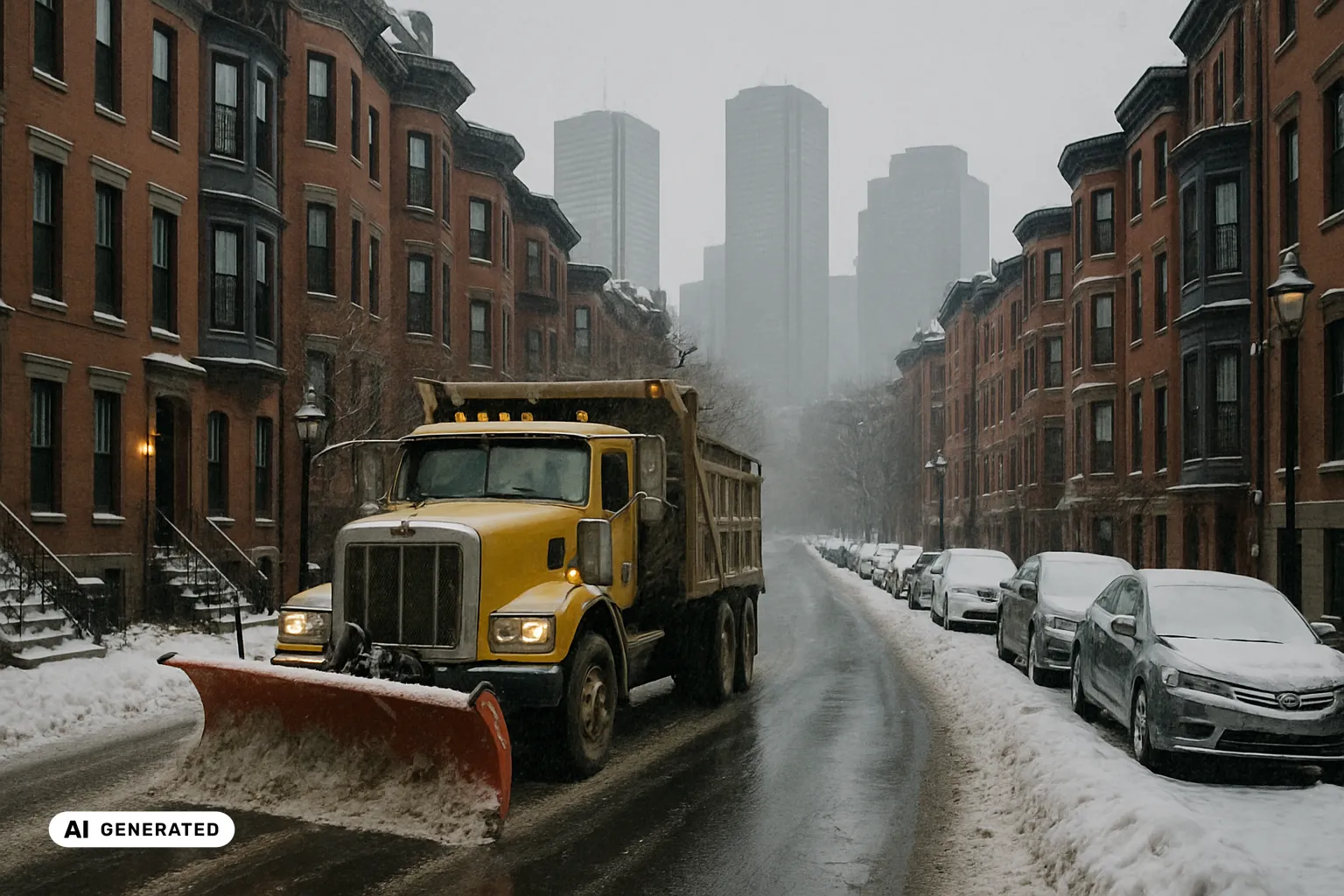
What winter actually does in Boston
Boston sits low and hard against the water. Its highest natural point, Bellevue Hill, is only about 330 feet; its low point is sea level; and Logan Airport, the weather station, stands just 19 feet above Boston Harbor, an arm of the Atlantic. More than two-thirds of the inner city’s land — the Back Bay among it — is built on fill that did not exist when the city was founded. That low, made-ground coastline, open to the north-east, is most of the explanation for a Boston winter.
The headline snowfall number — about 49.2 inches a year at Logan — looks moderate, and on its own it misleads. Boston is not a steady snowbelt city like Buffalo, where cold air off open water snows for days. Its snow is storm-driven: it arrives in a handful of big nor’easters and concentrates in the deep winter, with February (about 14.4 inches) and January (about 14.3) doing most of the work across only 23-odd days of measurable snow a year. Few snow days, large totals per storm — that is the signature.
The nor’easter, and the winter of 2015
A nor’easter is a low-pressure system that deepens off the US East Coast and throws north-easterly winds — hence the name — and Atlantic moisture at the shore. With cold air in place it falls as heavy snow; on the temperature margin it comes as wet snow, rain, wind and coastal flooding along the low coastline. One of these can bury the city in a day.
The clearest case is the record season of 2014–15, when 110.6 inches fell — beating the old record of 107.6 inches from 1995–96 — and most of it came in four storms in about four weeks. Roofs collapsed, neighbourhoods flooded, and the MBTA transit system seized up under snow and ice. That winter is the extreme, but it shows the shape of the normal one: a Boston winter is measured less by its average and more by how many big storms land, and where the rain-snow line falls when they do.
What the local rules say
Boston’s sidewalk rule lives in the City of Boston Code of Ordinances, Section 16-12.16, and the City states it plainly on its own snow-clearing page. As the City puts it, owners must clear snow, slush and ice from the abutting sidewalk and kerb ramps within three hours after the snow stops — or within three hours after sunrise if it fell overnight — and leave a path at least 42 inches wide so wheelchairs and strollers can pass.
Enforcement is graded by property type: about $200 for commercial, $100 for a residential building of 16 or more units, and $50 for one of 16 or fewer — with each day the walk is left counting as a “separate and distinct violation.” A related rule closes the obvious loophole: you may not shovel or push the snow you clear into the street, and doing so is separately finable. None of this is legal advice — the point here is simply what the code says. Because the figures and the section number matter, the sensible move is to read the City’s rules on clearing snow rather than take a summary’s word for it.
How the city clears — arteries first
On the road side, the Public Works Department runs the plowing, and in a big storm it can put up to 900 pieces of equipment on roughly 800 lane miles, with salt held in the order of 41,000 tons and some main roads treated before the snow arrives. The work runs by priority arteries first — Blue Hill, Commonwealth and Hyde Park Avenues are the City’s own named examples — so hospitals and emergency vehicles keep moving, then reaches toward the smaller residential streets.
The instrument that changes a bad day is the snow emergency. When the mayor declares one, parking is banned on the posted snow-emergency arteries and cars left there are ticketed and towed, so the plows can pass. It is also the trigger for the city’s most Boston habit: the “space saver.” In many residential neighbourhoods a resident who shovels out a spot may mark it — a chair, a cone — but only during a declared emergency, and only for up to 48 hours after it ends. The custom exists because the oldest streets have almost nowhere to put the snow, so a hand-dug space is genuinely hard-won.
The coast, the hills, and the city line
It helps to picture Boston winter service as two hazards on a low coast. Inland and on the flat, it is heavy, wet snow on narrow, historic streets — Beacon Hill, the North End, Downtown — where there is little room to store what gets plowed, which is the whole reason the street-dumping rule and the space-saver custom exist. On the waterfront it is something else again: a nor’easter arriving at high tide pushes seawater into the low, filled coastal areas — the Seaport, East Boston, Morrissey Boulevard in Dorchester — so salt water, snow and wind arrive together.
And the snow is not shared evenly. From the sea-level downtown the land climbs south to the Blue Hills — the Great Blue Hill at 635 feet, crowned by the Blue Hill Observatory, running since 1885 — and into higher neighbourhoods like Roslindale and West Roxbury. On a borderline storm the warm ocean nudges the coast toward wet snow or rain while the higher southern ground takes colder, cleaner snow. Follow that gradient 40 miles west and it becomes a different climate altogether: Worcester, at 479 feet inland, averages 72.9 inches a season against Logan’s 49.2 over the same 1991–2020 normals — about 48 per cent more snow, because the rain–snow line that gives the coast its slush usually sets up east of it. Every neighbouring town — Cambridge, Somerville, Brookline, Quincy — is its own municipality with its own sidewalk rule and its own deadline, so Boston’s three-hour rule describes Boston proper; cross a line and the rulebook changes, even though the same storm fell on both. This is a different winter again from the mountain-west snow of Salt Lake City — here the sea, not the elevation, writes the rules.
Keeping the record straight
In a city where a whole winter can land in four storms, and where the same nor’easter means wet snow inland and flooding on the waterfront, the useful thing is being able to show, plainly, what was done and when. Not to win an argument, but because a winter this concentrated generates exactly the questions — was the route cleared, at what time, in what conditions — that a vague answer can’t settle. A simple, time-stamped log of where a crew went and when, set against what the weather was actually doing, turns “we were out all storm” into something specific — a clear record a contractor can stand behind. That is the documentation support Wintertrace is built to make easy, whether you look after a single property or a fleet of routes across the city. It does not change any local rule; it just means that when someone asks what happened during the last storm, the answer is on file. Not a substitute for legal advice.
Local facts
- About 49.2 inches (around 125 cm) of snow falls in an average year at Boston Logan International Airport, based on the 1991–2020 climate normals — a moderate seasonal total for such a snow-prone city, because Boston's snow arrives in a few big storms rather than steady bands.Source
- The snow concentrates in the deep winter: February averages about 14.4 inches and January about 14.3, with December and March near 9 inches each — on roughly 23 days a year with measurable snow and a mean January low of about 23.3 °F (−4.8 °C).Source
- The snowiest season on record was 2014–15, with 110.6 inches — beating the old record of 107.6 inches from 1995–96 — and most of it fell in just four storms in about four weeks, the clearest illustration of Boston's storm-driven winter.Source
- Boston is strikingly low and coastal: the highest natural point is Bellevue Hill at about 330 feet, the low point is sea level, and Logan Airport — the climate station — sits just 19 feet above the harbour.Source
- More than two-thirds of inner Boston's modern land area did not exist when the city was founded — much of it, including the Back Bay, is built on fill — which leaves the core low, flat and exposed to coastal flooding during a nor'easter, not only to snow.Source
- The land rises to the south: the Great Blue Hill in Milton reaches 635 feet, the highest hill on the Atlantic coast south of Maine, and carries the Blue Hill Observatory, running since 1885 — the higher southern ground regularly sees more snow, and less changeover to rain, than the sea-level downtown.Source
- Under the City of Boston Code of Ordinances, Section 16-12.16, property owners must clear snow, slush and ice from the abutting sidewalk and kerb ramps within three hours after the snow stops — or within three hours after sunrise if it fell overnight — leaving a path at least 42 inches wide for wheelchairs and strollers.Source
- The fine for an uncleared sidewalk is graded by property type — about $200 for commercial, $100 for a residential building of 16 or more units, and $50 for one of 16 units or fewer — and each day it is left counts as a 'separate and distinct violation'; pushing the cleared snow into the street is separately finable.Source
- On the roads, the City's Public Works Department can put up to 900 pieces of plowing equipment on roughly 800 lane miles, holds salt in the order of 41,000 tons, and clears the main arteries first — Blue Hill, Commonwealth and Hyde Park Avenues among them — so emergency vehicles can move.Source
- When the mayor declares a snow emergency, parking is banned on the posted snow-emergency arteries and cars there are ticketed and towed; in many residential neighbourhoods residents may then mark a shovelled-out space with a 'space saver', but only during a declared emergency and for up to 48 hours after it ends.Source
Official contacts
City of Boston — Rules on clearing snow
The City's own page for the sidewalk duty under Ordinance 16-12.16: the 3-hour deadline, the 42-inch path, the fines, and the no-snow-in-the-street rule.
City of Boston — Managing winter and snow
How Public Works plows, the priority arteries, the snow-emergency parking ban, and how 'space savers' are allowed to work.
City of Boston — Winter weather preparations
The seasonal salt stock and equipment figures (updated each winter) and the City's anti-icing approach on main streets.
Massachusetts DCR — Winter Storm Plan and priority map
The state agency that clears the parkways (Storrow and Memorial Drive, the Blue Hills), distinct from City streets and MassDOT highways.
Common questions about winter service in Boston
- Do I have to shovel the sidewalk in front of my property in Boston?
- Yes. Under the City of Boston Code of Ordinances, Section 16-12.16, owners must clear snow, slush and ice from the abutting sidewalk and kerb ramps within three hours after the snow stops — or within three hours after sunrise if it snowed overnight — and leave a path at least 42 inches wide so wheelchairs and strollers can pass. The fine depends on the property: about $200 for commercial, $100 for a residential building of 16 or more units, $50 for one of 16 or fewer, and each day it is left is a separate violation. You also may not push the snow you clear into the street. This is general information, not a substitute for legal advice — read the City's page for the exact wording.
- Why can a whole Boston winter arrive in just a few storms?
- Because Boston's snow is storm-driven, not band-driven. Unlike a lake-effect city such as Buffalo, where cold air off open water snows steadily for days, Boston's big snow comes from nor'easters — coastal low-pressure systems that spin up off the Atlantic and throw moisture and strong north-easterly winds at the coast. One nor'easter can drop one to two feet in a day. The record 2014–15 winter, 110.6 inches, is the extreme case: most of it fell in four storms in about four weeks. So the seasonal average of roughly 49 inches understates how a bad Boston winter actually feels — it comes in a few overwhelming blows rather than a long steady grind.
- What are Boston's 'space savers', and are they actually allowed?
- A space saver is the Boston tradition of putting a chair, cone or bin in a parking spot you shovelled out to hold it while you are away. The City recognises it, but with limits: you may only use one when the City has declared a snow emergency, and it may stay for up to 48 hours after the emergency ends — after that it is fair game for removal. The rules also vary by neighbourhood; some dense districts opt out entirely. It exists because the oldest parts of the city have narrow streets and almost nowhere to put the snow, so a hand-dug space is genuinely hard-won.
- Who plows the streets, and which get done first?
- The City's Public Works Department runs the plowing, and in a large storm it can field up to 900 pieces of equipment across about 800 lane miles. It works the main arteries first — Blue Hill, Commonwealth and Hyde Park Avenues are named examples — so hospitals and emergency vehicles keep moving, then works toward the smaller residential streets. The City holds salt in the order of 41,000 tons and treats some main roads before the snow arrives. Not every road is the City's, though: MassDOT keeps the highways, and the state DCR clears the parkways such as Storrow and Memorial Drive.
- Where am I allowed to put the snow I clear?
- Not in the street. Boston's rules specifically forbid shovelling or pushing snow from your property into the roadway, and doing so is finable — graded, like the sidewalk fine, by how much and what kind of property. It is not red tape for its own sake: snow pushed back into a plowed street refreezes into a hazard and undoes the plow's work, which matters even more on Boston's narrow older streets where there is little room to begin with.
- Does Boston really flood in winter, or is that just a snow problem?
- It genuinely floods. Because the core is low and largely built on fill, right at the harbour's edge, a nor'easter arriving at high tide can push seawater into low coastal areas — the Seaport, East Boston, parts of Dorchester along Morrissey Boulevard. So a Boston winter storm is often two hazards at once: heavy, wet snow inland and coastal flooding with saltwater and ice along the waterfront. That combination — salt water, snow and wind on a low coastline — is a large part of what makes winter here different from an inland snow city.
- Why do the Blue Hills and the southern suburbs get more snow than downtown?
- Elevation and the rain-snow line. Downtown sits at sea level, where the relatively warm ocean often nudges a borderline storm toward wet snow or rain. Rise to the south — Roslindale and West Roxbury around Bellevue Hill at 330 feet, and further out the Great Blue Hill at 635 feet, the highest point on the Atlantic coast south of Maine — and the same storm falls as colder, cleaner snow. It is why a single 'Boston' snowfall figure can hide a big spread between a slushy waterfront and a foot of snow in the hills a few miles inland.
- Do Cambridge, Somerville and Brookline have the same sidewalk rules?
- No — each is its own city with its own ordinance, and the deadlines differ. Somerville, for instance, requires sidewalks cleared within six daylight hours of the snow stopping, with a path at least 36 inches wide; Cambridge and Brookline set their own timings again. So the City of Boston's three-hour rule describes Boston proper. Cross a line into a neighbouring municipality — which happens constantly across Greater Boston — and you are into a different local rulebook, even though the same nor'easter fell on both.
- Is the snow heavier here than in a colder inland city?
- Often, yes. Because Boston sits on the coast where storms ride the rain-snow margin, its snow is frequently the wet, dense kind rather than the light, dry powder of a colder continental or mountain climate. Wet snow is heavier to move, clings to trees and wires, and is the sort that collapsed roofs and buried cars in 2015. For anyone doing winter service, that means the same depth of Boston snow is more work per inch than an equivalent fall inland — and it sets up into hard, icy banks once it refreezes.
Documenting winter service in Boston
Anyone clearing snow and ice in Boston may later need to show when and where a route was treated. Wintertrace is open-source software that records exactly that — time, location and weather for each run — as a calm basis for your own operational records and service proof. It is not a substitute for legal advice.
This overview is for general information and is not legal advice. Local rules on snow and ice clearing vary — the wording of the local rule and the responsible authority always govern.