Winter service · Maine
Winter service in Portland
What winter is really like in Portland, Maine: about 69 inches of snow a year at the Jetport — one of the snowiest large cities on the US East Coast — driven by nor'easters off the Gulf of Maine, on a low peninsula that is more water than land. The City's 12-hour business / 18-hour residential sidewalk rule under Chapter 25, the overnight parking ban with its $130 penalty, and the record coastal tides of January 2024.
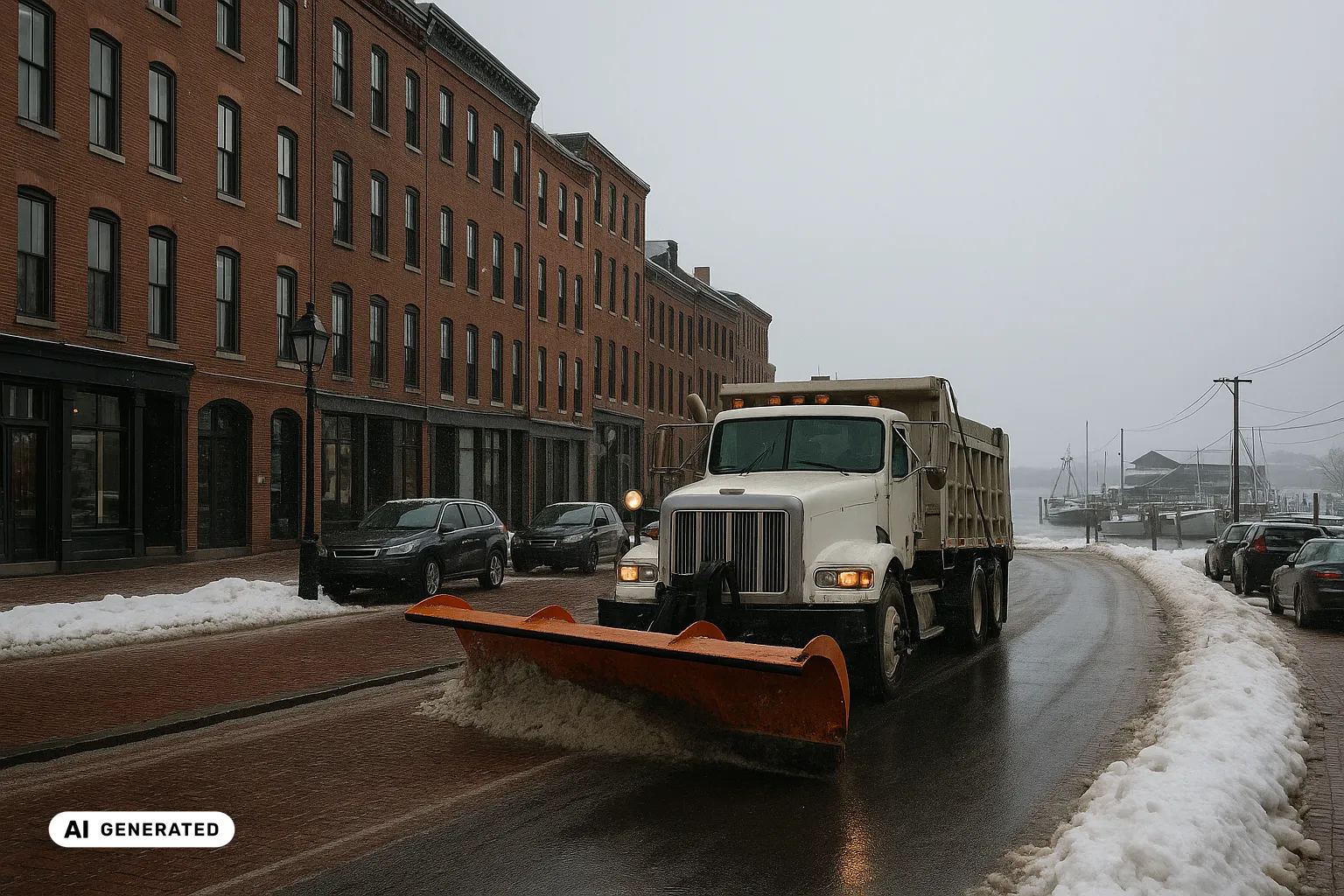
What winter actually does in Portland
Portland sits on a peninsula in Casco Bay, on the Gulf of Maine, and it is more water than land — of its 69.4 square miles, only about 21.3 are land and 48.1 are water. It sits low, at about 62 feet, with Munjoy Hill rising at the exposed East End, Back Cove cut into the north, and the Fore River along the south-west. That low, sea-surrounded position, open to the North Atlantic, is most of the explanation for a Portland winter.
And it is a genuinely snowy one. About 68.7 inches falls in an average year at the Jetport — well above Boston, and enough to rank Portland among the snowiest larger cities on the US East Coast. The snow is spread across a long season, November into April, with January (about 18.6 inches), February (16.6) and March (13.6) carrying most of it in a humid-continental climate that Köppen classes Dfb: “cold, snowy, and often prolonged winters.”
The nor’easters — and the tides
Portland’s defining winter risk is the nor’easter: a coastal low that tracks up the East Coast, driving strong easterly winds off the Atlantic, heavy snow, and — on this coast — often mixed precipitation and ice near the water. Sitting further up the coast than Boston, Portland catches more of these storms, and more of their precipitation falls as snow. The February 2013 blizzard, “Nemo,” is often cited as its biggest single storm, reported at around 31.9 inches.
But the sea is a hazard in its own right here, not just a snow machine. In January 2024, two back-to-back storms gave Portland its first- and fourth-highest tides on record, and broke the all-time water-level record of 14.17 feet — set in the historic 1978 blizzard — at 14.57 feet. The low, working waterfront along Commercial Street floods when a nor’easter meets a high tide, so a Portland winter storm is frequently two problems at once: snow on the streets and saltwater with ice along the shore.
What the local rules say
Portland’s sidewalk rule lives in the City Code, Chapter 25, Article VIII (“Removal of Snow and Ice”), and the City summarises it on its Winter Sidewalks page. As the City sets it out, business owners must clear the abutting sidewalk within 12 hours of a storm ending, and residential owners within 18 hours — or once the City finishes its own snow removal, whichever is later — leaving a path at least four feet wide and treating it against ice.
That an abutting owner owes the duty at all is a choice each city makes rather than a given. Burlington, Vermont holds the same chartered power to impose it, has never written it into its snow ordinance, and plows all 130 miles of its public sidewalk itself instead.
Enforcement is staggered through the season: for businesses $250, then $500, then $1,000; for homes $75, then $125, then $250. If the City ends up clearing the walk, the owner pays the removal cost plus a 10% administrative charge. And snow may not be pushed from driveways or lots onto public sidewalks and ramps — the very surfaces someone else has a deadline to keep clear. None of this is legal advice; it is simply what the code says. Because the exact deadlines and figures matter, the sensible move is to read the City’s Winter Sidewalks page, or the ordinance itself, rather than take a summary’s word for it.
How the city clears — the ban and the haul
On the road side, the Department of Public Works plows the city streets and maintains well over a hundred miles of sidewalk. When a storm needs it, the City declares a citywide overnight parking ban, typically 10 p.m. to 6 a.m., so crews can plow and clear without cars in the way. A vehicle left out during the ban can be ticketed and towed at the owner’s expense — the City Council raised that penalty from $40 to $130 — and the City opens some lots and streets for free parking so people have somewhere to move to.
Downtown gets a step further. The narrow Old Port streets have nowhere to pile snow, so the City runs a separate “Yellow Zone” ban: after a big storm, crews plow at night and haul the snow away rather than bank it at the kerb. The through-routes are a different responsibility again — MaineDOT keeps the interstates and state routes, and the Maine Turnpike Authority the tolled I-95 — so the City’s rules and plow plan describe city streets, not the highways around them.
The peninsula, the bridges, and the town lines
It helps to picture Portland winter service as an exposed coastal job. Munjoy Hill and the Eastern Prom at the East End take grade and wind off the water at once. The waterfront floods. The bridges over the Fore River to South Portland — exposed harbour crossings — ice early, the way exposed decks do everywhere. And across the whole peninsula the rain-snow line wanders close to the ground, so the hazard after a storm is as often refrozen slush and glaze as fresh snow, which is why the City pairs clearing with treating against ice.
Every neighbouring town is its own municipality with its own rules. South Portland, just across the river, has its own snow-removal ordinance and its own parking ban; Westbrook, Falmouth, Cape Elizabeth and Scarborough each set their own again. So Portland’s 12- and 18-hour rule and its overnight ban describe Portland proper; cross a bridge or a line and the rulebook changes, even though the same nor’easter fell on both. It is the same coastal, storm-driven winter that reaches Boston down the shore — and a very different one from the steady lake-effect bands of Buffalo, where the snow comes off open water rather than up the coast.
The sharpest comparison, though, is with the same state’s other winter, up the Penobscot. Bangor records 74.6 inches a season on the same 1991–2020 normals — only about 9 % more than the Jetport, which is not the gulf its reputation suggests. Where the two genuinely part is temperature: Bangor’s mean January high is 28.1 °F, below freezing, against Portland’s 32.4 °F, exactly on it, and Bangor sees roughly twice as many nights at or below 0 °F. That is the difference between a winter spent arguing with the rain-snow line and one where the snow simply stays snow — and it is why Portland’s duty is written as clearing paired with treating, while Bangor’s inland problem is mostly moving the stuff.
Keeping the record straight
In a place where a storm can bring heavy snow and a record tide on the same night, and where the real hazard is often ice rather than depth, the useful thing is being able to show, plainly, what was done and when. Not to win an argument, but because a coastal winter this variable generates exactly the questions — was the walk cleared, at what time, was it treated — that a vague answer can’t settle. A simple, time-stamped record of each treatment, and a log of where and when de-icer went down, turns “we salted overnight” into something specific. That is the documentation support Wintertrace is built to make easy, whether you look after a single property or a fleet of routes across the peninsula. It does not change any local rule; it just means that when someone asks what happened during the last storm, the answer is on file. Not a substitute for legal advice.
Local facts
- About 68.7 inches (around 175 cm) of snow falls in an average year at the Portland International Jetport, based on the 1991–2020 climate normals — making Portland one of the snowiest larger cities on the US East Coast.Source
- The snow is spread across a long season: January averages about 18.6 inches, February about 16.6 and March about 13.6, on roughly 16 days a year with an inch or more of fresh snow, in a humid-continental climate (Köppen Dfb) with a January mean daily high of about 32.4 °F (0 °C).Source
- Portland occupies a peninsula in Casco Bay on the Gulf of Maine, and it is more water than land — of its 69.4 square miles, only about 21.3 are land and 48.1 are water — sitting low, at an elevation of about 62 feet, with Munjoy Hill, Back Cove and the Fore River as its defining features.Source
- The city borders South Portland, Westbrook and Falmouth, with Cape Elizabeth and Scarborough nearby — each its own municipality with its own snow rules and public works, so responsibilities change the moment you cross a line.Source
- In January 2024 two back-to-back storms produced the first- and fourth-highest coastal tides ever recorded at Portland, and the all-time record water level of 14.17 feet — set in the 1978 blizzard — was broken at 14.57 feet, showing that on this coast winter storms bring flooding as well as snow.Source
- Under the City of Portland Code of Ordinances (Chapter 25, Article VIII), business owners must clear the abutting sidewalk within 12 hours of a storm ending and residential owners within 18 hours — or once the City finishes its own snow removal, whichever is later — keeping a path at least four feet wide and treating it against ice.Source
- Fines for an uncleared sidewalk are staggered per season — for businesses $250, then $500, then $1,000; for residences $75, then $125, then $250 — and if the City has to clear it, the owner pays the removal cost plus a 10% administrative charge; snow may not be pushed from driveways or lots onto public sidewalks and ramps.Source
- When plowing needs it, the City declares a citywide overnight parking ban, typically 10 p.m. to 6 a.m.; cars left on the street can be ticketed and towed at the owner's expense, and the City Council raised the penalty from $40 to $130.Source
- For the narrow downtown streets the City runs a separate 'Yellow Zone' ban so that, after a big storm, crews can plow at night and haul the snow away rather than just push it to the side.Source
Official contacts
City of Portland, Maine — Winter Sidewalks
The City's page on the sidewalk-clearing duty under Chapter 25: the 12- and 18-hour deadlines, the four-foot path, and the fines.
City of Portland, Maine — Snow Bans
The citywide overnight parking ban and the downtown Yellow Zone ban, plus where to park free while a ban is in effect.
City of Portland, Maine — Code of Ordinances, Chapter 25 (PDF)
The ordinance itself — Chapter 25 (Streets, Sidewalks and Other Public Places), Article VIII on the removal of snow and ice.
National Weather Service, Gray / Portland ME — Climate Normals 1991–2020
The official climate normals for the Portland Jetport and the wider forecast area.
Common questions about winter service in Portland
- Do I have to shovel the sidewalk in front of my property in Portland?
- Yes. Under the City of Portland Code of Ordinances (Chapter 25, Article VIII), business owners must clear the abutting sidewalk within 12 hours of a storm ending, and residential owners within 18 hours — or once the City finishes its own snow removal, whichever is later. The path has to be at least four feet wide and treated against ice. Fines rise through the season: for businesses $250, then $500, then $1,000; for homes $75, then $125, then $250. If the City clears it for you, you pay the removal cost plus a 10% administrative charge. This is general information, not a substitute for legal advice — check the City's Winter Sidewalks page for the exact wording.
- Why is Portland so snowy — snowier than Boston?
- Because it is further north and east, squarely in the path of the nor'easters that ride up the coast. Portland averages about 69 inches a year at the Jetport, well above Boston's roughly 49, and it is regularly named one of the snowiest larger cities on the East Coast. Like Boston its snow is storm-driven rather than lake-effect — it comes from coastal lows off the Gulf of Maine — but sitting up the coast it catches more of them, and more of their snow falls as snow rather than turning to rain. The February 2013 blizzard, 'Nemo', is often cited as its biggest single storm, reported at around 31.9 inches.
- What is the overnight parking ban, and how much is the fine?
- When a storm needs plowing, the City declares a citywide parking ban, usually running 10 p.m. to 6 a.m., so Public Works can plow, clear and haul without cars in the way. Leave a vehicle on the street during the ban and it can be ticketed and towed at your expense — the City Council raised that penalty from $40 to $130. During a ban the City opens some lots and streets for free parking so people have somewhere to move to. It is worth signing up for the City's ban notifications, because the ban is called storm by storm, not on a fixed calendar.
- Why does Portland flood in winter, not just get snow?
- Because it is a low peninsula — more water than land — right on the Gulf of Maine, so a strong nor'easter arriving at high tide pushes the sea into the low waterfront. It is not hypothetical: in January 2024, two back-to-back storms gave Portland its first- and fourth-highest tides on record, and broke the all-time water-level record of 14.17 feet — set in the great 1978 blizzard — at 14.57 feet. So a Portland winter storm is frequently two problems at once: heavy snow, and saltwater flooding with ice along Commercial Street and the working waterfront.
- Who plows the streets, and who handles the highways?
- The City of Portland's Department of Public Works plows the city streets and maintains well over a hundred miles of sidewalk. The interstates and state routes around the city are Maine Department of Transportation's, and the tolled Maine Turnpike (I-95) is run by the Maine Turnpike Authority. So the City's rules and plow plan describe city streets; the big through-routes are a separate, state responsibility. On the narrowest downtown streets the City goes further than plowing — it hauls the snow away under the Yellow Zone ban, because there is nowhere to pile it.
- Where am I allowed to put the snow I clear?
- Not on the public sidewalk or the kerb ramps. The City's rules specifically say snow may not be pushed or dumped from driveways and parking lots onto public sidewalks and access ramps — the very surfaces someone else has a deadline to keep clear. And when you clear your own walk, the point of the four-foot rule is a continuous, treated path; snow shoved back across it, or onto a ramp, just moves the hazard onto the next person.
- Do South Portland and the other nearby towns have the same rules?
- No — each runs its own. South Portland, just across the Fore River, has its own snow-removal ordinance (Chapter 23) and its own winter parking ban, with its own deadlines and penalties, and Westbrook, Falmouth, Cape Elizabeth and Scarborough each set theirs. So Portland's 12- and 18-hour rule and its overnight ban describe Portland proper. Cross one of the bridges to South Portland, or a line into Falmouth, and you are into a different rulebook — worth checking if you clear property in more than one town.
- Is the snow wet and icy on the coast, or dry?
- Portland often sits right on the rain-snow line, which makes its coastal snow frequently the wet, heavy kind, and its storms prone to mixed precipitation and ice near the water while the higher inland towns get colder, drier snow. That is why the City's rule pairs clearing with treating against ice, and why a treated four-foot path matters: on this coast the hazard after a storm is as often refrozen slush and glaze as fresh snow. For anyone doing winter service, coastal Portland is more an ice-management job than a pure snow-moving one.
Documenting winter service in Portland
Anyone clearing snow and ice in Portland may later need to show when and where a route was treated. Wintertrace is open-source software that records exactly that — time, location and weather for each run — as a calm basis for your own operational records and service proof. It is not a substitute for legal advice.
This overview is for general information and is not legal advice. Local rules on snow and ice clearing vary — the wording of the local rule and the responsible authority always govern.