Winter service · Maine
Winter service in Bangor
What winter is really like in Bangor, Maine: 74.6 inches of snow a year at the airport, but the number that matters is the January mean high of 28.1 °F — below freezing, where coastal Portland sits exactly on it. The city clears roughly 90 miles of sidewalk itself with six named machines, the owner's clearing duty under § 257-2 applies only in the Downtown Parking Management District, and the winter parking rule the City announced is not the one still written in the code.
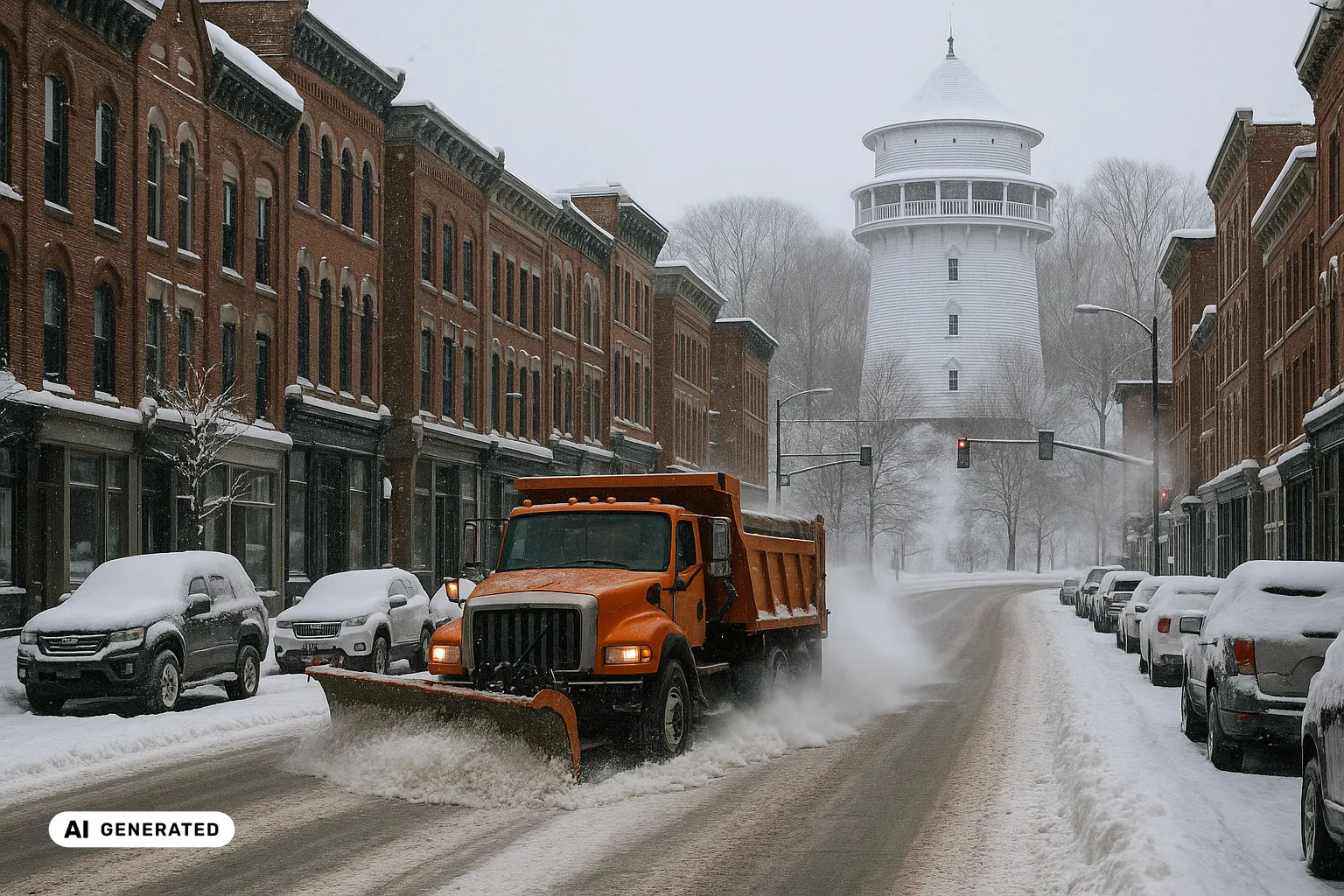
The number that matters here is not the snowfall
Bangor’s reputation is that it is the snowy one — the inland city that gets what coastal Maine is spared. The normals only half agree.
On the 1991–2020 normals Bangor International Airport records 74.6 inches a season. Portland, on the coast, records 68.7 on the same table. That is a difference of under six inches, or 8.6 % — real, but nothing you would build an argument on.
The temperature column is where the two cities separate.
Bangor’s mean January high is 28.1 °F. Not the low — the high. The average daytime maximum for the month sits below freezing. Portland’s is 32.4 °F, which is freezing, exactly. Bangor’s mean January low is 9.0 °F to Portland’s 15.6, and Bangor sees roughly 20 nights a year at or below 0 °F where Portland sees about 10.
That is the whole difference, and it changes what the work is. Portland spends much of its winter arguing with the rain-snow line: wet snow, mixed precipitation, a thaw mid-storm, and then everything it melted refreezing after dark. Ninety miles north-east, what falls as snow generally stays snow until a machine moves it. Bangor’s is a plowing winter where Portland’s is a treating one — and the salt on a Bangor street is working against a colder pavement for more of the season.
For scale in the other direction: Fargo, on the northern plains, gets 51.4 inches on the same normals — considerably less snow than Bangor — but is far colder still, with about 43 nights a year at or below 0 °F. Bangor sits between the two, and reads as neither.
A tidal river, not an inland one
It is easy to file Bangor as an interior city. The map says otherwise: the Atlantic is about 30 miles downstream, and the Penobscot at Bangor is tidal. The city exists because this is where the tideway ends and navigation stopped.
That has a winter consequence that nothing in the snowfall record predicts. The worst flood in Bangor’s modern history was not meltwater. On 2 February 1976 a rapidly deepening low pushed seawater up the river; the National Weather Service records that parts of downtown took 12 feet of water in about fifteen minutes, floating roughly 200 vehicles. Ice is the other river problem. The Coast Guard has been breaking ice on the Penobscot since the 1940s — up to two feet thick in places in the winter of 2014/15 — and the city’s worst ice-jam floods came in 1846 and 1902.
The city itself is compact and only moderately hilly: downtown sits at about 164 feet where the Kenduskeag Stream meets the Penobscot, and the ground rises north-west to Thomas Hill, whose 1897 standpipe stands at 225 feet. Around 60 metres of relief across the whole city. The grades out of the downtown — State, Union, Hammond — are real but gentle. This is not mountain winter service.
The unusual part: the City clears the sidewalks
In most American cities the sidewalk is the abutting owner’s problem. In Bangor, mostly, it is not.
The City clears roughly 90 miles of sidewalk itself — about six miles inside the downtown district with two small loaders, and about 84 miles outside it with six sidewalk tractors and a sidewalk loader. Under ideal conditions, the City says, all runs can be cleared in eight hours; after a run of storms it has taken a week or more.
It also publishes the list, which is more useful than it sounds. The city is divided into six districts — West, West Central, East, East Central, West Downtown, East Downtown — each with a Priority 1 and Priority 2 run, and each entry names its start, its end, its length, and which side of the street gets cleared.
That last column is the one residents actually feel. Downtown, entries read Both. Outside downtown, most read Odd or Even — one side only. So on a large share of residential streets the cleared sidewalk is the one opposite your house, deliberately, and that is the answer to the complaint that “they skipped us”. The City is blunt about the limit in its own words: it does not have the resources to maintain residential sidewalks on all residential streets, which is why there is a designated list and then an alternate list.
The machines that do it have names, from a public naming contest — Freeze-Mobile, AC Sleeter, Snarf Snarf, Nor’Easter Beaster, Bangorilla, Snowy McBlowie — and the City publishes a mileage report for each of them by season. On the road side the fleet runs 16 salt-spreading plow trucks, 9 large plows without spreaders and 6 smaller ones, with 43 drivers; a single route takes three to four hours.
Where the clearing duty does fall on the owner
There is a codified duty, and reading it carefully matters, because the first sentence limits everything that follows.
§ 257-2A of the City Code opens with applicability: the section
shall apply to any owner, tenant, firm, corporation, and/or other occupant of any property located on the streets in the Downtown Parking Management District.
Not city-wide. Downtown. Reported in 2017 as covering sections of more than thirty streets.
Where it applies, § 257-2B sets the deadline:
shall remove all snow and ice from any adjacent sidewalk and any adjacent alley, including private alleys, within six hours after the end of a precipitation event, except that if the precipitation ends after 6:00 p.m., then the snow and ice shall be removed before 1:00 p.m. on the following day.
Six hours is tight by American standards — compare Portland’s 12 hours for businesses and 18 for homes, a few hours down the coast under an entirely different arrangement, or the flat 24 hours written into Bismarck’s code. And the duty does not end when the sidewalk is clear: the same subsection imposes “a continuing duty” to keep it that way. Ice that cannot be removed has to be “covered or strewed with sand or other substances” under § 257-2C.
Then a clause most sidewalk ordinances do not carry. § 257-2D makes it the owner’s job to
install roof railings or other protection satisfactory to the Code Enforcement Officer to prevent the slide of snow and ice from the roofs into the street or sidewalk.
A duty about the building rather than the ground — and a sensible one for a downtown of tight brick frontages with pitched and mansard roofs standing directly over a narrow public sidewalk.
If nothing happens, § 257-2E lets the City Manager direct Public Works to clear it, with the owner or occupant “jointly and severally liable to repay the City of Bangor all reasonable charges therefor”. § 257-2F adds a civil fine “of not less than $100 per offense”, each day of continuing violation counting as a separate offense.
Whether tickets actually get written is a different question. The Bangor Daily News reported in March 2017 that the rule had existed since at least 1964 and that police had issued no fines or violations under it since at least 2000, with code officers working by letter and phone call instead. That is a 2017 account rather than a statement about this winter — and the cost-recovery route in § 257-2E does not depend on a fine being issued at all.
Where the snow may not go
A separate chapter handles the other half of the problem, and it is worth knowing if you clear property for a living. § 234-6 is one sentence with no qualifier:
No person shall deposit or cause or allow to be deposited ice or snow in any street or lane or sidewalk or public square of the City.
§ 234-6.1, added in 2018, supplies the consequence: the City Manager may have it removed, and the person who deposited it and the owner or occupant of the property it came from are jointly and severally liable for the City’s reasonable charges. The everyday version of this is a contractor clearing a private lot who leaves a windrow across the sidewalk — the same sidewalk a City machine is due to run down, on a list published in advance.
The parking rule, and the version of it still in the code
Bangor changed how it handles winter parking, and the change has not caught up with the codified text.
The City’s public guidance describes the current arrangement: after a trial in the 2024–2025 season, the Council in May 2025 authorised policy allowing overnight on-street parking in the winter months, so that winter now follows the year-round odd/even rule — even side on even-numbered days, odd side on odd. The stated reason is a zoning change that reduced required off-street parking for certain dwellings.
The code has not been rewritten to match. § 291-42A still reads as a seasonal prohibition running from the winter’s first Snow Clearing Order to 31 March, barring parking on any public way between midnight and 6:00 a.m., with odd/even applying during the day and named exceptions on stretches of State Street and Cedar Street.
We are not in a position to say which of the two governs a given night, and this page does not try to. It is the same shape of discrepancy that sits on the Fargo page, where the ordinance says 9 p.m. and the City’s own guidance says 24 hours: when the published guidance and the codified text disagree, the safe reading is the stricter one, and the authoritative answer comes from the City.
What is not in dispute is the layer on top. A Snow Clearing Order is issued
whenever the Public Works Director, in their sole discretion, determines that such order is appropriate for safe and orderly plowing and subsequent removal of snow and ice
and stays “in effect until cancelled by the Public Works Director”. There is no inch threshold to watch, unlike Fargo’s four-inch forecast trigger — the trigger is a person. A city-wide order takes every vehicle off the street; a downtown order affects only the district; and § 291-42C bars parking at any hour in a way that hinders the City’s snow removal. During a city-wide ban the City opens municipal lots for overnight parking from 5 p.m. to 7 a.m., and announcements go out through its mass alert system. The enforcement is not theoretical: 549 vehicles were towed between 9 December 2024 and 27 February 2025.
Who owns which road, and when
One Maine-specific wrinkle worth carrying if you work across the region. Under 23 MRSA § 754, state and state aid highways inside the compact areas of an “urban compact municipality” are maintained by the town, at the town’s expense — and an urban compact municipality is defined as one whose last census population “exceeds 7,500 inhabitants”. Bangor’s 2020 population was 31,753, so the threshold is not close. Which specific stretches count as compact area is determined by MaineDOT rather than by the population figure.
Outside compact areas, MaineDOT describes a split that is genuinely unusual: state-aid highways in rural areas are maintained “by the MaineDOT in the summer and by the town in the winter”. The same road, a different organisation responsible, depending on the season.
The through-routes themselves stay separate: I-95 runs west of the city core and I-395 crosses the Penobscot on the Veterans Remembrance Bridge to Brewer.
The bridges, and the rest of the hard parts
Three crossings link Bangor to Brewer on the far bank — the Veterans Remembrance Bridge carrying I-395, the Penobscot Bridge carrying State Street, and the Joshua Chamberlain Bridge carrying Union Street. Exposed river decks freeze before the approaches do, which is standard winter-service knowledge everywhere and simply more frequent here, given the number of nights below zero. The Chamberlain Bridge is in an extended rehabilitation with one-way running, pushing diverted traffic onto the Penobscot Bridge.
The Chamberlain deck also appears in the City’s sidewalk list as its own Priority 1 run — 4,200 feet, both sides — which is a good illustration of how granular that document is. The downtown lists also carry pedestrian ways with no carriageway at all: Merchants Plaza, West Side Plaza, the paths in front of and behind City Hall. One entry simply notes “DOORS IN SIDEWALK” at an address — a cellar hatch a machine cannot pass over, recorded so the operator knows.
Beyond the city line, Brewer, Orono, Old Town, Hampden and Veazie each run their own public works and their own rules. Bangor’s arrangement — the City clearing 90 miles of sidewalk, an owner duty confined to one downtown district — describes Bangor and nothing else. Cross a bridge and check again.
For historical scale: on 30 December 1962 Bangor recorded 25.5 inches of snow in a single day, reported at the time as the highest daily total in Maine’s climate records.
Documenting a winter that is measured in hours, not inches
Bangor is an unusually well-documented winter operation for a city of its size: a published priority list naming every run and the side of the street it covers, a mileage report per machine, an alert system for each parking ban. That is the same evidence trail a private contractor needs and rarely keeps.
If you clear snow here commercially — the downtown frontages under the six-hour rule, the private lots, the properties on the streets where the City’s machine takes only one side — the question that arrives weeks later is what you did and when. Wintertrace is self-hosted software for recording winter service work: what was cleared, when, by whom, with what material, with the weather conditions of the shift attached and a service record you can produce afterwards. It runs on your own hosting, with no subscription, and the data stays with you.
For a six-hour deadline that shifts to 1:00 p.m. when the snow stops after 6 p.m., the useful record is a timestamp, not a memory. And where a section like § 234-6.1 makes both the contractor and the property jointly liable for snow that ended up in the wrong place, being able to show where you put it is worth something to both.
A note on all of the above
This page is general information about winter service in Bangor, Maine, gathered from the City’s published material and its Code of Ordinances as of August 2026. It is not a substitute for legal advice, and it is not a statement of what applies to any particular property. Ordinances are amended — the winter parking provisions in particular are in flux — so check the City’s current pages and the code text itself before relying on anything here.
Local facts
- About 74.6 inches (189.5 cm) of snow falls in an average season at Bangor International Airport on the 1991–2020 normals, spread over roughly 31.3 days a year with 0.1 inch or more of snowfall.Source
- The monthly normals put the core season from December to March — December 14.7 in, January 18.6 in, February 17.5 in, March 15.2 in — with November at 4.3 and April at 3.7.Source
- January's mean daily maximum is 28.1 °F (−2.2 °C) — the average high for the month is below freezing. The mean daily minimum is 9.0 °F (−12.8 °C), and the record low is −32 °F (−35.6 °C), set in February 1948.Source
- Bangor sits at 164 feet on the Penobscot River, 34.26 square miles of land, with the Kenduskeag Stream running through downtown to the confluence. Thomas Hill, the high ground north-west of downtown, carries the 1897 standpipe at 225 feet above sea level.Source
- The Atlantic is only about 30 miles (48 km) downstream, and the river at Bangor is tidal — the city grew as the head of navigation on the tideway.Source
- The City clears sidewalks itself: approximately six miles inside the downtown district and approximately 84 miles outside it, using six sidewalk tractors and a sidewalk loader. All runs can be cleared in eight hours under ideal conditions; the City states plainly that it does not have the resources to maintain residential sidewalks on all residential streets.Source
- The published street list divides the city into six districts with Priority 1 and Priority 2 runs, each entry naming the side of the street cleared. Outside downtown most entries read Odd or Even — one side only; downtown entries read Both.Source
- The road fleet runs 16 salt-spreading plow trucks, 9 large plow trucks without spreaders and 6 smaller plow trucks, with 43 plow drivers; one driver's route takes three to four hours.Source
- Under § 257-2A of the City Code, the owner's snow-clearing duty applies only to property 'located on the streets in the Downtown Parking Management District' — not city-wide.Source
- Where it does apply, § 257-2B requires snow and ice to be removed from the adjacent sidewalk and alley 'within six hours after the end of a precipitation event, except that if the precipitation ends after 6:00 p.m., then the snow and ice shall be removed before 1:00 p.m. on the following day', with 'a continuing duty' to keep them clear thereafter.Source
- § 257-2D requires downtown owners to 'install roof railings or other protection satisfactory to the Code Enforcement Officer to prevent the slide of snow and ice from the roofs into the street or sidewalk'.Source
- § 257-2F sets a civil fine 'of not less than $100 per offense', with each day a violation continues counting as a separate offense; under § 257-2E the City may clear it and charge the cost back.Source
- Separately, § 234-6 states that 'No person shall deposit or cause or allow to be deposited ice or snow in any street or lane or sidewalk or public square of the City', and § 234-6.1, added in 2018, makes whoever put it there and the property it came from jointly and severally liable for the City's removal costs.Source
- The City's public guidance says the Council authorised overnight on-street winter parking in May 2025 after a trial winter, aligning winter with the year-round odd/even rule. The codified § 291-42A still reads as a seasonal prohibition on parking between midnight and 6:00 a.m. from the winter's first Snow Clearing Order until March 31.Source
- A Snow Clearing Order is issued 'whenever the Public Works Director, in their sole discretion, determines that such order is appropriate', and remains in effect 'until cancelled by the Public Works Director'. Between 9 December 2024 and 27 February 2025, Bangor police had 549 vehicles towed for parking violations.Source
- Maine law shifts highway maintenance by municipality size: under 23 MRSA § 754, state and state aid highways inside the compact areas of urban compact municipalities are maintained by the town at the town's expense, and an urban compact municipality is one whose last census population 'exceeds 7,500 inhabitants'. Bangor's 2020 population was 31,753.Source
- MaineDOT describes the seasonal split directly: 'state-aid highways in the rural area are maintained by the MaineDOT in the summer and by the town in the winter'.Source
- On 30 December 1962 Bangor recorded 25.5 inches of snow in a single day, reported at the time as the highest daily total in Maine's climate records.Source
- The worst flood in the city's modern history was not a snowmelt event but a storm surge: on 2 February 1976 a rapidly deepening low pushed seawater up the Penobscot and put 12 feet of water into parts of downtown within 15 minutes, flooding around 200 vehicles.Source
- The Coast Guard has run icebreaking on the Penobscot since the 1940s; in the winter of 2014/15 the ice reached up to two feet thick in places. Bangor's worst ice-jam floods were in 1846 and 1902.Source
Official contacts
City of Bangor — Sidewalk Snow Removal
The central winter page: what the City clears, the size of the sidewalk fleet, the designated and alternate lists, and the free sand available to residents.
City of Bangor — Sidewalk Street Listing (PDF)
The priority list itself, district by district — every run with its from/to, the side of the street cleared, and its length.
City of Bangor — Parking Information
The City's statement of the current winter parking policy, the two kinds of ban, and the municipal lots opened during a city-wide ban.
City of Bangor Code — Chapter 257, § 257-2 (Snow and ice control and removal)
The codified duty: who it applies to, the six-hour deadline, ice control, roof railings, clearing by the City and the penalty.
City of Bangor Code — Chapter 234, §§ 234-6 and 234-6.1 (Deposits of snow or ice)
The rule against pushing snow into the street or onto a sidewalk, and the cost-recovery provision added in 2018.
National Weather Service, Caribou — forecast office for Penobscot County
The office covering Bangor, including its account of the 1976 storm surge and the local climate record.
MaineDOT — Roadway inventories, classifications and urban compacts
How responsibility for state and state aid highways is divided between the state and the municipality, including the seasonal split outside compact areas.
Common questions about winter service in Bangor
- Do I have to shovel my sidewalk in Bangor?
- In most of the city, no — and this is the detail that surprises people who have lived elsewhere in the US. The clearing duty in § 257-2 opens with an applicability clause: it 'shall apply to any owner, tenant, firm, corporation, and/or other occupant of any property located on the streets in the Downtown Parking Management District'. Outside that district the City clears the sidewalks itself, on a published priority list. That does not make a residential owner's own path, steps and driveway someone else's problem, and it does not mean nothing is expected of you — but the codified deadline and the fine attach downtown. This is general information rather than legal advice; if your property is anywhere near the edge of the district, read the section and ask the City which side of the line you are on.
- If the City clears the sidewalks, why is the one in front of my house still full of snow?
- Two likely reasons, both visible in the City's own published list. First, priority: every district has a Priority 1 list and a Priority 2 list, and the City states it does not have the resources to maintain residential sidewalks on all residential streets — there is a designated list and then an alternate list. Second, and more often the answer: outside downtown most runs clear one side of the street only. The list names the side for each run, mostly 'Odd' or 'Even', where downtown entries read 'Both'. So on a good many residential streets the cleared sidewalk is the one across the road from you, by design. Under ideal conditions all runs can be done in eight hours; after a long storm or a run of storms it takes considerably longer.
- How much snow does Bangor get compared with Portland?
- Less than the reputation suggests: about 74.6 inches a year against Portland's 68.7, on the same 1991–2020 normals — under nine per cent more. The real difference between the two cities is not depth but temperature. Bangor's January mean high is 28.1 °F, below freezing; Portland's is 32.4 °F, sitting right on it. Bangor's mean January low is 9.0 °F to Portland's 15.6, and Bangor has roughly twice as many nights at or below 0 °F. In practice that means coastal Portland spends much of the winter negotiating with the rain-snow line — wet snow, mixed precipitation, refreezing slush — while in Bangor what falls as snow generally stays snow until someone moves it.
- What are the current winter parking rules?
- Here the City and the code do not read the same, and both are worth knowing. The City's public guidance describes a policy changed in May 2025 after a trial winter: overnight on-street parking is now allowed through the winter months, with the year-round odd/even rule applying — park on the even-numbered side on even-numbered days, the odd side on odd days. The codified § 291-42A, however, still sets out a seasonal prohibition running from the winter's first Snow Clearing Order to 31 March, barring parking between midnight and 6:00 a.m., with the odd/even rule for daytime. We are not in a position to say which governs a given night; that is a question for the City. What is not in dispute is the ban layer on top: during a Snow Clearing Order vehicles have to come off the street, and § 291-42C separately bars parking at any hour so as to hinder the City's snow removal.
- What is a Snow Clearing Order and how do I find out about one?
- It is Bangor's storm-triggered parking ban, and it comes in two sizes: a city-wide ban, where all vehicles must move to off-street parking, and a Downtown Parking Management District ban, which only affects the district. The code gives the trigger to a person rather than a threshold — the Public Works Department issues an order 'whenever the Public Works Director, in their sole discretion, determines that such order is appropriate for safe and orderly plowing and subsequent removal of snow and ice', and it runs 'until cancelled by the Public Works Director'. So there is no inch count to watch. Notice goes out through the City's mass alert system, and during a city-wide ban the City opens a set of municipal lots for overnight parking from 5 p.m. to 7 a.m. The enforcement is real: 549 vehicles were towed between 9 December 2024 and 27 February 2025.
- Where am I not allowed to put the snow I clear?
- In the street, the lane, the sidewalk or a public square — § 234-6 puts it in one sentence with no qualifier: 'No person shall deposit or cause or allow to be deposited ice or snow in any street or lane or sidewalk or public square of the City.' A companion section added in 2018, § 234-6.1, gives it teeth: if snow does end up there, the City Manager may direct Public Works to remove it, and the person who put it there together with the owner or occupant of the property it came from are 'jointly and severally liable to repay the City of Bangor all reasonable charges therefor'. The practical trap is the contractor clearing a private lot who leaves the windrow across the sidewalk the City is about to run a machine down.
- Is there anything unusual in the downtown rules?
- One clause that most US sidewalk ordinances do not carry: § 257-2D requires downtown owners to 'install roof railings or other protection satisfactory to the Code Enforcement Officer to prevent the slide of snow and ice from the roofs into the street or sidewalk'. It is a duty about the building rather than the ground, and it makes sense for the street it governs — tight frontages, several storeys of brick, pitched and mansard roofs directly over a narrow public sidewalk. The rest of § 257-2 is more familiar: clear within six hours of precipitation ending, or by 1:00 p.m. the next day if it ends after 6 p.m.; treat ice you cannot remove with 'sand or other substances'; the City may clear it and bill you; and the fine is 'not less than $100 per offense', each day counting separately.
- Is the duty actually enforced?
- Not with tickets, at least as of the last reporting we could find. The Bangor Daily News reported in March 2017 that the ordinance had been on the books since at least 1964, covered sections of more than 30 downtown streets, and that police had not issued any fines or violations under it since at least 2000 — enforcement running through code officers making calls and sending letters instead. That is a 2017 account, not a statement about this winter, and it is not a reason to disregard the section: § 257-2E means the City can clear the sidewalk and bill the cost regardless of whether anyone is fined.
- Who plows the highways around Bangor — the city or the state?
- It depends on where the road is, and Maine draws the line by municipality size rather than by road. Under 23 MRSA § 754, state and state aid highways inside the compact areas of an 'urban compact municipality' are maintained by the town, at the town's expense; an urban compact municipality is one whose last census population 'exceeds 7,500 inhabitants', and Bangor's 2020 population was 31,753. Which specific stretches count as compact area is determined by MaineDOT, not by the population figure. Outside compact areas there is a further wrinkle worth knowing if you work across the region: MaineDOT states that state-aid highways in rural areas are maintained 'by the MaineDOT in the summer and by the town in the winter' — the same road, different owner of the problem depending on the season.
- Does the river cause winter problems as well as the snow?
- Yes, and not the ones people expect this far up. The Penobscot at Bangor is tidal, with the Atlantic about 30 miles downstream, so a severe coastal storm reaches the city as water. The worst flood in Bangor's modern history was a storm surge, not a thaw: on 2 February 1976 a rapidly deepening low drove seawater up the river and put 12 feet of water into parts of downtown within about 15 minutes, floating some 200 vehicles. Ice is the other river problem — the Coast Guard has been breaking ice on the Penobscot since the 1940s, with the ice reaching up to two feet thick in the winter of 2014/15, and the city's worst ice-jam floods came in 1846 and 1902.
- What is the free sand the City mentions?
- The City makes sand available at no charge at its Public Works facility for residents to use on sidewalks, driveways and steps, on weekdays during working hours. It is a small thing, but it fits the pattern the rest of this page describes: in Bangor the winter work is split between the City and the property owner differently from most US cities, and the sand pile is the household end of that arrangement. Bring your own container and shovel.
Documenting winter service in Bangor
Anyone clearing snow and ice in Bangor may later need to show when and where a route was treated. Wintertrace is open-source software that records exactly that — time, location and weather for each run — as a calm basis for your own operational records and service proof. It is not a substitute for legal advice.
This overview is for general information and is not legal advice. Local rules on snow and ice clearing vary — the wording of the local rule and the responsible authority always govern.