Winter service · Vermont
Winter service in Burlington
What winter is really like in Burlington, Vermont: 87 inches of snow a season on the 1991–2020 normals and snow on the ground about 90 days a year, on a slope climbing 200 feet from Lake Champlain. The city holds the chartered power to require owners to clear their sidewalks — and has never written it into the snow ordinance. It plows all 130 miles itself, on nine routes starting at three in the morning.
A power the city has never used
At the foot of Burlington’s snow ordinance there is a cross-reference most readers would skip. It points to the city charter, and to the council’s power “to compel snow and ice removal”. Follow it, and Sec. 48(23) of the charter turns out to grant the council authority
“to compel all persons to remove from the sidewalks and gutters in front of the premises owned or occupied by them all snow, ice, dirt and garbage, and to keep such sidewalks and gutters clean”.
That is the ordinary American arrangement, written out in full: the owner shovels the walk in front of the building. Portland, Maine, a few hours east, gives businesses 12 hours after a storm ends and homes 18. Burlington has held the same power for well over a century. It has never put it into the snow ordinance.
Article IV of Chapter 27, “Snow and Ice Removal”, consists of five sections — 27-84 through 27-88 — after which the article reads “27-89—27-99 Reserved.” Those five cover roof guards, awnings, a prohibition on pushing snow outward, and the notification of violations. None of them requires an abutting owner to clear the sidewalk.
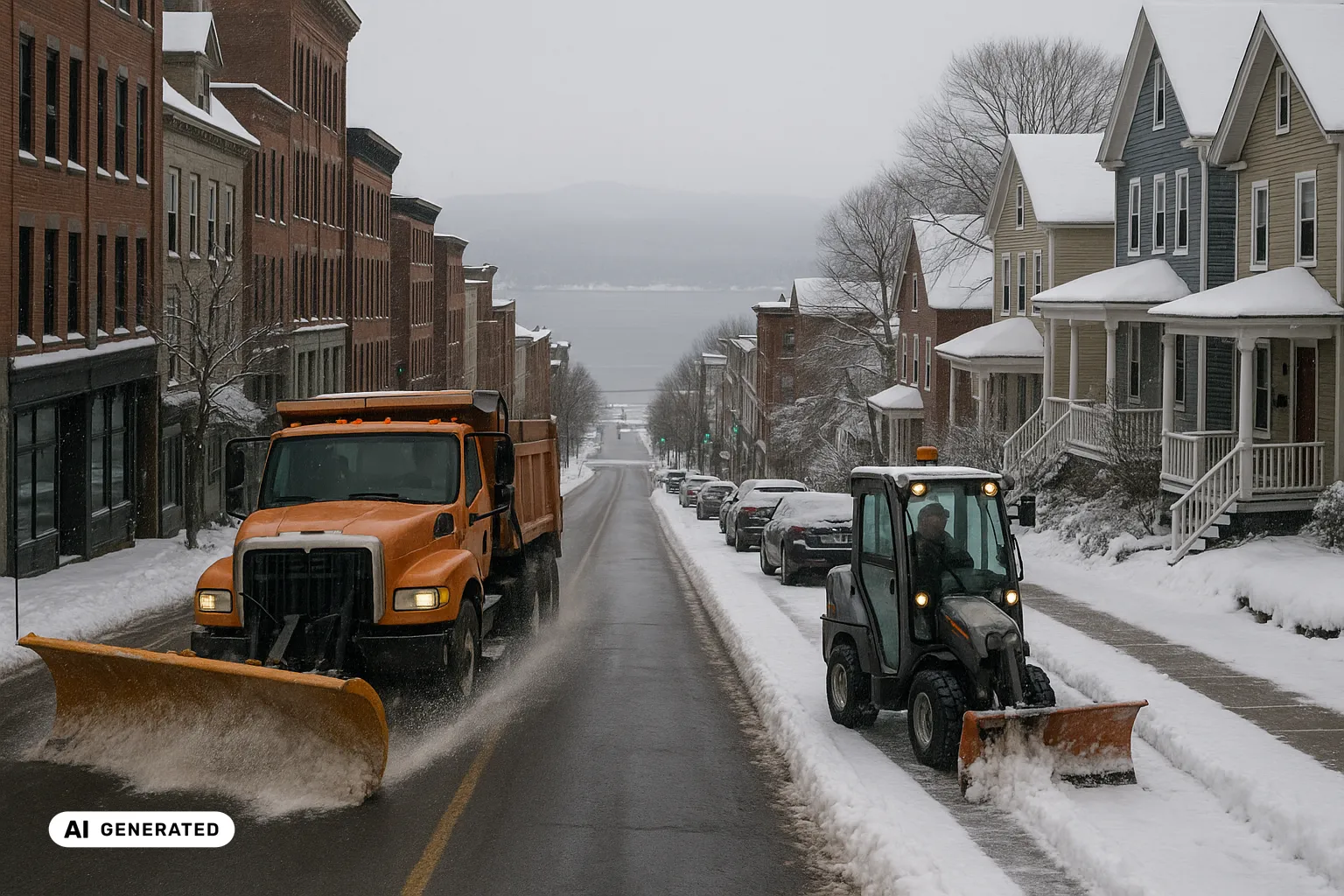
What the city does instead is clear them. Burlington Public Works defines its level of service for “our 95 miles of streets, 130 miles of sidewalks, and 33 combined miles of bike lanes” — and runs nine sidewalk plow routes against ten street routes to do it.
Eighty-seven inches, and ninety days of it on the ground
On the 1991–2020 normals Burlington records 87.5 inches (222 cm) a season, over about 23 days with an inch or more of new snow. The city plans against a rounder 80 inches in its own operational document, which is a fair working figure rather than a contradiction.
The number that describes the winter better is how long it stays. The Weather Service office here — which is both the forecast office and the observing station, so the record is unusually good — puts measurable snow cover at about 90 days a year. A quarter of the year with snow on the ground.
That study also shows a winter changing shape rather than simply shrinking. Across the period of record, seasonal snowfall rose from about 60 to 87 inches and days with measurable snowfall from 44 to 58 — while days with snow cover slipped from about 95 to 90, and the season’s edges pulled inward: first measurable snow from 12 to 6 November, last from 18 to 10 April. More snow, falling on more days, lying slightly less long, inside a slightly shorter season.
The spread between years is wide. The snowiest season on record is 1970–71 at 145.4 inches; the least snowy, 1912–13, managed 31.8. The largest single storm is 33.1 inches on 2–3 January 2010.
The lake takes snow away, it does not add it
It is tempting to file Burlington with the Great Lakes cities, and it does not belong there. The Champlain Valley lies in the lee of the Adirondacks, and the University of Vermont describes the result as the state’s “banana belt”: northern Vermont can be in a full blizzard with two feet accumulating while the valley sits under blue skies with nothing on the ground. Burlington’s snow arrives with synoptic storms tracking through, not in bands off the water — unlike Buffalo, where the lake is the whole story. The Green Mountains east of the city get considerably more than the city does.
The lake’s real winter signature is a different one, and it is beautifully documented. The National Weather Service has recorded whether Lake Champlain freezes over since 1868, judging it by full ice coverage from Burlington across to Port Kent as observed from the Battery Park overlook. Since 2000 the lake has closed nine times — most recently on 13 February 2026, the first full freeze in seven years. The earliest closing in the series is 7 January 1868, the latest 26 March 1894. The office is careful to say the record is kept “for informational and non-scientific purposes only”, which is the right caveat for a 158-year yes-or-no series maintained by eye.
What the ordinance does contain
Reading Article IV in full is a short job, and it explains what the drafters were actually worried about: snow coming down from above, not snow lying underfoot.
Section 27-85 requires roof guards on any building from which snow, ice or water may slide onto a street or sidewalk. Section 27-86 carries the only hard deadline in the article — and it is about awnings. Snow must be cleared from an awning or shade “within four (4) hours if in the daytime and by 12:00 noon of the following day if in the nighttime.” If it is not, under 27-87 the superintendent of streets does it at the owner’s expense.
Section 27-84 is the one that binds ordinary property owners: no person shall throw or put snow or ice “in the part of the street known as the travel portion nor on a sidewalk of a street.” Asked directly whether residents may push snow from their property onto the sidewalk or street, the city answers “No, a City ordinance restricts this act.” Given that the city is plowing that sidewalk on a schedule, snow pushed back onto it is being cleared twice at public expense.
Two penalty figures sit side by side in the current code and neither should be quoted on its own. Section 27-87 fines an uncleared awning “not more than twenty dollars ($20.00) nor less than one dollar ($1.00)” — text carried forward from the 1962 revised ordinances. Section 27-21, last amended in December 2025, makes a violation of any provision of Article IV a civil offence of $50 to $500, with each day a separate offence.
One further section deserves attention from anyone clearing snow commercially here. Section 27-8 provides that “no person shall sprinkle salt in a street except by permission of the superintendent of streets” — and section 27-1 defines “street” for the whole chapter as “the entire width between property lines of every way used for vehicular traffic and pedestrian travel.” On the face of the text, the permission requirement reaches the footway as well as the carriageway. How it is applied is another matter, and the city separately hands out salt to residents, as below. But the section is there, and it is two lines long.
Nine routes, starting at three in the morning
The department’s own timings are the most concrete description of a Burlington winter anywhere. A right-of-way crew of 17 full-time street maintenance workers plus about two seasonal staff runs 10 large plow trucks (one spare), one small truck for dead ends and narrow streets, and 11 tractors (two spare).
| Operation | Time |
|---|---|
| Plow every street once | 5–7 hours |
| Salt every street at 500 lb per mile | 4 hours |
| Plow every sidewalk once | 8 hours |
| Salt every sidewalk | 12 hours |
| Snow-blow every sidewalk | 24–30 hours |
The last line is the threshold that changes the machine. Above 12 inches, with snow banks along the walks, plowing is no longer enough: “we will have to snow blow every sidewalk. This will take considerable time and manpower.”
Night work is scheduled around the school run: sidewalk plowing usually starts around 3 a.m. so the walks are open when school begins. Extra attention goes to downtown, the Old North End, and the areas around schools and crossing guard posts. Twelve hours after a storm, every city street is expected to have been plowed, and the street maintenance foreman inspects them.
Downtown and the narrow streets cannot be plowed to the side at all — there is nowhere to put it — so snow is removed two to three days after the storm, in the early morning. It goes to 702 Lake Street, a former oil tank farm on the waterfront, chosen for a specific reason: “the berm keeps contaminants from reaching the lake.” Accessible parking spaces are cleared after the streets and sidewalks, and the plan is honest that “it may take many days before all spaces can be cleared.”
Named trouble spots come straight from the route sheets: Plow Route #1 lists Ledge Road, Fern Hill on North Prospect, Maple Street and Cliff Street under “areas to pay close attention to.” That is the hill, and it is the defining piece of Burlington’s geography — the ground climbs roughly 200 feet from lake level to the top of the hill across a handful of cross streets. The University of Vermont’s own description is that “the steeply paved roads of Burlington give adrenaline rushes to college students on skateboards and are a headache for city planners.”
A ban that cannot be put in a calendar
Burlington’s winter parking rule is unusual in the region, and the city says so itself: “Burlington does not have a seasonal parking ban like most towns in our region.” The public works director declares one storm by storm, weighing the length of the storm, the snow forecast and how much is already lying uncleared.
Read the ordinance and you find it sets the machinery, not the hours. Section 20-56 makes it unlawful to park “within any designated city right-of-way, including the sidewalk, anytime of the year during a declared parking ban”; it gives the power to declare to the public works director, the mayor or the police chief; and it requires that the affected area’s parking prohibition lights be placed into flashing operation six hours ahead, with notice scheduled to begin at 3 p.m., followed by press releases. The plan describes activating “up to 90 plus flashing parking ban lights” at the entrances to the city, at important intersections and throughout the neighbourhoods — a physical signal, visible from the street, rather than a notification you have to subscribe to.
What section 20-56 does not contain is any hours for the ban itself. That is worth saying, because the city’s operational plan attributes hours to it — “By City ordinance 20-56 the ban must be declared by 3 p.m. in order to be in effect by 10 p.m. that evening until 8 a.m.” — while the city’s winter parking page gives 10 p.m. to 7 a.m., and midnight to 6 a.m. downtown. The times are not in the codified text at all. Before a storm, the city’s current page is the version to work from.
A violation costs $75 under section 20-66(b)(4), and a towed vehicle is additionally assessed the removal charges. Cars may be relocated to another street or impounded within five miles of the city boundary; the plan names Lake Street Extension, Gosse Court off North Avenue and the Oakledge Park lot.
Four thousand tons, and a lake slowly getting saltier
Public works uses approximately 4,000 tons of road salt a year, supplemented with magnesium chloride and a liquid product specifically to reduce the quantity of salt needed. The planning rate is 500 pounds per lane mile, every spreader and spreader control is calibrated each November, and after every storm each truck’s mileage and pounds per lane mile are recorded. That last detail is a municipal department keeping exactly the record a private operator is usually asked for.
Residents get a share: property owners may take one five-gallon bucket of salt per winter from the salt shed on Pine Street, as a courtesy and when it does not interrupt the city’s own work.
The reason for the caution about quantity is in the water. The Lake Champlain Basin Program reports that chloride concentrations in the lake remain well below the benchmarks for drinking water and aquatic life — 250 and 230 milligrams per litre — but that the concentration is increasing, driven by rising chloride loading from nearly all of the basin’s rivers. Those two facts belong next to each other rather than multiplied together: nobody has attributed the trend to the city’s 4,000 tons, and this page does not either.
Three winter services on a short walk
Central Burlington runs three separate regimes within a few blocks, which is worth knowing before assuming who is responsible for a given stretch of pavement.
The city clears the streets and the 130 miles of public sidewalk. The University of Vermont clears its own campus: a grounds crew of 15 full-time staff covers 15 miles of walkway, 9 miles of road and 39 acres of parking across more than 450 acres, working primarily in regular Monday-to-Friday daytime hours — which is a different service promise from a municipal crew starting at 3 a.m. And the Church Street Marketplace, the four-block pedestrian street, is run by its own director and commission, with winter clearing as an enhanced clear-and-dispose operation funded through an assessment on the abutting businesses rather than out of ordinary street plowing.
Beyond the city, the Vermont Agency of Transportation handles the interstates and state routes with a fleet of 275 plow trucks, 60 loaders, 8 graders and around 100 heavy-duty pickups, working to bare pavement on a corridor priority schedule. VTrans is candid about the difference in approach: “Towns often use considerably more salt than we do, and as a result, they can often obtain bare roads very quickly.”
Across the river, the opposite system
Winooski is a few minutes away over the river and runs Burlington’s logic backwards. Where Burlington declares storm by storm, Winooski works from a fixed calendar: its code prohibits parking in the central business district between 2:30 and 6:00 a.m. from 1 December to 31 March, with no declaration required. It also allows the city to remove any vehicle left in a public parking area more than twelve hours after a snowstorm.
Two cities on opposite banks of the same river, in the same weather, with opposite answers to the same problem. If there is one practical lesson on this page, it is that these rules are municipal and have to be checked where the property actually is — including the neighbouring towns, where a different answer may apply a few hundred metres away.
Keeping a record where the city holds the shovel
Burlington shifts the documentation question rather than removing it.
Because the city clears the public walks, a contractor working here is mostly not being measured against a municipal sidewalk deadline. The work is on private ground — entrances, steps, driveway aprons, car parks, the paths between a building and the public walk the city plows — and that is exactly the ground where nobody else is keeping a record of what was done and when. Half of the city’s residents rent, so on a great many properties the person who notices an icy step is not the person who arranged for it to be cleared.
Wintertrace is self-hosted software for recording winter service work: which site was attended, when, by whom, what material went down and how much, with the weather conditions of the shift captured automatically and a service record you can produce months later. It runs on your own web hosting, without a subscription, and the data stays with you.
The city offers an unintentional model here. It calibrates every spreader in November and records mileage and pounds per lane mile after every storm — the same shape of record a property manager tends to ask a contractor for, kept for the same reason.
A note on all of the above
This page is general information about winter service in Burlington, Vermont, drawn from the city’s published material and the Burlington Code of Ordinances as of September 2026; the code as published is current through an ordinance of 15 July 2026. It is not a substitute for legal advice, and it is not a statement of what applies to any particular property — least of all the observation that the snow ordinance contains no general sidewalk duty, which describes Article IV and not the whole of the law that might bear on an icy walk. Ban hours differ between the city’s own documents, and the general penalty was amended in December 2025, so check the city’s current pages and the ordinance text before relying on anything here.
Local facts
- About 87.5 inches (222 cm) of snow falls in an average season at Burlington International Airport on the 1991–2020 normals, over roughly 23 days a year with an inch or more of new snow. The city's own operational plan budgets for a rounder 80 inches.Source
- The more telling figure is persistence: the NWS Burlington snow climatology puts measurable snow cover at about 90 days a year — a quarter of the year with snow on the ground — down from about 95 across the earlier part of the record.Source (PDF)
- Over the period of record the same study finds seasonal snowfall rising from about 60 to 87 inches, and days with measurable snowfall rising from 44 to 58, while the season's edges have contracted: first measurable snow has moved from 12 to 6 November, last from 18 to 10 April.Source (PDF)
- Across the observation series back to 1892/93, the snowiest season was 1970–71 with 145.4 inches and the least snowy 1912–13 with 31.8. The largest single storm on record is 33.1 inches on 2–3 January 2010.Source
- Burlington Code of Ordinances Article IV, 'Snow and Ice Removal', consists of five sections — 27-84 to 27-88 — after which the article is marked Reserved. None of them imposes a general duty on abutting owners to clear the sidewalk.Source
- The city holds the power to impose one. Article IV cites its own charter reference, and Burlington City Charter Sec. 48(23) empowers the city council 'to compel all persons to remove from the sidewalks and gutters in front of the premises owned or occupied by them all snow, ice, dirt and garbage'.Source
- Instead the city clears them. Burlington Public Works states its level of service for 'our 95 miles of streets, 130 miles of sidewalks, and 33 combined miles of bike lanes', worked by a right-of-way crew of 17 full-time street maintenance workers and about two seasonal staff.Source
- There are nine sidewalk plow routes against ten street routes. Plowing every sidewalk once takes about 8 hours; salting every sidewalk about 12; snow-blowing every sidewalk, which becomes necessary above 12 inches, takes 24 to 30 hours.Source
- Night sidewalk work starts early by design: 'During a night time snow push back or any night time plowing operation, sidewalk plowing usually starts around 3 a.m. so that the sidewalks are open when school begins.'Source
- The single deadline written into the snow article does not concern sidewalks at all. Section 27-86 requires snow be cleared from an awning or shade 'within four (4) hours if in the daytime and by 12:00 noon of the following day if in the nighttime'.Source
- Two penalties sit side by side in the current code. Section 27-87 fines an unremoved awning 'not more than twenty dollars ($20.00) nor less than one dollar ($1.00)' in text dating from 1962; section 27-21, last amended in December 2025, makes any violation of Article IV a civil offence of $50 to $500, each day a separate offence.Source
- What owners may not do is push snow outward: section 27-84 prohibits throwing or putting snow or ice 'in the part of the street known as the travel portion nor on a sidewalk of a street'. Asked whether residents may push snow onto the sidewalk or street, the city answers 'No, a City ordinance restricts this act.'Source
- Section 27-8 requires permission for private salting: 'No person shall sprinkle salt in a street except by permission of the superintendent of streets.' Section 27-1 defines 'street' for the whole chapter as 'the entire width between property lines of every way used for vehicular traffic and pedestrian travel'.Source
- Burlington has no seasonal parking ban. Its operational plan states it plainly — 'Burlington does not have a seasonal parking ban like most towns in our region' — and the public works director declares one storm by storm.Source
- The declaration is announced physically. Under section 20-56 the affected area's parking prohibition lights are placed into flashing operation six hours ahead, with notice scheduled to begin at 3 p.m.; the plan describes activating 'up to 90 plus flashing parking ban lights' at city entrances, major intersections and throughout the neighbourhoods.Source
- Section 20-56 itself fixes no hours for the ban. It regulates who may declare it, how it is announced and what follows — the prohibition covers 'any designated city right-of-way, including the sidewalk'. The times come from the city's winter parking page: 10 p.m. to 7 a.m., and midnight to 6 a.m. downtown.Source
- A parking ban violation costs $75 under section 20-66(b)(4), and a vehicle removed to another street or a remote location is additionally 'assessed charges for removal as part of the issuance of the penalty'.Source
- Public works uses approximately 4,000 tons of road salt per year, supplemented with magnesium chloride and Promelt Magic Minus Zero to reduce the quantity needed, spread at a planning rate of 500 pounds per lane mile with every spreader calibrated each November.Source
- Property owners may collect one five-gallon bucket of salt per winter from the city salt shed on Pine Street, as a courtesy and when it does not interrupt the city's own operations.Source
- Snow trucked out of the streets is stored at 702 Lake Street, a former oil tank farm on the waterfront, chosen because 'the berm keeps contaminants from reaching the lake'.Source
- Chloride in Lake Champlain remains well below the benchmarks for drinking water and aquatic life — 250 and 230 milligrams per litre — but the Lake Champlain Basin Program records that the concentration is increasing, driven by rising chloride loading from nearly all of the basin's rivers.Source
- The National Weather Service has kept a record of Lake Champlain freezing over since 1868. Since 2000 the lake has closed just nine times — most recently on 13 February 2026, the first full freeze in seven years.Source
- The lake does not generate a snow belt here. The Champlain Valley lies in the lee of the Adirondacks, and the University of Vermont describes it as the state's 'banana belt': northern Vermont can be in a full blizzard while the valley sits under blue skies.Source
- About a fifth of the city's area is water — 5.19 of its 15.49 square miles — and the ground rises from lake level near 95–100 feet to about 300 feet at the top of the hill, a climb of roughly 200 feet across a handful of cross streets.Source
- The University of Vermont clears its own campus rather than relying on the city: a grounds crew of 15 full-time staff maintains 15 miles of walkway, 9 miles of road and 39 acres of parking across more than 450 acres, primarily during regular Monday-to-Friday daytime hours.Source
- Half of Burlington's residents live in rental housing and a third in owner-occupied housing, with the remainder in group quarters — 21,405 people in rentals against 15,721 in owned homes, on the city's own analysis of census data.Source
- Winooski, immediately across the river, runs the opposite system: its code bans parking in the central business district between 2:30 and 6:00 a.m. on a fixed calendar from 1 December to 31 March, rather than storm by storm.Source
Official contacts
Burlington Public Works — Snow and Ice Control Plan (PDF)
The full operational plan: route counts, timings, equipment, salt figures, the parking ban procedure and the snow storage site. The single most useful document about winter in Burlington.
City of Burlington — Winter Parking
Current ban hours, zones, garages and fees, in the version the city maintains for residents.
Burlington Code of Ordinances — Article IV, Snow and Ice Removal
All five sections of the snow article, and the charter reference at its foot. Short enough to read in full.
Burlington Code of Ordinances — Chapter 27, Article I
The chapter's definition of 'street', the requirement of permission to sprinkle salt, and the general penalty covering Article IV.
Burlington DPW — Street and sidewalk maintenance FAQ
The city's answers to resident questions, including where snow may not be pushed and how to report a problem.
National Weather Service Burlington — Lake Champlain closings
The freeze-over record back to 1868, with the observation criterion and the office's own caveats about it.
Vermont Agency of Transportation — Winter maintenance FAQ
For the interstates and state routes around the city, which the state maintains rather than Burlington.
Common questions about winter service in Burlington
- Do I have to shovel my sidewalk in Burlington?
- Not under the snow ordinance, which is unusual enough to be worth stating carefully. Article IV of the city code, headed 'Snow and Ice Removal', runs from section 27-84 to 27-88 and is then marked Reserved — and none of those five sections imposes a general duty on the abutting owner to clear the walk. What they cover is roof guards, awnings, and a prohibition on pushing snow outward into the street or onto the sidewalk. The city clears the public sidewalks itself, all 130 miles of them. That does not make a private path, step or driveway somebody else's problem, and it does not settle questions of liability for your own property — but the shovel-by-morning duty that most American cities place on owners is not in Burlington's snow ordinance.
- Could the city require it if it wanted to?
- Yes, and that is the interesting part. Article IV carries a charter reference at its foot, pointing to the city charter's grant of power over snow and ice removal. Section 48(23) of the charter empowers the city council 'to compel all persons to remove from the sidewalks and gutters in front of the premises owned or occupied by them all snow, ice, dirt and garbage, and to keep such sidewalks and gutters clean'. The authority to impose the duty every neighbouring city imposes has been sitting in Burlington's charter the whole time. The council has not used it, and the city runs nine sidewalk plow routes instead.
- Is there any deadline at all in the snow ordinance?
- One, and it is about awnings. Section 27-86 requires the occupant, tenant or owner of a building with an awning or shade to clear snow from it 'within four (4) hours if in the daytime and by 12:00 noon of the following day if in the nighttime'. If they do not, the superintendent of streets does it at the owner's expense. It is a rule aimed squarely at snow falling onto people below, and alongside section 27-85's requirement for roof guards it shows what the ordinance was actually worried about: snow coming down from above rather than lying underfoot.
- What are the penalties, then?
- Two figures sit side by side in the current code, and neither should be quoted alone. Section 27-87 fines a failure to clear an awning 'not more than twenty dollars ($20.00) nor less than one dollar ($1.00)' — text carried over from the 1962 revised ordinances. Section 27-21, which was last amended in December 2025, makes a violation of any provision of Article IV a civil offence punishable by $50 to $500, with each day the violation continues a separate offence. The larger figure is the modern general penalty for the whole chapter; the smaller is the specific historical one attached to awnings.
- Where am I allowed to put snow I clear from my own property?
- Not into the street or onto the public sidewalk. Section 27-84 prohibits throwing or putting snow or ice 'in the part of the street known as the travel portion nor on a sidewalk of a street', and the city's own answer to the question is blunt: 'No, a City ordinance restricts this act.' It also points out the practical consequence — if pushed snow causes an accident, that is a problem for whoever pushed it. Since the city is plowing that sidewalk on a schedule, snow put back onto it is also being cleared twice at public expense.
- Do I need permission to salt?
- The text says so, and it is worth reading before assuming otherwise. Section 27-8 provides that 'no person shall sprinkle salt in a street except by permission of the superintendent of streets'. Read with section 27-1, which defines 'street' for the whole chapter as 'the entire width between property lines of every way used for vehicular traffic and pedestrian travel', the wording reaches the footway as well as the carriageway. How that is applied in practice is not something this page can tell you — and the city separately offers property owners a five-gallon bucket of salt per winter from its own salt shed. If you are treating public surfaces commercially in Burlington, the section is short and the superintendent of streets is the right person to ask.
- When is a parking ban in force?
- Whenever the public works director says so — there is no calendar to check. Burlington is explicit that it 'does not have a seasonal parking ban like most towns in our region'; bans are declared case by case on the length of the storm, the amount of snow forecast and how much is already lying uncleared. Section 20-56 sets the machinery rather than the hours: the director, the mayor or the police chief may declare, the affected area's parking prohibition lights go into flashing operation six hours ahead with notice scheduled to begin at 3 p.m., and press releases go out. The city describes activating up to 90-plus flashing lights across the city. The hours themselves come from the city's winter parking page — 10 p.m. to 7 a.m., midnight to 6 a.m. downtown — and the operational plan quotes 10 p.m. to 8 a.m. Since the ordinance fixes no hours, check the city's current page before a storm rather than relying on either figure.
- What does it cost if I leave the car out?
- $75 under section 20-66(b)(4), plus removal charges if the vehicle is towed — the code says a removed vehicle is 'assessed charges for removal as part of the issuance of the penalty'. Vehicles may be moved to another street or impounded within a five-mile radius of the city boundary, and the plan names three relocation areas: Lake Street Extension, Gosse Court off North Avenue, and the Oakledge Park lot. Free parking is offered in the downtown garages from the evening, though the plan and the city page give different morning deadlines for getting the car back out.
- Does Lake Champlain give Burlington lake-effect snow?
- No — if anything the opposite. The Champlain Valley sits in the lee of the Adirondacks, and the University of Vermont calls it the state's 'banana belt', noting that northern Vermont can be in a full blizzard with two feet accumulating while the valley sits under blue skies with nothing on the ground. Burlington's 87 inches come from synoptic storms tracking through, not from bands coming off the water, and the Green Mountains east of the city get a great deal more. The lake's real winter signature is different: the National Weather Service has recorded whether it freezes over since 1868, and since 2000 it has done so only nine times — most recently in February 2026, the first full freeze in seven years.
- I rent here. What is actually my responsibility?
- Less of the public realm than in most American cities, and that matters more here than elsewhere: half of Burlington's residents live in rental housing, and another substantial share live in group quarters. Because the city plows the public sidewalks, the usual tenant-versus-landlord argument about the pavement out front largely does not arise. What remains is everything inside the property line — the path to the door, the steps, the driveway apron, the parking area — plus moving the car for a declared ban. Those are lease questions rather than ordinance questions, which is a good reason to settle them in writing before the first storm.
- Who clears the university campus and Church Street?
- Neither is the city. The University of Vermont clears its own: a grounds crew of 15 full-time staff covers 15 miles of walkway, 9 miles of road and 39 acres of parking across more than 450 acres, working primarily in regular Monday-to-Friday daytime hours. The Church Street Marketplace, the four-block pedestrian street downtown, is run by its own director and commission, and its winter clearing is an enhanced clear-and-dispose operation funded through an assessment on the abutting properties rather than out of ordinary street plowing. On a short walk through central Burlington you can cross three different winter maintenance regimes.
- How is it different across the river in Winooski?
- Almost completely. Winooski works from a fixed calendar where Burlington works storm by storm: its code prohibits parking in the central business district between 2:30 and 6:00 a.m. from 1 December to 31 March, without anyone having to declare anything. It also allows the city to remove any vehicle found in a public parking area more than twelve hours after a snowstorm. Two cities on opposite banks of the same river, a few minutes apart, running opposite systems — which is the clearest possible illustration that these rules are municipal and have to be checked where the property actually is.
Documenting winter service in Burlington
Anyone clearing snow and ice in Burlington may later need to show when and where a route was treated. Wintertrace is open-source software that records exactly that — time, location and weather for each run — as a calm basis for your own operational records and service proof. It is not a substitute for legal advice.
This overview is for general information and is not legal advice. Local rules on snow and ice clearing vary — the wording of the local rule and the responsible authority always govern.